To avoid these ads, REGISTER NOW!

Inflating tires...and your tools that do it.

Oida!

Active member
Joined
Sep 30, 2017
Messages
39
Location
It's in my blood.
This post could very well get out of hand quick. And if it does it's because I'm at my wits end when the seasons change and the warm weather calls for more attention to my truck's tires.

I'm wanting to get educated (through y'all of course!) about:
1. Your preferred pneumatic tire inflator, and why?
2. Your fave tire pressure gauge, and why.
3. How to easily inflate and check pressure on a dually (the rear axle, of course).
4. Filling tires with Nitrogen. Yes or no? Why or why not?

With respect to #2, I've got a handful of psi gauges laying around...and I swear to God when I check any random tire with six different gauges, I get six different answers and it's kinda scary/******* me off/curious as hell about it.

And lastly, tire valve extensions. Do you use them? What brands to buy? Avoid?

Thanks fellas!
 
To avoid these ads, REGISTER NOW!

sberry

Banned
Joined
Jun 18, 2005
Messages
35,747
Location
Brethren, Michigan
I check the inflator again st a master, common pencil gauges are also pretty good, not perfect but good. , got an inflate bent to fit good in duals, extensions, maybe, yes, add 78% nitrogen.
 

Shiftless

Well-known member
Joined
Mar 9, 2014
Messages
14,513
Location
East Bay SFO
I too use the same 78% nitrogen mix in all of my tires. Even the wheelbarrow. I might be airing on the side of caution. :)
 

matt_i

Well-known member
Joined
Mar 14, 2008
Messages
10,725
Location
SE Michigan
I patiently await the Milwaukee M18 tire inflator....:)

For now I use a combo of a Milton gage and an Intercomp gage which is limited to 60psi. The Milton has the dual head for the duals.

Inflator is the reliable Blue Point YA258 inflator...which I don't think is made, new, anymore. It also has the dual head for the duals.
 

Pontiac787

Well-known member
Joined
May 31, 2016
Messages
797
Location
New Hampshire
Are you taking about a truck or a pick-up?

For a point of reference, the air we breath and therefore what comes out of your compressor is 78% nitrogen... I use Milton gauges. Not fancy but made in the USA and they work. I also have a Milton inflator with a built in gauge that works well but needed to be calibrated right from the factory.
 

Boilerhouse

Well-known member
Joined
Mar 20, 2012
Messages
1,320
Location
Muskoka
I use a Milton inflator with the built in pressure gauge. Makes topping up tires a snap, you're not messing with two different devices.
 

Citation

Well-known member
Joined
Jan 20, 2016
Messages
3,212
Location
Indy
I use a cheap "pistol grip" type inflator with a built in digital pressure gauge. In general digital pressure gauges are more accurate than analog. It's just easier/cheaper to produce a decent digital mechanism vs mechanical. I don't deal with heavy truck tires so the reach/access issues aren't a problem for me.

I've tried using less than 78% nitrogen but mother nature gets in the way.
 

samss

Well-known member
Joined
Aug 20, 2014
Messages
502
Location
Conway, AR
+1 Milton
The only time I use dry nitrogen, is when I can't easily get to an air compressor. HVACR tech, so, I have a tank on the truck.:thumbup:
 

Ilikeike

ALLIANCE MEMBER
Joined
Jan 8, 2015
Messages
2,452
Location
Northern Ca.
Don't we all have shop air in our home garages :headscrat

If I have to mess with my air pressure much I have a leak that needs fixing.


At the track, I use the Milwaukee 12v inflator to adjust a psi or two.


We used nitrogen in aircraft tires (USAF), I think costco still does to, I don't bother at home.
 
Last edited:

CR888

Well-known member
Joined
Feb 19, 2017
Messages
1,198
Why not fit a compressor to your truck, I have one & they are super handy. Even holds enough air to get few impact gun bursts. Probably do that cheaper than buying a chinese Milwaukee plastic battery tool that may or may not be charged when you most need it. You can even put a system in that allows you to inflate/deflate your tyres from within the cab and monitor each tyres pressure.
 

Copymutt

Well-known member
Joined
Sep 3, 2016
Messages
3,387
Location
Colorado
Shop air, gauge brand has varied over the yrs..
My biggest concern is adhering to inflation pressures as labeled on door pillar is total B.S. for a truck. Use the tire manufacturer inflation specs.
 

alexwang32

Well-known member
Joined
Dec 27, 2018
Messages
137
Location
Ottawa
Nitrogen is used for sports car mainly for maximizing performance, I don't see the necessity to use it on everyday cars. Also, chances are that your wheel's face will rust well before moisture in the air you pump in starts corroding it from inside, so there's another reason not to be concerned over using regular air over nitrogen.

I use DeWALT's 20V Max inflator , it's pretty accurate (±0.5psi), relatively quiet, and easy to attach using its threaded chuck. I don't find the need to use an additional pressure gauge, my car has TPMS and it confirms that the inflator's numbers are quite reliable.

I think I posted my review on here before but here's it again for anyone who wants to learn about my experience with it in detail.
 
Last edited:

Citation

Well-known member
Joined
Jan 20, 2016
Messages
3,212
Location
Indy
Shop air, gauge brand has varied over the yrs..
My biggest concern is adhering to inflation pressures as labeled on door pillar is total B.S. for a truck. Use the tire manufacturer inflation specs.

What spec is on the tire? I haven't really delt with heavy trucks but for passenger cars and light trucks the tire just has the maximum pressure, not the pressure recommended for the particular vehicle.
 

engineer2

Well-known member
Joined
Dec 13, 2009
Messages
11,797
Location
Chicago burbs
1. Your preferred pneumatic tire inflator, and why?
I bought the cheap Harbor Freight one and threw the gauge away. It's OK, but a little leaky.

2. Your fave tire pressure gauge, and why.
Cecomp digital gauge. Reliable, accurate expensive. It's what race teams use. If you can get a gauge that is consistent and within a pound or two, you should be good for street tires.

3. How to easily inflate and check pressure on a dually (the rear axle, of course).
Use a dual foot chuck. Have yet to buy a decent tire chuck like a Haltec or similar.

4. Filling tires with Nitrogen. Yes or no? Why or why not?
No. Air is 78% nitrogen already. Unless you are racing, it's not worth the trouble. You do want to get as much moisture out of the air as you can.
 
Last edited:
To avoid these ads, REGISTER NOW!
OP
O

Oida!

Active member
Joined
Sep 30, 2017
Messages
39
Location
It's in my blood.
Shop air, gauge brand has varied over the yrs..
My biggest concern is adhering to inflation pressures as labeled on door pillar is total B.S. for a truck. Use the tire manufacturer inflation specs.


In terms of light trucks, you opt to follow tire manufacturer's recommended psi over the trucks data "plate" on the door? I would be very interested to know why you do this.

My '95 F350 7.5 460 big block is a dually. All six tires are basic Mesa A/P2 tires I bought at Big O about 10,000 miles ago.

Ford recommends 60psi front, 80 psi rear. I have followed this reco.

But now I'm curious to know what the over effect would be if I did 80 psi in the front too....

1. Would it accelerate tire wear?
2. Would it increase my mpg?
3. Would it negatively impact the comfort of the ride?
4. Would the increased psi have a slightly increased "bouncy" or "jostling" type stress on the engine, or any of the components for that matter? (I'm thinking fuel injector rail? The battery? Starter?
 
OP
O

Oida!

Active member
Joined
Sep 30, 2017
Messages
39
Location
It's in my blood.
Shop air, gauge brand has varied over the yrs..
My biggest concern is adhering to inflation pressures as labeled on door pillar is total B.S. for a truck. Use the tire manufacturer inflation specs.

For trucks, you follow the tire manufacturer's recommended psi (the max) over the sticker on the door?

My '95 F350 7.5 460 big block is a dually. All six tires are basic Mesa A/P2 tires I bought at Big O about 10,000 miles ago.

Ford recommends 60psi front, 80 psi rear. I have followed this reco.

But now I'm curious to know what the over effect would be if I did 80 psi in the front too....

1. Would it accelerate tire wear?
2. Would it increase my mpg?
3. Would it negatively impact the comfort of the ride?
4. Would the increased psi have a slightly increased "bouncy" or "jostling" type stress on the engine, or any of the components for that matter? (I'm thinking fuel injector rail? The battery? Starter? Some other component?
 
Last edited:
OP
O

Oida!

Active member
Joined
Sep 30, 2017
Messages
39
Location
It's in my blood.
I patiently await the Milwaukee M18 tire inflator....:)

For now I use a combo of a Milton gage and an Intercomp gage which is limited to 60psi. The Milton has the dual head for the duals.

Inflator is the reliable Blue Point YA258 inflator...which I don't think is made, new, anymore. It also has the dual head for the duals.


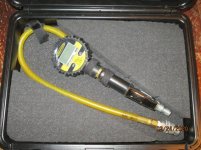
This Blue Point GA-477A was a Craigslist buy for twenty bucks. To be honest, I am not a fan. Perhaps I'm doing it wrong, but I cannot get a true "connection" to a valve to save my life. The readout gauge is difficult to read, and the gauge psi readout always is the lowest psi value. (When I happen to measure it against the others laying around.

It's getting to the point that this trusty & inexpensive Cambell Hausfeld inflator is seeing more of my hands than the Blue Point.
 

Attachments

  • Inflator.jpg
    Inflator.jpg
    155.2 KB · Views: 100

cvairwerks

Well-known member
Joined
Aug 12, 2016
Messages
7,206
Location
Within hearing distance of Texas Motor Speedway
Got Miltons here at home and at work. The ones at work have safeties set at 400 psig, as all of our tires on the aircraft run between 220 psig and 305 psig. Some of the support equipment runs at 80 psig. Aircraft get water pumped nitrogen and everything else gets shop air.
 

setfocus

Well-known member
Joined
Jan 15, 2020
Messages
413
Location
rust belt
I wouldn't run car tires much more than 5psi over the sticker or you'll get uneven tire wear and a rougher ride, assuming factory tire size.
On pickups I'd also run the sticker pressure unless the bed is loaded down or pulling a trailer, then I'd bump up the pressure on the rears only for the extra weight

nitrogen is a gimmick unless you have a race car

I've got a little bluepoint air chuck and a cornwell digital inflator at work. I like how the cornwell uses AAA batts instead of those watch batts that cost $$$. I also have a 12v cig lighter air pump in my trunk https://www.amazon.com/dp/B000L9AD2K/?tag=atomicindus08-20
 

Crow Horse

Well-known member
Joined
Dec 22, 2011
Messages
312
Location
Southern Tier, NY
Shop air, gauge brand has varied over the yrs..
My biggest concern is adhering to inflation pressures as labeled on door pillar is total B.S. for a truck. Use the tire manufacturer inflation specs.

Don't use what's on the sidewall of the tire as your pressure. That is the maximum pressure at the tires maximum load. Chalk test your tires and what's printed on the door jamb is a good start if your vehicle is stock or near stock. If you run heavy, then a chalk test is in order. Actually the accuracy of a tire gauge isn't that important. More important is consistency. Chalk test your tires to dial in the optimum pressure for your vehicle and use the same gauge.

My go to gauge is a Powertank digital gauge. Deflating or airing up, I use a home made "manifold to do 2 tires at once that has a Longacre gauge on it. I keep a Viaire 088 in my truck and sometimes a CO2 tank as well......
 

Attachments

  • IMG_3776.jpg
    IMG_3776.jpg
    57 KB · Views: 81
  • IMG_3805.jpg
    IMG_3805.jpg
    66.1 KB · Views: 82
Last edited:

alexwang32

Well-known member
Joined
Dec 27, 2018
Messages
137
Location
Ottawa
I think I saw an article by some car magazine putting the common belief that higher PSI leads to better mileage to the test. The guys who did it endured what may be a very loud and bumpy ride but saw not much improvement in mileage, lesson learned.

There's one thing I see being thrown on car forums which I follow religiously, and that is to intentionally pump the front tires around 2psi higher to accommodate for the engine's extra weight. Doing so seems to have some benefit, I find that my front tires always drop faster than the rear, by the time I recheck the pressure rating has become the same.
 
Last edited:

Crow Horse

Well-known member
Joined
Dec 22, 2011
Messages
312
Location
Southern Tier, NY
I think I saw an article by some car magazine putting the common belief that higher PSI leads to better mileage. The guys who did the test endured what may be a very loud and bumpy ride but say not much improvement in mileage, lesson learned.

There's one thing I see being thrown on car forums which I follow religiously, and that is to intentionally pump the front tires around 2psi higher to accommodate for the engine's extra weight. Doing so seems to have some benefit, I find that my front tires always drop faster than the rear, by the time I recheck the pressure rating has become the same.

Higher pressure do lead to an increase in mileage but at the cost of even tire wear and ride comfort. If you are talking about a 1 or 2 pound increase in pressure don't expect huge gains in mpg's. Higher pressures decrease the rolling resistance. In my book, even tire wear has the priority over trying to wring out more mpg's. The door jamb pressure info should have pressures that reflect the weight differences from front to rear. Now if you swap to new and maybe larger tires or tires with a different load rating, the door jamb pressures might not even apply.......
 

Leaflessshadetree

Well-known member
Joined
Aug 1, 2013
Messages
7,147
Location
Don't ask.
I've seen trucks with passenger tires. Door says 60/80 PSI tires say 41 PSI (or something like that). Owner wanted a smoother ride or wanted to save a few bucks.
I'm sure there are people that put heavy duty truck tires on cars or light trucks.
With these mis-matches I'd go with the lower number.


As far as gauges I have a few in different ranges. Some tires are 10 PSI or less, others are 110 PSI. I don't trust a mechanical gauge for a wide range. It's hard to find one gauge that fits all tires/wheels too.

From what I hear even cheap digital gauges are accurate (even over wide ranges). Unfortunately with the few I've bought the display or button has messed up within a year. (Some were cheap, a couple cost as much as a good quality mechanical gauge).

I've tried a few inflators with the built in gauge. None were very accurate.

Some vehicles required a different style or length of chuck . One size fits all doesn't work. For duals the straight/reverse angle ones usually work. The one I use most often is angle/reverse angle. (I'm not sure if there are official names for the different styles so I made up these terms.)
 

alexwang32

Well-known member
Joined
Dec 27, 2018
Messages
137
Location
Ottawa
Higher pressure do lead to an increase in mileage but at the cost of even tire wear and ride comfort. If you are talking about a 1 or 2 pound increase in pressure don't expect huge gains in mpg's. Higher pressures decrease the rolling resistance. In my book, even tire wear has the priority over trying to wring out more mpg's. The door jamb pressure info should have pressures that reflect the weight differences from front to rear. Now if you swap to new and maybe larger tires or tires with a different load rating, the door jamb pressures might not even apply.......

Interesting, underinflated tires causes extra tire wear, overinflated tires causes uneven tire wear, neither scenario is good. Like you said the passenger door or owner manual's recommended psi should be followed when using oem tires and wheels.

Rotating tires must also be a huge priority on your book :) Does it involve taking the tires off the wheels entirely or merely switching front and back wheels diagonally?
 

Crow Horse

Well-known member
Joined
Dec 22, 2011
Messages
312
Location
Southern Tier, NY
Rotating tires is important to maximize the life of your tires. Honestly, there are several methods (read- patterns) depending on what type of vehicle (2wd, FWD, 4x4, AWD,) and the tire size. I really don't know which pattern is better than the next when you do have a choice of patterns. I recently got a new set of tires (5) and the spare will enter the rotation.
Tires stay on the wheels.....
I'm also a big fan or road force balancing........
 

Crow Horse

Well-known member
Joined
Dec 22, 2011
Messages
312
Location
Southern Tier, NY
For standard valves, the Haltec H-5265 (closed), H-5265-OP (open) air chucks are the bee's knees.They seal without leaking and do not destroy the threads on the valve stem......
 

Professional Tool User

Well-known member
Joined
Apr 9, 2018
Messages
1,835
Location
BC
1. My preferred chuck is the Milton dual foot one hooked up to my 21 gallon Harbor Freight compressor.

2. My preferred pressure gauge is the Milton dual foot gauge.

3. Make sure you buy a dual foot chuck and gauge. Do not buy the ones where the holes are not offset.

4. The composition of air is already mostly nitrogen. Nitrogen is a waste of money.
 

kbeefy

Well-known member
Joined
Sep 14, 2013
Messages
3,449
Location
Harington, Eastern Washington
Nitrogen is used in aviation to mitigate pressure changes with altitude.
Costco and 'racers' use it to mitigate pressure changes with temperature.
IIRC, Nitrogen is not completely inert so cannot completely do either task, but is better at it than atmospheric air.
I have a 100# tank of nitrogen and use shop air for tires.

I like this inflator/deflator with digital guage..

Astro Pneumatic Tool 3018

And this gauge for quickly checking whatever...

Tekton Digital Guage

If I don't have shop air available, I have several different size powertanks (20#, 5#, 24oz) for quick, remote refilling.

I don't have much experience with duallies.

As far as pressure, I check the rated max pressure and weight of the tire and extrapolate roughly what my vehicle would be. I run 60# in the front of my Diesel, 60# rear empty and 80# rear loaded. I usually check pressures before towing, roadtrips and at oil changes.
 

Copymutt

Well-known member
Joined
Sep 3, 2016
Messages
3,387
Location
Colorado
What spec is on the tire? I haven't really delt with heavy trucks but for passenger cars and light trucks the tire just has the maximum pressure, not the pressure recommended for the particular vehicle.

For truck tires go to the tire manufacturers web site. There you will find the proper inflation for the load you are carrying. Obviously higher for heavier loads.
I see other posts stating set pressures as to the truck manufacturers specs. Maybe its different for 1/2 tons. I do know that the pillar call outs on newer F-150s, 2012 & newer is bogus, thus the consult w/ the tire manufacturer.
 

JJ13

Well-known member
Joined
Nov 20, 2016
Messages
350
Location
Twin Cities, Minnesota
Check out Viair compressors, there are some models designed to be permanently attached to off-road rigs if I remember correctly.

I bought the 88P Portable Air Compressor for about $60 shipped. I chose that model because it uses battery clamps instead of a lighter plug. It pulls slightly more power than the more convenient models but has a higher flow rate. Previously I relied on a dinky, $20-25 compressor stashed in my trunk for emergencies. Topping off tires took FAR too long and they get HOT, very low duty cycle. I burnt it up trying to inflate a nearly flat tire so I could limp the last 1.5 miles to work and didn't see anything in stores comparable to the build quality of the Viair.
 

IndyGarage

Well-known member
Joined
Apr 29, 2010
Messages
9,680
Location
Indy
I have a small Hotdog nailer compressor in my home garage with 100 feet of line on a hose reel and I use a Branick inflator gauge with a lock-on connector - Love the Branick - easy to read and use.

At my shop I have 100 feet of line hooked to my large compressor with a Milton inflator gauge - Milton isn't nearly as good as Branick, but cheaper and more available. I find the numbers hard to read on the Milton.
 

matt_i

Well-known member
Joined
Mar 14, 2008
Messages
10,725
Location
SE Michigan
This Blue Point GA-477A was a Craigslist buy for twenty bucks. To be honest, I am not a fan. Perhaps I'm doing it wrong, but I cannot get a true "connection" to a valve to save my life. The readout gauge is difficult to read, and the gauge psi readout always is the lowest psi value. (When I happen to measure it against the others laying around.

It's getting to the point that this trusty & inexpensive Cambell Hausfeld inflator is seeing more of my hands than the Blue Point.

The YA258 has a U.S. Gauge (round dial) instead of the number-line setup that I think the one you posted has. I don't have a picture currently.

I have a locking chuck somewhere to use when seating tractor tire beads, in case one lets go, its not a recovery site you would want to be a direct part of.
 

matt_i

Well-known member
Joined
Mar 14, 2008
Messages
10,725
Location
SE Michigan
Yep. Make it a FUEL too. One that's faster and quieter than the M12. I'd pay good money for that.

I don't need a lot of fancy bells & whistles on it, just that I don't plan on adopting another battery type just for inflating tires. If the current M12 version could simply use the M18 battery I'd be all-in. However the thermal capacity of the unit might be overrun by the bigger battery.

I hate dragging a billion feet of hose out that flatly refuses to coil properly. I have a hose reel in the works but eventually its not going to be long enough. A portable battery setup would be superfly for my needs :cool:
 
To avoid these ads, REGISTER NOW!
Top Bottom