To avoid these ads, REGISTER NOW!

inline draft inducer

jmiller_2308

Well-known member
Joined
Nov 16, 2013
Messages
551
Location
Shakopee, MN
My naturally aspirated boiler venting into a draft hood will sometimes have an issue creating a draft when the flue is cold (I.e. first thing in the morning) which leads to a bit of a back drafting until the flue warms up.

I have been trying to get my HVAC guy out to offer ideas but in the meantime I've been researching inline draft inducers that you essentially bolt onto the flue as close as you can get it to the chimney. The thing is, these inducers want to be attached to a section of single wall instead of the b-vent pipe that is part of the current flue. One manufacture I emailed said that yes, it has to be single wall and that they advise to replace a section of the b-vent with a 1 foot section of single wall with the inducer on it.

So the issue I am contemplating is that the single wall is going to be much hotter than the b-vent requiring additional clearance to combustibles. I'm not sure what those clearances need to be in this situation but I think it is 12". Unfortunately, when I look at where an inducer could be installed I'm closer to 10" to the floor joists which of course are combustible.

Can anyone provide opinions on whether I might be able to install an inline draft inducer on a section of single wall under these circumstances? Alternatively, can anyone suggest an inline draft inducer that could be installed on b-vent? Again, this is for my education as I will ultimately rely on a professional HVAC guy to make the final decision as I really don't want to die of CO poisoning or burn my house down.
 
To avoid these ads, REGISTER NOW!

danski0224

Well-known member
Joined
Jan 29, 2005
Messages
13,381
Location
Near Naperville, IL
A barometric damper and the elimination of the factory draft hood will fix the problem.

Other modifications are needed and the draft and combustion need to be checked.

Modifications are still needed to add an inducer to ensure that the draft is going through the appliance and not the draft hood, which need to be verified.
 
Last edited:
OP
J

jmiller_2308

Well-known member
Joined
Nov 16, 2013
Messages
551
Location
Shakopee, MN
Thanks @danski0224 , I did a bit of reading on the barometric damper before but wasn't sure if it would work given that my house has a bit of a negative pressure issue due to radon mitigation. After your post I read some more and apparently this type of damper can indeed be used for the type of issues I'm seeing.

I'll be asking my hvac guy about this as soon as I can get a moment with him.
 
OP
J

jmiller_2308

Well-known member
Joined
Nov 16, 2013
Messages
551
Location
Shakopee, MN
I have 2 6" make up air supplies into the boiler room. The second 6" was added in conjunction with the radon mitigation.

The house is very tight with a blower door test indicating a 2 (whatever that means).

The boiler is 105,000 btu/hr input and it runs the indirect water heater so no additional makeup air needed for a water heater. The only other air consuming gas device is a cooktop which obviously doesn't run often. There is an ERV that is running and I balanced the input and output from it so that should not be consuming any other make up air.

I have done extensive crawling around with a smoke pen and I can follow the smoke to the boiler but it doesn't really **** anywhere else. However, if I have a cold flue and the boiler starts with back drafting it immediately fixes the back drafting when I open a window. After that the make up air from the tubes feeds the boiler sufficiently. :headscrat

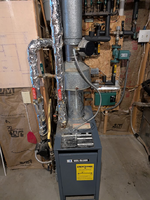
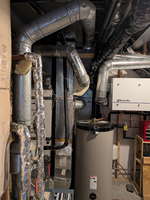
Here are pictures of the make up air tubes, the boiler, and the b-vent that runs to the chimney.

1756742471040.png1756742487615.png1756742504097.png
 

danski0224

Well-known member
Joined
Jan 29, 2005
Messages
13,381
Location
Near Naperville, IL
I have 2 6" make up air supplies into the boiler room. The second 6" was added in conjunction with the radon mitigation.
The problem, despite what "code" says, is that the passive make up air pipes don't work. They act like a chimney.
The house is very tight with a blower door test indicating a 2 (whatever that means).
If you can still breathe inside, it isn't too tight.

"2" is probably 2 air changes per hour at a pressure of 50 Pascals. You can search "blower door test result of 2".
The boiler is 105,000 btu/hr input and it runs the indirect water heater so no additional makeup air needed for a water heater. The only other air consuming gas device is a cooktop which obviously doesn't run often.
Bathroom fan? Powered attic ventilator? Whole house fan? Not enough soffit venting for the roof? Openings behind bathtubs or around plumbing stacks, allowing air into the attic? Some of these would or should have showed up during a blower door test.
There is an ERV that is running and I balanced the input and output from it so that should not be consuming any other make up air.
How do you know it is balanced? Did someone actually measure the airflow?
I have done extensive crawling around with a smoke pen and I can follow the smoke to the boiler but it doesn't really **** anywhere else. However, if I have a cold flue and the boiler starts with back drafting it immediately fixes the back drafting when I open a window. After that the make up air from the tubes feeds the boiler sufficiently. :headscrat
The solution is a powered combustion air intake fan for the boiler, and get rid of those passive vents.

Obviously, something is still negative, despite those passive vents, and it doesn't switch until the window is opened. That something can be found with zonal pressure testing.

The radon system likely needs its own forced makeup air system. If it is exhausting 100 cfm all of the time, then you need to bring in at least 110 cfm all of the time (just picking a number). There's no way around it. You can probably dump the air into the HVAC supply duct plenum.

Warning: Testing ONLY: The opening around the bottom of the boiler draft hood can be temporarily plugged with a few slightly damp towels while a draft gauge is used to monitor what is happening in the flue pipe when the boiler is off and then turned on. If the draft is now correct, then it can be fixed with a barometric damper and thermal safety switches. The problem is finding someone that is trained to do this kind of stuff... and has the tools to test it to make sure that it is working.

But if your house really did test out at 2ACH50, then you need a mechanical forced air combustion intake system for the boiler.
 
Last edited:
OP
J

jmiller_2308

Well-known member
Joined
Nov 16, 2013
Messages
551
Location
Shakopee, MN
Before I start, thank you @danski0224 for all the comments and ideas.

The problem, despite what "code" says, is that the passive make up air pipes don't work. They act like a chimney.

If you can still breathe inside, it isn't too tight.

The smoke pen shows that airflow is coming into the house from the pipes and flowing toward the boiler even when it is not running. The boiler does have a mechanical damper that closes when the boiler is off and opens when the boiler is on. When the boiler is off there is no airflow from the room into the draft hood; only into the bottom of the boiler.

Airflow toward the boiler when the boiler is off may just be convection currents due to the boiler being warmer than the rest of the room.

"2" is probably 2 air changes per hour at a pressure of 50 Pascals. You can search "blower door test result of 2".

Bathroom fan? Powered attic ventilator? Whole house fan? Not enough soffit venting for the roof? Openings behind bathtubs or around plumbing stacks, allowing air into the attic? Some of these would or should have showed up during a blower door test.

Part of a multi-year upgrade to the house included replacing ceiling insulation and at that time all ceiling penetrations were sealed. The bathroom fans run through the ERV so no additional changes there. Windows were also replaced using a "new installation" method of ceiling back from the actual opening. I think all of these changes are part of why the house now has a blower door value of 2.

How do you know it is balanced? Did someone actually measure the airflow?

I measured it using a differential manometer.

In trying to track this down I discovered that the intake originally had a much lower CFM than the exhaust. I followed mfg installation instructions to get the intake and exhaust CFM to be equal or balanced.

I looked at ways to improve the intake CFM and could only improve it slightly. In the end I had to restrict the exhaust to get the system balanced. I'd like to have the system have slightly more intake CFM than exhaust CFM (positive pressure) but restricting the exhaust even more would likely drop the ERV CFM below its lower rated capacity. After typing this I think I'll go back and verify that again.


The solution is a powered combustion air intake fan for the boiler, and get rid of those passive vents.
I thought about a powered intake on the make up air vents and asked my HVAC guy about it. He was against them as he felt that they were just another potential failure point.

Obviously, something is still negative, despite those passive vents, and it doesn't switch until the window is opened. That something can be found with zonal pressure testing.

Agreed, I'm just not qualified or educated enough to figure this out myself and I suspect my HVAC guy may not be either. How does one go about finding someone that has the tools and really knows how to figure this out? If you have any recommendations for somebody in the Shakopee, MN (Minneapolis) area I'd appreciate a reference.

The radon system likely needs its own forced makeup air system. If it is exhausting 100 cfm all of the time, then you need to bring in at least 110 cfm all of the time (just picking a number). There's no way around it. You can probably dump the air into the HVAC supply duct plenum.
I'm not sure how you would provide a forced air makeup system for radon since in theory the radon mitigation should only be sucking air from under the basement slab.

The reality is that my house was built during the era that used "cactus board" around the perimeter of the foundation to reduce moisture issues. I have sealed a lot of the cactus board and used the smoke pen to look for additional air exhausting through the radon system and haven't found any additional areas to seal. Still, I suspect the radon system is the culprit to creating the negative air pressure in the house. It has been awhile but as the season cools I'll have to turn the radon off and see if the pressure issue changes.

Warning: Testing ONLY: The opening around the bottom of the boiler draft hood can be temporarily plugged with a few slightly damp towels while a draft gauge is used to monitor what is happening in the flue pipe when the boiler is off and then turned on. If the draft is now correct, then it can be fixed with a barometric damper and thermal safety switches. The problem is finding someone that is trained to do this kind of stuff... and has the tools to test it to make sure that it is working.
Interesting testing idea. I'll contemplate doing this as it would be nice to know if throwing a barometric damper would help.

In the meantime, DANG... I wish I knew how to find that someone that is trained in this kind of work and has the tools as well! Given the CO potential issues this is potentially a life threatening issue and is something I'd really like to have an expert look at.

But if your house really did test out at 2ACH50, then you need a mechanical forced air combustion intake system for the boiler.

I'm not opposed to this. I just need to find somebody that can do the analysis and be willing to install it.
 

danski0224

Well-known member
Joined
Jan 29, 2005
Messages
13,381
Location
Near Naperville, IL
I'm not sure how you would provide a forced air makeup system for radon since in theory the radon mitigation should only be sucking air from under the basement slab.

The reality is that my house was built during the era that used "cactus board"
I am having a hard time understanding how the radon ventilation system is "only pulling from under the slab" yet this cactus board has a bunch of holes (pathways) in it, and how the house allegedly has a blower door test result of "2", which is assumed to be "2ACH50".

Something isn't adding up.
 
OP
J

jmiller_2308

Well-known member
Joined
Nov 16, 2013
Messages
551
Location
Shakopee, MN
I am having a hard time understanding how the radon ventilation system is "only pulling from under the slab" yet this cactus board has a bunch of holes (pathways) in it, and how the house allegedly has a blower door test result of "2", which is assumed to be "2ACH50".

Something isn't adding up.

The radon mitigation system is a pipe that connects to the drain tile that is embedded in gravel under the concrete and has an active fan in the attic that draws air from within the drain tile and dumps outside above the roof. All penetrations into the floor and the sump basket have been sealed. All cracks in the floor have been sealed. I went through a lot of effort to cut open drywall and used foam to seal as much of the cactus board as I could access. In theory this should force the radon system to only draw air (radon) from beneath the slab.

I have tried diligently to look for other air movement from above the slab into the ground using mostly my smoke pen and have not been able to locate any. Still, I suspect there must be some leakage somewhere but not enough that it significantly impacted the blower door test.

The blower door test was performed by an energy company's contractor and he provided the report that gave me the 2 rating. He also used an IR camera to look for any additional leaks which helped to try to confirm that there is no air leaking down through the sill and the block foundation. He said that the house was indeed that tight. His only recommendation for energy saving was to possibly put in an attic fan which might help to reduce the attic heat (currently only passive ventilation) but which also might make a negative pressure house worse.

So a tight house and a 2 make sense to the professional that was here and with regard to all the sealing efforts that happened with the attic insulation and my efforts but yes, why is the house still having issues with occasional backdrafting? I can't find a way to measure the actual house pressure or at least I'm unaware of how to use my differential manometer to measure it. There is no obvious door slamming or opening issue but yet the makeup air pipes don't seem to be able to allow the boiler to avoid backdrafting when the chimney is cold :headscrat
 

Fav Onefour

Well-known member
Joined
Jul 14, 2022
Messages
702
Location
MN cold and hot
The horizontal run seems fairly long. I can't really see the connection into your chimney. Is the flue diameter increased right at that point?
It may be hard to get the air started moving with that combination. What does the smoke pen show around the draft hood at startup?

Those radon pumps don't move much air. They do move it constantly. If you building is that tight, is it possible you have a slight negative pressure? I know the thinking with those pumps is to only remove from under the slab. In theory, they need to create some negative pressure to be completely effective.
Turn off the radon pump for awhile and then fire up the boiler.
 

danski0224

Well-known member
Joined
Jan 29, 2005
Messages
13,381
Location
Near Naperville, IL
I can't find a way to measure the actual house pressure or at least I'm unaware of how to use my differential manometer to measure it.
You need a micromanometer.

A blower door can be set up, and then you do zonal pressure testing.

Can also get a fog machine, fill up the house, then with the blower door fan turned around, pressurize the house and look for the smoke.

What about can lights? Have any of those?
 

dscheidt

Well-known member
Joined
Apr 26, 2017
Messages
2,888
The smoke pen shows that airflow is coming into the house from the pipes and flowing toward the boiler even when it is not running. The boiler does have a mechanical damper that closes when the boiler is off and opens when the boiler is on. When the boiler is off there is no airflow from the room into the draft hood; only into the bottom of the boiler.

If the boiler back drafts at startup, it means the the make up air vents don't provide enough airflow statically for what the boiler consumes. They're either too small, or need some help (a fan). One thing you could try is temporarily locking the chimney damper open, and see if that helps. if it does, then adding a delay between when the damper end of travel switch closes and when the boiler burner fires.

I used to live in medium sized building with a large steam boiler (75 boiler HP, I think, about 2,500,000 BTU/hr). the firing sequence was motorized louvers opened to provide make up air, then a 10 or 15 second pause, then the chimney damper opened, and a minute long pause before the power to the igniter was provided, and the boiler would fire. When it was cold out, you could hear the exhaust pipe rattling starting a few seconds after the damper opened. I suspect without a draft established the boiler would have sucked air down the chimney. (I know all this because there were lights on the control box that showed the phases, and one of the louver end of travel switches failed when it was below 0F for a week straight, and I blocked the louver open and bypassed the switch until the repair people could come fix it. They were rather busy, for some reason...)
 
OP
J

jmiller_2308

Well-known member
Joined
Nov 16, 2013
Messages
551
Location
Shakopee, MN
The horizontal run seems fairly long. I can't really see the connection into your chimney. Is the flue diameter increased right at that point?
It may be hard to get the air started moving with that combination. What does the smoke pen show around the draft hood at startup?

Those radon pumps don't move much air. They do move it constantly. If you building is that tight, is it possible you have a slight negative pressure? I know the thinking with those pumps is to only remove from under the slab. In theory, they need to create some negative pressure to be completely effective.
Turn off the radon pump for awhile and then fire up the boiler.
The "horizontal run" is a 5' section that rises 10" before going into the cavity that has the chimney run . I don't know what is behind where it goes into the chimney but I believe it to all be 4" b-vent.

In the early days of the radon system the backdrafting was so bad that it caused CO monitors to go off (that is one heck of a way to be woken up :shocking:). I turned off the radon system until I got done sealing things up. After sealing everything I turned the system back on and kept monitoring and things seemed to have been resolved. However, about a month ago I happened to be in the boiler room when the indirect water heater turned on the boiler and it had an issue starting. That issue was related to a dirty flame sensor which has since been fixed (I had my hvac guy go over the entire boiler).
However, when watching for the flame sensor issue I noticed the backdrafting occurring but only when the flue was cold. It wasn't bad enough to set off the CO monitors but I could smell it and feel it. A quick opening of a window and the exhaust began flowing up the chimney again and once the chimney was warm the boiler continued to start without backdrafting.

So yes, the radon system was a huge issue previously and I shall attempt to test again without the radon system on. I'll likely shut it off tonight and see what happens with a cold chimney in the morning.

You need a micromanometer.

A blower door can be set up, and then you do zonal pressure testing.

Can also get a fog machine, fill up the house, then with the blower door fan turned around, pressurize the house and look for the smoke.

What about can lights? Have any of those?

All the ceiling penetrations (can lights, speakers, etc.) were sealed up when I had new attic insulation done and prior to the blower door test.

When you say "look for smoke" I'm guessing you mean to look on the outside of the house or perhaps in the attic? I don't think I'd see any coming out around the foundation. In any event, I think I have probably reached my limit as far as tools and knowledge to be able to do the negative pressure testing you are describing and the blower door people I have talked with seemed to be mostly concerned about closing up air intrusion from doors, windows, etc. The guy I had used an IR camera to also look for potential problem areas but that was when he was sucking air out. He never attempted to put a positive pressure on the house.

If the boiler back drafts at startup, it means the the make up air vents don't provide enough airflow statically for what the boiler consumes. They're either too small, or need some help (a fan). One thing you could try is temporarily locking the chimney damper open, and see if that helps. if it does, then adding a delay between when the damper end of travel switch closes and when the boiler burner fires.
Yup, I tried the locking of the mechanical damper and it didn't seem to matter much.

The chimney and outside temp are now warm enough that I can't get the backdrafting to occur but I will try more experiments in the morning.

In the meantime I used my smoke pen to observe air flow around the draft hood and was really surprised at what I saw:
  • Boiler off but warm and chimney damper closed the smoke showed air flow into the bottom of the boiler the the smoke really didn't deflect much at the hood.
  • Turned the boiler on and watched smoke at the hood while the chimney damper opened and the boiler fired and the smoke again didn't really deflect much at the hood. Since the boiler and flue were warm there was no backdraft at this point.
  • Boiler off with chimney damper open and still no real deflection of smoke. Perhaps when the flue/boiler cool I might see something so I left with the chimney damper open and will check early tomorrow.
  • BTW: when backdrafting the smoke would definitely be deflected away from the stack; I know this because that is what I feel with my hand when I witness this occurring.

I'm trying to research forced makeup air now and still waiting for my hvac guy to get back to me.
 

danski0224

Well-known member
Joined
Jan 29, 2005
Messages
13,381
Location
Near Naperville, IL
However, when watching for the flame sensor issue I noticed the backdrafting occurring but only when the flue was cold.
There are time standards for a BPI test for backdrafting at a flue. The time is different for a cold or warm flue. You can search it and read for yourself.

I'm not saying that the time period will "fix" your problem, but there are allowances in place.
 
To avoid these ads, REGISTER NOW!

danski0224

Well-known member
Joined
Jan 29, 2005
Messages
13,381
Location
Near Naperville, IL
The guy I had used an IR camera to also look for potential problem areas but that was when he was sucking air out.
All the blower door does is amplify the air infiltration, and all that the thermal camera can do is look for temperature on a surface. If there is an air leak where it does not touch a surface for the infrared camera to see the change, then without other observation, the air leak will not be readily noticed.

I have only done a few blower door tests, and been through a few classes, and the door is not the end all, be all for the answers. It is a tool to generate a number for a result. Actually tracking down a problem, which is above and beyond a typical scope of work, is a pain in the ***. Besides the fact that it is extremely difficult to find people that want to pay for the diagnostics. I have done it to get an actual infiltration number for a Manual J calculation to avoid "assumptions" on very involved jobs that I have done myself.

I see an air handler in one of the pictures, and ductwork. Air could be moving through there, especially if there is ductwork in the attic, or if the building cavities are used for return ductwork. I just looked at a customer issue that is due to attic ductwork that is insulated poorly and improperly, and zero of the connections are sealed.
He never attempted to put a positive pressure on the house.
This would not be typical procedure. This is done pretty much only as a step to find a problem as there is no test, as far as I am aware of, that pressurizes a house for a recognized rating. But, certainly could be wrong.

It would also require a pretty beefy smoke machine.
 
OP
J

jmiller_2308

Well-known member
Joined
Nov 16, 2013
Messages
551
Location
Shakopee, MN
Again, @danski0224 thanks for all the comments and thoughtfully suggestions.

The ERV does not go into the attic but it does indeed tie into the duct work to push outside air in to the house and yes in a number of places house cavities are used for air return. None of the professionals that have been in the house nor anything I've read so far had mentioned the return air being a potential issue. I'll have to look at them more although I'm not sure what I'll be looking for.

With regard to chasing air leaks in the cavities I assumed that when the attic insulation was done that since they made an effort to seal all ceiling penetrations that any cavity leaks would have been addressed as well. I'll have to try to verify that now; perhaps with the use of my smoke pen at the return registers?

I took some time yesterday to reconfigure one of the makeup air pipes that in my opinion had way too many turns and bends in it. With the done there does appear to be a bit more air coming from that pipe when the boiler is running.

I'm still researching a forced makeup air solution. Everything I keep running into is either for things like kitchen hoods or LARGE boiler installations; nothing for 105,000 btu/hr input (something like 33 bhp?). At one point I wondered if putting a duct booster fan in one of the makeup air pipes and having it wired to the line voltage that goes to the circulation pump on the boiler so that it would come on when the boiler comes on. That seems like it would work but I wondered about what bad things might happen by just jury rigging a half assed solution. I'm still waiting for my HVAC guy to come so that I can run the force makeup air idea past him. Darn... I think I need to find another guy that is more responsive but how to find one that is truly knowledgeable about this :headscrat
 

fitter30

Well-known member
Joined
Jun 23, 2019
Messages
2,968
Location
Peace Valley,mo
Flue horizontal needs more pitch. Minimum 1/4" per foot more the better. Chimney might need a flue liner. Flue looks to large would need btu Input of boiler, flue length in basement size of chimney and height. Pic of the chimney and roof penetration. Call a chimney sweep they deal with flue problems.
 
Last edited:

u3b3rg33k

Well-known member
Joined
Dec 18, 2017
Messages
4,047
I'm still researching a forced makeup air solution. Everything I keep running into is either for things like kitchen hoods or LARGE boiler installations; nothing for 105,000 btu/hr input (something like 33 bhp?). At one point I wondered if putting a duct booster fan in one of the makeup air pipes and having it wired to the line voltage that goes to the circulation pump on the boiler so that it would come on when the boiler comes on. That seems like it would work but I wondered about what bad things might happen by just jury rigging a half assed solution. I'm still waiting for my HVAC guy to come so that I can run the force makeup air idea past him. Darn... I think I need to find another guy that is more responsive but how to find one that is truly knowledgeable about this :headscrat
if you're looking for an example of a professional-assed solution, check out Field Controls FAN IN A CAN COMBUSTION AIR SYSTEM

there's more than one brand that sells a version of this.
 
OP
J

jmiller_2308

Well-known member
Joined
Nov 16, 2013
Messages
551
Location
Shakopee, MN
Flue horizontal needs more pitch. Minimum 1/4" per foot more the better. Chimney might need a flue liner. Flue looks to large would need btu Input of boiler, flue length in basement size of chimney and height. Pic of the chimney and roof penetration. Call a chimney sweep they deal with flue problems.

As stated earlier, the horizontal is a 10" rise over 5' so well better than the 1/4" per foot. Boiler is 105,000 BTU/hr input.

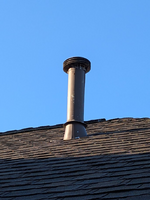
I'm likely mixing terms inappropriately mixing flue, chimney, etc. The "chimney" is the same b-vent you see coming off the boiler. The b-vent from the boiler enters the wall cavity at the end of the picture as seen above. From there it goes straight up and out the roof with a total rise well in excess of 30'. The top of the pipe has a weather shield cap on it. It is too dark for a picture at the moment but if it would be useful I'll try to get a picture later and repost.
1756990838385.png
Chimney sweep for b-vent?
 
Last edited:

fitter30

Well-known member
Joined
Jun 23, 2019
Messages
2,968
Location
Peace Valley,mo
Since stated you shut the radon fan off to get the boiler to fire. 24 vac timed delay on relay when the boiler gets a call for heat it turns off the radon fan for a few minutes then turns radon fan back on.
 
Last edited:
OP
J

jmiller_2308

Well-known member
Joined
Nov 16, 2013
Messages
551
Location
Shakopee, MN
Update on this mornings testing:
  • With all mechanicals shutdown I see smoke movement into the return register that is in the wall cavity :(
  • With all mechanicals shutdown there is some air coming in from the makeup air pipes
  • House closed and only radon on, exhaust stack cool, fire the boiler and there is a brief backdraft that corrects as soon as the flue heats :(
  • House closed, radon off, exhaust stack now warm, fire the boiler and no issues.
I think fan in a can is likely the solution but I'm still hoping to get a professional to look at everything to bless the idea as well as provide some input as to the size of fan to get.
 

danski0224

Well-known member
Joined
Jan 29, 2005
Messages
13,381
Location
Near Naperville, IL
I measured it using a differential manometer.
All this does is measure a pressure difference, it does not measure airflow.

Even if you have a fan chart with airflow at a stated pressure in inches of water column, it does not necessarily mean that the stated airflow per chart = measured airflow.
From there it goes straight up and out the roof with a total rise well in excess of 30'.
Given a 30 foot rise and a single 105,000 btu natural draft appliance and a 5 foot lateral, the B vent chart tells me that 5" vent is good for 176,000 btu.

So, there should be a **** ton of air being drawn up the chimney, right? This is an example of the "code" not always working.

And even if the air is being drawn up the chimney, it won't necessarily be drawn through the appliance by default. It will likely bypass the appliance and go up the draft diverter hood, which can result in a no-vent (spillover) situation. This is what the barometric damper fixes. But that damper has to be sized and installed correctly.
Update on this mornings testing:
  • With all mechanicals shutdown I see smoke movement into the return register that is in the wall cavity :(
Aha.

It would take hours to do testing. A blower door is needed, along with an additional micromanometer, some hoses and a pressure pan. All of the rooms/attic/basement have to be checked for a pressure difference with respect to the rest of the house, and all of the holes in the walls and ceilings need to be checked with a pressure pan. This would pinpoint the low hanging fruit. This is ********* diagnostics, not just a blower door test to get an ACH50 number.

Don't forget about all of the holes in the walls for conduit (or Romex), and all of the holes in those electrical boxes. Until fairly recently, wall plates were not caulked before they were stood up on the exterior. Ever seen a dirt line in carpeting along an exterior wall?
  • With all mechanicals shutdown there is some air coming in from the makeup air pipes
Technically, per code, there is supposed to be (2) combustion air intake pipes, one installed high, one low. Each one is supposed to terminate within 12" of the floor or ceiling (respectively). But, it still doesn't mean that they will work.
  • House closed and only radon on, exhaust stack cool, fire the boiler and there is a brief backdraft that corrects as soon as the flue heats :(
As stated before, there is a timeframe that allows a downdraft condition in BPI testing.
  • House closed, radon off, exhaust stack now warm, fire the boiler and no issues.
I think fan in a can is likely the solution but I'm still hoping to get a professional to look at everything to bless the idea as well as provide some input as to the size of fan to get.
The "Fan in a Can" is sized by input BTU. A controls package is also required.

Tjernlund also sells these, but a different design. There are specific residential models.
 
OP
J

jmiller_2308

Well-known member
Joined
Nov 16, 2013
Messages
551
Location
Shakopee, MN
The "Fan in a Can" is sized by input BTU. A controls package is also required.

Tjernlund also sells these, but a different design. There are specific residential models.

It is the "controls package" that makes me not want to do a hillbilly installation of a duct fan wired to the boiler when it comes on. At the very least, I believe the "controls package" would include the mandatory safety equipment to ensure the boiler doesn't fire unless the fan is actually doing its job.

The Field Controls CAS-34U literature indicates that it would work in my situation and that it also includes a pressure monitor and safety interlock for the boiler.
 
OP
J

jmiller_2308

Well-known member
Joined
Nov 16, 2013
Messages
551
Location
Shakopee, MN
Update:

Quick rant: I continue to be unable to get my normal HVAC guy to come out and it seems he has ghosted me for some reason. Asking around to my neighbors and friends and they didn't have any good recommendations as they were unsatisfied with the big name guys they have been using. What is it with HVAC? It seems that you can only get the big name guys with lots of fancy ads to respond and even they are scheduled out a long way as well as having really ridiculous prices to pay for their ads. Rant over.

I ended up hooking up with Supply House and struggled deciding on the CAS-34 vs. the CAS-4JR. The CAS-4JR is advertised as providing makeup air for roughly 1/4 of what the CAS-34 can handle on its high setting. The CAS-34 has a 68db noise level which concerned me but there was no information as to how many db the CAS-4JR would create or if the CAS-34 was quieter on its low setting. Actually, I'm quite disappointed that Field Controls provides no real quantifiable information as to what the difference is between high and low. I asked Supply House and Field Controls for more information and eventually learned that the CAS-4JR produced roughly 1/2 the db of the CAS-34 but Field Controls could not tell me the db of the CAS-34 when it was running on low "because they hadn't tested it" - WTF? In my case the CAS-4JR was near capacity for my current boiler and it wasn't significantly cheaper than the CAS-34 so I decided to go for the CAS-34 to provide buffer should I increase my boiler size in the future and hope that when running on low the CAS-34 would be significantly quieter than 68db.

Installation wasn't hard and it also allowed me to reconfigure my existing makeup air pipes so that one was high and the one feeding the CAS-34 and boiler was low per current recommendations (previously they were both low). With the CAS-34 installed I no longer of any backdraft issues even with the house closed up, the full radon system on and other mechanicals operating. Unfortunately the CAS-34 running on low is still well over 60 db which is quite disappointing.
 

danski0224

Well-known member
Joined
Jan 29, 2005
Messages
13,381
Location
Near Naperville, IL
Quick rant: I continue to be unable to get my normal HVAC guy to come out and it seems he has ghosted me for some reason.
Because that person doesn't know how to fix the problem. It is exceedingly difficult to get someone to venture outside of the box. I have worked with many that will only do things 1 way.
Asking around to my neighbors and friends and they didn't have any good recommendations as they were unsatisfied with the big name guys they have been using. What is it with HVAC? It seems that you can only get the big name guys with lots of fancy ads to respond and even they are scheduled out a long way as well as having really ridiculous prices to pay for their ads. Rant over.
Don't know.

In my little slice, most of the time people want solutions, want them now, but do not want to pay. And of course, the "fair price" is always debated here, because "it isn't rocket science".

Then there are those that find someone that knows, gets the info, and does it themselves or passes the info to the cheaper guy. And people ***** about not getting "info".

I applied at a few "bigger" residential companies in the past, and none of them wanted to pay, pushed scam tactics to upsell the customer, but had no issues with a high customer hourly rate.

In the end, IMHO, HVAC is a ****** industry, at least on the residential side. Finding that "good shop" as a customer or employee is not easy.

With the CAS-34 installed I no longer of any backdraft issues even with the house closed up, the full radon system on and other mechanicals operating.


At least it appears to be working, but without measuring draft, and checking it with a combustion analyzer, one does not know for sure. I still think that a barometric damper could have fixed the problem by itself.
 

u3b3rg33k

Well-known member
Joined
Dec 18, 2017
Messages
4,047
Update:

Quick rant: I continue to be unable to get my normal HVAC guy to come out and it seems he has ghosted me for some reason. Asking around to my neighbors and friends and they didn't have any good recommendations as they were unsatisfied with the big name guys they have been using. What is it with HVAC? It seems that you can only get the big name guys with lots of fancy ads to respond and even they are scheduled out a long way as well as having really ridiculous prices to pay for their ads. Rant over.

I ended up hooking up with Supply House and struggled deciding on the CAS-34 vs. the CAS-4JR. The CAS-4JR is advertised as providing makeup air for roughly 1/4 of what the CAS-34 can handle on its high setting. The CAS-34 has a 68db noise level which concerned me but there was no information as to how many db the CAS-4JR would create or if the CAS-34 was quieter on its low setting. Actually, I'm quite disappointed that Field Controls provides no real quantifiable information as to what the difference is between high and low. I asked Supply House and Field Controls for more information and eventually learned that the CAS-4JR produced roughly 1/2 the db of the CAS-34 but Field Controls could not tell me the db of the CAS-34 when it was running on low "because they hadn't tested it" - WTF? In my case the CAS-4JR was near capacity for my current boiler and it wasn't significantly cheaper than the CAS-34 so I decided to go for the CAS-34 to provide buffer should I increase my boiler size in the future and hope that when running on low the CAS-34 would be significantly quieter than 68db.

Installation wasn't hard and it also allowed me to reconfigure my existing makeup air pipes so that one was high and the one feeding the CAS-34 and boiler was low per current recommendations (previously they were both low). With the CAS-34 installed I no longer of any backdraft issues even with the house closed up, the full radon system on and other mechanicals operating. Unfortunately the CAS-34 running on low is still well over 60 db which is quite disappointing.
if noise is your primary concern, get some sound dampening panels and make a little wall around it. it's amazing how much a bit of that stuff can do.
 
To avoid these ads, REGISTER NOW!
Top Bottom