To avoid these ads, REGISTER NOW!

input needed for wall lift

Kaizen

Well-known member
Joined
Jan 9, 2015
Messages
6,946
Location
New England
I'll be building my garage pretty much solo. As I'm not a framer I don't want to rent a lift/forklift and then rush.
So here is the challenge. Garage will have 2 foot knee walls and 2x6x10 foot walls that are 12 foot long sections. Total weight of the wall section is about 400 pounds.

I apologize in advance I tried to draw this out and it sucked.
I'm thinking of welding a stand that is 12x11 feet. On top of the stand will be a platform bolted to the stand at the knee wall. The platform will be at or an inch higher then the knee wall and function like a drawbridge. With the drawbridge in the down position I can build the fully sheathed wall on top of it.
connected to the middle of the stand away from the wall will be the lifting arm.
The lifting arm will be 12 feet high with a pulley at the top and a winch attached to the bottom below the platform table. The cable will go from the winch to the pulley and back down to the wall. The arm will pivot at the stand height so as the wall raises it can follow the same ark.
I'll have removable brackets on the stand to attach to the wall which will keep the table from kicking out.

I like the thought of using metal so after i'm done I can reuse the material for shop items.
I want the lightest steel structure for the assembly table. supports will go across the wall. 5 total? The supports will be connected together maybe with angle iron? This wall will have to slip on the 2x6's slightly as the wall raises. what size steel would you use for this? What size for the base and legs? For the lifting arm should I use steel or do you think I can use a couple 2x6s with the pulley bolted in the middle? I think either way I can add weight to the lower part of the arm to counterbalance the 12 foot boom.
 
To avoid these ads, REGISTER NOW!
OP
K

Kaizen

Well-known member
Joined
Jan 9, 2015
Messages
6,946
Location
New England
Or you could buy some wall jacks.

yes I've thought of that. issues i'll have are getting the wall bottom edge up onto the 2 foot knee wall, no way to secure the foot without drilling and anchors, 50 trips up and down two ladders on each section, and being in harms way if it falls. My design is based on the idea of ladder jacks but just easier.
figure if I take 4 hours to weld it together all the lifts will be so much easier
 

SDBOB1

Member
Joined
Apr 5, 2016
Messages
23
I've framed alot. Framed my garage,30x60 myself. Walls were 2x6x16longx 6ft high,on concrete block 4ft high.I'd frame one and slowly raise it with braces.The wall was built at block wall height.I had bolted a 2x8 to the block.I just had to make sure it didn't slide.I would get some help just for the lift you DO NOT want to get hurt and it's easy to do.The system you described sounds ok. I believe everyone has creativity. My 2cts.
 

theoldwizard1

Well-known member
Joined
Feb 22, 2011
Messages
43,106
Location
SE MI
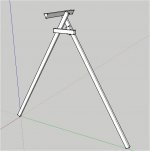
The simplest lifting rig is called an A-frame. Think of a tripod but with only 2 legs ! You are going to make a temporary, portable, skyhook !! In your case those legs need to be about 18-20' long ! You can make them out of 2by material by doubling up a couple of 2x4 (2x6s would be better). You can use shorter pieces (10'), but the seam need to be overlapped. Use construction adhesive and nail or screws to hold it together. Wait for the adhesive to completely cure !

You will need 2 come-a-longs/winches for this system and 2 anchor points outside of the building. Attach the 2 long poles together at one end with a 1/2" all-thread or long bolt. The problem is you need an arm that sticks out about 4', perpendicular to those 2 poles. (I have not figured out a good, simple design for this yet !)

Using heavy rope, make a slip loop around where the joint is and connect to one of the 2 come-a-long. Spread the legs of the 2 poles apart about 6' and stand them up on the outside of your knee wall about a 3-4' back. Place the base of each leg in a shallow hole (< 1'). Crank back on the come-a-long until the A-frame is standing. This come-a-long will adjust the in/out of arm overhanging the knee wall. You must keep weight on the forward side of the A-frame because there is nothing to support it if it goes past vertical !

Hang a pulley on the end of the perpendicular arm and run the rope from the second come-a-long through it. This is your lifting point.
 
Last edited:

pstnbly

Well-known member
Joined
Jul 20, 2010
Messages
766
Location
So. Vermont
By the time you fabricate your stand you could have your walls up and framed. There is a thread in the general section where another member and I discuss framing from a stem wall. Lay out you plates (top and bottom) attach the bottom plate. Toe nail corner studs in place and brace both directions (just square the bottom of the studs, don't cut to length yet),

Mark you top of stud height on the corners, run a chalk line from 1 corner to the next, hold your studs on the layout line the chalk line will mark the cut, cut the stud and toe nail in place (they will stand if nailed properly). place the studs and apply the top plates and bracing as you go.

The benefit of this method is the studs are fit to the stemwall as the concrete is usually never perfect. It goes very fast. I personally have framed the walls a 24' x 32' garage in less than a day by myself (minus the sheathing).

Search the other thread, it has a better description.
 
OP
K

Kaizen

Well-known member
Joined
Jan 9, 2015
Messages
6,946
Location
New England
The simplest lifting rig is called an A-frame. Think of a tripod but with only 2 legs ! You are going to make a temporary, portable, skyhook !! In your case those legs need to be about 18-20' long ! You can make them out of 2by material by doubling up a couple of 2x4 (2x6s would be better). You can use shorter pieces (10'), but the seam need to be overlapped. Use construction adhesive and nail or screws to hold it together. Wait for the adhesive to completely cure !

.

I had considered this set up first. but on one side wall there is no anchor points and the other is close to the property line/neighbors house so I can't get anything over there either. I had thought about using land anchors but as its going to be winter and ground frozen I came up with the reverse. instead of pulling from outside i'll be kind of pushing from the inside.
 

drivesitfar

Well-known member
Joined
Oct 23, 2013
Messages
35,999
Location
Pacific Northwest
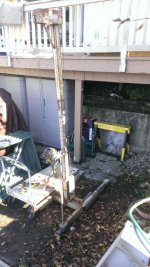
KAI: if you weren't 3,000 miles from me i'd loan you my VERMETTE cable lift that you could lift up to 500 pounds with. i had 3 and down to one and sold the other 2 for about $300 each so not a spendy lift if you might find one on Craigslist in your area.

here's a few pictures of mine. if the cable is long enough and you have enough sections i'd think 14 feet is doable with this lift.
 

Attachments

  • WP_20161022_009.jpg
    WP_20161022_009.jpg
    153.4 KB · Views: 56
  • WP_20161022_010.jpg
    WP_20161022_010.jpg
    149.2 KB · Views: 45
  • WP_20161022_011.jpg
    WP_20161022_011.jpg
    158.8 KB · Views: 46
  • WP_20161022_013.jpg
    WP_20161022_013.jpg
    155 KB · Views: 42
Last edited:
OP
K

Kaizen

Well-known member
Joined
Jan 9, 2015
Messages
6,946
Location
New England
By the time you fabricate your stand you could have your walls up and framed. There is a thread in the general section where another member and I discuss framing from a stem wall. Lay out you plates (top and bottom) attach the bottom plate. Toe nail corner studs in place and brace both directions (just square the bottom of the studs, don't cut to length yet),

Mark you top of stud height on the corners, run a chalk line from 1 corner to the next, hold your studs on the layout line the chalk line will mark the cut, cut the stud and toe nail in place (they will stand if nailed properly). place the studs and apply the top plates and bracing as you go.

The benefit of this method is the studs are fit to the stemwall as the concrete is usually never perfect. It goes very fast. I personally have framed the walls a 24' x 32' garage in less than a day by myself (minus the sheathing).

Search the other thread, it has a better description.

I'll take a look. I see this individual cutting and placing as issue prone at least for me. I also hate wrestling sheets of ply as I don't do this everyday and can see me getting tired quick. All reasons I thought the assembly setup would be better and more accurate for me. If it works well i'm also going to use it to flip and maybe raise my trusses. especially the end wall trusses. limiting the movement using this setup would keep walls and trusses from falling past where I want them. it would hold them in position so I could brace and nail the panel/truss in place.
 
OP
K

Kaizen

Well-known member
Joined
Jan 9, 2015
Messages
6,946
Location
New England
KAI: if you weren't 3,000 miles from me i'd loan you my VERMETTE cable lift that you could lift up to 500 pounds with. i had 3 and down to one and sold the other 2 for about $300 each so not a spendy lift if you might find one on Craigslist in your area.

here's a few pictures of mine. if the cable is long enough and you have enough sections i'd think 14 feet is doable with this lift.

I'll take a look around. I had been looking at beam lifters but nothing used around. am I correct in saying that in my scenario you would use that to get the wall most of the way up but because its 2 front legs are 3 feet approx. from wall that it wouldn't get it all the way vertical? that sure would be nice for trusses! same idea i'm trying to describe but with the arm able to arc as the wall goes up.
 

My Old Tools

Well-known member
Joined
Jun 4, 2014
Messages
5,427
Location
Hamrick Lake, TX
3 friends and a case of beer (or BBQ, or...). Get all the wall sections built flat first, stacked like a house of cards. Call the friends. 2 hours later your done.
 

theoldwizard1

Well-known member
Joined
Feb 22, 2011
Messages
43,106
Location
SE MI
Like below. Obviously you need a support between the arm sticking out and the cross piece.

attachment.php


A come-a-long might be adequate for the in and out tilt, but you are going to need some kind of a winch for the lifting rope.
 

Attachments

  • Capture.JPG
    Capture.JPG
    50.1 KB · Views: 287
To avoid these ads, REGISTER NOW!

Chris705

Well-known member
Joined
Nov 1, 2012
Messages
834
Location
The Finger Lakes of NY
I really think the Qualcraft wall jacks are the best way to lift walls by yourself....I purchased two from ebay after reading another fella's post on here....my walls were 2x6x14' and I had a foot high stem wall at the time before I poured my slab.

So I framed and sheathed my walls in place, I used conc. blocks to set the top plate on and I infilled studs to the sole plate ...at the sole plates I used a piece of lumber steel strapping to act as a hinge and to keep the wall sole plate in place with the fixed treated bottom plate as I lifted....I also screwed a couple short lengths of vertical 2x4 strips to the treated bottom plate to prevent wall from falling off stem wall as I began to lift each section. I left off whole 4x8sections of sheathing and came back to install later when all walls were up to join them solidly together. The wall pump jack easily lifted my walls...I did have scaffold and a 12' step ladder to get up to the jack as it got higher and higher....I would then screw long bracing boards to plumb the wall and brace it once I almost fully got the wall upright....at that point I also had a rope to the top tied off to a stake to prevent wall from going past 90 degrees when I pushed up the last bit to vertical.....it worked like a charm, I raised all my wall sections of my 40x44 garage this way by myself...the 40' depth was divided into two sections of 20' each and the 44' length I had 3 sections...I built my front wall in place as it was mostly OH doors.....was the process pretty...no but it worked and I did this over 3 or 4 weekends....

Good luck however you proceed! Do it safely!
 

csp

Well-known member
Joined
Mar 23, 2010
Messages
5,719
Location
Franktown, CO
KAI: if you weren't 3,000 miles from me i'd loan you my VERMETTE cable lift that you could lift up to 500 pounds with.

You couldn't get a wall all the way vertical with a Vermette. The bottom legs are longer than the lifting arms. We use them to lift HVAC equipment to rooftops and unit heaters in garages and warehouses and the bottom legs frequently get in the way of final placement.
 
OP
K

Kaizen

Well-known member
Joined
Jan 9, 2015
Messages
6,946
Location
New England
I really think the Qualcraft wall jacks are the best way to lift walls by yourself....I purchased two from ebay after reading another fella's post on here....my walls were 2x6x14' and I had a foot high stem wall at the time before I poured my slab.

So I framed and sheathed my walls in place, I used conc. blocks to set the top plate on and I infilled studs to the sole plate ...at the sole plates I used a piece of lumber steel strapping to act as a hinge and to keep the wall sole plate in place with the fixed treated bottom plate as I lifted....I also screwed a couple short lengths of vertical 2x4 strips to the treated bottom plate to prevent wall from falling off stem wall as I began to lift each section. I left off whole 4x8sections of sheathing and came back to install later when all walls were up to join them solidly together. The wall pump jack easily lifted my walls...I did have scaffold and a 12' step ladder to get up to the jack as it got higher and higher....I would then screw long bracing boards to plumb the wall and brace it once I almost fully got the wall upright....at that point I also had a rope to the top tied off to a stake to prevent wall from going past 90 degrees when I pushed up the last bit to vertical.....it worked like a charm, I raised all my wall sections of my 40x44 garage this way by myself...the 40' depth was divided into two sections of 20' each and the 44' length I had 3 sections...I built my front wall in place as it was mostly OH doors.....was the process pretty...no but it worked and I did this over 3 or 4 weekends....

Good luck however you proceed! Do it safely!

how did you secure the jack foot to the floor?
 
OP
K

Kaizen

Well-known member
Joined
Jan 9, 2015
Messages
6,946
Location
New England
3 friends and a case of beer (or BBQ, or...). Get all the wall sections built flat first, stacked like a house of cards. Call the friends. 2 hours later your done.

always seems I can't get any friends when I want them so with some simple machines i'll be fine. might reserve them for the trusses
 

Chris705

Well-known member
Joined
Nov 1, 2012
Messages
834
Location
The Finger Lakes of NY
the jack foot is the end of 2x4 that the jack rides up on....to begin with the 2x4 is vertical when your wall is flat on the ground....the jack goes up as the wall is lifted....the 2x4 begins to lean in as the wall goes up further....
I think qualcraft has photos on their web page.
 

gasgas17

Well-known member
Joined
Nov 7, 2009
Messages
443
Location
Nova Scotia, Canada
We would just normally stick frame the walls in place, right off the concrete wall. Unless the concrete pony wall is perfectly flat (usually not the case) then stick framing in place is the preferred method. Just set your corners plumb and cut to the proper level/height. Then string a tight chalk line to mark your studs and cut them. Or you could nail them in place on the bottom plate and snap a line and cut them standing in place, using a piece of strapping as a temporary top plate a couple feet down from the line. One lift of scaffold on wheels would let you build that wall if your tallish. Then the heaviest thing you would have to lift is a sheet of plywood or a top plate.
 

kbs2244

Well-known member
Joined
Nov 11, 2006
Messages
14,065
When it came time to frame my walls that were going on top of a 2 foot stem wall my carpenter bolted the bottom 2x4 of the plate to the block.
The bottom of the wall was put up tight to it. and bolt holes drilled to match.
The top plate was supported on double high 5 gal pails at the corners.
He called in my son for help at lift time.
(I was 72 at the time and not much good but for anchoring the bracing 2x4s.)
 

drivesitfar

Well-known member
Joined
Oct 23, 2013
Messages
35,999
Location
Pacific Northwest
Kai: like CSP mentioned a Vermette might not be ideal with the legs out front, but i've used some extenders and lifted things a few feet out from the main stack before.

how much is a fork lift cost to rent for a week cause i think that would be your best option?
 
OP
K

Kaizen

Well-known member
Joined
Jan 9, 2015
Messages
6,946
Location
New England
the jack foot is the end of 2x4 that the jack rides up on....to begin with the 2x4 is vertical when your wall is flat on the ground....the jack goes up as the wall is lifted....the 2x4 begins to lean in as the wall goes up further....
I think qualcraft has photos on their web page.

right those are the ones I have seen but it had a bracket on the foot that they attached to the decking.......it was a house.....I was concerned just a 2x would kick out if not secured? esp on slick concrete. and with me under the falling wall on the ladder?
 
Last edited:
OP
K

Kaizen

Well-known member
Joined
Jan 9, 2015
Messages
6,946
Location
New England
Kai: like CSP mentioned a Vermette might not be ideal with the legs out front, but i've used some extenders and lifted things a few feet out from the main stack before.

how much is a fork lift cost to rent for a week cause i think that would be your best option?

honestly if I can't make my idea work or the wall jacks i'd rather pay a few guys to lift it. looking at 400plus for forklifts a week and who knows how long it will take me? with my proposed contraption all i'm out is my time and some wire. I have the winch and would reuse the steel.

I was mostly looking for input on what steel size to use. guess i'll let ya'll know how it turns out.
 

AMCguy

Well-known member
Joined
Dec 23, 2009
Messages
2,022
Location
Sunshine Coast, BC Canada
I had almost the exact same situation you have. I'm sure glad I decided to use wall jacks. I think I paid $30. each for mine.

My garage is 32'x32'. The walls are 2''x6'' 12' tall. They sit on a 2'6'' concrete wall. I built them in 16' sections. I sheeted the bottom 4' of each section to keep it from racking while being raised.

I laid a couple of 2x4s up on the concrete walls and slid the bottom of each section up onto the concrete wall Marked and drilled my sill plate for anchor bolt holes and then stood it up with my wall jack. When the wall is almost vertical you can go to the other side and put up a brace. The anchor bolts will stop the wall from slipping while it's going up. The first section of wall is the tricky one. Once it's up all the others are easier. I did this all by myself.
 
To avoid these ads, REGISTER NOW!
Top Bottom