To avoid these ads, REGISTER NOW!

Install question: Insulation

Stepper

Active member
Joined
Mar 12, 2012
Messages
30
Location
Michigan, N of AA
I just spent 20 minutes typing this thing out so that it hopefully made sense to everyone and then the computer dumped it....dammit!

Ok..so now the cliff-notes version.
- I want to insulate my roof...3 car..detached..unfinished garage. 2x4 stick built.
- has soffit and ridge vents.
- I want to keep the ceiling open..I like the open feeling of the rafters.
- Can I just insulate the underside of the roof (angled part).?
If so, do I need to find a way to make sure the insulation has stand-off from the roof...kind of like hanging it rather than stapling it directly to the roof as you would walls?

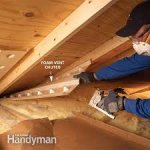
- My understanding is that I need to use the insulation to create an air channel from the soffit vent to the ridge vent.

Is there some sort of a "hanger" that I sould use to install the insulation to the 2x4 construction that will get me the air gap? Or is there some sort of thinner insulation I should use that I'm not aware of?
The r-13 I used in the walls of the garage is made for the 3.5" depth. If I use that thickness, I won't have the air gap.

Or am I completely misunderstood and don't need the air gap?

Any suggestions..."this is how I did it" info...or pics would be great.

I really don't want to close in my ceiling just to put in insulation.

Thanks
 
To avoid these ads, REGISTER NOW!

tcianci

Well-known member
Joined
Feb 7, 2009
Messages
4,242
Location
Walpole, Ma
Since you mentioned that the rafters are 2 x 4, I am assuming that the roof framing is trusses. As you said, if you fill the bay with R-13 there is no air flow.

The purpose of the soffit and ridge vents is a construction detail called "cold roof construction". It serves a two fold purpose: First, it takes advantage of convection to move the hottest air in your attic space to the outdoors. This can help if you are planning to condition the space with cooling in the summer. Also some claim that roofing materials will last longer with air flow behind the sheathing.

The 2nd and most important function of the soffit vent/ridge vent cold roof construction is that it allows cold air behind the sheathing in the winter weather. The presence of the cold air counteracts heat lost from the building that tends to warm the back side of the sheathing, especially at the point on the roof just inboard of the exterior walls, where the roof sheathing is closest to the finished ceiling, if you had one. Without the cold air, the heat migrating from the conditioned space warms the back of the sheathing causing snow melt. The melting snow obviously wants to run down the roof and it will, until it gets to the edge of the roof. The edge of the roof is distant from the melting point by the width of the soffit and the thickness of the wall framing. That also makes this edge cold. The melt re-freezes and starts to build a dam for additional melt to back up behind. The dam gets bigger, and since water seeks it's own level, the level of the water behind the dam rises and will continue to do so until it finds the first breach in the roofing material, the water is literally backing up under the shingles. Then it leaks into the building.

Since your building is currently open, the venting is doing the most good in the hot weather. In the winter, any heat you create in the building immediately rises and heads for the ridge vent, un-impeded by insulation but since you can assume that any heat in the structure may be pretty evenly distributed,you are in effect warming all of the sheathing and making a situation where ice dams can form. At this point, your soffit vents are just another air infiltration point and they aren't really helping you.

So, adding insulation that will fill the bay may help, if you heat the place at all by keeping the back side of the sheathing colder than it would be without the insulation. You will still lose heat out the ridge vent but in the warmer weather, as long as there is a source of make up air other than the soffit vents, the ridge vent will still function.

I'm assuming that there is some sort of heat planned or you wouldn't be inquiring about insulation, although insulation may help somewhat with heat in the summer too but R 13 is a pretty small amount of insulation and you may be disappointed in the result.
 
OP
S

Stepper

Active member
Joined
Mar 12, 2012
Messages
30
Location
Michigan, N of AA
Hmm...Ok..so I am now clear that I need to maintain a channel per-se between the underside of the roof and the top side of whatever insulation I use.
Is anyone aware of any sort of "hanger" that would attach to the 2x4 rafters and anchor the batt insulation, keeping some stand off from the underside of the roof?
 

MScott

Well-known member
Joined
Jun 30, 2009
Messages
1,616
Location
Eastern Ontario
First of all, your location in your profile would help especially with questions about insulation. (weather related)
Secondly, when I was redoing a house for my daughter, I attached (with glue and screws) 2x4's to the 2x4 rafters. This gave an effective 2x8 rafter and had lots of room for R30 insulation and the channels mentioned by Doug B. Again, your location might indicate that 2x2's would be adequate.
 
To avoid these ads, REGISTER NOW!

Highbeam

Well-known member
Joined
Feb 15, 2011
Messages
2,292
Location
Mt Rainier foothills, WA
Why would that defeat the purpose?

By using them, you are creating a channel for the air to move from the soffit vent to the ridge vent.

It's attic ventilation and not just roof ventilation. You don't want to run the foam vents to the ridge because doing so will bypass the purpose of a vented attic. The only time you run them all way to the ridge is when you have a cathedral ceiling or if you want a non-ventilated attic.
 

RickP

Well-known member
Joined
Jan 15, 2013
Messages
1,547
Location
Annapolis, MD
You could use rigid foam insulation panels between the trusses. The 2-inch thick panels are R-13 and have foil on both sides:
Dow Thermax

thermaxhd.jpg


Probably a little more pricey than batts, but installing it with an air pocket next to the roof would be a lot easier.
 

kngelv

Well-known member
Joined
May 25, 2011
Messages
2,214
Location
Detroit, MI
I have the exact same issue except I have 2x6 joists. I'd like to do just soffit to ridge veny chutes and batts but figure I can't leave the batts exposed. The thought of covering it all has caused a two year delay in getting this done. I could also use foam but figure I'll only be here another five years, and so the cost doesn't make sense. Looking forward to more suggestions.

James
 
OP
S

Stepper

Active member
Joined
Mar 12, 2012
Messages
30
Location
Michigan, N of AA
I live in Michigan, between Ann Arbor and Detroit.

I also like the idea of attaching 2x2s or 2x4s, provided the cost of that plus batted insulation is cheaper than say just putting up the foam boards.
So, I guess now it's a price comparison and R-value comparison.
It seem attaching foam insulation to the trusses would be easiest, but could potentially be costly and not as high of an R value as rolled batted insulation.
Conversely, attaching 2x2s to get stand-off from the underside of the roof and then installing batted insulation would yield the best R value, but I'll need to shop some numbers to see if it's cost effective.

Thanks guys for all of the input.
 

NUTTSGT

Super Moderator
Staff member
Joined
Sep 14, 2009
Messages
50,856
Location
Northern Central Ohio
It's attic ventilation and not just roof ventilation. You don't want to run the foam vents to the ridge because doing so will bypass the purpose of a vented attic. The only time you run them all way to the ridge is when you have a cathedral ceiling or if you want a non-ventilated attic.


The OP stated he wanted to insulated under the roof line and leave the rest of the trusses open. . . . . akin to the last part of your post.
 

Kels

Well-known member
Joined
May 14, 2013
Messages
211
Location
Silverdale WA State
I have the exact same issue except I have 2x6 joists. I'd like to do just soffit to ridge veny chutes and batts but figure I can't leave the batts exposed. The thought of covering it all has caused a two year delay in getting this done. I could also use foam but figure I'll only be here another five years, and so the cost doesn't make sense. Looking forward to more suggestions.

James

Insulation guy I talked to suggested using wmp vapor barrier under the cathedral ceiling after doing as you wanted to. It is fire rated not as good as sheetrock but it will work and is white so should brighten the area!
 
To avoid these ads, REGISTER NOW!
Top Bottom