I believe that It could be used as a disconnect pending that it:
-Is within sight of the heater and no more than 50 feet away
-The thermostat has the ability to disconnect all hot sources from the unit.
-The is a difinitive OFF settin got the stat. Turning it down does not qualify although it shuts it off.
That second one could be sticky because I dont think that line level 230V stats switch both hots, I belive they only switch one. I am not positive there but check your stat and see.
Huh. TRDon is saying that the code requires a disconnect for the heater, not merely an on-off switch. I'm not sure what the code says, since I can't get to the online document, but your circuit breaker panel will serve as a disconnect if it is within line of sight of the heater and less than 50' away.
You can get the line-level thermostat linked above in either a single pole or double pole configuration. The double pole 'stat qualifies as a disconnect by the definition above. However, you only need the single pole 'stat or a single pole switch if you just want to control the heater and not disconnect it.
To Buening, sorry if I was brusque regarding the 15A switch question. Here's some background.
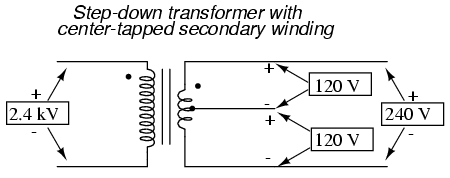
The power comes in from the pole transformer at 230VAC. There is a center tap to the pole transformer (neutral) that divides the incoming power in the middle. Neutral is referenced to ground potential at the panel. Thus you have a "top" half of the panel at 115VAC and a "bottom" half at 115VAC. When you have a double breaker for 230VAC, you are jumping over the neutral to take voltage from the two hot conductors (top and bottom) at the full 230VAC. The heater does not need 115VAC, so no neutral connection is needed.
(picture linked from:
http://www.allaboutcircuits.com/vol_2/chpt_10/1.html )
Now, when you put the double breaker in, it has two circuit breakers ganged together. Each of these breakers is in series with the 230VAC load, so each sees the full current drawn by the load; this is two 30A CBs ganged together, one for the top and one for the bottom. You only need one CB to break the circuit and protect the device in case of overload, but for safety each side of the circuit needs to be protected against a short to ground. For example, if at the heater, you accidentally grounded one of the conductors and only the other conductor were protected, that CB would not be tripped. The double breaker is required to protect both conductors against accidental grounding.
hth!