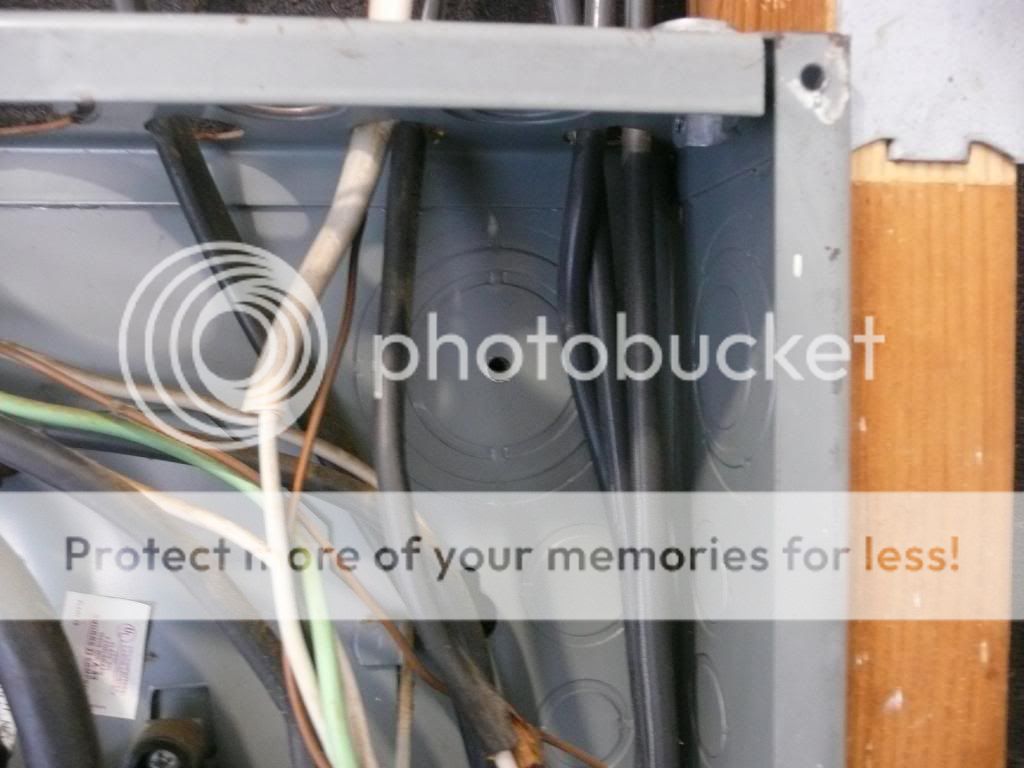
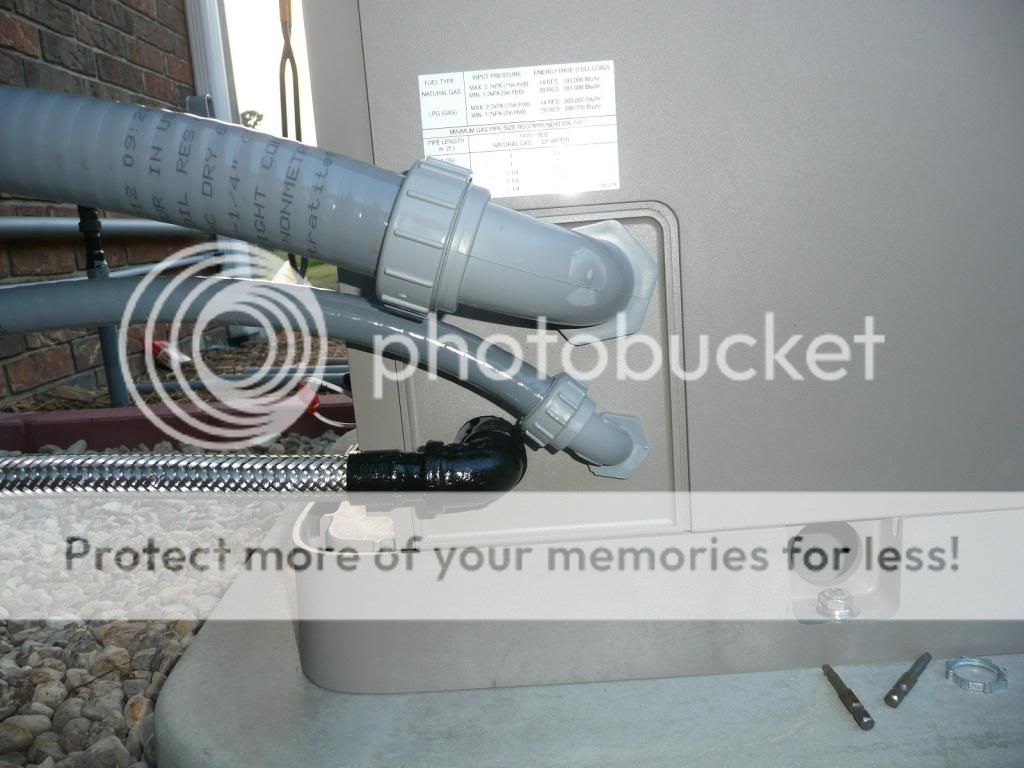
To avoid these ads, REGISTER NOW!

Installing a standby generator with ATS

soj

Well-known member
Joined
Dec 3, 2007
Messages
729
Location
North Georgia
I am in the process of installing a Kohler 14RESA generator with a 200A whole house transfer switch. I have taken a few pics along but haven't had time to post anything. If there is any interest in this type of project let me know and I will show what I have done so far.
jp
 
To avoid these ads, REGISTER NOW!

CNGsaves

Well-known member
Joined
Sep 26, 2012
Messages
13,233
Location
KS and OK
Lots of interest will sprout up once hurricane season cranks back up again. Same with ice problems in dead of winter. Might as well get a head start.

GJer's also interested in whether you have NG (natural gas) and/or LPG (propane . . . liquid petroleum gas) as your fuel source, and your costs to run during any outages. There's been a few on diesel, but more rare.

Post up your pics. We LOVE pics !! ;)
 
OP
S

soj

Well-known member
Joined
Dec 3, 2007
Messages
729
Location
North Georgia
OK, I see a little interest, and I esp. like that wyliesdiesels is on board to keep me straight. I hope other electricians will follow along to not only help me, but the advice they give can be used by others. Does that statement tell you I am not an electrician? Good, because I am not, nor do I play one on TV. AND, I did NOT stay at a Holiday Inn Express last night. So I am open to all help and suggestions from those who are.

So, on to the project at hand. Some background. I have been using a portable generator for backup power for about 4 years. I wired it through a GenTran 30A inlet box, then through a Reliance watt meter box (so I could monitor and try to balance the load on each hot leg), then through a interlocked back feed breaker. That worked great, through several outages, including a couple that lasted several days. Then the Generac 8kw portable crapped out on me. I couldn't fix it, and neither could an electric motor shop. The engine was fine, just no output. So I removed the generator from the engine and mounted a Harbor Freight "so called" 10kw generator head. It is really 7kw with a 10kw surge. That worked OK, even for one multi day outage. About a year ago I decided I was tired of having marginal power during outages and started planning for a standby, auto startup generator. My first step was eliminating electrical load so I could use a smaller unit. There was no gas in the house, but I do have a 500 Gal LP tank at my shop. First step was planning, sizing and installing a gas line from the tank to the house. Next was changing the water heater from electric tank to gas tankless. I wasn't sure when I would change the heat pump (with supplemental heat strips) to an AC / gas heat setup, but the old unit decided for me. About a month ago it crapped out and I replaced it with a Carrier unit with two stage gas heat. That is what prompted me to go ahead with the generator install.

Based on my major loads and how I plan to manage them (and replace one more with gas), I selected a 14kw Kohler. I bought it from a local dealer with a 200A ATS and startup, but no install. Once I get everything hooked up he will send a serviceman out to run through the Kohler checklist, fire it up, check it under load and register the startup date (which also starts the warranty) with Kohler. Without the dealer startup, the warranty starts on date of mfg.
I picked it up at the dealer, that saved delivery fee. The brown box is the ATS.

Install001Truckload.jpg


The slab on top of the box is an "Ultra Pad", made to fit the Kohler 14 and 20kw units. There are four cast in threaded inserts and they lined up perfectly with the holes in the base of the generator. It came with 4 SS bolts.

Install002BoxandUltraPad.jpg


It is heavy, so have a forklift or lots of help to unload or move it.

Install004BoxOnForks.jpg


The cardboard lifts off the wooden skid. Notice how close the vertical portion of that fork is to the end of the housing. It is not touching cause there was clearance there to remove the box...

Install005UnboxedOnForks.jpg


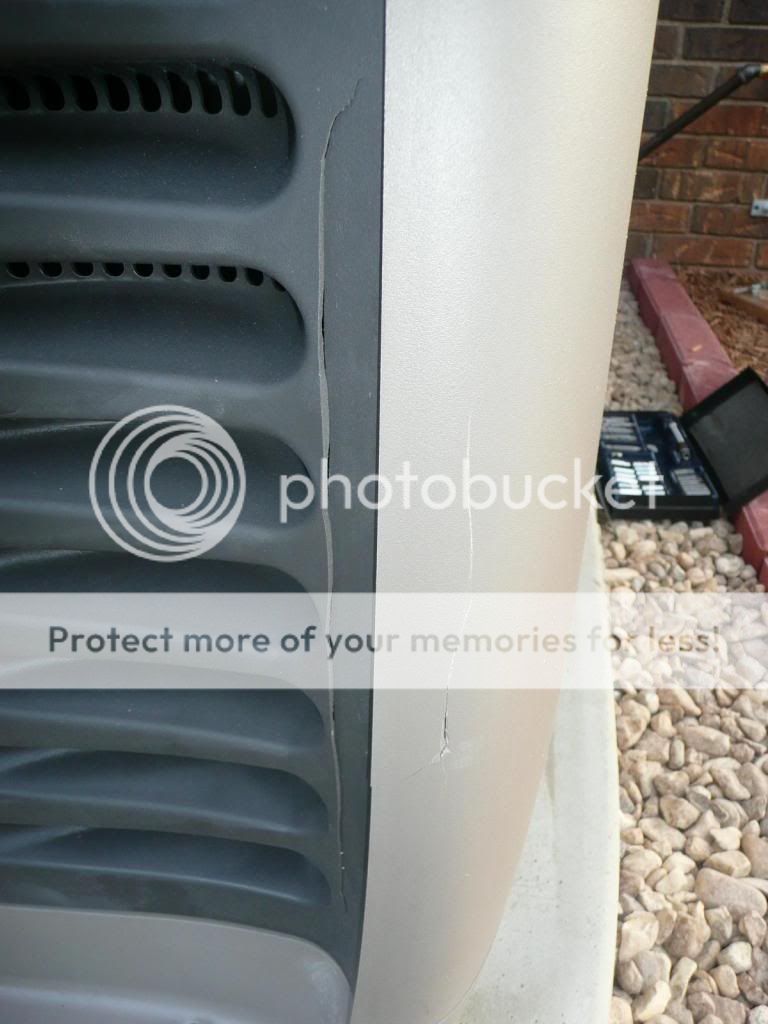
But when I sat it down, the ground wasn't level and the housing leaned back against the fork...OUCH!

Install006CrackedHousingampGrill.jpg


Made me sick! I buy a new generator, and the FIRST thing I do is bust it. After I get it installed I will remove that black grill and see if I can pop that crack back in place, maybe put some epoxy on the back side. The crack in the lighter colored part I better leave it alone, anything I do will probably make it worse. It won't affect performance, so I will just live with it. I only showed this to warn that altho the polymer housing is corrosion proof it can be cracked. Mind you, it took the full weight of the unit pushing back against the fork as I set it down. If it was metal I am sure it would have dented. Nothing is safe from an idiot on a tractor!

So, after I finished kicking myself, I found the big key tie wrapped to one of the grills and popped the hood...
Install007UnboxedHoodUp.jpg


There is an inner hood/insulator over the engine/generator compartment. It hinges up and is held open with a magnet under the main hood. The engine was full of oil. Kohler says use 5W30 synthetic.
Install008UnboxedEngCoverUp.jpg


This area, inside the border bricks, was all mulch. I put in the divider and the gravel bed once I knew what gen I was getting. I can get by with 3 feet clearance from the house since it is brick. Combustible wall coverings require 5 feet. Kohler recommends 6 inches of gravel on three sides and 4 feet on the exhaust end. My exhaust will be blowing away from the house, 6-8 inches from the grass. I am going to take my chances on damaging the grass cause I don't want to move the border out any further. If the grass dies then I will decide what to do.
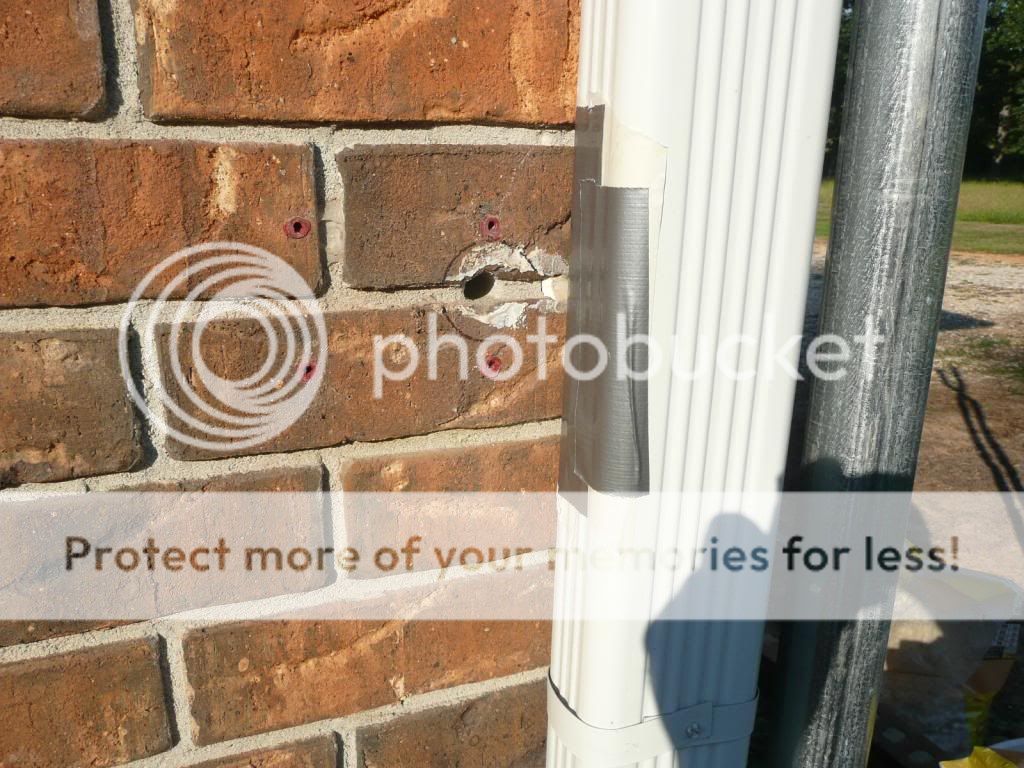
The little box on the wall, next to the gutter, is the GenTran inlet for the portable setup. I will be expanding the hole there for the new power wires.
Install009GravelPad.jpg


I sat the pad in place with my forks. Working alone, I lifted one end up while it was still on top of the gen. box. I put a 4X4 under it in the center so I could slide the forks under it. Then I set it on the stacks of 2X4s on the gravel and backed away. Then I could lift one corner at a time and slide the 2X4s out. Probably two guys could lift and set it in place. I think it weighs about 200 lbs. They make a thicker and heavier one for hurricane prone areas. You can see the preinstalled SS bolts here.
Install010PadInPlaceOnBlocks.jpg


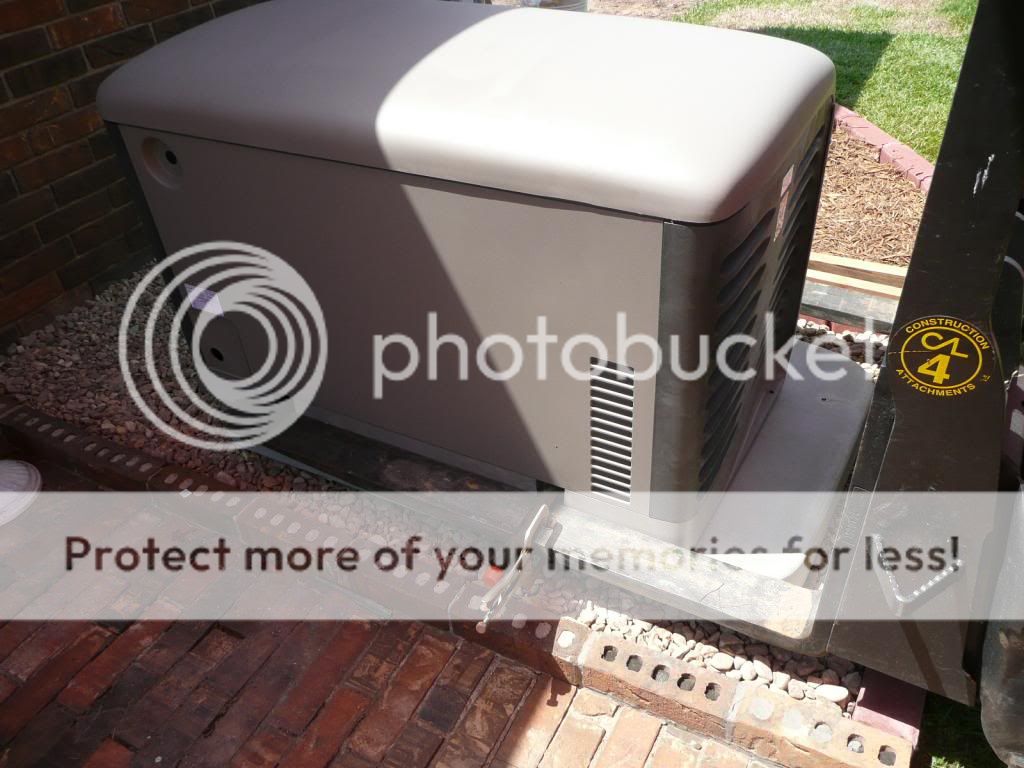
This is how I lifted the generator after unbolting it from the shipping skid. There are two holes in the base that I slid 3/4" water pipe through. The Vise Grip c-clamps are to keep it from sliding back against the forks. Once is enough!. I kept it from sliding off the forks by keeping it tilted back. It weighs 420lbs. The 20kw model weighs 535lbs. Four guys should have no trouble setting one in place with two pipes about 3-4 feet long.
Install011PlacingOnPad.jpg


There it is, safe in it's new home, and with no additional cracks in the housing! It is easy to slide on the pad to line up the bolt holes. I added a flat and lock washer to each bolt.
Install013SittingOnPad.jpg


That's it for now. Tomorrow we will cut and thread some pipe for the gas.
jp
 

frankzlt1

Well-known member
Joined
Sep 5, 2011
Messages
80
Location
Beacon Falls ct
Looks good. I believe the distance from around the generator is the same as generaac. 5' from any opening for the exsauhst fumes and 3' from sides and front of generator and 18" on just the back of generator all from combustible materials. From the last pic you have a drier vent, from the pic it looks deceiving but it looks closer than 5' from the generator.
 

frankzlt1

Well-known member
Joined
Sep 5, 2011
Messages
80
Location
Beacon Falls ct
Do you have central air and if so did you size the generator to handle the a/c unit. There's a LRA on the name plate of the a/c unit and that will tell you how much amperage the surge is when the a/c starts. Looks like you got a 14 kw if so its should be good for 100a or so for the lock rotor amperage.
 
OP
S

soj

Well-known member
Joined
Dec 3, 2007
Messages
729
Location
North Georgia
Looks good. I believe the distance from around the generator is the same as generaac. 5' from any opening for the exsauhst fumes and 3' from sides and front of generator and 18" on just the back of generator all from combustible materials. From the last pic you have a drier vent, from the pic it looks deceiving but it looks closer than 5' from the generator.

The dryer vent is 6 or more feet from the gen. Of more concern is the exhaust for the tankless WH, the white pipe higher up the wall. It is only offset a couple of feet from the gen. I may rotate that turndown elbow away from the gen. and possibly add some pipe to it. That is a condensing tankless, vented with PVC, so the exhaust is not very hot. When it is running you can only feel the heat about a foot or so below the pipe opening. Even though it is fan forced exhaust, as soon as the hot air gets free of the pipe it starts to rise.
 
OP
S

soj

Well-known member
Joined
Dec 3, 2007
Messages
729
Location
North Georgia
Do you have central air and if so did you size the generator to handle the a/c unit. There's a LRA on the name plate of the a/c unit and that will tell you how much amperage the surge is when the a/c starts. Looks like you got a 14 kw if so its should be good for 100a or so for the lock rotor amperage.

Heat pump with supplemental gas heat. LRA is 82. For air conditioning, of course the compressor has to run, but for heat I can select gas only from the thermostat.
 

cowboyjosh

Well-known member
Joined
Mar 11, 2010
Messages
1,066
As for the crack in the housing, this happens ALL THE TIME on the composite KOHLER, GENERAC, and ONAN air cooled generators; you can call a KOHLER dealer or wherever you bought the generator from and try to see if they will "warrant" the damage, I might go so far as to say the crack was there when it was received. Either way I'd throw a ***** fit questioning the durability of the unit, etc; until they sent a new panel. I know the bases on the KOHLERS can easily be broken too; personally witnessed damage when my EC has installed them on my new homes.
 
OP
S

soj

Well-known member
Joined
Dec 3, 2007
Messages
729
Location
North Georgia
A little background on the gas line. I had no real gas service to the house. I say no "real" service, but there was a 150 Gal tank plumbed into the fireplace for gas logs. They smoked so I got rid of them and put a space heater on the hearth. But when I started considering a LP powered generator I knew I would need more gas capacity. I already had a 500 Gal tank at the shop and space in the back yard of the house is kinda limited, so I decided to run a new line from the existing tank. The total distance is about 150 feet, so I needed a two stage system. The purpose of two stage (high pressure and low pressure) LP piping is to deliver more BTU over a greater distance than with a low pressure system. Usually LP tanks are close enough to the house to use only low pressure. I am not sure what the usual max distance is, but I knew 150 feet was too far. This is the type of two stage regulator that was feeding my shop.
P1030688.jpg


That is not my shop tank, but the regulator is the same type

A little about LP gas pressures for those who are not familiar with them. There is tank pressure, then high pressure and finally, low pressure. Tank pressure varies with the temperature, high pressure is 10 psi and low pressure is 11"wc (water column). That regulator in the above pic has a high pressure section on the right, then the larger portion on the left is the low pressure section. For a two stage system, the tank has a high pressure regulator only. They are usually painted red. They look like this:
P1030686.jpg


Naturally you can push more gas a greater distance with 10 psi than with 11"wc (roughly 1/2psi). But LP appliances require the 11"wc to operate properly, so a second stage, low pressure regulator is required close to the point of use, usually just outside the house. Here is the one feeding my shop after the change over from a low pressure system to two stage:
P1030687.jpg


The copper tube at the top is coming from the high pressure regulator on top of the tank. The brown, low pressure regulator is feeding the shop through the copper tube going into the ground. The shop is only 10' away. The grey pipe going in the ground is feeding the house through 3/4" plastic pipe. The gray metal portion above ground is a "riser" which has the plastic pipe inside, fused to a threaded end. The riser makes a 90* bend to bring the pipe above ground. All parts of the plastic pipe have to be below ground for physical protection and to keep it out of sunlight. It is PB (polybutylene) and not sunlight resistant.

This is a riser in the ground, connected to the pipe. The riser has about a foot of pipe coming out of the metal (underground) and connects to the pipe with a fusion union. I got a plumber to make the connections for me. He has a tool that heats the OD of the pipe and the ID of the coupling at the same time. Then they are just pressed together by hand and they melt together. The gauge is to pressure test the whole system after he had fused all the joints.

P1030528.jpg


This gives an idea of the distance to the shop.
P1030501.jpg


The generator will be located about 10-12 feet behind the camera. That line was put in last spring.

The next two pics are of the generator piping I put in a few days ago.
From the backside of the gen:
Install014GasLineBackView.jpg


And from the front:
Install015GasLineFrontView.jpg


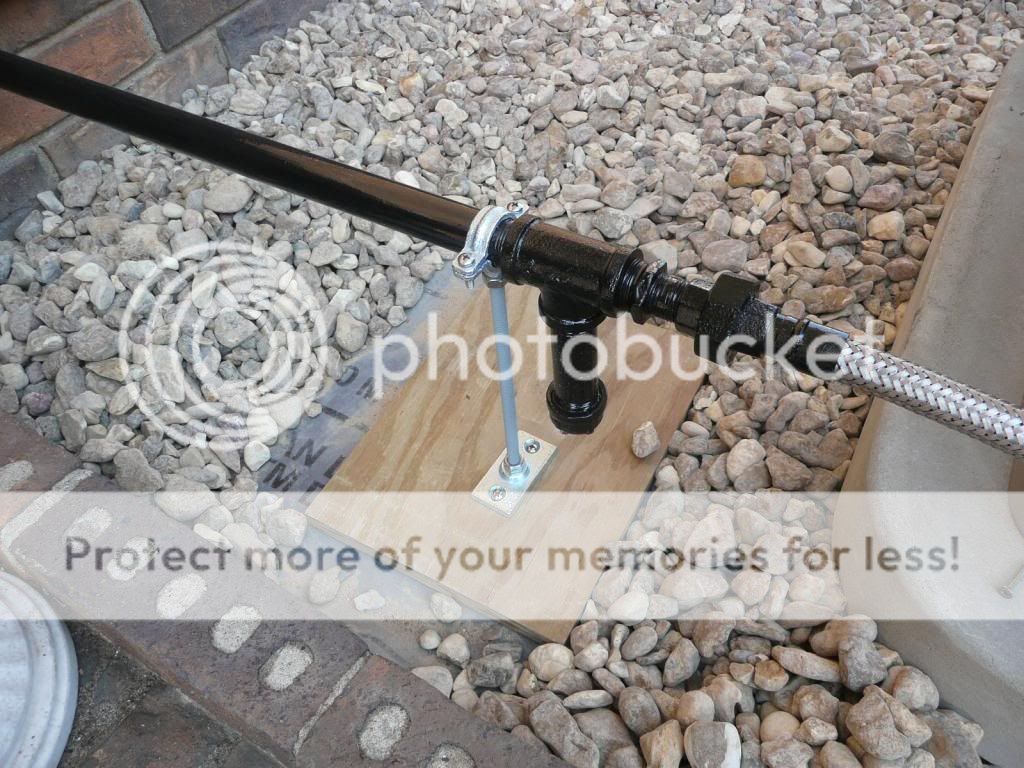
You can see the second stage regulator on top of the riser pipe. The pipe going into the house feeds the water heater, and in the future, the kitchen stove. The other thing to notice here are separate shut off valves, a sediment trap at the end of the black iron pipe and a flexible section just before the generator. That flex pipe and the union came with the generator. The sediment trap is the short pipe pointing down off the tee just before the flex. That is supposed to catch any moisture and/or debris before it gets to the generator. Required on each appliance hookup.

After screwing it all together and pressure testing (no leaks!), it got a coat of primer:
P1030676.jpg


Then a coat of black:
P1030690.jpg


Then a stand to support the weight:
P1030693.jpg

Rocks back over the base (treated plywood):
P1030694-1.jpg

I used that same clamp and base to secure the riser to the house wall:
P1030695.jpg


I still have to convert the generator from Nat. Gas to LP. That only involves moving the fuel line from the regulator in the generator (yes, another regulator!) from the NG port to the LP port. And unplugging a wire. That changes the timing in the electronic engine control. Not sure if it advances or retards the timing, Kohler doesn't say, just that the two wires are connected for NG, and disconnected for LP.
BTW, this regulator, mounted on the generator, is a demand regulator. It senses engine air flow, or vacuum, and puts out more gas to match more air. If the throttle closes, it reduces the amount of gas to match the air flow.

Tomorrow we start on the wiring
jp
 
OP
S

soj

Well-known member
Joined
Dec 3, 2007
Messages
729
Location
North Georgia
As for the crack in the housing, this happens ALL THE TIME on the composite KOHLER, GENERAC, and ONAN air cooled generators; you can call a KOHLER dealer or wherever you bought the generator from and try to see if they will "warrant" the damage, I might go so far as to say the crack was there when it was received. Either way I'd throw a ***** fit questioning the durability of the unit, etc; until they sent a new panel. I know the bases on the KOHLERS can easily be broken too; personally witnessed damage when my EC has installed them on my new homes.

After the crack incident, I was a little gunshy of the composite housing. It made me glad I got the base to give it a good even support. Kohler says it is not necessary, but that is more marketing hype than anything else. I can see that if the gravel base (or the ground under it) is not compacted evenly that plastic would warp to follow the settling. At least with the concrete pad it is on a firm, level footing.

When I bolted the base to the pad I just snugged the bolts enough to compress the lock washers... didn't need more cracks!!
jp
 

frankzlt1

Well-known member
Joined
Sep 5, 2011
Messages
80
Location
Beacon Falls ct
One of the issues you my have with the low pressure gas regulator is that its combined with other appliances, you'll never be able to adjust it for the generator gas pressure without messin with the appliance. You should have a seperate low pressure regulator for the generator off the same high pressure line. By the way nice job on the plumbing.
 

frankzlt1

Well-known member
Joined
Sep 5, 2011
Messages
80
Location
Beacon Falls ct
You also want to have a static gas pressure at least 12.5-13 on the water column. The reason you want it that high is once other gas appliances come on with generator running it will drop the pressure.
 
OP
S

soj

Well-known member
Joined
Dec 3, 2007
Messages
729
Location
North Georgia
One of the issues you my have with the low pressure gas regulator is that its combined with other appliances, you'll never be able to adjust it for the generator gas pressure without messin with the appliance. You should have a seperate low pressure regulator for the generator off the same high pressure line. By the way nice job on the plumbing.

I am hoping the one regulator will be enough. It is 3/4" inlet and outlet with 935,000 BTU capacity. The generator maxes out at 203,000 BTU at full load, the water heater is 157,000 BTU max. When I add a stove that will be 40,000 BTU. Probably not that much, but just a WAG for planing purposes. Always better to guess high. Add it all up to 400,000 BTU, I still have 535,000 left on that regulator, even with everything going wide open. The furnace is on a separate regulator, at the other end of the house, it is rated at 90,000 BTU. So my max total draw is 490,000 BTU. The 3/4" plastic pipe in the ground is rated for 1.6 or 1.8 million BTU at 150', depending on whose chart you go by.
Having said all that, as soon as I get the generator going I will put a gauge at the generator solenoid valve and check the wc at full load (or as best I can load it) with the water heater and furnace going at the same time. I don't want to just wait and see if it works OK during an outage, better to KNOW before hand.

Thanks for the kind words on the plumbing. There is plumbing, then there is pipefitting... I am not a plumber or a pipefitter, but I did cut and thread all the longer pieces in that run. I lined up to the generator inlet within a 1/4". Guess that is why I am not a pipefitter:dunno: And thank goodness for the flex connection!

BTW, the piece going at an angle toward the wall was the most difficult to get the length right. But doing it that way allowed me to use only two 45* elbows. Otherwise it would take three 90*s to get to the wall and going in the right direction. Per the Kohler installation book, each 90* elbow adds 8' to the calculated length. Not sure how much a 45* adds, but it has to be less. Just as a guess, just say a 45* adds 5', I only added 10' to my calculated length, three 90*s would have added 24'.
 
OP
S

soj

Well-known member
Joined
Dec 3, 2007
Messages
729
Location
North Georgia
Next comes conduit. The generator is about 6-8 feet from the corner of the house. Right around the corner, on the end of the house, is the power meter. The easiest way to get to the meter area would be on the outside wall, but there is a downspout there and a fence post within an inch of the brick. Inside the house at that corner is the utility room with the breaker panel and the water heater. The inside wall covering (paneling) was removed when I wired in the portable generator. I had never replaced it cause I never felt that was a long-term, permanent solution. Also there are wiring problems at the breaker panel that needed to be fixed, so the wall where I need to run the generator wires is already open. Since I can't go around the outside of the corner I will go inside on the back wall of the house, then go through the end wall directly into the transfer switch. It will look better since there will be no conduit exposed on the end of the house except the existing feed from the ground up to the meter base.

This is the hole where the portable generator inlet box was located. I need to enlarge it for 1 1/4" conduit for the power wires. The marked circle is the size it needs to be. If you have ever used a hole saw you know you have to have a pilot bit in the center to keep it from "dancing" all around as you try to get it started. With that size hole in the center, a hole saw is useless.
P1030673.jpg


But a wooden peg driven into the hole will give the pilot bit something to keep it centered.
P1030674.jpg


And this is after I had started drilling:
P1030675.jpg


The same hole from the inside:
P1030677.jpg


This is after drilling through the brick and changing to a regular bi-metal saw for the wood. Three 2X4s together in that corner stud.
P1030678.jpg


That will get the power wires from the generator into the wall. We will deal with going back through the wall into the ATS later. First, because it determines exactly where on the wall the ATS will mount, I will go through the wall for the new wires to feed the main panel.

The existing wires from the meter base to the main breaker will have to be removed and discarded. The meter base and main panel are back to back on the left side of the panel (as viewed from inside). Notice there is no plastic bushing on the end of that 2" conduit to protect the wires from its sharp edges. That will be corrected on the new setup.
P1030707.jpg


The ATS will be mounted to the left of the meter (as viewed from outside). The new wires will go into the ATS through a short rainproof hub. Then from the ATS they will come into the main panel through the opposite corner from where the existing wires are in the previous pic.

This is the new entry location. I have to get a hole through the outside brick lined up exactly with this knockout:
P1030682.jpg


So I work from the inside out. First I drill a 1/4" hole in the center of the knockout. I held a shop vac under the drill bit to catch the chips.
P1030683.jpg


Using that hole as a guide, I drill through the brick with a 1/4" masonry bit:
P1030685.jpg


Above you can also see the knockout I will be using in the side of the meter base to connect to the ATS.

Using that hole as a guide for the hole saw, I drill through the brick:
P1030691.jpg

That is a 2 1/2" hole, which turned out to not be big enough for the raintight hub to fit into. I later opened it up with a hammer and chisel.

Here you can see it is lined up perfectly with the knock out in the box inside:
P1030692.jpg


I don't have pics for the next few steps. Next I removed the knockout from the side of the meter base and installed a raintight hub with a short threaded ****** connected to another raintight hub, the one to be connected to the ATS. I then held the ATS against that hub and marked it for drilling. The ATS is in a NEMA 3R enclosure. That means outdoor rated, weather proof. There are no knockouts on the box, so holes can be drilled or punched where ever they need to be, provided they clear the internal switch components. Speaking of the switch, it is best to remove it from the box while drilling or punching holes. Kohler warns several times to not get chips in the switch, and to only use a vacuum (NEVER compressed air) to remove chips if the switch is in place. Removing the switch solves that problem, and makes the box much lighter. With that hole drilled I was able to place the box on the wall where it will be mounted. After leveling it, I had a helper hold it in place while I went inside with an extended length Sharpie and marked the location for the hole in the back. This is an extended length Sharpie:
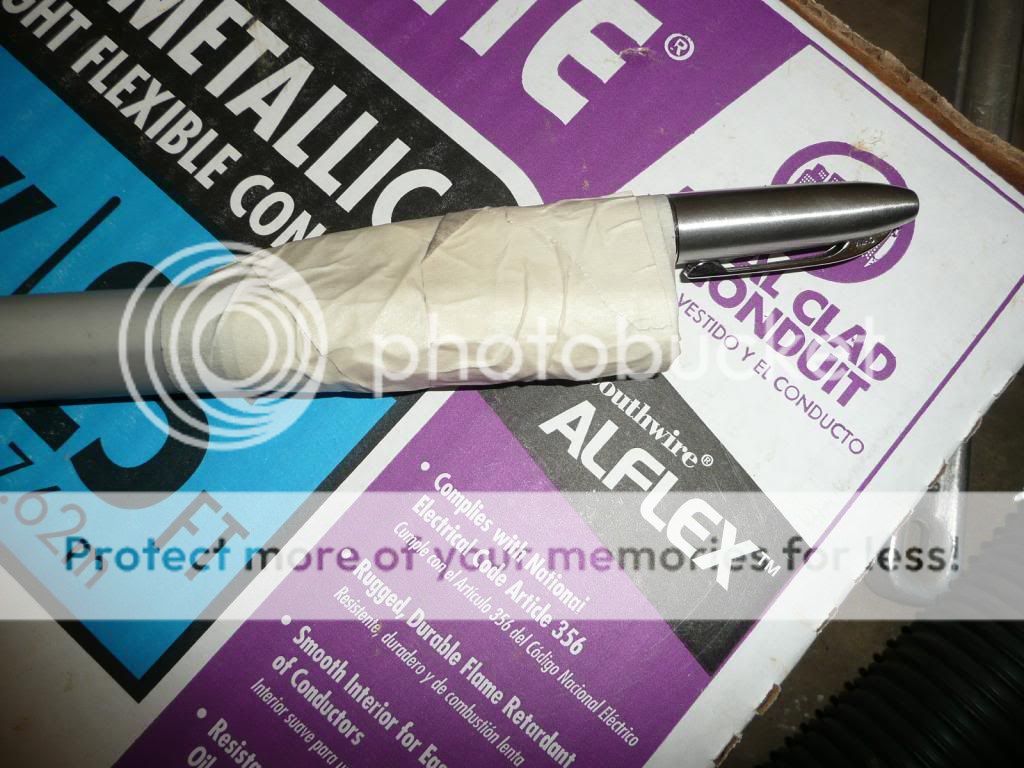
P1030705.jpg

(Sharpie taped to a piece of 1/2" conduit)

After drilling that hole it was just a matter of measuring inside the box to determine where the other two holes could be. You just have to pick a place that clears the switch and lugs and is also accessible from inside the wall. Fortunately I had a full 16" stud space to work in. Once you determine where the holes will be, drill the brick from inside as before, then use that 1/4" hole to guide the hole saw from the outside. Then hold the box back on the wall and mark the other two holes. This is the result, three holes in the back of the box:
P1030697.jpg


And three matching holes in the wall:
P1030698.jpg

(I had already ran the conduit when I took the pic.) That little grey wire is the phone wire I will have to make sure it doesn't get pinched behind the box when mounting it. It is too short to go around the box.

This is the new conduit into the main panel:
P1030700.jpg


And with the plastic bushing on the end. All the raintight connectors in the ATS have bushings built in, that is what the yellow plastic is on the other end of the conduit.
P1030706.jpg


And the finished conduit in the wall:
P1030699.jpg


On the outside wall. Still needs clamps.
P1030709.jpg


At the generator:
P1030710.jpg


The generator connection panel:
P1030711.jpg


I didn't get a pic of the switch mounted, I will post that tomorrow. As soon as I get the conduit mounted on the outside wall I will be ready to pull wire.
jp
 

larry4406

Well-known member
Joined
Jan 27, 2006
Messages
19,057
Location
Northern Virginia
Are you having the power company schedule an outage to jerk the meter so you can replace the service entrance cable to the ATS vs panel or are you doing this yourself?
 
To avoid these ads, REGISTER NOW!
OP
S

soj

Well-known member
Joined
Dec 3, 2007
Messages
729
Location
North Georgia
Are you having the power company schedule an outage to jerk the meter so you can replace the service entrance cable to the ATS vs panel or are you doing this yourself?

The meter base is unsealed. It was that way when I moved here.
 
OP
S

soj

Well-known member
Joined
Dec 3, 2007
Messages
729
Location
North Georgia
Careful LP dissolves Teflon tape.

I am using the yellow tape rated for LP and NG. I have used that for years without a problem. The gas company also used Teflon tape to install the regulators, but it was white. I thought he was using regular Teflon for water pipes, but I checked the label and it was rated for gas. First time I had saw white gas rated Teflon, but he said they regularly have it in either color, just depends on the mfg.
 

Rookie2

Well-known member
Joined
Feb 27, 2013
Messages
1,925
Location
Western Pa.
I would repair your meter to panel feed, they look like they are loose and have heat/corrosion damage.

also since your generator is on the ground and under the gutter , you'll have to beware of snow blocking the air intake and falling snow and ice from the roof.

nice work !
 
OP
S

soj

Well-known member
Joined
Dec 3, 2007
Messages
729
Location
North Georgia
The box mounted on the wall. It looks crooked but it IS level. The brick on that corner are not level. There is vinyl siding above the row of vertical brick at the top, it is level, but does not line up with the brick.
P1030716.jpg


This is the only thing I don't like about how I had to mount the box. These two conduits are closer than I would like. There will be three 2/0 copper wires in each, it will be a little crowded, but it is the only way I could get the box close enough to the meter base so it would line up with the knockout in the main panel. I tried a offset ******, but it was too long.
P1030718.jpg


Even the rainproof hubs I used were too long, so I shortened them before screwing them together with a shortened close ******. I could have used a plain ****** with lock nuts, but I wanted to use rainproof fittings on all ATS box openings. I think code requires it anyway, but I just wanted a water proof installation. Here you can see there is no seal on the meter. Also, the lock nut on that conduit under the meter, it is on backwards. The "teeth" should be against the box. Nothing I can do about tho.
Also note the foam on top of the phone box. I squirted expanding foam in around the conduits from the outside just prior to mounting the box.
P1030719.jpg


Then I foamed the openings from the inside as well. Air and bug tight!
P1030720.jpg
 
OP
S

soj

Well-known member
Joined
Dec 3, 2007
Messages
729
Location
North Georgia
I would repair your meter to panel feed, they look like they are loose and have heat/corrosion damage.

also since your generator is on the ground and under the gutter , you'll have to beware of snow blocking the air intake and falling snow and ice from the roof.

nice work !

I agree, they are corroded. They will be replaced with the new feed from the ATS. There is other evidence of water entering the main panel, I suppose running in on those wires. After they are removed I will seal that conduit.

Good point about the snow/ice. I had not considered that since we don't have a lot of snow, but ice storms are common, and the main reason for any extended power outages we have. The main concern would be during automatic start up with no one home to clear the intake.
 

cowboyjosh

Well-known member
Joined
Mar 11, 2010
Messages
1,066
Great install pics, nice, clean, work; you aught to start installing backup generators as your day job.
 
OP
S

soj

Well-known member
Joined
Dec 3, 2007
Messages
729
Location
North Georgia
Great install pics, nice, clean, work; you aught to start installing backup generators as your day job.

Thanks for the kind words. No time for a day (or night) job. I have been retired for 5 years and have barely made a dent in the honey-do list. :lol:
 

Rookie2

Well-known member
Joined
Feb 27, 2013
Messages
1,925
Location
Western Pa.
Just in case you forgot: coat the aluminum wire lugs with corrosion inhibitor before you install the wires.

ground your generator and panels also.
 

pattenp

Well-known member
Joined
Jun 4, 2008
Messages
10,175
Location
Virginia - USA
Nice job with what you're doing on the ATS. I assume you'll take care of all the missing NM clamps in the main panel and put knockout covers on any open knockouts.
 

cowboyjosh

Well-known member
Joined
Mar 11, 2010
Messages
1,066
Nice job with what you're doing on the ATS. I assume you'll take care of all the missing NM clamps in the main panel and put knockout covers on any open knockouts.

I noticed that too, in Colorado there are still some counties that DO NOT require inspections on new dwellings and most commercial buildings (with the exception of schools) and you'll see where some electrical contractors will "cut cost" and not install any NM clamps at the panel; because they know no one from a AHJ will ever look at it. Keep in mind these are large counties (land wise) with a very small population. In commercial applications in these counties I have seen where the EC's will use the EMT as the ground, to save cost and not have to run a ground wire, while this I'm told is technically 'OK, its still wrong, but I digress.
 

bjones

New member
Joined
Aug 31, 2013
Messages
3
Nice gas piping job. I like the 45s back to the wall and the drip leg. It’s a very professional, neat looking job. Also, you did a very neat job outside with the PVC conduit and liquid tight conduit. Although you cannot support the electrical conduits using the gas piping. NFPA70 Article 300.11B and Article 356.60

You probably haven’t got around to it yet, but you’ll need to support both PVC conduits on the wall with a few more straps. See Article 352.30

You have a few problems with the existing main breaker panel, the installation of the ATS and some other issues you should be aware of that I’ll list below. All references below are based on the National Electrical Code NFPA-70.

1. The raceway containing "service conductors" from the meter require a “bonding bushing”, not just a regular 2” locknut and 2”plastic busing. This is service equipment, therefore any metallic raceway where there are concentric knockouts still present (one in your case) a bonding bushing is required and a bonding wire is required to be run to the EGC (equipment grounding bar) bar in the panel. Article 250.92. Otherwise you could get away with a grounding locknut, but under no circumstances can you use a regular locknut on the supply-side of the service when using a metallic raceway. By the way, not sure on how you’re doing this, but you cannot use the panel as a raceway to the ATS for service entrance conductors. You must come out of the side of the meter into either the service rated ATS or service disconnect switch first and then out of the disconnect to the ATS or out of the service rated ATS and then to the panel. Oops, I just saw the pictures you posted of the ATS, sorry. You will need to install the “grounding locknut” (not bushing because I don’t see any concentric knockouts left) to the fitting going through the wall and the one going into the meter pan. If you had used PVC you could have used a regular locknut.

2. Numerous non-metallic (NM) or romex cables entering the top of the panel are not coming through the knockout in an approved connector. Article 314 and 334 and I see someone already pointed that out.

3. You’ll need to separate the neutrals from the equipment grounding conductors in the existing panel as it now becomes a sub-panel and remove the bonding screw or strap from the existing ground (neutral bar). You’ll have to purchase the grounding bar kit that is approved for that panel and relocate the equipment grounding conductors on the branch circuits to it. If the ATS you purchased is a “service rated” switch with a main breaker it becomes your first means of disconnect. You’ll be required to relocate all Grounding Electrode Systems and Grounding Electrode Conductors (grounding electrode and water ground). See Article 250.24, 250.26. 250.50, 250.52 and 250.53
Read about objectionable current.

4. If the ATS is not "service rated", then you will have to install a “service rated” disconnect between the meter pan and the ATS. In this case, the service rated disconnect becomes your first means of disconnect and all grounding will have to come to it.

5. I think someone already mentioned this, but I’ll mention it again, there are loose connections on the existing terminations on the main breaker causing resistance and heat. Like you said, that will take care of itself when the conductors are replaced with the ones from the ATS.

6. Don't drive a ground rod for the generator. It is not a "separately derived" system (meaning it doesn't switch the neutral) so you are not required to drive a "grounding electrode" for it. No, it is not a good idea to put one in either. It is a liability. Lightning strikes or stray utility voltage gradients can fry out the electronics in your generator.

Please, don't shoot the messenger, I'm just trying to help you out. Some of these things are life safety issues as well as equipment longevity issues.

Cheers!

Bill
Master Electrican
Generac and Kohler Dealer
 
OP
S

soj

Well-known member
Joined
Dec 3, 2007
Messages
729
Location
North Georgia
Just in case you forgot: coat the aluminum wire lugs with corrosion inhibitor before you install the wires.

ground your generator and panels also.

I will be using copper wire. I always use no-ox on aluminium wire, but not copper. I realise the lugs may be made of aluminium (I always thought they were plated copper or brass), but they are rated AL/CU. Kohler's instructions only say to apply "joint compound" to any aluminium conductors, nothing mentioned about copper.

I will be using a ground conductor from the generator to the ATS. Also from the ATS to the main panel. The main panel becomes a sub panel, since the ATS is service entrance rated and is the first connection and disconnect after the meter. So it is four wires from the ATS to the main panel. I will be adding a ground bar to isolate the neutrals and grounds.
 
OP
S

soj

Well-known member
Joined
Dec 3, 2007
Messages
729
Location
North Georgia
Nice job with what you're doing on the ATS. I assume you'll take care of all the missing NM clamps in the main panel and put knockout covers on any open knockouts.

That is part of the plan. This house must have been wired by a blind monkey. That is just one example of many, not just code violations, but common sense violations I have found. There is another one in that panel, and I am kinda surprised one of you electricians haven't noticed it yet. It is in this pic that was in an earlier post:

P1030699.jpg


It is not the wires missing from the 240 breaker on the right. That is the dryer circuit and its wires were in my way getting the conduit in the upper right corner, so I pulled them out of the box. It is not that white NM cable laying across the main breaker, that is just another wire pulled out of the top right corner for working access.

If you don't see it right away, once you do see it, you will wonder how you missed it
jp
 
OP
S

soj

Well-known member
Joined
Dec 3, 2007
Messages
729
Location
North Georgia
Nice work. Great job!

Thanks for buying a great product from the State of Wisconsin.

Thanks for the pep talk!:beer:

I just hope it is ALL made in Wisconsin. So many so called "made in USA" products have that fine print... "Assembled in USA from foreign and domestic components".
 
OP
S

soj

Well-known member
Joined
Dec 3, 2007
Messages
729
Location
North Georgia
Nice gas piping job. I like the 45s back to the wall and the drip leg. It’s a very professional, neat looking job. Also, you did a very neat job outside with the PVC conduit and liquid tight conduit. Although you cannot support the electrical conduits using the gas piping. NFPA70 Article 300.11B and Article 356.60

You probably haven’t got around to it yet, but you’ll need to support both PVC conduits on the wall with a few more straps. See Article 352.30

You have a few problems with the existing main breaker panel, the installation of the ATS and some other issues you should be aware of that I’ll list below. All references below are based on the National Electrical Code NFPA-70.

1. The raceway containing "service conductors" from the meter require a “bonding bushing”, not just a regular 2” locknut and 2”plastic busing. This is service equipment, therefore any metallic raceway where there are concentric knockouts still present (one in your case) a bonding bushing is required and a bonding wire is required to be run to the EGC (equipment grounding bar) bar in the panel. Article 250.92. Otherwise you could get away with a grounding locknut, but under no circumstances can you use a regular locknut on the supply-side of the service when using a metallic raceway. By the way, not sure on how you’re doing this, but you cannot use the panel as a raceway to the ATS for service entrance conductors. You must come out of the side of the meter into either the service rated ATS or service disconnect switch first and then out of the disconnect to the ATS or out of the service rated ATS and then to the panel. Oops, I just saw the pictures you posted of the ATS, sorry. You will need to install the “grounding locknut” (not bushing because I don’t see any concentric knockouts left) to the fitting going through the wall and the one going into the meter pan. If you had used PVC you could have used a regular locknut.

2. Numerous non-metallic (NM) or romex cables entering the top of the panel are not coming through the knockout in an approved connector. Article 314 and 334 and I see someone already pointed that out.

3. You’ll need to separate the neutrals from the equipment grounding conductors in the existing panel as it now becomes a sub-panel and remove the bonding screw or strap from the existing ground (neutral bar). You’ll have to purchase the grounding bar kit that is approved for that panel and relocate the equipment grounding conductors on the branch circuits to it. If the ATS you purchased is a “service rated” switch with a main breaker it becomes your first means of disconnect. You’ll be required to relocate all Grounding Electrode Systems and Grounding Electrode Conductors (grounding electrode and water ground). See Article 250.24, 250.26. 250.50, 250.52 and 250.53
Read about objectionable current.

4. If the ATS is not "service rated", then you will have to install a “service rated” disconnect between the meter pan and the ATS. In this case, the service rated disconnect becomes your first means of disconnect and all grounding will have to come to it.

5. I think someone already mentioned this, but I’ll mention it again, there are loose connections on the existing terminations on the main breaker causing resistance and heat. Like you said, that will take care of itself when the conductors are replaced with the ones from the ATS.

6. Don't drive a ground rod for the generator. It is not a "separately derived" system (meaning it doesn't switch the neutral) so you are not required to drive a "grounding electrode" for it. No, it is not a good idea to put one in either. It is a liability. Lightning strikes or stray utility voltage gradients can fry out the electronics in your generator.

Please, don't shoot the messenger, I'm just trying to help you out. Some of these things are life safety issues as well as equipment longevity issues.

Cheers!

Bill
Master Electrican
Generac and Kohler Dealer

Lots to address here, but I will start with the last paragraph. No way I am shooting at you! This is what I wanted from this thread. Like I stated in the first post, I am not an electrician, and I need all the help and advice I can get.

Now the first paragraph: Thanks for the kind words. I always try to do good looking work, but I want it to be truly good work as well. So I guess I will have to devise an alternate method to support the conduit where I have it supported on the gas pipe. I don't have a copy of the NEC, so will just have to take your word for it, although I don't doubt you. I know it needs support at the end of that liquid tight flex, or it and the end of the elbow it connects to will droop. I think I can go all the way to the ground, like I did with the gas pipe.

I am "getting" around to it. I have already drilled the holes, but I ran out of Tapcons. But it will get done.

Item 1. I was wondering about the grounding bushing, cause a couple of my wiring books show that, but they aren't clear on the requirements. And I am still not real clear after your explanation. And I googled it and all I got was electricians disagreeing on when and when not to use grounding or bonding locknuts or bushings. The only concentric knock outs are in the side of the meter box and where the through the wall conduit enters the main panel. The holes in the ATS are drilled. So I understand you to say I need two, both inside the ATS? What about in the main panel, where the conduit is fastened to a concentric knock out? What about in the meter base, is one ever used there? I ask because there are concentric knock outs there where I put the rain tight hub. Sorry, I am just still confused.

Item 2. Yes already noted, and I had planned to correct that from the start.

Item 3. Thanks for pointing this out. I already knew it, but others may not have realised the main panel can become a sub panel. I have already purchased the listed Square D bus bar. I am still undecided on where to mount it. I have not found any pre drilled holes in the back of the panel. I would like to put it on the left side, the right side will have all the neutrals and most of the circuit wires, so is kinda crowded. I will make sure the grounds will reach before I decide. The neutral/ground bars are not bonded. The label in the box shows the location of the bonding screw, and that hole is open, so no "un-bonding" to do.
I am not sure what you mean by "You’ll be required to relocate all Grounding Electrode Systems and Grounding Electrode Conductors (grounding electrode and water ground)." Again, I don't have a copy of the NEC. I probably couldn't interpret it if I did. :dunno: The only ground wire is the bare copper from the meter base to the ground rod. All water pipes are plastic. Is there something else I need to do?

Item 4. The ATS is service rated, model # RXT-JFNC-0200ASE.

Item 5. As you say, the new wires will take care of that. What about anti corrosion paste for copper, is it required or needed?

Item 6. I knew not to do that from having a portable hooked up. I had read internet discussions on generator ground rods and neutral/ground bonding in the generator till my eyes glazed over!:eyecrazy: Tons of disagreement. My understanding is that the neutral and ground should NOT be bonded in the generator. It came with a bonding strap installed. Kohler says it depends on the installation, and the generator will work properly either way. The way I understand it is, that since the neutral is not switched by the ATS, there should be only ONE neutral/ground bond, and that is at the first means of disconnect, in this case, the ATS. Bonding the neutral/ground in the generator would be the same as having them bonded in a subpanel. Correct me if I am wrong.

Thanks again for pointing all these things out.
jp
 

mm08822

Well-known member
Joined
Jan 13, 2012
Messages
5,866
Location
NJ
I like the attention to detail that you are putting into this install. Now is the time to do it right – the first time.
In providing feedback to your installation, I agree with all of the points BJones raised. Again – please don’t shoot this messenger either – I’m trying to get you all ready for inspection - one inspection.

Since your new ATS is now considered the main disconnect/panel, you will also need two ground rods spaced 6 ft or more apart and connect them to the new ATS with #6 Copper. New equipment has to meet the current code requirements. (You can still use the old ground rod for one of these.)

Since you only have a concentric KO on one end of that ****** between ATS and meter pan, you can use a bonding locknut on the ATS side - not the meter side.

Did you install a double locknut (back-back i.e. – interior/exterior) on the new ****** from ATS into the old panel? It needs to have this to meet code and be considered a grounding means for that ******.
(FYI – the exterior locknut on the utility riser conduit into the meter pan is installed upside down – teeth need to bite into the meter pan enclosure.)

I also wanted to bring up that the interior side of the wall that the (oldmain) new sub panel is located on needs to be sheet-rocked for fire protection. The LB covers must remain accessible. What is the purpose of the ¾” T?
Your panel looks flush with the studs – it should be raised 3/8 - 1/2” for sheet-rocking.

Once you have the old feed to the panel removed from the meter, ATS utility side fed from the meter, and before replacing meter, I suggest you do the following:
Label and remove all branch circuits,
Remove the panel entirely,
add a KO seal to the back of the panel opening from the old ****** – peen the ends over,
remove the old ****** from the meter pan and KO seal that opening,
seal the wall
replace the new ****** with a longer one (3/8 – ½” longer) and locknut
install the panel, locknut and bushing
Feed the panel from the ATS load side through the new ****** – identify neutral and ground wires with tape
One by one – re-install each branch circuit cable with proper connectors and staple each within 12” of panel
Remember the new grounding block(s) – neutrals and grounds are separated now
(You may want to provide a horizontal nailer above the panel first to give easy access to staple)

To your question about oxide inhibitor – I use it on all exterior lug connections, including removing the lug set screw and applying to those threads – prevents galling and allows for better torque applied onto the conductor instead of just torque between set screw and lug body.

Looking forward to the final pics!
 

mm08822

Well-known member
Joined
Jan 13, 2012
Messages
5,866
Location
NJ
Also need to fix that white romex cable - black is tied to neutral block and white is on single pole breaker. I wouldn't just reverse those wires until I checked the downstream connections were done right.
 
OP
S

soj

Well-known member
Joined
Dec 3, 2007
Messages
729
Location
North Georgia
Another great, helpful response. Thanks! My replies below are in bold.

I like the attention to detail that you are putting into this install. Now is the time to do it right – the first time.
In providing feedback to your installation, I agree with all of the points BJones raised. Again – please don’t shoot this messenger either – I’m trying to get you all ready for inspection - one inspection.

All messengers are safe here. You are automatically enrolled in my "messenger protection program".

Since your new ATS is now considered the main disconnect/panel, you will also need two ground rods spaced 6 ft or more apart and connect them to the new ATS with #6 Copper. New equipment has to meet the current code requirements. (You can still use the old ground rod for one of these.)

I was considering this, but wasn't sure it was required. What I am not sure about is the proper connection at the service. You say "connect them to the new ATS". The current bare copper is connected to the neutral in the meter base. If I add a ground rod I would run one continuous piece of new #6 copper to both rods. Where should I terminate it in the service? The meter or the ATS?

Since you only have a concentric KO on one end of that ****** between ATS and meter pan, you can use a bonding locknut on the ATS side - not the meter side.

Will do. Do I need any other bonding or grounding locknuts or bushings anywhere else?

Did you install a double locknut (back-back i.e. – interior/exterior) on the new ****** from ATS into the old panel? It needs to have this to meet code and be considered a grounding means for that ******.

I did not. I could not get one through the wall without opening up the hole in the brick all the way through. I only opened it up deep enough to make room for the rainproof hub on the back of the ATS. How important is it that the main panel be grounded via the ******? It will be grounded with a #6 copper via the 4 wire sub panel feed.

(FYI – the exterior locknut on the utility riser conduit into the meter pan is installed upside down – teeth need to bite into the meter pan enclosure.)

I saw that, but there is no way to correct it short of having the POCO kill the power at the pole so the meter base could be removed.

I also wanted to bring up that the interior side of the wall that the (oldmain) new sub panel is located on needs to be sheet-rocked for fire protection.

The rest of the room is paneling, as was the area around the main panel before I removed it for access. It will be recovered when I finish.

The LB covers must remain accessible.

I wasn't sure if they had to be accessible or not, since they do not contain any splices. But I planned to make a removable (mounted with screws) access plate for them anyway. If any of that wiring ever had to be changed/modified they would have to be opened up.

What is the purpose of the ¾” T?

At the T the control cable between the generator and ATS will pass through, but the CAT 5E network cable will exit and continue in free air to the attic and on to my router. Before I pull that cable I will add a cable clamp to that opening, for strain relief and to seal up the conduit.

Your panel looks flush with the studs – it should be raised 3/8 - 1/2” for sheet-rocking.

Pictures can be deceiving, it is raised.

Once you have the old feed to the panel removed from the meter, ATS utility side fed from the meter, and before replacing meter, I suggest you do the following:
Label and remove all branch circuits,
Remove the panel entirely,
add a KO seal to the back of the panel opening from the old ****** – peen the ends over,
remove the old ****** from the meter pan and KO seal that opening,
seal the wall
replace the new ****** with a longer one (3/8 – ½” longer) and locknut
install the panel, locknut and bushing
Feed the panel from the ATS load side through the new ****** – identify neutral and ground wires with tape
One by one – re-install each branch circuit cable with proper connectors and staple each within 12” of panel
Remember the new grounding block(s) – neutrals and grounds are separated now
(You may want to provide a horizontal nailer above the panel first to give easy access to staple)

I had considered replacing the entire panel, but could not find a justification to do so. If it was smaller would be a reason, but it is already 200A. If I needed more circuit spaces would be a reason, but I have spaces left over. I had not considered pulling it out just to seal the old opening to the meter. Also, it does not need to be repositioned to be flush with the finished wall, so would not need the longer ******. I realise that I will have it 90 percent removed because I am going to remove all the branch circuit wires to add the NM cable clamps. It is nailed in place, so those would be more difficult to remove than if it was screwed in. So the only reason to remove it would be to take out the ****** to the meter base, or to add the lock nut to the exterior of the ****** to the ATS (if necessary, see above). I planned to just seal both ends of that ******. Would that be good enough?

I have a new ground bar for separating the neutrals and grounds.

I had not thought about adding a horizontal nailer above the panel, but I will. Thanks for the suggestion.


To your question about oxide inhibitor – I use it on all exterior lug connections, including removing the lug set screw and applying to those threads – prevents galling and allows for better torque applied onto the conductor instead of just torque between set screw and lug body.

I guess I need to look for oxide inhibitor listed for copper. All I have seen before says it is for aluminium.

Looking forward to the final pics!

Thanks again for all the help.
jp
 
OP
S

soj

Well-known member
Joined
Dec 3, 2007
Messages
729
Location
North Georgia
Also need to fix that white romex cable - black is tied to neutral block and white is on single pole breaker. I wouldn't just reverse those wires until I checked the downstream connections were done right.

You spotted it! (See post # 34)

The "downstream connections" are more evidence of the blind monkey theory. This is what is just above the panel:
P1030672.jpg


White to black, black to white... at least they put ground to ground. I can't imagine why :dunno: anyone would do this.

I plan to add a j-box for a proper splice and mount it so I can put a plain cover plate on after the wall is finished.
 
To avoid these ads, REGISTER NOW!
Top Bottom