To avoid these ads, REGISTER NOW!

Installing Detached Garage sub panel

cmb816

Member
Joined
Feb 8, 2016
Messages
11
I have two electrical projects to work on at home. First is am going to insulate my detached garage, and wanted to upgrade the electrical beforehand. I am in central VA, building (16x20) is 75ft from the main panel and is currently fed by a 20a single circuit run thru 3/4" metal conduit. I'll likely pull that the wire out and reuse somewhere (maybe for the second project, or just to the extra lights/outlets in the garage) and maybe then run a network cable thru as I'm working out of the garage now due to covid and the wifi signal is weak.
Plan is to add a 60a sub panel in the garage, add some additional outlets and lights and leave room for a 220v outlet down the road if I get a larger welder. Currently it will need to run lights, a heater in the winter, and maybe two or maybe 3 tools at a time (something like a saw and dust collection/shop vac) depending on if the compressor kicks on.

Since the conduit is already connected to the house, and in theory properly grounded, do I also need a grounding rod at the garage? I was thinking of doing direct burial 4g aluminum wire, will that be enough?

Second project is running 20a circuit 50 ft to a small mini barn for lights. For that I was going to just run direct burial from the 20a breaker currently used for the garage. I was not adding a panel, just a gfci plug and light switch.

An electrician friend suggested digging down 18", using the direct burial wire and skipping the permit. I had been trying to contact the local inspector about permit requirements, but he hasnt called me back several times now. Im still trying to learn what I can, and am open to advice, ridicule, etc... it is the internet after all.
 
Last edited:
To avoid these ads, REGISTER NOW!

Bsimster

Well-known member
Joined
Oct 23, 2020
Messages
58
Location
North Jersey
As long as your house panel can support it just do it. I am actually getting the material to do the exact same thing in my garage. I am in Jersey so I'm not sure the difference with your codes and Ours however an 18" trench is highly recommended. My angle on it is I already have electric out there and when I bought the house that was known for the CO so they can't tell me what was or was not in there. I don't have that long of a run from my house to my garage although I would almost rather that. Just rent yourself a trencher and zip right through the ground. Should take you a half hour at Absolute most. I would also highly recommend using at least 1 inch PVC piping, if not larger. Run your lines in it and it'll give you wiggle room for anything you may want to do down the line

Sent from my LM-V350 using Tapatalk
 

andyvh1959

Well-known member
Joined
Feb 15, 2020
Messages
2,598
Location
Green Bay WI
I just did similar on my detached garage project in Green Bay WI. I ran 1-1/2 PVC conduit for the four cables buried at 24" for the 35' run from the main panel in my attached garage to the new detached garage. I have 100 amp at the house and will also have 100 amp to the new main breaker panel in the detached garage. I had installed one ground rod through the slab of the new garage, but WI and NEC require two ground rods 6' apart at the detached garage. For you, I say plan two ground rods when repowering the garage.

Does your current power to the house max out 60 amp? If so must be an older house that has not been updated to 100 amp service. Most new homes are 200 amp these days. If your house has 100 amp service I'd plan 100 amp to the detached garage.
 

sky jumper

Well-known member
Joined
Mar 13, 2018
Messages
127
the 60A feeder to the detached garage must be 24" deep if direct bury. 18" if in conduit. I don't think you're allowed to have a continuous metal conduit running from house panel to garage panel, though -- double check that. you need 2 ground rods at the garage, and a 4 wire feeder with dedicated ground conductor back to the main panel in the house. there's a good write up in the FAQs here. 4ga aluminum is enough for 60A if your inspector allows aluminum for a feeder (mine does not). if you don't get a permit you might want your electrician friend to look things over before you turn it on (although he was mistaken on the 18" direct bury).

The 20A to the mini barn I believe can be 12" deep direct bury if protected by GFCI. double check that. over 20A its 24" deep. I'd probably put it in PVC conduit anyway to easy to hit with a shovel at 12in.
 
OP
C

cmb816

Member
Joined
Feb 8, 2016
Messages
11
The house has a 200a service. The garage is 16x20, so no need for 100a service as I wouldn't be able to fit in there if I had that much in there to draw that much.

Its definitely metal conduit coming up out of the ground to the garage, I'm assuming it's all metal underground. 50-60 yr old house so maybe was allowed when it was built. I read the faq, and wasnt sure if the metal conduit counted as being connected to the house ground.
 
Last edited:

wyliesdiesels

Well-known member
Joined
Aug 14, 2012
Messages
20,013
Location
Modesto, CA
the 60A feeder to the detached garage must be 24" deep if direct bury. 18" if in conduit. I don't think you're allowed to have a continuous metal conduit running from house panel to garage panel, though -- double check that. you need 2 ground rods at the garage, and a 4 wire feeder with dedicated ground conductor back to the main panel in the house. there's a good write up in the FAQs here. 4ga aluminum is enough for 60A if your inspector allows aluminum for a feeder (mine does not). if you don't get a permit you might want your electrician friend to look things over before you turn it on (although he was mistaken on the 18" direct bury).

The 20A to the mini barn I believe can be 12" deep direct bury if protected by GFCI. double check that. over 20A its 24" deep. I'd probably put it in PVC conduit anyway to easy to hit with a shovel at 12in.

Why not? BTW there is no such prohibition
 

acer66

Well-known member
Joined
Dec 4, 2010
Messages
4,418
Location
Western North Carolina
You need two ground rods at the detached garage and I would use the existing wire as a pull wire.
Not sure if 3/4” pipe can let you run wires for 60A my conduit fill calculation skills are not very good.
The pipe might be filled with all sorts of stuff, rusted etc . and you might not able to use it.l anyway.
Normally you need 4 wires for a detached garage but I am not sure if metal conduit under ground is permitted as a ground.
 
To avoid these ads, REGISTER NOW!

sky jumper

Well-known member
Joined
Mar 13, 2018
Messages
127
Why not? BTW there is no such prohibition

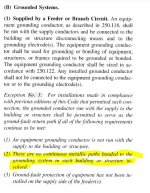
LOL... because my inspector said so... but he also told me #3 cu was good for 165A, RMC 90s were required underground, using the meter base as a raceway was permitted, etc... hence my caveat to "double check that.."

EDIT. I'm pretty sure this is the source of confusion with my inspector on this topic... the vast majority of people reading this will walk away having no clue what they just read...
 

Attachments

  • NEC250.32.JPG
    NEC250.32.JPG
    102.5 KB · Views: 53
Last edited:

wyliesdiesels

Well-known member
Joined
Aug 14, 2012
Messages
20,013
Location
Modesto, CA
If your inspector thinks #3 cu is good for 165a, then he needs to resign and go get a job flipping burgers... smh

BTW that highlighted part of the code is providing an exception allowing a 3-wire feeder with bonded neutral IF there are no parallel metallic pathways between the structures. However, the code changed in 2008 and that exception is no longer allowed. Hence the requirement for a 4-wire feeder regardless of conduit type.

That DOES NOT prohibit the use of metallic conduit for a feeder between buildings.

Your inspector is a *****.
 

sky jumper

Well-known member
Joined
Mar 13, 2018
Messages
127
If your inspector thinks #3 cu is good for 165a, then he needs to resign and go get a job flipping burgers....

at first he said 135. when I questioned him on that he rolled his eyes, got very irritated with me, pulled out his code book and showed me this table and said "its actually 165". at that point I shut up (yes I knew it was the wrong table, and wrong column). oh, he also told me aluminum feeders were not allowed between buildings due to corrosion or something. I had already decided on Cu so I ignored that. on the + side he never bothered to measure my conduit depth and took my word for it. there were 3 spots where it was marginal due to buried drain pipes and the septic pipe. I had no intention of digging under those.
 

Attachments

  • 310.15b17.JPG
    310.15b17.JPG
    111 KB · Views: 40

yeldogt

Well-known member
Joined
Jan 2, 2012
Messages
18,184
It's often easier to go with conduit --- most often you need a riser anyway. I recently ran two oversized conduits ... the trench is not as deep w/ conduit. Easier .... It's done.

The larger conduit allowed for a three way to the outbuilding lights that I only use for safety reasons .... big spot lights.
 
OP
C

cmb816

Member
Joined
Feb 8, 2016
Messages
11
Is there any compelling reason to use Copper vs Al for this 80'+/- run? Al would be 4/4/4/6 wire, I think for Copper 6g would be ok for 60a... but maybe not. If using conduit I guess I can also run individual wires, not sure if they come in Al, but not sure if there is an advantage to that either.

If putting the wire inside conduit, do I still need UF rated cable?

Thanks
 
Last edited:
To avoid these ads, REGISTER NOW!
Top Bottom