To avoid these ads, REGISTER NOW!

Installing Pex for radiant into concrete

bedn0009

Well-known member
Joined
Mar 1, 2014
Messages
309
Location
Hudson, Wisconsin U.S.A.
Good evening,

I am starting a 32 x 28 build in Wisconsin. This garage will have two floors ... with the second initially unfishied as we're not sure what the space will be used for.

I'm insulating underneath and around my slab and footings. The concrete guy mentioned that it might only be a few hundred dollars more for me to run the pex tubing in case I want to do radiant heat in the future.

1. Any thoughts on the expense of this (pex only for now)?
2. Could I run these tubes to heat the upstairs as well? Where are they positioned relative to my flooring?
3. Is the pex stapled directly to the Styrofoam?
4. Can I do this myself, and if so, what size pex, how many zones, and what do I use to attach it with?

Thanks very much for any advice.

JB
 
To avoid these ads, REGISTER NOW!

rburke65

Well-known member
Joined
Nov 10, 2007
Messages
12,349
Location
Canfield, Ohio
You can use the "search" function and search for topics on PEX.....RADIANT HEAT......or maybe STYROFOAM. There is a college degree worth of info on this site on tis very subject. Good luck. Ok.....in a nut shell, from the top.....$1K, yes....on top or on the bottom, yes it can be, yes you can, MAYBE 1/2", at least 2 I would think, staples.
 

kabinenroller

Well-known member
Joined
Sep 14, 2013
Messages
898
Location
S.E. Wisconsin USA
Hello fellow Wisconsinite!
I would definitely install the pex now. It can be purchased on-line relatively cheap, make sure it is oxygen barrier, 1/2" Plan on spacing it about 12"- 15" apart and keep the runs at about 250'
The pex should be attached to the wire mesh with zip ties, but don't pull the ties too tight. When they put the concrete have them pull the mesh up so it does not sit on the bottom of the slab.
Run the pex to a place where the boiler can be installed at a later date. Supply lines should be exit the slab together and the same with the return lines. Use plastic electricial PVC bent in a 90 for each pex line coming out of the slab, this will protect the pex from damage. There is all kinds of info on the web.
Hydronic heat is the best.
Jim


Reflex

Well-known member
Joined
May 19, 2015
Messages
49
Bedn,

You've received some good information here. I thought I'd put in my two cents.

Since you're planning to insulate already, the thought of putting in some radiant tubing is a good idea. You're correct, the tubing itself is relatively inexpensive. The expensive portion of what needs to be done under the slab is the insulation. Most folks back off the radiant idea when they realize how expensive the insulation is.

The tubing can be tied to the rebar/wire or stapled to the foam. There's an argument about where the most efficient place to put the tubing (mid slab, toward the top, on the foam) that is as fierce as the Packers vs. Bears rivalry. In the end, nobody has proven their point as to where the best place to put the tubing is.

In my case I stapled the pex to the foam and placed the rebar on "chairs" above the tubing. My thought was that I didn't want the possibility of a come-along puncturing the tubing during the pour. Having the tubing below the rebar is adds a degree of safety against punctures.

If you're insulating the slab and perimeter anyway, the incremental cost of putting some pex in the slab is minimal. When the job is complete, you can decide if you want to use it, finish the instal at a later date, or never use it.

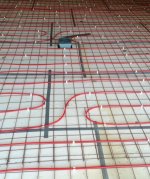
I've attached some pictures of my install below.

Pex1_1.jpg
Above is a picture of the completed layout. The tubing is stapled on 2" foam, joints sealed with duct tape, and stapled every three feet. Although I insulated under the entire floor, many believe that insulating past the first 4' around the edge is not necessary. Note the perimeter insulation as this is a place where many people neglect to insulate.


Pex2.jpg
A close up of the re-bar on top of the tubing. Although the chairs aren't shown in this photo, the rebar is not sitting on top of the tubing. The "jog" in the layout is because a well though out design puts the length of each loop very close to equal in length. This is hard to accomplish without some pre-planning. Many folks end up putting curls, zig-zags, etc. to try and end up with equal loop lengths.


Pex3.jpg
This photo just shows the pour. A couple of notes, the manifolds have pressure gauges on them. The tubing is pressurized during the pour to let us know if there is damage to the tubing (puncture). Also, see that there is conduit to protect the tubing where it exits the slab.

As stated above there is a pronominal amount of information on the Internet as to how to do this. If you'll take a look at the ZurnPex, Uponor, etc. web sites, you'll find their full manuals on radiant. The read is significant, but all the steps are covered in their manuals. Radiat is not hard, making sure you know your heat loss, the design is sound and understanding the flow rates, are the key.

By the way, I used ZurnPex.

Best of luck,

Reflex
 
Last edited:

mygarageone

Well-known member
Joined
Oct 16, 2013
Messages
2,691
Location
Munising , Mich
The only time equal tubing length is necessary is if you have no way to balance flow.
I see you have flow meters and balancing valves , you will be fine .
 

BadgerBoilerMN

Well-known member
Joined
Aug 4, 2011
Messages
837
Location
Minneapolis
Reflex has it right. The PEX position in the slab is of no concern, especially in a commercial type property. Rebar or wire go over the PEX as it is the only place it will work structurally.

Even circuit length though not necessary is very useful since no balancing is necessary if the they are within 20% or so. CAD drawings help with this detail.
 
To avoid these ads, REGISTER NOW!

dlhindiana

Member
Joined
May 10, 2013
Messages
17
Location
Western PA
I bought a product called Quips from Insulation solutions. If you call they will send you out a sample. I attached the pex to wire mesh. They worked really well.pex.jpg
 

Randy in Maine

Well-known member
Joined
Nov 21, 2010
Messages
2,176
Location
The Beach
I bought a product called Quips from Insulation solutions. If you call they will send you out a sample. I attached the pex to wire mesh. They worked really well.pex.jpg

Me too. Worked great and it allowed me to change the layout as I did it. The only way to do it IMO.
 

Crazy68Dart

Well-known member
Joined
Apr 10, 2010
Messages
484
Location
NE Ohio
Was kinda curious what Reflex used... would like to keep the wire mesh up where it will do some good if I can.

Has anyone done two layers of mesh? Lower to attache PEX and then lay another layer on top of PEX? More cost, which isn't cool but....
 

smuth10

Well-known member
Joined
Jun 8, 2014
Messages
91
Location
Troy, mi
I think the idea with the wire mesh is the concrete contractor pulls it up to the middle of the slab as he is pouring. I worry about the relief cuts after they pour the slab tho. What Badger says makes the most sense to me. That and I don' have to worry about them cutting one of my lines.

To answer your original question Crazy68Dart, I have seen a tool that is used to put the clips into the foam. Not sure what it is called and would like to know myself. It is similar to a deck collated screw gun with extension so you don't have to bend over.

Scott
 

kj_mustang

Well-known member
Joined
Feb 9, 2011
Messages
1,213
Location
Harrisonburg, VA
Put the mesh on concrete chairs and you don't have to pull it up. I rolled out one row of wire mesh and ran the pex under that section of mesh in the proper layout, repeat with each row of mesh. Then I wire tied the pex to the mesh after making sure the layout was correct. I then lifted the wire and pex off the foam about 1.5".
 
To avoid these ads, REGISTER NOW!
Top Bottom