To avoid these ads, REGISTER NOW!

Insulated floor?

twinscrewcaddy

Active member
Joined
Apr 24, 2013
Messages
35
Hello all,
First post here!

I am in the early stages of planning where/how big/construction type at my new residence. I will be building a new shop/garage sometime this year. My current (soon to be former) shop is a 30X40 pole building construction. When I build the new place, I would like to make improvements over the old one. My friend built a 40X70 with PEX in floor heating. He has to feed a wood burning boiler half a tree a day it seems... i'm not interested in doing that!

I wondered if simply laying foam board insulation before pouring the concrete floor would make a great improvement in thermal barrier compared to normal no insulation construction concrete floor? Has anyone done this before? Results?

I'm thinking the new shop size will be on the order of 40X60ish and probably two story or loft area...
 
To avoid these ads, REGISTER NOW!

Highbeam

Well-known member
Joined
Feb 15, 2011
Messages
2,292
Location
Mt Rainier foothills, WA
What is your goal? To heat the space? Freeze protection? What temperature? How will you heat it? What is your climate?

Your buddy's choice to use radiant floor heat isn't why he is burning a tree per day. His building loses a certain amount of energy to the outdoors each day and he must replace it to maintain an indoor temperature. He could have poor insulation, he could be wasting wood by making energy in a low efficiency way, or maybe he just likes to burn trees. Radiant floor heat is one of the most efficient ways to deliver heat to your space. Don't blame the radiant heat system.

Putting the pex in the floor is cheap. I can't imagine building a shop of any size in a heating climate without putting in the tubes.

If you plan to heat the shop above 50 with any source of heat then you should insulate under the slab even if you choose to heat with a forced air heater.
 
OP
T

twinscrewcaddy

Active member
Joined
Apr 24, 2013
Messages
35
I'm in central PA. Yes, my friends garage is poorly insulated... he plans to remedy this soon.
My 30x40 has no insulation under concrete and i used a house oil furnace with insulated walls and ceiling. going larger now, i am thinking of better/cheaper ways to heat.

The goal of just insulated floor would be to keep it from being cold during winter months/freeze protection/ heat loss when using a seperate heat source. I would consider a heated floor if the source was not wood. I don't have time to deal with cutting wood! What is the best, most effecient, cheapest way to heat the in-floor system?
Otherwise, forced air would probably be the way to go, either gas or oil... OR maybe both systems. Floor for stable ambient heat, and a small forced air setup to quickly take the chill off if it gets real cold. I will have a paintbooth, paint supplies and other various autobody stuff I need to keep warm and not ignite.
 

matouse3

Well-known member
Joined
Feb 19, 2012
Messages
289
Location
Mid-Michigan
What is the best, most effecient, cheapest way to heat the in-floor system?

Difficult answer for anyone to give you without more information, so I'm not going to touch that one. There are lots of threads on here on the different heat sources and options depending on your foreseen use and such.

But, if you do go ahead and insulate under your new floor, I would definitely run the pex as the insulation is by far the most expensive portion of running the pipe system (I'm not including the heat source at this point). You can always just not use it, but if you do decide one day that you want it, there's no easy way to go back and do over.
 

theoldwizard1

Well-known member
Joined
Feb 22, 2011
Messages
43,216
Location
SE MI
The goal of just insulated floor would be to keep it from being cold during winter months/freeze protection/ heat loss when using a seperate heat source.

Simply insulating the floor with typical "forced air" heating will not save you much (if any) money or provide you with a more comfortable building to work in. The temperature of the ground under the floor more than 5' from the foundation will be a constant 50-60F all year round, with or without insulation.

Forced air does a poor job of heating the slab, so you are not going to lose a lot of heat through the floor.

... going larger now, i am thinking of better/cheaper ways to heat.
I would consider a heated floor if the source was not wood. I don't have time to deal with cutting wood! What is the best, most effecient, cheapest way to heat the in-floor system?

That is tough ! A lot of the answer has to do with how much you want to spend upfront versus long term. Also, does this place need to be "equally" heated (i.e. can it be zoned with at least some kind of wall between areas) ? Also, are you considering A/C ?

If you are not going to do A/C (except for a small office which you could just use a window A/C), then gas fired forced air is probably the cheapest to install. A couple of ceiling mounted units and you are done. Cheap. Probably the least "comfortable" as you will be subject to hot blasts and cold drafts. And a cold floor.

The efficiency in all cases will have to do with the ceiling and wall insulation.

(In) Floor for stable ambient heat, and a small forced air setup to quickly take the chill off if it gets real cold.
Now you are thinking ! Radiant heat has slow recovery, so when you open the garage door in winter, it will take awhile for the place to warm up again.

Think zones ! The least expensive to operate long term is a geothermal heat pump. Bonus is you get A/C for free. Down side is, this is the most expensive to install. With proper design and zoning, you can get both radiant floor heat and forced air. Second cheapest to operate (long term) is probably a regular heat pump. Still not cheap to install, especially if you want it zoned.

If you do install radiant floor heating, insulating the floor is VERY IMPORTANT. 2" minimum, 4" is better. Remembr, "You pay for insulation once, you pay for heating energy every day"

Radiant heat (in floor) big win is comfort.

IMHO, propane and oil should not even be considered.

One down side about heat pumps is that if you loose electricity you will need a fair size generator (> 10kw ?) to run your heat pump or a secondary heat source (many homes with heat pumps have a propane/natural gas "fireplace").
 
Last edited:

GYPSY400

Well-known member
Joined
Mar 21, 2013
Messages
517
Location
Naughton Ontario
But, if you do go ahead and insulate under your new floor, I would definitely run the pex as the insulation is by far the most expensive portion of running the pipe system (I'm not including the heat source at this point). You can always just not use it, but if you do decide one day that you want it, there's no easy way to go back and do over.


I second that thought.. I'm building a garage this year and I'm insulating the floor and running Pex pipe.. Not sure of the heat source yet, but I will have the option.
 

50cal

Well-known member
Joined
Sep 20, 2009
Messages
100
The thing I hardly ever see in these threads is the use of a good vapor barrier under your foam board. It is expensive, you cant expect a 6 mil to perform like a 15 mil. Use it tape the seamsto the point you create resivoir, and watch when they pour it to make sure they dont poke holes in it. You will cure moisture problems. If you later want to coat it the coating will stick. just good future insurance.

http://www.wrmeadows.com/c/construction-products/vapor-barriers/
 

e-tek

Well-known member
Joined
Dec 19, 2007
Messages
10,690
Location
Saskatoon, SK
I think the only time you'd put 15ml poly and foam under a slab would be if you're gonna run the PEX. I live near the North frikken Pole and have forced air heating - which is great in many ways - but the slab is cold in the winter. Of course any rubber or foam mats, or old carpet easily quells the cold.
 

HoosierBuddy

Well-known member
Joined
May 9, 2006
Messages
2,930
Location
Southern Indiana
Quote:
We have to recognize that paying more for quality products made in countries that support the quality of life we want for ourselves and our children, is critical to protecting our own quality of life. .

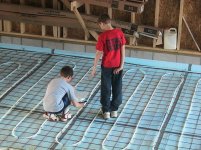
ETek...you probably will HATE the use of child labor depicted in this picture of my foam install in 2006. :lol_hitti


To the original post though...I really think even with forced air that foam under the slab would make the garage easier to heat AND more comfortable to work in. Your comfort level is not just related to the temperature of the air around you. Any warm body loses heat not only through convection but also through radiant heat exchange with other objects around you. If the slab is warmer...you will lose less heat radiantly to it...and your body feels that as "comfort". I haven't explained this as well as others could...but that's the gist of it.

In practical terms, radiant heat (like hydronic heat) should allow for a lower t-stat set point for the same comfort level compared to a forced air system as you have less radiant heat loss from persons in the heated space AND potentially less convective heat loss because of air movement required for forced air.

BTW...The big one is taking his last final today at Purdue where he's a mechanical engineering major. The little one is playing #1 on his highschool golf team and is carrying a 4.0 through his junior year. Teaching kids how to work is a GOOD thing. Forced child labor in a sweatshop...NOT.

Phil
 

Attachments

  • garage75.jpg
    garage75.jpg
    151.1 KB · Views: 57
Last edited:

matouse3

Well-known member
Joined
Feb 19, 2012
Messages
289
Location
Mid-Michigan
The thing I hardly ever see in these threads is the use of a good vapor barrier under your foam board. It is expensive, you cant expect a 6 mil to perform like a 15 mil. Use it tape the seamsto the point you create resivoir, and watch when they pour it to make sure they dont poke holes in it. You will cure moisture problems. If you later want to coat it the coating will stick. just good future insurance.

http://www.wrmeadows.com/c/construction-products/vapor-barriers/

Good point, I think 6ml would be your minimum, but I preferred to do a little more since I was doing the work. The 10ml was going to cost me $200, but I bought the 15ml Stego barrier for $350. A little difficult to track down, but if you contact the company they will find it for you in your area.

http://www.stegoindustries.com/
 
To avoid these ads, REGISTER NOW!

theoldwizard1

Well-known member
Joined
Feb 22, 2011
Messages
43,216
Location
SE MI
The thing I hardly ever see in these threads is the use of a good vapor barrier under your foam board. It is expensive, you cant expect a 6 mil to perform like a 15 mil.

Would a double layer of 2" foam board (4" total) that was taped and theb the second layers joints were staggered and taped be adequate ?
 

theoldwizard1

Well-known member
Joined
Feb 22, 2011
Messages
43,216
Location
SE MI
I googled some stuff and found this solution from this place... anyone ever use this product?
http://www.barnworld.com/livestock-supplies/Radiant_Floor_Heating/

From what I can see there is nothing "special" about that. It is just a pre-packaged "kit" with an electric boiler. You need multiple kits for your size (each kt will handle about 1800 sq ft). And if you read their installation guide (talk about brief !) under floor insulation is mandatory !

You would be better off hiring a heating contractor in your area to design and size your system.

Electric is NOT the cheapest fuel. (Well, maybe in some parts of Canada. Ed, why is it still called "hydro" in Western Canada ? Long way from Niagara !)
 

Highbeam

Well-known member
Joined
Feb 15, 2011
Messages
2,292
Location
Mt Rainier foothills, WA
Electric is NOT the cheapest fuel. (Well, maybe in some parts of Canada. Ed, why is it still called "hydro" in Western Canada ? Long way from Niagara !)

Not so fast wizard. Electric is often the cheapest conventional fuel. It is for me, though our region has lots of hydro and wind.

That was a bizarre statement. There are guys burning waste oil that they got for free, I suppose free is the cheapest but that isn't likely what you had in mind.
 
OP
T

twinscrewcaddy

Active member
Joined
Apr 24, 2013
Messages
35
ya, i have some local contractor researching to do. my previous 30x40 was done ok. but the new one I want a little more bells and whistles.


HoosierBuddy, are your kids for hire?!!
 
Last edited:

theoldwizard1

Well-known member
Joined
Feb 22, 2011
Messages
43,216
Location
SE MI
Not so fast wizard. Electric is often the cheapest conventional fuel. It is for me, though our region has lots of hydro and wind.
Well, I don't want to start a ******* contest, but I will dispute your use of the word "often". In some regions, you are correct.

I did error in making an absolute statement.
 

Coldspot

New member
Joined
Nov 9, 2012
Messages
2
Location
Regina,sask
One more item to consider is the edge of the slab or gradebeam. The edge sees the coldest outside temps so if the slab is heated you have a direct connection to the out doors and concrete is not a great insulator. If you use a grade beam I would insulate both sides.
Gord
 
Last edited:

theoldwizard1

Well-known member
Joined
Feb 22, 2011
Messages
43,216
Location
SE MI
One more item to consider is the edge of the slab or gradebeam. The edge sees the coldest outside temps so if the slab is heated you have a direct connection to the out doors ...

Very true ! You should insulate the inside of the footing down to below the frost line.
 

brewchief

Well-known member
Joined
Sep 20, 2008
Messages
2,370
Location
Michigan
Simply insulating the floor with typical "forced air" heating will not save you much (if any) money or provide you with a more comfortable building to work in. The temperature of the ground under the floor more than 5' from the foundation will be a constant 50-60F all year round, with or without insulation.

We insulated under the slab(and ran pex) of a friends 50x100 building and even just heating it up on occasion with forced air it feels more comfortable then other buildings I've been in, the slab just doesn't seem to **** the heat out as much, your feet don't freeze either.


The slab edge insulation is very important, you can see a big difference in heat loss when you add or subtract it in my load calc program.
 

BadgerBoilerMN

Well-known member
Joined
Aug 4, 2011
Messages
837
Location
Minneapolis
If you need heat, you need insulation. How much depends on the climate and the use of the building. If you radiate the floor you may need slightly more insulation but as suggested the perimeter is where it is most important and frost line is the devil.

Heating a slab is the most economical way to heat any building if comfort is your goal. Any fuel will work but do the math. I use an electric boiler personally but electricity cost my neighbor 3 times as much. For him we installed a condensing boiler since he has natural gas and I have a good electric COOP and no natural gas.

The heat source does not make the load, the building is the thing. Insulation should be specified for your area and the heat source designed to the load.

ACCA Manual 'J'.
 
OP
T

twinscrewcaddy

Active member
Joined
Apr 24, 2013
Messages
35
excellent input again by all.
thanks. I will digest it all and start figuring out what to do.
sounds like i'll be at least, installing insulation AND PEX right off the bat.

I have a lot to think about. I started a build thread in the Gallery... but it's going to be a lengthy process to follow...
 
To avoid these ads, REGISTER NOW!
Top Bottom