To avoid these ads, REGISTER NOW!

Insulating a building within a building (pics)

bradgray

Member
Joined
Mar 30, 2024
Messages
8
Location
St George UT
Greetings all!

Long-time lurker of the forum. Lots of great advice has been given on here and I'm grateful for all those that have shared their experiences over the years.

I've tried without much success to find first-hand experiences from folks who are doing what I am doing, in the area I am doing it. If my hours of digging have missed a relevant thread - please just send me there and I won't burden anyone else to repeat themselves.

However. In the event that my question is unique, below is what I have to work with and my thoughts on the matter.

I live in the banana belt of Southern Utah in a hot, arid climate. For those unfamiliar - think Vegas - which is just slightly over an hour away. Palm trees and cactus here.

I have a 25' x 55' x 10' steel tube building on concrete. I made this decision after getting bids on red iron and c-channel alternatives. I know this structure is less impressive to most on the site - but a few variables steered me back to tube steel and value was certainly a factor.

I got a joke of a bid on 1.5" closed-cell. Little over $10K. That's quite the horse pill if I ever had to swallow one. I've also read some reports of rust and our particular manufacturer does void the warranty for closed cell. I am also the personality that hates permanence if risk exists - I like the idea of being able to fix leaks or damage later if I need to. Needless to summarize, I'm having a hard time being sold on spray foam. So for the sake of my questions here, assume I can't be talked into it.

I am building two large rooms within my shop that occupy over half the sq-footage. These will be fully finished and conditioned spaces - a fitness room and a large recording studio. I have already framed these rooms and they exist entirely independent of the metal structure. Walls and ceilings have no contact with the metal structure around them.

I do not plan to condition the 'shop' portion of the building - my climate is fairly comfortable year-round other than late July when its 117F. In which case I am in the pool and not the shop. I do however plan to order a 200 board-foot DIY spray kit or decent canned-foam kit and seal all the seams of the entire envelope, but beyond this I would like to simply insulate the 2x4 walls of the interior wood structure and be done.

There is plenty of space for R-21 fiberglass batt stapled to the framing. May or may not touch the metal - if it does, just barely. The question I cannot get clarity on is if I am susceptible to a moisture issue. If the only space that is conditioned is within the sealed framed spaces, there should be no differential on any of the metal that exists outside of it, and subsequently no condensation. Am I correct on this or is there a fatal flaw in my logic? If pictures are helpful, I can provide some.

Thanks in advance for entertaining yet another insulation question. I'm sure you tire of them!
 
Last edited:
To avoid these ads, REGISTER NOW!
OP
B

bradgray

Member
Joined
Mar 30, 2024
Messages
8
Location
St George UT
Forgive the bump. I'm seeing posts made only hours ago with 50+ replies. If this has already been covered I would love a link. I have spent actual hours looking for a similar use-case and I truly could not get a clear answer. I am hoping some direct feedback will help me ensure I don't make a foolish mistake.
 
OP
B

bradgray

Member
Joined
Mar 30, 2024
Messages
8
Location
St George UT
Hello everyone. I've resumed work on the shop now that summer temps are below 100F. I came back hoping to find at least one or two replies with some feedback.
I'm admittedly shocked this thread has been sitting here for 6 months without a single reply.

Did I put this in the wrong place?

Did I ask a stupid question? If so, can someone just call me stupid so I can make a better decision?

I'm humbly open to feedback and have relied on this forum for a lot of other decisions so far. I always argue with myself over whether to subscribe or just forum creep. I chose to join hoping this would be a resource now and in the future - I'm feeling like I made a mistake.

If this is unwelcome or unwanted, can someone give me the satisfaction of telling me so?
 

danski0224

Well-known member
Joined
Jan 29, 2005
Messages
13,406
Location
Near Naperville, IL
The DIY foam kits do not have a good success rate. Temperature of the foam chemicals has to be just right, or else it doesn't cure properly. Good luck on even application, too.

You can use attic insulation chutes to keep the fiberglass off of the metal.

You probably need to control indoor humidity to ward off condensation on the steel... just a guess.
 

dcg9381

Well-known member
Joined
Jun 20, 2018
Messages
11,748
Location
Austin, TX
First, often building manufacturers sell insulation packages. Spray foam competes with that profit. Sure, if you get water intrusion an the panels rust, they're going to blame the spray foam. But bottom like is that buildings should not leak and if they do leak, dollars do donuts that's an "installation problem" and the steel won't be warrantied.

A tight foam building can change things for HVAC, especially in moderate climates that do a lot of heating.

I've seen spray foam on all sorts of metal builds, not one problem... Including mine.
Open cell will be cheaper (if you have the space), but $10k for 1000 sqft is high. I'd keep shopping. When buildings get this big you should be able to have a contractor do it for what it would cost to DIY from something like TigerFoam.

Bottom line is you can use whatever you want to insulate this. You could start with foam panels, frame out from those with traditional bat.
Or just treat the "enclosed" portions of the building as heated/cooled space and JUST insulate those...
 

txvwnut

Well-known member
Joined
Jan 1, 2015
Messages
7,619
Location
Bedford, Texas
I had a 15 x 15 office in a metal building that was insulated with regular batt insulation, the building itself was insulated with spray foam.
 

chinboys

Well-known member
Joined
Jun 20, 2011
Messages
434
If you are not going to insulate and stop air leaks in the main building then in time, the inside of the main building will equalize to that of the outdoors less the moisture or water leaks. There will be some form of heat transfer from the main building in or from your room out.

Get a Manual J calculation done for the room based on the type of insulation and its R value to calculate the heat and cooling loads.
Try to stop the air leaks which bring on additional cooling or heating loads.
Add a moisture barrier on the inside walls.
 

jake28

Well-known member
Joined
Aug 28, 2018
Messages
482
Location
SF, CA
I’m not a GC and I don’t play one on TV, but, assuming I’m reading your posts correctly: you’re worried about moisture build up.

My gut reactions:
- you live in a dry place, so the moisture sources are going to be fairly minimal.

- you’ve built already, so see if moisture is a problem during day to day use.

- I’d be more concerned about moisture build up in the conditioned spaces vs. the overall building.

- you could do a tyvek wrap around the inner rooms which is breathable and water resistant for piece of mind.

-managing air flow and adding a a dehumidifier would be easy tools to test with.
 
OP
B

bradgray

Member
Joined
Mar 30, 2024
Messages
8
Location
St George UT
Thank you all!

There are a few too many items to reference in the responses so I will just boil it down quickly to re-iterate.

I'm not doing a DIY spray foam in the strict sense. I only mentioned that product because I considered buying that kit, and spraying only the seams for more effective "sealing" than the canned foam may provide. However I have already made the purchase of a 'professional' gun for the Great Stuff style and all the bottles of foam. The foam is only being used to seal the corners/edges of the metal.

The 2x4 walls stand off of the metal structure. There will be roughly 2.5" between the metal panels and the back of the batt, and about .5" between the batt and the beams. This would theoretically provide air flow around the framed/closed internal envelope.
I had also considered doing blow-in insulation to fill voids and truly separate the two structures thermally, but this would mean insulation does indeed touch the metal - which is where I am unclear if problems arise. The metal will get very hot (its black) but the most dramatic differential will be external temps at night. The building snaps and pops constantly with things as simple as a momentary cloud cover on a warm day.

I have had the building a year and never had a drop of condensation inside the structure. But I have also not yet tried to climatize the structure. It gets very hot inside the building during the day and cools off dramatically at night with our dry air. I figured as long as the conditioned space was self-contained, I would continue to get the same results with the rest of the building that I have now. I perhaps foolishly cannot imagine very much thermal radiance escaping from these rooms.
 
Last edited:
To avoid these ads, REGISTER NOW!

jake28

Well-known member
Joined
Aug 28, 2018
Messages
482
Location
SF, CA
Cheers Brad, you're on the right track. The self-contained units will be a good place to experiment. Luckily, you have a sort of laboratory to experiment in and the raw materials and components like a vapor barrier and dehumidifier are low expense and low commitment. I'm still thinking a vapor barrier like Tyvek that is water-resistant but air permeable would be a good option around the outside of your 2x4 structure.
 
OP
B

bradgray

Member
Joined
Mar 30, 2024
Messages
8
Location
St George UT
Thank you again to all who have taken a moment to give me feedback. I am heavy with a sense of doom and hopeful someone can help me lift it.

I received a MUCH better quote on closed-cell spray foam, was sold hard on their experience of installing on thousands of structures like mine, and excitedly and tentatively set on their schedule for 2 weeks from today (early Jan 2025). That was, until a shoulder angle forcefully reminded me I will hate myself if the roof leaks. That haunt then steered me to the choir singing exposed fastener roofing is a guaranteed failure in a matter of time and requires perpetual nightmare maintenance. There are endless threads on sites everywhere, that poo-poo these roofs and suggest anyone stuck with one should just go jump off it.

I am in too deep. I was not educated enough on metal roofing when we selected our structure type. The shop has trillions of exposed screws. The indoor spaces are built and they are hugely useful, so I do not want to tear them out and make it an expensive shed. I need the structure to be confidently water-tight. I am feeling regret and do not know what to do.

I'll boil it down to 3 main questions:

1) Is adding spray foam direct to these panels really worst case? I've read reports of rust because water cannot escape. But if I live in a very dry climate, is that concern mitigated by even a small amount?
2) Does annual rain type/amount really make much of a difference? We experience monsoonal rain, which comes quick and hard. It's rare to have multiple days with constant rain, which is the rain I perceive as an issue. It does happen once or twice a year, but it's not the norm.
4) If I bit the bullet on a tedious prevention strategy, would sealing every screw with GEOCEL or similar even be worth it, or will that crack and fail faster than the washers on the fasteners?

FWIW; the screws the installers used seem to be of higher quality. I've removed several and the washers are a bit compressed, but did not even begin to show signs of splitting or cracking like the even newer TEK screws I've used on other pergolas etc in my yard. I tried to research the logo on the screw of my shop but couldn't find a match. I've love to learn about the screws used to get any idea of what my future holds. I added some photos of a new screw vs a used/compressed one in case anyone may recognize them and/or can comment on the perceived quality?

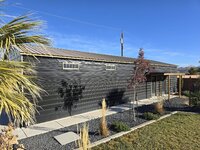
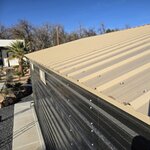
I've also included a handful of photos of the shop this time. I just realized I had never uploaded any!

Thank you again to all who have and may comment. I struggle immensely when I feel backed into a corner without good options.
 

Attachments

  • 20241229_104331.jpg
    20241229_104331.jpg
    1 MB · Views: 25
  • 20241229_104258.jpg
    20241229_104258.jpg
    645.4 KB · Views: 24
  • 20241229_100924.jpg
    20241229_100924.jpg
    658.1 KB · Views: 25
  • 20241229_100408.jpg
    20241229_100408.jpg
    1 MB · Views: 28
  • 20241229_100609.jpg
    20241229_100609.jpg
    972 KB · Views: 27
  • 20241229_100417.jpg
    20241229_100417.jpg
    1.3 MB · Views: 27
  • 20241229_100956.jpg
    20241229_100956.jpg
    709 KB · Views: 24
Last edited:
OP
B

bradgray

Member
Joined
Mar 30, 2024
Messages
8
Location
St George UT
I think something happens with forum-member notification when the moderator has to approve my posts. This forum is generally so helpful. Does anyone have some advice?
I've burned about a week since posting trying to feel comfortable with spray foam, and I'm not sure that I feel it's the right move. But I also have a hard time discounting the advice from the insulation group that our 115F temps simply won't be mitigated by anything else on a black shop.
 

y'sguy

Well-known member
Joined
May 1, 2010
Messages
1,316
Location
Tulsa, Oklahoma
I see your post. And I take an interest in them. But I won't be one of those guys who throw out an idea for something he knows nothing about. Good luck and I hope you can find a decent solution you can share from your experience. It sounds like you'll have to be one of the first to prove it.
 
OP
B

bradgray

Member
Joined
Mar 30, 2024
Messages
8
Location
St George UT
I see your post. And I take an interest in them. But I won't be one of those guys who throw out an idea for something he knows nothing about. Good luck and I hope you can find a decent solution you can share from your experience. It sounds like you'll have to be one of the first to prove it.
I appreciate you taking the time to comment. Perhaps I need to take a moment and read all the posts on this forum again. Maybe someone else has had similar questions answered since I posted last. It just seemed like there were quite a few who had active experience with spray foam and I was curious if those experiences were in fact applicable to our circumstance. As you said, maybe we will just have to test it and see. Still very interested if folks have comments regarding the fasteners.
 

Boogerman

Well-known member
Joined
Jan 28, 2021
Messages
833
Location
aspen cove hill
I'll venture a reply, not an expert on these, but I am very familiar with your climate (lived in Cedar City) and practiced as a facilities engineer when I was there for 5 years.

You have a few things going on.

First, your concern over the fasteners, gaskets and leakage. Yes, those have a finite life. They may crack and leak in a few years. However, as you point out, the rains come fast and infrequent where you are, followed by immediate drying weather. This should minimize leakage. You might look into snow seal type (white elastomeric) coating to cover the roof; this will add a second layer of protection and will also greatly decrease the solar gain by reflecting and insulating from the sun.

Second, your concern over spray foam and water trapping. As discussed above, the leakage/rust will be minimized by the rain pattern where you are. My opinion is that the potential problem will surface in 30 years or more; as the fasteners deteriorate and leak more, it will then occur, if it does. Looking into sealing the screws in 5 years or so, and continuing to inspect them would mitigate that. Or, continually maintained roof coating such as snow seal would mitigate the risk. Lots of metal buildings and trailers sealed with snow seal in your area.

Third, the concerns over condensation. If you don't put a vapor barrier on the outside of your conditioned space, you could get condensation against the back side of the inside wall surface, through the fiberglass batts. However, except for occasional rainstorms, your air is generally dry enough to not be a problem. Putting an air barrier on the outside of the walls so the fiberglass isn't exposed would mitigate much of that, and would also make heating and cooling more efficient. But, bottom line is in your climate, I don't think it will matter much. To finish the walls and make them more useful, sheetrock on the internally exposed surfaces would work great, and tyvek on the back side of the walls adjacent to exterior steel walls would suffice for air barrier.

My recommendation would be to snow seal the roof externally to seal it and cool it, and foam the inside if the cost is reasonable to mitigate the direct sun heat through most of your year. It will make the shop a lot more usable in spring, fall and summer, and will keep it warmer in winter. I'd manage the internal temperature by installing an exhaust fan up high, and a louvered intake down low on the opposite end of the building, and operating it at night when the temperature cools, and closing up in the day time. You can manage a quite decent summer temperature with that strategy. You can automate that by using a differential temperature controller, that automatically controls the fan and louver when the outside temperature falls below the inside temperature.

1736364601790.png
 

rebelranger

Well-known member
Joined
Sep 18, 2012
Messages
188
You are over thinking it because of cost.
1. Do it. Pay the pro and enjoy.
2. I do recommend wrapping house wrap around building before spray foam just in case you have to replace a metal panel. But it's not a issue if you can't, just harder to panel a damaged panel.
3. The metal will rust eventually... around the warranty of the paint. 20 plus years from now.
4. My metal exterior has 2in if closed cell foam in it and no issues here in the midwest with extreme temperature swings between -10 and 107[last year high].
5. The closed cell foam is both moisture and vapor barrier. It won't leak if sprayed right. In fact it'll help keep the metal screws sealed.
 
OP
B

bradgray

Member
Joined
Mar 30, 2024
Messages
8
Location
St George UT
I'll venture a reply, not an expert on these, but I am very familiar with your climate (lived in Cedar City) and practiced as a facilities engineer when I was there for 5 years.

You have a few things going on.

[et al]
This was such a well thought out reply. Thank you for spending the time on it! I appreciate your experience and opinion a great deal!
Spray foam is going in tomorrow. Have to admit - I am quite excited.
You are over thinking it because of cost.
1. Do it. Pay the pro and enjoy.
2. I do recommend wrapping house wrap around building before spray foam just in case you have to replace a metal panel. But it's not a issue if you can't, just harder to panel a damaged panel.
3. The metal will rust eventually... around the warranty of the paint. 20 plus years from now.
4. My metal exterior has 2in if closed cell foam in it and no issues here in the midwest with extreme temperature swings between -10 and 107[last year high].
5. The closed cell foam is both moisture and vapor barrier. It won't leak if sprayed right. In fact it'll help keep the metal screws sealed.
Thank you for reaffirming. I understand perfect solutions do not exist and that metal will rust just as concrete will crack. I was merely hoping that I was choosing the 'best' options available and not bending over to pick up pennies, nor paying for a premium product that would actually cause more harm than good.

On the advice of the insulation crew, I am going with 1.5" closed cell on the whole structure, plus R13 in all interior walls and R19 in interior ceilings for those finished spaces. Tomorrow will be a good day!

I believe this will give me pretty comfortable building.

It will be nice to have the cracking and snapping ease up and all this fine sand from getting everywhere. I FILLED a 16 gallon shop vac with sawdust and sand today in prep for the sprayfoam. easily half of it was sand. It was unreal how much was trapped in the grooves and spread thinly across the floor.
The next tough decision is ductless mini vs residential heat pump. They each have pros and cons, but I'm currently leaning toward ductless mini after chatting with my electrician buddy about amp draws etc. I know a few HVAC guys. Trying to decide if I want to ask them to help me with the line-sets and charges if I just go direct to wholesale for a Gree.
 

rebelranger

Well-known member
Joined
Sep 18, 2012
Messages
188
12k btu senville extreme heats and cools my 30x40x12 shop in all temps -10f to 102. I set at 60 heat and 75 cool year round
 
To avoid these ads, REGISTER NOW!
Top Bottom