To avoid these ads, REGISTER NOW!

Insulating a Garage currently w/o a ceiling

zc15

Well-known member
Joined
Dec 22, 2020
Messages
433
Location
SE Michigan
We have a 720 sqft detached garage that we are planning to install a heater in this year. 3/4 of the walls are insulated, but we will need to insulate the roof/ceiling and remaining wall sections.

Currently the garage has no ceiling, but there are some sheets of plywood lying over the joists providing for some attic storage space. We have various seasonal items stored up there for now, and would like to keep this storage space.

We also have our 5 kayaks/canoes hanging from the joints by straps. Worst case scenario, I think I could rig up some hooks to hang the straps from.


What would be the most budget-friendly way to insulate the ceiling/roof and keep that storage space?

Right now, I'm thinking of attaching drywall to the underside of the joists to create a ceiling, and laying fiberglass batts over the drywall.
 
Last edited:
To avoid these ads, REGISTER NOW!

TractorJeff

Well-known member
Joined
Dec 8, 2013
Messages
3,309
Location
Elkhorn, WI
Right now, I'm thinking of attaching drywall to the underside of the joists to create a ceiling, and laying fiberglass batts over the drywall.

Go for it! You may need to use "strap" material on those 2x6's as it looks wider than 2 feet.
Personally, I put the Insulation up first to create a Vapor Barrier, then Sheetrock.
 

sick467

Well-known member
Joined
Jul 11, 2012
Messages
269
Location
Hughesville, Mo
Drywall is certainly an option, but price out light duty tin (sheet metal siding/roofing). Some stores will carry a lighter and cheaper grade for interior use.

The super cheap way to get through the winter would be temporary plastic sheeting to keep the warm air from moving up to the rafters so quickly. Not really efficient, but cheap, temporary, and better than nothing. I'm not a big fan of drywall, but it is the cheapest, more permanent solution. Just watch your rafter spacing. My old house had 24 inch centers and the drywall ceiling was a "ripple in a pond" when we bought it and had to be redone.

I am a fan of batt insulation compared to the blow-in type. Look into rockwool insulation. It cost more, but has better R value per inch and a much better fire rating.

Your access to the overhead storage space is something to think about too. How do you plan to close the hole so that access is still available?
 

DaveWB

Member
Joined
Feb 23, 2016
Messages
10
You could DIY spray foam over the drywall instead of batt, and then add some blown in cellulose on top. Would give a nice air tight seal and decent R-value. Only downside is it’ll be about $1/sq ft at 1” thickness.
 

theoldwizard1

Well-known member
Joined
Feb 22, 2011
Messages
43,129
Location
SE MI
Right now, I'm thinking of attaching drywall to the underside of the joists to create a ceiling, and laying fiberglass batts over the drywall.

Ceiling insulation is the MOST IMPORTANT part of an insulation job. Living in MI, you should go for 12" of fiberglass even it you don't do the walls.
 

HeavyD1

Active member
Joined
Nov 10, 2014
Messages
25
Location
Michigan
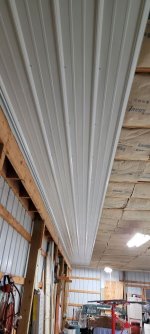
I'm using the interior steel mentioned a few posts up. R38 batts. Slow going, but so far happy with the results.
 

Attachments

  • ceiling.jpg
    ceiling.jpg
    75.5 KB · Views: 202
OP
Z

zc15

Well-known member
Joined
Dec 22, 2020
Messages
433
Location
SE Michigan
Go for it! You may need to use "strap" material on those 2x6's as it looks wider than 2 feet.
Personally, I put the Insulation up first to create a Vapor Barrier, then Sheetrock.

Great idea on the strapping. I had never heard of that before, but it makes a ton of sense!


Drywall is certainly an option, but price out light duty tin (sheet metal siding/roofing). Some stores will carry a lighter and cheaper grade for interior use.

The super cheap way to get through the winter would be temporary plastic sheeting to keep the warm air from moving up to the rafters so quickly. Not really efficient, but cheap, temporary, and better than nothing. I'm not a big fan of drywall, but it is the cheapest, more permanent solution. Just watch your rafter spacing. My old house had 24 inch centers and the drywall ceiling was a "ripple in a pond" when we bought it and had to be redone.

I am a fan of batt insulation compared to the blow-in type. Look into rockwool insulation. It cost more, but has better R value per inch and a much better fire rating.

Your access to the overhead storage space is something to think about too. How do you plan to close the hole so that access is still available?

Can you elaborate on the tin? It seems like a lot more work for not a very big payoff from my quick research

You could DIY spray foam over the drywall instead of batt, and then add some blown in cellulose on top. Would give a nice air tight seal and decent R-value. Only downside is it’ll be about $1/sq ft at 1” thickness.

Thanks for the thought. I'm trying to do this on as much of a budget as I can, so that would definitely raise the overall project cost

Ceiling insulation is the MOST IMPORTANT part of an insulation job. Living in MI, you should go for 12" of fiberglass even it you don't do the walls.

That's what we're doing. I'm thinking R-49
 

cadunkle

Well-known member
Joined
Feb 13, 2011
Messages
472
Location
NJ
Any insulation is better than no insulation, but ceiling gets you the most benefit for the time and money spent. Cheapest would be drywall. Back when I finished my garage drywall and OSB were the same price, I did drywall ceiling and OSB walls. If I had to do it again at those prices I've OSB the ceiling for less finish work, I don't look at my ceiling.

Now drywall is $11 and OSB is $31. I need to finish my shed and prefer OSB for everything for ease of install and finishing. I need 26 sheets and am considering drywall for the ceiling in the shed to save a few bucks. In any event, insulation is expensive these days but if your case I'd staple faced batts between joists and hang drywall for the ceiling and take the time to make it look decent. Since others have mentioned metal paneling for ceiling, I'd compare cost and if you don't mind the look and working with metal go for that if it's appreciably cheaper. It'll save time on finish work.
 

Bert_

Well-known member
Joined
Dec 24, 2016
Messages
9,716
Location
NW Iowa
Tin is a little more up front but it goes up quick, is light weight, can span farther than drywall, is already painted and probably other advantages in not thinking of at the moment.
 

sick467

Well-known member
Joined
Jul 11, 2012
Messages
269
Location
Hughesville, Mo
Tin for me is an aesthetic thing. I just like the looks of it. I believe it to be less work too. No mudding and taping, no painting, BUT it will cost more and it will not have the troubles that a finished drywall job would have. Being in the garage, it might be subjected to temp changes along with humidity changes. Both of these things will cause cracks and possibly sagging. Not to mention any roof leaks as they will ruin the drywall if bad enough. So, the pay off is in the life of the install.
 
OP
Z

zc15

Well-known member
Joined
Dec 22, 2020
Messages
433
Location
SE Michigan
Any insulation is better than no insulation, but ceiling gets you the most benefit for the time and money spent. Cheapest would be drywall. Back when I finished my garage drywall and OSB were the same price, I did drywall ceiling and OSB walls. If I had to do it again at those prices I've OSB the ceiling for less finish work, I don't look at my ceiling.

Now drywall is $11 and OSB is $31. I need to finish my shed and prefer OSB for everything for ease of install and finishing. I need 26 sheets and am considering drywall for the ceiling in the shed to save a few bucks. In any event, insulation is expensive these days but if your case I'd staple faced batts between joists and hang drywall for the ceiling and take the time to make it look decent. Since others have mentioned metal paneling for ceiling, I'd compare cost and if you don't mind the look and working with metal go for that if it's appreciably cheaper. It'll save time on finish work.

I was originally planning OSB until I saw the price. Yikes! I have read that OSB lets moisture pass through it more easily, plus painting it is a chore, so that is why I'm leaning drywall. USG has Mold tough sheetrock for I think $11.50/sheet. In the grand scheme of things, if I'm looking at drywall mud for a few years, I won't really be bothered. My parents' garage is like that, so maybe it would be a little nostagic. The plan is to paint the walls and ceiling to lighten up the garage a bit.


Tin is a little more up front but it goes up quick, is light weight, can span farther than drywall, is already painted and probably other advantages in not thinking of at the moment.

I will have to look more into it I suppose. Do you know of any resources that I can use to educate myself?


Tin for me is an aesthetic thing. I just like the looks of it. I believe it to be less work too. No mudding and taping, no painting, BUT it will cost more and it will not have the troubles that a finished drywall job would have. Being in the garage, it might be subjected to temp changes along with humidity changes. Both of these things will cause cracks and possibly sagging. Not to mention any roof leaks as they will ruin the drywall if bad enough. So, the pay off is in the life of the install.

Can you point me to a better resource to look into tin? I am potentially seeing the benefits outweighing the cost differential
 

sick467

Well-known member
Joined
Jul 11, 2012
Messages
269
Location
Hughesville, Mo
Your local steel roofing/siding supplier would be my first visit. The big box stores will sell tin in typical lengths, but most tin suppliers will sell you the lengths that you need. This avoids end seems in the middle of the ceiling which are not a big deal, but the lack of seems does make the install more "finished" IMO. This also reduces the number of cuts that you would have to make given that you take very good measurements to begin with. This can be tricky as rectangular rooms, for example, are rarely square and one end could be wider/longer than the other. You can take the install to any level you like. The basic is just buying the sheets alone and hanging those by themselves with some creative wood trim work, but you can step it up and get the "J" and/or "F" channels that nicely tie in the edges and give it more of a professional look. These pieces will also hide some poor cuts or shortcomings. I would visit your local sheet supplier and get a quick education on what they offer and pump them for installation tips. Do a web search for "DIY sheet metal ceiling". Plenty of videos on the subject.

A few tips:

I use a circular saw with a rough cut carbide blade turned around backwards (in the saw, not in your hand LOL) and it cuts the panels nicely for straight cuts. A cut-off wheel is used for holes for outlets and ceiling fixtures.

You will probably want to rent/borrow a drywall jack either way you go (drywall or sheet metal). It makes getting the sheets up to the ceiling by yourself soooo much easier than than 3 people could do...hands down. I did my whole 50x50 shop with 12' ceilings by myself using panels up to 19 feet long using the neighbor's jack. Life saver...literally!
 

Firebrick43

Well-known member
Joined
May 12, 2015
Messages
14,017
Location
West central Indiana
Your ceiling joist are not joist, they are rafter ties and should not be used for storage what so ever nor have any weight of a ceiling installed! Especially not drywall

They only thing i would recommend is foil faced polyiso foam (celotex) installed with cap screws and seams taped with foil duct tape. It is much more fire resistant than any other foam and is pretty good if you install 1.5". My father put it in an old pole shed for a shop that was intermitantly heated and even 3/4 thick made a huge difference but he wasn't heating it full time.
 
To avoid these ads, REGISTER NOW!
OP
Z

zc15

Well-known member
Joined
Dec 22, 2020
Messages
433
Location
SE Michigan
Your local steel roofing/siding supplier would be my first visit. The big box stores will sell tin in typical lengths, but most tin suppliers will sell you the lengths that you need. This avoids end seems in the middle of the ceiling which are not a big deal, but the lack of seems does make the install more "finished" IMO. This also reduces the number of cuts that you would have to make given that you take very good measurements to begin with. This can be tricky as rectangular rooms, for example, are rarely square and one end could be wider/longer than the other. You can take the install to any level you like. The basic is just buying the sheets alone and hanging those by themselves with some creative wood trim work, but you can step it up and get the "J" and/or "F" channels that nicely tie in the edges and give it more of a professional look. These pieces will also hide some poor cuts or shortcomings. I would visit your local sheet supplier and get a quick education on what they offer and pump them for installation tips. Do a web search for "DIY sheet metal ceiling". Plenty of videos on the subject.

A few tips:

I use a circular saw with a rough cut carbide blade turned around backwards (in the saw, not in your hand LOL) and it cuts the panels nicely for straight cuts. A cut-off wheel is used for holes for outlets and ceiling fixtures.

You will probably want to rent/borrow a drywall jack either way you go (drywall or sheet metal). It makes getting the sheets up to the ceiling by yourself soooo much easier than than 3 people could do...hands down. I did my whole 50x50 shop with 12' ceilings by myself using panels up to 19 feet long using the neighbor's jack. Life saver...literally!

Thanks, I will definitely reach out to someone local before making any final decisions

Subscribed, as I have the same situation and have been thinking what to do with my garage. Will be interested to hear what comes of this.

Hope you're ok with waiting awhile. I don't see this project starting until August at the earliest.

Your ceiling joist are not joist, they are rafter ties and should not be used for storage what so ever nor have any weight of a ceiling installed! Especially not drywall

They only thing i would recommend is foil faced polyiso foam (celotex) installed with cap screws and seams taped with foil duct tape. It is much more fire resistant than any other foam and is pretty good if you install 1.5". My father put it in an old pole shed for a shop that was intermitantly heated and even 3/4 thick made a huge difference but he wasn't heating it full time.

That's a pretty big claim. Don't fret, all that is up there now are empty cardboard boxes. Can you explain the difference for me please? The first page of Google searching didn't really clarify for me
 

Firebrick43

Well-known member
Joined
May 12, 2015
Messages
14,017
Location
West central Indiana
You have rafters. The bottom boards are known as rafter ties. They keep the down and out force of the roof from spreading the wall out.

Someone has modified things over the years, incorrectly. They doubled up the ties and also attempted to "truss" things. I imagine that it was done as things were sagging or attempted to use as storage. The attempt to make trusses is terrible and will not do anything. Rafter/rafter ties could possibly be converted to trusses with help of an engineer but they will never just be pieces scabbed onto the sides. They have to have either truss nailing plates
Trusses+2+092913.jpg
or correctly sized plywood gussets on both sides with glue and lots of 6 penny nails(like 30 per gusset)View media item 71671
The other option is ceiling joist. How wide is your garage?? I am guessing by the square footage 28x28 feet? or something close?

For no storage you would need 10lbs dead load and 5 lbs live load.
https://www.awc.org/pdf/codes-standards/publications/span-tables/AWC-SpanTables2015-1505.pdf

Page 11 (or 17 of pdf) has the span tables. You would be pretty much limited to 26' span with select grade lumber on 12" centers. You don't have neither the depth, grade, nor spacing.

For light storage with a 30lbs dead load page 4(10 of pdf) you would need 2x12s on 12 inch centers for a max of 26'.

Going further than 26" is going to require and engineered beam, a floor truss of some kind, or a supported header beam in the center of the span to divide it in half.

But don't trust me, get a PE (professional engineer) out and look at your structure. He will make recommendations and provide stamped drawing to make your ceiling structure sound.
 

HeavyD1

Active member
Joined
Nov 10, 2014
Messages
25
Location
Michigan
Regarding a lift, drywall lift is working really well for me. I bought a cheap lift and bolted 16ft 2x4's to it. Lifting 18ft sheets of metal by myself. Holds them up nice and easy to tweak into position. Looked at renting, was way cheaper for me to buy one at the speed I am going and I can probably garage sale the lift when I am done.
 

rsanter

Well-known member
Joined
Dec 22, 2007
Messages
18,505
Location
visalia ca
If it was me I would insulate te underside of the roof deck.
Spray foam is the bast but you can also use rigid foam
 

shalamo

Well-known member
Joined
Nov 11, 2018
Messages
90
Location
Ohio
I’m thinking about doing steel interior in mine also. Are you using a lighter gauge metal than what is used for the exterior? Thanks for any info you can give.
 

mobetta

Well-known member
Joined
Feb 10, 2010
Messages
370
Location
twin cities, mn
Interior steel is referred to as "Liner" around these parts

Thats probably a great option- light weight and prefinished
 

b-boy

Well-known member
Joined
Oct 2, 2013
Messages
2,155
Location
Buffalo NY
Tin for me is an aesthetic thing. I just like the looks of it. I believe it to be less work too. No mudding and taping, no painting, BUT it will cost more and it will not have the troubles that a finished drywall job would have. Being in the garage, it might be subjected to temp changes along with humidity changes. Both of these things will cause cracks and possibly sagging. Not to mention any roof leaks as they will ruin the drywall if bad enough. So, the pay off is in the life of the install.

Nice thing about tin is you can easily pull out a section if needed.

Plus, it looks good, and will last forever.

My rafters are 48" on center. I had no issue putting up tin with that span. I did use strapping across the rafters to support the insulation above it.

I used plain corrugated sheets. Nothing fancy. They were ~$14 for a 2ft x 12ft panel. I also used a drywall lift to hoist them 12ft to the ceiling. Didn't even need a helper.

Very easy to work with. just plan on cutting yourself at least 2 dozen times. :D
 
OP
Z

zc15

Well-known member
Joined
Dec 22, 2020
Messages
433
Location
SE Michigan
Nice thing about tin is you can easily pull out a section if needed.

Plus, it looks good, and will last forever.

My rafters are 48" on center. I had no issue putting up tin with that span. I did use strapping across the rafters to support the insulation above it.

I used plain corrugated sheets. Nothing fancy. They were ~$14 for a 2ft x 12ft panel. I also used a drywall lift to hoist them 12ft to the ceiling. Didn't even need a helper.

Very easy to work with. just plan on cutting yourself at least 2 dozen times. :D

Dumb question, why did you go 12 foot lengths and not full length? I think someone else commented going full length would minimize the number of seams and look better, but I think you method would make for easier removal if needed
 

HeavyD1

Active member
Joined
Nov 10, 2014
Messages
25
Location
Michigan
12ft lengths would be a lot easier to handle. I am putting up (1) 18 and (2) 15.5ft lengths for three pieces in my 50ft (about 48.5ft inside) barn. I thought about two pieces 24.5ft each, but the handling would have been a lot more difficult.
 

jjwithers

Active member
Joined
Nov 18, 2012
Messages
30
I'm going through the exact same project here.

I installed fiberglass insulation in 2/3 of the garage. I can't access the other 1/3 because of stuff in the way preventing a ladder.

'A' frame beams are 24" apart.

Joists/rafters across the garage ceiling are currently 48" apart but I plan to add more in between them to be 24". Then I'll build a storage loft with a plywood floor as my garage ceiling.

I will drywall a visible section of the roof between the loft and the entryway to the house.
I'll never see what's above the rest of the loft unless I'm up there.

I'm trying to figure out what the cheapest and easiest thing will be to cover that insulation with. So far 1/2in 4x8 foam sheets are the cheapest ($8 each), then drywall is a few bucks more per sheet ($12) more and maybe worth it in the long run. Foam I could do myself. Navigating drywall up there seems tricky and needs a lift, or a few guys.
 
Last edited:

jjwithers

Active member
Joined
Nov 18, 2012
Messages
30
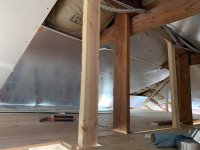
Here is what I have going on. An attic ladder going up to the loft. Drywall plywood floor which acts as a ceiling to the garage. Drywall where it is visible and foam for the rest of the loft to cover the insulation.
 

Attachments

  • IMG_5501.jpg
    IMG_5501.jpg
    136.6 KB · Views: 66
  • IMG_5499.jpg
    IMG_5499.jpg
    136 KB · Views: 70
To avoid these ads, REGISTER NOW!
Top Bottom