To avoid these ads, REGISTER NOW!

Insulating a metal roof

Orionrising

Well-known member
Joined
Nov 16, 2012
Messages
960
Location
Western Maine
I have a garage that has attic trusses, but the metal is installed over purloins with no decking...

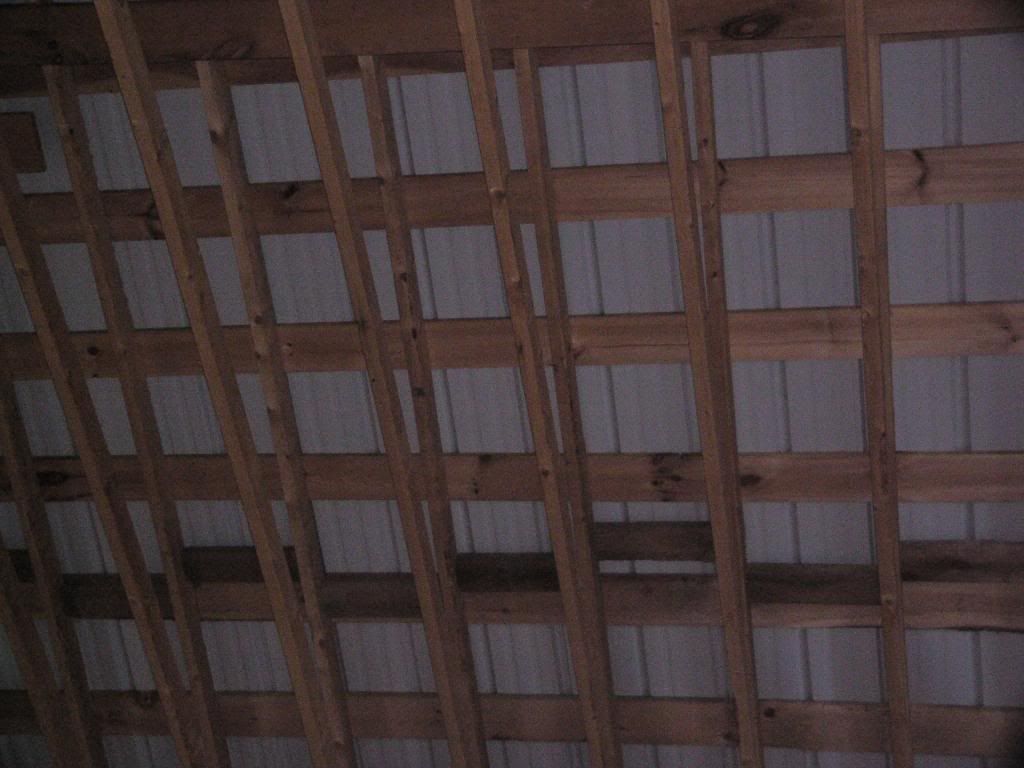

If I just insulate it conventional I forsee huge condensation issues.

I see my options as the following:

Hire someone to strip the roof and have it sheathed, and probably need new metal. (expensive, waste of a good roof)

Have it sprayfoamed (Expensive, which will then require the inside always be conditioned, will make the roof unreplaceable)

Put up tarpaper on the inside of the outer members of the trusses, then try and sheath underneath it which would leave a 3 inch air gap all round (difficult to do but not expensive)

Other ideas?
 
To avoid these ads, REGISTER NOW!

RossABQ

Well-known member
Joined
Jan 5, 2010
Messages
4,140
Location
NM
Where do you live?

Why do you think you need to condition the space if you sprayfoam it?
 
OP
O

Orionrising

Well-known member
Joined
Nov 16, 2012
Messages
960
Location
Western Maine
from what I understand closed cell foam, which would be what is needed to prevent the condensation will form a hugely effective moisture trap for all the rising moisture in a structure.

I could be overestimating though.
 

kj_mustang

Well-known member
Joined
Feb 9, 2011
Messages
1,213
Location
Harrisonburg, VA
Spray foam, if sprayed thick enough, will prevent water vapor from passing through from the outside to the inside. How much water vapor you have inside will depend on how well the rest of the structure is sealed, your local conditions, and any conditioning done. Is the building vented at the soffits or ridge?
 

DEnd

Well-known member
Joined
Oct 25, 2008
Messages
218
Firstly where are you located?

Secondly is the roof vented?

You want to address air leakage, as you have a pre existing building about the easiest way to do this is with spray foam. If you are in a low snow load area you can go directly to the roof deck with the foam if it is closed cell. If you go Open cell then you would need to condition the air most likely (dehumidified air at 50 cfm per 1000 sqft of ceiling area during warm weather). Closed Cell foam does not hold nearly the same amount of water as open cell does, therefore it dries out faster in stagnant air. Open Cell foam is associated with some roofing failures when installed as part of an unvented roof deck. To the best of my knowledge Closed Cell is not when properly installed. The least risky way is to have a vented roof deck, you can buy baffles to keep the insulation off the roof deck or you can make your own, as long as you also install or already have installed the continuous soffit vents and a ridge vent.
 

yeldogt

Well-known member
Joined
Jan 2, 2012
Messages
18,184
You need to do a little research -- look at the roof manufacturers recommendations. Some metal roof specs are very specific. They also are also not vapor tight.

While I love closed cell foam -- I don't think it is wise to foam the underside of the roof. It may damage the panels depending on the thickness of the metal ... and it will be impossible to repair the roof.

You may have to treat this similar to a wood shake roof -- insulating the inner room walls. What is above the room?

If you had a wood deck -- it would be easy.

I think you are going to find that the only way to properly do this is to insulate the inner stud bays.

Close cell foam stops the flow of vapor -- open cell slows it -- the theory is that you need 5" of open to stop vapor flow enough to be on the safe side. I have never used open foam -- and would not use it on a roof.
 
OP
O

Orionrising

Well-known member
Joined
Nov 16, 2012
Messages
960
Location
Western Maine
It is a garage attic truss looking to insulate and use as a seasonally conditioned space. Roof manufacturer is unkown. I could certainly do a double layer of roxul or fiberglass on the ineterior members. I may also be able to put rigid foam on the inside of the outer truss members but the taping would be on the wrong side.

High snowload area in maine but unheated or insulated metal roof sheds all snow

Sent from my LG-L38C using Tapatalk 2
 

ctgoodman

Well-known member
Joined
Mar 1, 2010
Messages
315
Location
Salisbury, NC
We have a very similar space. Finished room over garage. We have a knee wall that is insulated conventionally with roll insulation. Then the area that angles up with the outside roof has a durovent product installed creating an air channel between the insulation and the metal. We've been there three years. I have a couple of places where I can access these areas behind the knee wall and I've checked several times in every season and so far it's always been bone dry. We live in Central NC. The contractor that placed our metal roof says the biggest key with metal roofs are they need to breath. So with continuous ridge vent and continous soffit vent I can say that I've never encountered any condensation on the inside metal even when there is noticeable condensation on the outside. Ours is also just metal over purlins.

The durovent product
http://www.lowes.com/pd_135598-7522...ue&Ns=p_product_qty_sales_dollar|1&facetInfo=
 
Last edited:

Rookie2

Well-known member
Joined
Feb 27, 2013
Messages
1,925
Location
Western Pa.
I have a similar garage. The morning sun on the eastern facing side causes it to ' rain ' inside from condensation collecting at the roof. If i have the garage door open on a cool morning , look out !
 

yeldogt

Well-known member
Joined
Jan 2, 2012
Messages
18,184
I don't think you can do it watch batts alone - you have to have something to isolate the roof or any moisture is going to drip on the insulation.

I wonder if you can use foam panels on the roof rafters sealing the roof and then batts on the inside truss. You are creating an insulated box within an insulated box.


My metal roof is on top of plywood sheathing siting on internal battens.
 

yeldogt

Well-known member
Joined
Jan 2, 2012
Messages
18,184
When they insulate the roof rafters -- you want to have a complete vapor barrier .. and create enough R value in the whole structure to be lower then the dew point.

If you don't you will get condensation on the underside of the roof
 
OP
O

Orionrising

Well-known member
Joined
Nov 16, 2012
Messages
960
Location
Western Maine
Well it's 3 years later and now I am back to this question... My best though it radiant barrier on the inside of the outer roof truss member then dense pack cellulose about a foot thick to inside truss members with a small knee wall at the bottom to maintain thickness.

Sent from my Moto G (4) using Tapatalk
 

Randy in Maine

Well-known member
Joined
Nov 21, 2010
Messages
2,176
Location
The Beach
Warm most air condenses on cold things. 3 or 4 inches of closed cell foam would not allow that to happen on the metal roofing as well as it sealing up any air infiltration. It will also be the vapor barrier.

Do not over think this.

Spray it (or better yet hire a pro to do it) and move on.
 

toyotadriver

Well-known member
Joined
Dec 30, 2010
Messages
1,586
Put the thickest rigid foam you can afford between the rafters and nail it to the purlins with cap nails. I wouldn't do less than 2 inches XPS. Seal up any gaps with spray foam in a can....Or even better get those two part foam kits and just spray a thin layer on all gaps and edges. Then fill the cavities with fiberglass batts or even better, damp spray or BIB system cellulose. Cover with drywall and be done with it.

Alternatively you could install sheet foam on the underside of the rafters, put more purlins on the inside over the foam, put 1.5 inch foam sheets between the purlins, put another layer of something like 1/2 inch foam sheets, then cover that with drywall screwed through the 1/2 foam. That means the seams will be staggered and prevent warm moist air from getting through to the metal. Make sure the metal has vent channels to vent the underside.
 
Last edited:

mrpizza

Well-known member
Joined
Nov 1, 2011
Messages
2,935
Location
IL
I vote spray foam, closed cell. Best bang for your buck, no worries about condensation.
 

Firebrick43

Well-known member
Joined
May 12, 2015
Messages
14,009
Location
West central Indiana
Why not staple Tar paper to the outside of OSB first then screw the OSB (tar paper towards metal) to the underside of the purlins. If multiple pieces leave tar paper over hang the OSB at the bottom. Hang the first part at the top and work down to maintain proper overlap of the building paper. The you can do what ever you want below as far as insulation.

If you want to be really **** apply two or three good beads of silicone caulk to the bottom of each purlin in the slope direction. Let these dry well before placing the OSB/building paper pieces up. This will provide a nice drain channel for any condensation running down the tar paper so it doesn't set against the purlin edge. Just don't go crazy with the screws.
 
To avoid these ads, REGISTER NOW!
OP
O

Orionrising

Well-known member
Joined
Nov 16, 2012
Messages
960
Location
Western Maine
I would have to form a 2ndary stud wall inside the inner truss members to get any kind of sheetgood on the outer members. No space to get it in between 16 oc trusses. I am hesitant to spray the roof directly as it would glue the metal on and prevent any future repairs to it from say hail.

Sent from my Moto G (4) using Tapatalk
 

alanbillips

Member
Joined
Jun 10, 2015
Messages
14
Mine had a ridge vent and soffits on the sides.
I added the breathable foam at the vent to seal out any wind driving rain up and over.
Added continuous baffles from the soffit to the ridge vent to allow air flow.
Then used R30 batts unfaced. Made vapor barrier with plastic.
 

toyotadriver

Well-known member
Joined
Dec 30, 2010
Messages
1,586
I would have to form a 2ndary stud wall inside the inner truss members to get any kind of sheetgood on the outer members. No space to get it in between 16 oc trusses. I am hesitant to spray the roof directly as it would glue the metal on and prevent any future repairs to it from say hail.

Sent from my Moto G (4) using Tapatalk


Not sure what you are saying there because you can cut sheet foam to fit between the rafters.
 

Franz1.0©

Banned
Joined
Feb 8, 2017
Messages
134
Lets begin by defining what you're trying to accomplish.

If your end goal is to eliminate condensation on the inside of the steel, that's fairly easy to do.

If you have a dirt floor below it becomes slightly more difficult.

If you want to create a climate controlled living space it becomes a different set of goals to accomplish.
 
OP
O

Orionrising

Well-known member
Joined
Nov 16, 2012
Messages
960
Location
Western Maine
I want a heatable attic workshop, probably not cooled, and definitely not constantly climate controlled. This is a heating dominated climate generally with low humidy in those heating period. The garage below will have its ceiling insulated (floor of shop), but the garage will not usually be heated. There is moisture in the garage in the winter from snowy wet cars, and it does not appear there is a vapor barrier under the slab

I lean away from spray foam or foam panels, because of the cost, and my understanding of it is I will need either powered ventilation or climate control in the 3 seasons I would not be heating, which i would prefer to just leave some windows cracked. It is my understanding that from airflow I am likely to get condensation on the underside of the roof metal which will drip into and soak conventional bat insulation as there is no roof deck for it to land on.

My though on tar papering the inside of the outer truss members is it will keep drips of condensation out of dense pack cellulose, keep it into truss cavity and leave me a traditional 3.5 in airflow gap under the roofing to the continuous eve vent, and I assume there is a gable vent at the peak.
 

rebelranger

Well-known member
Joined
Sep 18, 2012
Messages
188
I'm going to be blunt, you must a. Spray foam to get above dew point, typically 3inches close cell or 6inches open cell based on your area; b. Remove the metal roof and install 1.5inches min xps rigid insulation then reinstall metal; or c. Remove metal install wood sheathing and insulate conventional.

If you have leaky building then no mechanical ventilation if tight then must install mechanical ventilation.

No other "proper" way to do it.
 

73RR

Blank Email
Joined
Dec 13, 2016
Messages
300
Location
Central Ory-Gun
Just how often do you find yourself replacing roof panels because of hail damage? Generally, hail does not penetrate 29g steel ......
If you are truly concerned about foam on the tin then you can cut pieces of 'x' and glue/tape/staple to shield the metal surface....but only the metal.
Spray foam may seem expensive at first but it does the absolute best job of sealing the structure from air infiltration, which is the source of the moisture you want to eliminate.
With a proper spray foamed roof and walls you can eliminate the vents and have a giant picnic cooler. Easy to heat, easy to cool.
 

Franz1.0©

Banned
Joined
Feb 8, 2017
Messages
134
I'd go with fitting ½" foam board, preferably foil faced to the inside of the 2x4 member of the truss, preferably leaving a 1" opening at the bottom and definitely creating a plenum chamber at the peak so the whole roof structure can be power vented with a 5" computer fan exhausting to the outside.

That will provide sufficient air movement to minimize the roof steel from being a plate condenser for the water you're hauling into the envelope on vehicles. Using foil faced provides reflection of the short wave infrared being reradiated from the inside of the roof steel which is a considerable heat gain in Summer. In Winter, when you are heating, you can depower the fan, and the space between steel and foam board has insulation value.

You can generally find recycled foam board on Craigslist at around half of new price.
 

toyotadriver

Well-known member
Joined
Dec 30, 2010
Messages
1,586
If you seal the inside well enough with rigid foam moisture from the inside won't be able to condense on your metal. What I'm recommending will work if done carefully but it won't be cheap.....Then again, neither will spray foam.

What you need to do is gonna cost some money.....no way around that.
 

Randy in Maine

Well-known member
Joined
Nov 21, 2010
Messages
2,176
Location
The Beach
I recently turned my attached one car garage into a heated stained class studio for my wife using 4" rigid foam + 1 1/2" foam on top of it (for the 2x6 ceiling) and 2" + 1 1/2" (for the 2x4 walls). I cut the 4x8 sheets of foam to fit on my table saw and spray foamed around them to try and save some money. It worked OK but that was the worst stuff I have ever cut on my table saw. I will never do that again. I thought it was going to kill and blind me even with a full respirator and eye protection.l

It would have been cheaper and a lot faster to just have the spray foam guy do the high density foam. Plus it seals up any air leakage. The spray foam also works as the vapor barrier.

If you were going to cook or shower in this room you might need some sort of power vent or an air to air heat exchanger I suppose. My room has some windows that I open if needed. Never an issue.
 
Last edited:

toyotadriver

Well-known member
Joined
Dec 30, 2010
Messages
1,586
Also, keep a humidity meter in the room. If the humidity gets above 50% run a dehumidifier. Gotta keep the moisture level down inside if you want to avoid condensation.
 
Last edited:

73RR

Blank Email
Joined
Dec 13, 2016
Messages
300
Location
Central Ory-Gun
the whole roof structure can be power vented with a 5" computer fan exhausting to the outside.

...really...????? That I gotta see.
 

Franz1.0©

Banned
Joined
Feb 8, 2017
Messages
134
Yeah, considering that size fan only pushes about 50 cfm.

Only been doing it for 30 years now, feel free to call for an appointment to stop by for a class in ventilation when it warms up.

Using your figure of 50cfm on the fan, the roof of my small 24 x 24 barn does a complete air change every 7 minutes.
Ain't rocket proctology boys.
 

kj_mustang

Well-known member
Joined
Feb 9, 2011
Messages
1,213
Location
Harrisonburg, VA
he is talking about the area between insulation and roof deck, not the volume of the attic.

I assumed that was what he was referring to but wanted to clarify that. In theory it should work, but I would not want to rely on a computer case fan for that job. Such a small volume fan over a very spread out area and those fans like everything else can vary wildly in quality. I have replaced quite a few of them. I would not rely on one to last in a hot attic space very long.
 
To avoid these ads, REGISTER NOW!
Top Bottom