To avoid these ads, REGISTER NOW!

Insulating a Shop

sign216

Well-known member
Joined
Feb 24, 2017
Messages
60
Location
Taunton, Massachusetts
Is my process reasonable?

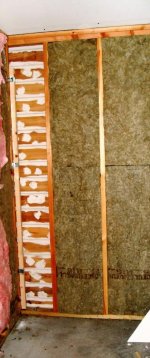
I'm insulating a garage, then adding drywall, to make it into a more livable shop for engine repair, etc. The shell is grooved cedar siding over a cement floor. I'm adding insulation (rock wool) and then drywall over it. Not going to finish it beyond that.

This is New England, and the shop will be occasionally partially heated in the winter, when I'm in it.

Here's a picture.
 

Attachments

  • SDC15621a.jpg
    SDC15621a.jpg
    76.1 KB · Views: 205
To avoid these ads, REGISTER NOW!

stm317

Well-known member
Joined
Aug 8, 2017
Messages
1,339
I don't see anything to keep moisture from getting into the insulation. Most buildings need a moisture barrier such as Tyvek, Typar, Housewrap, etc between the siding material and the insulation. This will keep most of the moisture that's outside the building from getting into your wall cavity, while still being permeable enough to let any moisture that is in the wall to exit to the outside.
You'll also want to install a vapor barrier between your Sheetrock and the insulation. This is an impermeable layer that keeps any moisture vapor from passing between the wall cavity and your conditioned space.
 
OP
S

sign216

Well-known member
Joined
Feb 24, 2017
Messages
60
Location
Taunton, Massachusetts
Stm317, I am worried about moisture getting through to the insulation. Should I put up house wrap between the studs?

Optimally it would have been done on initial construction, but this is what I'm working with now.
Joe
 

428PI

Well-known member
Joined
Jul 14, 2018
Messages
1,976
Location
Peabody, KS
I don't think drywall is what you want if you don't ac and heat the space all the time. It will crack at the seams.
 

matt_i

Well-known member
Joined
Mar 14, 2008
Messages
10,728
Location
SE Michigan
Ideally, the best practice is to seal each stud bay as much as possible so inside it contains "still air" that doesn't convect.

But, you'd have to do a major change to do that. I think I'm seeing that the siding was individually edge-painted before it was put on, which is good work in my opinion.

I think your choice of Roxul (etc) is excellent if there are concerns of moisture, it won't harbor organic growth like fiberglass could in the same conditions.

Just thought I'd also mention that NOW is the time to add any and all in-wall electrical...future-proof as much as you can.
 
OP
S

sign216

Well-known member
Joined
Feb 24, 2017
Messages
60
Location
Taunton, Massachusetts
Ideally, the best practice is to seal each stud bay as much as possible so inside it contains "still air" that doesn't convect.

But, you'd have to do a major change to do that. I think I'm seeing that the siding was individually edge-painted before it was put on, which is good work in my opinion.

I think your choice of Roxul (etc) is excellent if there are concerns of moisture, it won't harbor organic growth like fiberglass could in the same conditions.

Just thought I'd also mention that NOW is the time to add any and all in-wall electrical...future-proof as much as you can.


It wasn't edge-painted. I did that from the inside as extra waterproofing. There was slight water entry at some seams and knots. Thanks for the thumbs-up on Roxul, and the electrical work is done.

So...should I put house wrap on each individual stud bay, from the inside? As irksome as that would be, it appears to be the best step if I'm going to insulate. Am I missing an easier or more productive approach? Or should I just go w the insulation against the boards?
 

matt_i

Well-known member
Joined
Mar 14, 2008
Messages
10,728
Location
SE Michigan
I wouldn't do the interior housewrap, at first it seems directionally correct to protect the insulation in the cavity. But its my opinion that due to the path of easy vertical runoff, any leaks would concentrate at the bottom of the cavity and potentially cause problems with the siding or even the drywall itself.

Just going as-is, little leaks would get a small area wet, but then it would dry back out. Unless it was a gross leak it would probably just stay local and not migrate all the way to the bottom.

I would even do some caulking, flexible clear stuff, if you had certain areas that had evidence of higher water intrusion, maybe one side of the building gets more wind-driven rain than the others.
 

Kaizen

Well-known member
Joined
Jan 9, 2015
Messages
6,948
Location
New England
I’d use plastic over the whole wall before applying drywall. When you do heat it most likely it will be with propane? That dumps a lot of moisture into the building. Any moisture in the other side of the plastic will air dry eventually. Jmo.
Where the building is not conditioned a lot probably won’t be an issue either way.


Sent from my iPhone using Tapatalk
 
To avoid these ads, REGISTER NOW!
OP
S

sign216

Well-known member
Joined
Feb 24, 2017
Messages
60
Location
Taunton, Massachusetts
Kaizen, it won't be fully heated. Just +20 deg over the ambient temp, with an electric heater. I don't understand it when you say "Plastic over the whole wall." Do you mean on top of the insulation?

Matt, I'm liking your idea of not adding any wrap. Mainly because the insulation is already in place, and I'm not eager to take it off for a nebulous gain. But am I just being lazy?
There aren't any areas of great water intrusion, and it's likely that the rock wool could handle it.

Joe
 

Kaizen

Well-known member
Joined
Jan 9, 2015
Messages
6,948
Location
New England
Vapor barrier stapled to the interior edge of the studs. Six mil. As little seams as you can have. Tape the seams. Drywall lays on top of it.
More for if you want to condition it in the future. Cheap money now. Keeps the drywall from getting mold.


Sent from my iPhone using Tapatalk
 
OP
S

sign216

Well-known member
Joined
Feb 24, 2017
Messages
60
Location
Taunton, Massachusetts
I wouldn't do the interior housewrap, at first it seems directionally correct to protect the insulation in the cavity. But its my opinion that due to the path of easy vertical runoff, any leaks would concentrate at the bottom of the cavity and potentially cause problems with the siding or even the drywall itself.

Just going as-is, little leaks would get a small area wet, but then it would dry back out. Unless it was a gross leak it would probably just stay local and not migrate all the way to the bottom.

I would even do some caulking, flexible clear stuff, if you had certain areas that had evidence of higher water intrusion, maybe one side of the building gets more wind-driven rain than the others.


I am leaning to following this idea. No wrap, and let the little leaks that get to the rock wool dry out. If a gross leak develops (hasn't happened yet) then the wrapping the individual stub bays is moot. Then the water would pool at the foot for the same problem.

Joe
 

Joe_K

Well-known member
Joined
Jan 12, 2018
Messages
202
Rockwool is exactly what I'm going to use. Pull up youtube and watch videos of water running right off of it. It's also fire resistant up to 2000F. I'm not going to use Tyvek on the exterior side of mine, but I will use a 6mil vapor barrier underneath the wall covering.
 

Kaizen

Well-known member
Joined
Jan 9, 2015
Messages
6,948
Location
New England
Kaizen, okay for vapor barrier, but you abandoning the idea of house wrap on between the insulation and the exterior clap boards?

Joe


Unless you are stripping the exterior there isn’t a way to do it. Stapling on the inside in each bay is useless. Situations where this happens people spray a one inch foam envelope. Not for a little heated garage.


Sent from my iPhone using Tapatalk
 

myredracer

Well-known member
Joined
Nov 1, 2015
Messages
557
Location
Langley, BC
What is the white stuff in the left stud space? Horizontal siding planks? If so, no exterior sheathing? Is that a single floor-ceiling stud in the corner?

Is this a free-standing or attached structure? Being built to code? If a fire rating is required, you may need a certain type/thickness of drywall and joints to be mudded.

No rain screen requirement? Tyvek or equiv. installed from the interior side would not do much, if anything.

Def. should have a vapor barrier/retarder on the interior side of the walls & ceiling if insulated. Even a slight amount of moisture in insulation will reduce it's R-value significantly.

Not saying you are, but trying to cut corners, cheap out and/or not getting a permit is asking for problems as is not doing your research to understand building code requirements and general construction procedures.
 
Last edited:
OP
S

sign216

Well-known member
Joined
Feb 24, 2017
Messages
60
Location
Taunton, Massachusetts
Joe K - I am with 100% on the rock wool. Totally worth whatever the extra money is.

Kaizen - Relax, this is an informational forum. No need to get directive.

Racer - This is built to code. But...this is a small town and "code" is subjective. I want a sound, study structure. That's it.

Joe
 
To avoid these ads, REGISTER NOW!
Top Bottom