To avoid these ads, REGISTER NOW!

Insulating and vapor barriers.

Allanz

Member
Joined
Nov 9, 2023
Messages
9
HI, New to the forms, and GJ. Just had a 24x30 post frame garage built, and want to insulate it. I had a rep from Retrofom give me a cost for spray foam, and recommended 6 inches of closed cell foam on the ceiling against the roof panels. There was a bubble wrap placed under the metal roof sheeting. There is a ridge vent and soffit vents. I wanted to cover the ceiling with metal sheeting, because the trusses were not designed for much load on the bottom cords.
So would the spray foam be worth putting on the roof sheeting? The rep was telling me that 6 inches of open cell foam would have an r value of around 20. What good would that R value be if the attic space is vented? Instead of spray foam I thought about blown in cellulose. If I went with blown in cellulose. Should I have a vapor barrier between my steel ceiling sheeting and the cellulose?
Im framing 2x6 walls, and plan on using 6 inches of unfaced fiberglass, then a plastic vapor barrier between the fiberglass and finished OSB wall. Would this approach be right? I live in western Pa.
 
To avoid these ads, REGISTER NOW!

Fav Onefour

Well-known member
Joined
Jul 14, 2022
Messages
709
Location
MN cold and hot
You would be throwing away money by doing the roof. I'd quit talking to that guy. He's way to willing to take your money for little return on your investment. His R value numbers don't mean squat when talking building values.
I'm a little confused about whether you are talking open or closed cell? Either way, it's a poor investment on the backside of a roof especially over bubble wrap. Let your current venting do what it should and vent the attic.

You are on the right track with your own thinking. Insulating the ceiling is a better idea for building envelope. The vapor barrier with steel is tricky. You should have one. Just take it easy if you do plastic and tape any holes.
Another option if you were already thinking closed cell foam. You could put up steel ceiling and foam the topside with a couple inches to get your vapor barrier. You could add the cellulose on top of the foam. Your garage would be well insulated if you combine that with your wall proposal.
 
OP
A

Allanz

Member
Joined
Nov 9, 2023
Messages
9
Thanks for replying. Yes the Retrofoam rep recommended 6 inches of open cell foam. She said it would be equivalent to 3 inches of closed cell, as far as R value. My thought was the same. What good is the the insulating factor on the roof line if the attic space is ventilated. the cost I got for open cell foam was $3.41 per sq ft. The closed cell cost was $.77 per sq ft. As you mentioned I think if Im getting foam it would be best to have it applied to the top of the steel ceiling sheeting. Then add insulation on to that. The cost of spray foam is pricy, not sure if I want to go that route if I can make something else work.
 

racecougar

Well-known member
Joined
Jan 26, 2021
Messages
5,136
Location
Missouri
You're already set up for a ventilated attic; I'd put up vapor barrier, put up your liner panel, and blow cellulose or fiberglass on top.

Did that foam rep even discuss the fact that the ridge and soffit were vented?
 
OP
A

Allanz

Member
Joined
Nov 9, 2023
Messages
9
No she didn't. I even told her the attic space would be vented, and she said nothing about that. She didn't have any reply regarding the space vented. I didn't think at the time to ask her about the foam on the roof panels with a vented attic space. I was mostly in sticker shock at the cost of it.
 

CraigStu

Well-known member
Joined
May 22, 2014
Messages
4,037
Location
Blacksburg, Va
I agree move on to someone else or do it yourself. Seems to me there are 2 theories of general design. One has the attic vented w/ inlet at the soffits and outlet at a ridge vent or similar. In this case you insulate the attic floor as well as possible. The other method is include the attic in the conditioned space. Here the attic is not vented and you insulate under the roof as well as possible. When you told her the attic will be vented, and she didn't change her recommendation or even acknowledge your info, that is the clue to move on.
 
OP
A

Allanz

Member
Joined
Nov 9, 2023
Messages
9
Thanks guys, and I have decided to tell them I'm not interested. Going to get pricing for blown in fiberglass or cellulose.
 

Firebrick43

Well-known member
Joined
May 12, 2015
Messages
14,096
Location
West central Indiana
Thanks guys, and I have decided to tell them I'm not interested. Going to get pricing for blown in fiberglass or cellulose.
Cellulose is a much better product than blown fiberglass. It resist forming convection currents at high temp differentials that fiber glass does.

R value test were implemented by the fiberglass industry to specifically hide this as they have air barriers which stop convection current from forming so it’s only useful for showing purely conduction insulation values.

Oakridge labs did a study that showed if tested as a ceiling/roof assembly in a large chamber that blown fiberglass significant amount of its r value at differentials of 32 degrees and above

Many of the fiberglass companies say they have fixed the problem but it’s not hard to see that fiberglass allows airflow thru the product and other kinds do not.

Cellulose offers much better fire protection as well

Also blown cellulose can be a very easy DIY project with the right blower that is free to use with many lumber yards. Although still check as many time insulation supply houses have installation crew that can match DIY insulation as long as the prep work is done.
 

billconner

Well-known member
Joined
Jul 20, 2021
Messages
6,970
Location
Thousand Islands NYS
I agree with firebricks recommendation for cellulose. FWIW, I just had it installed - 22x24 20" - $1108 or about $2.10 SF. I priced the material and free loaner machine at Lowe's - over $900. Just one of those times it was worth it to me to hire it,vans have it done in a few hours rather than me and brother in law taking a day or more, and many trips.

I don't know how less thickness would affect price. You probably don't need 20" - and probably can't get it all the way to wall sheathing.
 

racecougar

Well-known member
Joined
Jan 26, 2021
Messages
5,136
Location
Missouri
I went with 16"+ of blown fiberglass in my 30'x60' back in early 2019. I was hopeful that I'd be able to have it done at a reasonable price, and I even obtained 7 quotes. The cheapest quote was $2800 plus tax. I was able to do it myself for less than half of that. It really wasn't that big of a deal, just suit up, ******** a headlamp, and wear a respirator. From what I recall, it only took about four hours using the free rental machine from Home Depot.
 
OP
A

Allanz

Member
Joined
Nov 9, 2023
Messages
9
After seeing the price of foam, I'm leaning toward cellulose. Someone is to stop and give me a price for cellulose soon. I first need to frame the walls and get my wiring done, and metal sheeting up on the ceiling. With cellulose would, or should I have a vapor barrier under it with the vented attic space? I have heard both yes and no.
 

cfk

Well-known member
Joined
Jun 28, 2021
Messages
67
Location
Iowa
My shop has a metal ceiling, vapor barrier between it and the insulation, and then 16" fiberglass insulation blown in on top of it. I asked the lumberyard about cellulose and they told me that they usually do fiberglass in shops. I assume its because of the weight? I know the deadload rating on my bottom truss chord is 5#/sqft, and the ceiling metal and fiberglass insulation weighs 3#/sqft.
 
OP
A

Allanz

Member
Joined
Nov 9, 2023
Messages
9
My shop has a metal ceiling, vapor barrier between it and the insulation, and then 16" fiberglass insulation blown in on top of it. I asked the lumberyard about cellulose and they told me that they usually do fiberglass in shops. I assume its because of the weight? I know the deadload rating on my bottom truss chord is 5#/sqft, and the ceiling metal and fiberglass insulation weighs 3#/sqft.
I didn't think about the weight of cellulose. The bottom cords on my trusses are not rated for load either. Its the reason I'm putting sheet metal up instead of any kind of wallboard. Thanks for mentioning that.
 

Firebrick43

Well-known member
Joined
May 12, 2015
Messages
14,096
Location
West central Indiana
My shop has a metal ceiling, vapor barrier between it and the insulation, and then 16" fiberglass insulation blown in on top of it. I asked the lumberyard about cellulose and they told me that they usually do fiberglass in shops. I assume its because of the weight? I know the deadload rating on my bottom truss chord is 5#/sqft, and the ceiling metal and fiberglass insulation weighs 3#/sqft.
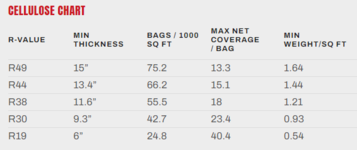
Cellulose is a whole 0.8 lbs more a square foot at R38 than fiberglass.

Still well within the 5#
 
  • Like
Reactions: cfk

racecougar

Well-known member
Joined
Jan 26, 2021
Messages
5,136
Location
Missouri
That increased weight matters more and more as you increase the desired R-value. It may not matter if you only want R-38 in your attic. 29ga R-panel/liner panel supported at 48" actually sags a tiny bit with 18"-20" of blown fiberglass on top (~R-55), which is less than the weight of cellulose at just R-30.


1699882552410.png
1699882567972.png
 
To avoid these ads, REGISTER NOW!

Firebrick43

Well-known member
Joined
May 12, 2015
Messages
14,096
Location
West central Indiana
That increased weight matters more and more as you increase the desired R-value. It may not matter if you only want R-38 in your attic. 29ga R-panel/liner panel supported at 48" actually sags a tiny bit with 18"-20" of blown fiberglass on top (~R-55), which is less than the weight of cellulose at just R-30.


1699882552410.png
1699882567972.png
But if blown fiberglass losses 50% of its r value in high temp differential situations R30 cellulose is going to perform better than R55 blown fiberglass and be a hell of a lot cheaper to boot.
 

racecougar

Well-known member
Joined
Jan 26, 2021
Messages
5,136
Location
Missouri
From what I've read on that topic (this test), it would take a temperature differential of >75F to potentially create a R-value loss of 50%, assuming you only blew a R-19 level of fiberglass into place. If you're in an extreme climate, it certainly would be something to consider.

As far as cost goes, IIRC, when I priced both paths out in early 2019, fiberglass was only a couple hundred more than cellulose for 2500 cu ft. That may be different nowadays (the OP should do his/her research).

One other factor to consider, especially with an exposed fastener roof, is what happens when a roof leak occurs.

At the end of the day, the OP needs to determine what factors are important to this specific building. There is a reason why there is more than one option on the market.
 

racecougar

Well-known member
Joined
Jan 26, 2021
Messages
5,136
Location
Missouri
I never lived anyplace where the temperature difference from August to January isn't over 100°F. Snowing here right now.
That temp swing happens, but is rare here in MO. That said, the reference above is regarding temp differential between the insulated space (indoors) and the attic (outdoors). A 75F delta is pretty extreme, again, for MO.
 

billconner

Well-known member
Joined
Jul 20, 2021
Messages
6,970
Location
Thousand Islands NYS
Ah. Well probably 60 to 70 degrees difference is not uncommon here in January into March, but global warming may reduce that also. Think I'll remain a cellulose fan.
 

racecougar

Well-known member
Joined
Jan 26, 2021
Messages
5,136
Location
Missouri
Yeah, I just pulled a comparison of our two climates. They are a bit different. :)

Climate for 13692:
Avg 39" of rain, 99" of snow per year. Avg July high is 80F. Avg Jan low is 9F.

Climate for 63052:
Avg 44" of rain, 12" of snow per year. Avg July high is 88F. Avg Jan low is 23F.
 

bluedog225

Well-known member
Joined
Jan 31, 2012
Messages
3,296
Location
Texas
The foam guys are good at sales but jeeze. Cellulose is great and it’s cheap.

But nobody nobody makes money off things that are cheap and just work.

Thank God for forums like this, where we can actually talk to each other and avoid the carp on the Internet.

I think you’re on the right track.

PS-I’d pay a premium not have to breathe in fiberglass fibers.
 
OP
A

Allanz

Member
Joined
Nov 9, 2023
Messages
9
From what I've read on that topic (this test), it would take a temperature differential of >75F to potentially create a R-value loss of 50%, assuming you only blew a R-19 level of fiberglass into place. If you're in an extreme climate, it certainly would be something to consider.

As far as cost goes, IIRC, when I priced both paths out in early 2019, fiberglass was only a couple hundred more than cellulose for 2500 cu ft. That may be different nowadays (the OP should do his/her research).

One other factor to consider, especially with an exposed fastener roof, is what happens when a roof leak occurs.

At the end of the day, the OP needs to determine what factors are important to this specific building. There is a reason why there is more than one option on the market.
I wondered too about roof leaks. This is the first metal roof I've owned.
 

bluedog225

Well-known member
Joined
Jan 31, 2012
Messages
3,296
Location
Texas
Agreed. I was thinking more of when I bump something and those little shiny slivers come raining down from the roof….forever.
 

Kpaige

Well-known member
Joined
Aug 12, 2015
Messages
751
Location
Big Lake Minnesota
I just blew in cellulose yesterday in my garage and my son’s house. 47 bags got bulk discount and free machine rental from Home Depot. Cost was under $500.
 

My Old Tools

Well-known member
Joined
Jun 4, 2014
Messages
5,441
Location
Hamrick Lake, TX
I used blown cellulose in my old shop. Two things I didn't care for:
1. It settled badly over a few years.
2. It was dusty as hell and never stopped being dusty. This was in an attic setting.
 

Kpaige

Well-known member
Joined
Aug 12, 2015
Messages
751
Location
Big Lake Minnesota
All blown insulation settles that is part of how it’s installed. You get more settling the more air is put in as it’s installed.
 

billconner

Well-known member
Joined
Jul 20, 2021
Messages
6,970
Location
Thousand Islands NYS
All blown insulation settles that is part of how it’s installed. You get more settling the more air is put in as it’s installed.
True for loose fill like attics. In closed cavities like walls, dense packing, very lean blowing - lots of air to minimum cellulose - and dense pack doesn't settle. I have no idea if you can dense pack fiberglass.
 
To avoid these ads, REGISTER NOW!
Top Bottom