To avoid these ads, REGISTER NOW!

Insulating and venting a Cape Cod Garage

travisn1

Well-known member
Joined
Oct 22, 2012
Messages
152
Location
Waterloo NY
Of course the 'perfect' house had to be a cape cod. Now I'm dealing with the repercussions.

I'm a few rows into putting fiberglass insulation in the ceiling of my garage when a friend comes over and tells me I should put the foam vent baffles to allow moisture to leave the underside of the plywood.

https://www.homedepot.com/p/Owens-Corning-Raft-R-Mate-Attic-Vent-22-1-2-in-x-4-ft-70RM/204848302

Since I don't have eaves and there isn't any existing venting it's my belief that if you don't allow for air to get in, it won't create flow to carry the moisture out.

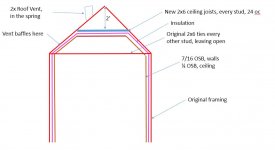
I've installed 'rafter ties' a few feet from the peak to give me a flat spot for a ceiling fan, so there will be a volume of air at the top that would facilitate venting.

Would the theory be that moisture would collect during the winter then evaporate during the summer? Anything else I'm forgetting?

I had planned today for finishing the insulation but no, I'm sitting on the computer frustrated because home depot is closed so I can't purchase the baffles.
 
Last edited:
To avoid these ads, REGISTER NOW!

73fxe

Well-known member
Joined
Jun 11, 2016
Messages
308
Location
SW. Michigan
Are You fastening the insulation to the rafters? If so yes You would want to leave air space under the plywood .
 

Kaizen

Well-known member
Joined
Jan 9, 2015
Messages
6,948
Location
New England
Baffles aren’t going to do much if they don’t have an eave and ridge vent. I’d add all three


Sent from my iPhone using Tapatalk
 

James-W

Well-known member
Joined
Feb 3, 2013
Messages
12,432
Location
Southeastern Wisconsin
Are you sure Home Depot is closed today? I would have thought they would be open and have a lot of stuff on sale. Many stores around here have New Years sales going on and I have to wonder why Home Depot is not doing the same.
 
OP
T

travisn1

Well-known member
Joined
Oct 22, 2012
Messages
152
Location
Waterloo NY
Are you sure Home Depot is closed today? I would have thought they would be open and have a lot of stuff on sale. Many stores around here have New Years sales going on and I have to wonder why Home Depot is not doing the same.

The app says closed today. I got wrangled into installing the over range microwave so I guess its ok either way. Hopefully taking Wednesday and Thursday to get the garage finished.

Baffles aren’t going to do much if they don’t have an eave and ridge vent. I’d add all three

I can't do air in, it's just not going to happen.

Not going to add a whole ridge vent either, just a 2 roof vents. Not trying to re-do the whole garage.

your friend is wrong...you need the baffles or moisture gets trapped and you'll have mold issues.

My friend told me to add the baffles. I was under the impression that since I didn't have eaves I couldn't get air in and it the baffles would be useless. But if it's hot enough and I don't have plastic against the insulation air will find it's way in through the walls/ceiling and allow the moisture to leave.

is there attic space or a room above the garage?

No attic space persay, it's open to the floor. I'm just adding in horizontal 2x6's two feet from the peak to give a flat spot for the ceiling fan. That will give place for air to circulate and vent out.

Are You fastening the insulation to the rafters? If so yes You would want to leave air space under the plywood .

Thats the plan. I looked into spray foam but they wanted $3500 for my 19x25 garage.
 

Kaizen

Well-known member
Joined
Jan 9, 2015
Messages
6,948
Location
New England
If you are not insulating the whole thing then why bother with any insulation? If you are eventually doing it all do it right.


Sent from my iPhone using Tapatalk
 

kbs2244

Well-known member
Joined
Nov 11, 2006
Messages
14,065
Cape Cod style does not have soffits.
Only 4 to 6 inches from wall to gutter.
No way to do a vented roof.
You are building a sealed roof and doing it correctly.

Use short drop ceiling fans and blow the air up.
Let them run 24/7/365
The air will flow down the ceiling slope and pick up any moisture on the way.

Any moisture in the walls will be blocked by the wall top plate 2x4s.
If that is a concern, I would leave a 3 or 4 inch gap at the top of the inside paneling.
To be safe, you can do the same at the peak of the ceiling.

In both cases, it will raise and vent.
 
Last edited:

firebirdparts

Well-known member
Joined
Jun 8, 2016
Messages
10,588
Location
Kingsport, TN
That seems a little extreme. I have a cape cod, and I can assure you that plenty of air can get in there if you didn't deliberately seal it up really tight.

The big problem with them is stopping air infiltration, not creating it, where you have that upper half story. Cold air comes in the end of the floor joists, even though that is not vented, and it gets freezing cold inside the house. We get condensation on the ceiling. There is not an easy way to insulate the resulting combination of shapes that happen where the roof sits on that upper half story. Or at least there wasn't 40 years ago when this house was built.

So anyway, my house is brick, and plenty of air goes up between the bricks and the roof. No problem. If your eaves are really sealed up, then maybe you can create some leaks.

With fiberglass, you wouldn't necessarily need those little baffles. Baffles are necessary for blown in insulation, for instance. Fiberglass is dimensionally stable. You just need to look at your insulation and your rafters and see if you have room in there for air movement or not. You don't need all that much in my opinion.
 
OP
T

travisn1

Well-known member
Joined
Oct 22, 2012
Messages
152
Location
Waterloo NY
The air will flow down the ceiling slope and pick up any moisture on the way.

Any moisture in the walls will be blocked by the wall top plate 2x4s.
If that is a concern, I would leave a 3 or 4 inch gap at the top of the inside paneling.
To be safe, you can do the same at the peak of the ceiling.

I can't figure out what you are trying to say, where and how should I leave gaps? I'm worried that will let warm air in which would be excessive/extra moisture. plus heat would just get sucked out.
 
To avoid these ads, REGISTER NOW!
OP
T

travisn1

Well-known member
Joined
Oct 22, 2012
Messages
152
Location
Waterloo NY
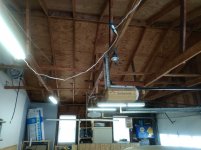
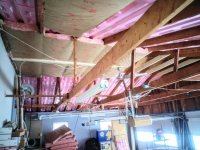
Maybe these pics and diagram will help explain the situation.
 

Attachments

  • garage 1.jpg
    garage 1.jpg
    132.6 KB · Views: 103
  • garage 2.jpg
    garage 2.jpg
    143.2 KB · Views: 98
  • garage 3.jpg
    garage 3.jpg
    39.7 KB · Views: 108

yeldogt

Well-known member
Joined
Jan 2, 2012
Messages
18,184
The moisture problem is created when humidity from the building envelop enters the cold spaces above and hits a temp under the dew point.

investagate "unvented attic" "unvented roof". When I started doing rehabs 30+ years ago the whole venting thing never made any sense to me ... and I have never done one. I found it interesting that when the state mandated energy audit was done on my house and office a couple years ago (NJ clean energy program) ... they now all recommend sealed space and making everything part of the building envelope.

Why don't conventional walls rot when done correctly? The key is to seal things up -- recessed lights, chimneys and steps being a big leak spot with many attic's.

The other concern some have is with "ice dams" .. again ... do it correctly and the heat can't get to that spot and make the roof warmer ......

My cape is sealed -- they are difficult to get right.
 

TFerg

Member
Joined
Feb 7, 2015
Messages
7
Location
Chicago Suburbs
I have a cape cod and was told to install baffles, a ridge vent (or equivalent) and a special type of vent that sits by the gutter. I don't remember what they call the vent by the gutter but it's specifically for cape cod type houses with no soffit.

Baffles with no airflow won't do much.
 

strutaeng

Well-known member
Joined
Dec 12, 2011
Messages
2,261
Location
Dallas, TX
The moisture problem is created when humidity from the building envelop enters the cold spaces above and hits a temp under the dew point.

investagate "unvented attic" "unvented roof". When I started doing rehabs 30+ years ago the whole venting thing never made any sense to me ... and I have never done one. I found it interesting that when the state mandated energy audit was done on my house and office a couple years ago (NJ clean energy program) ... they now all recommend sealed space and making everything part of the building envelope.

Why don't conventional walls rot when done correctly? The key is to seal things up -- recessed lights, chimneys and steps being a big leak spot with many attic's.

The other concern some have is with "ice dams" .. again ... do it correctly and the heat can't get to that spot and make the roof warmer ......

My cape is sealed -- they are difficult to get right.

I agree with this statement.

Do some research on GreenbuildingAdvisor.com on this. I have a 25x25 detached garage that was un-insulated and un-heated with 3 eave vents per side and 3 soffit vents per side, plus 2 gable ends per side and a whirly wind! Talk about exceeding ventilation requirements! Aside from not needing the venting because it is not conditioned, the amount of dust from the vents I get inside is insane, plus bugs, noise, etc.

I plan to seal, insulate and condition the space. Attic ventilation is an afterthought due to old, leaky conditioned spaces. With newer, better sealed conditioned spaces possible today, attic venting is not really needed. There have been studies that state that the attic temperature difference from vented to un-vented is marginal.

Consider that a space sealed with polyurethane foam does not need attic venting. Also consider that a foam cooler or a household refrigerator also does not need venting. Same principle.
 

kbs2244

Well-known member
Joined
Nov 11, 2006
Messages
14,065
"Any moisture in the walls will be blocked by the wall top plate 2x4s.
If that is a concern, I would leave a 3 or 4 inch gap at the top of the inside paneling.
To be safe, you can do the same at the peak of the ceiling."

If you panel all the way to the top plate of the wall or to the ridge board you are blocking any airflow exit.
What I am suggesting is an escape vent for any moisture that does manage to get into the wall or roof insulated space.
The vents will be at the high point of the interior paneling.

The heat will raise and be vented into the interior.
Any moisture will follow the heat.

You want to keep your outside surface as sealed as possible.
 

tcrimsonk

Member
Joined
Jan 3, 2018
Messages
7
Location
tbd
The issue (Which you might already know, but I haven't seen it explained in this thread) is that batt fiberglass insulation is not a vapor barrier. When you put fiberglass on the bottom of your roof plywood, the space below the insulation will be heated, and the space above the insulation will be cold outdoor temperature. But moist air from inside your heated garage can pass through the fiberglass insulation. When it does, it will reach the cold plywood. When moist air reaches plywood that's colder than the dew point, the moisture will condense an the bottom of your plywood will get wet.

If you don't have an air space and ventilation between the plywood and the fiberglass, then the plywood will stay wet, will grow mold, and will rot.

Now, you can reduce this problem significantly by cutting down on the air flow into and around your insulation. If you're putting drywall up after you insulate, and seal it up very well, then you might be fine. If you're not doing drywall, then maybe a vapor retarder would be a good idea. The rule of thumb seems to be that vapor barriers/retarders go on the warm side of the insulation. Since you're in NY, I'm assuming you don't plan on running AC in the garage very often. In that case, you might be okay to install your insulation as you've already started, and then hang some plastic vapor retarder below that.

Disclaimer: I barely know what I'm talking about. Do your own research. Also, this is one of the reasons people opt for the much more expensive closed-cell spray foam. It is a vapor barrier, and it is very good at restricting air flow.
 

tcrimsonk

Member
Joined
Jan 3, 2018
Messages
7
Location
tbd
"The heat will raise and be vented into the interior.
Any moisture will follow the heat.

You want to keep your outside surface as sealed as possible.


I'm confused. You're suggesting that he create a system where air from inside his conditioned space should flow up between the insulation and the plywood roof, into the un-insulated space, and then flow back into the insulated space?

Doesn't that defeat the purpose of insulating it at all?
 
OP
T

travisn1

Well-known member
Joined
Oct 22, 2012
Messages
152
Location
Waterloo NY
Now, you can reduce this problem significantly by cutting down on the air flow into and around your insulation. If you're putting drywall up after you insulate, and seal it up very well, then you might be fine. If you're not doing drywall, then maybe a vapor retarder would be a good idea. The rule of thumb seems to be that vapor barriers/retarders go on the warm side of the insulation. Since you're in NY, I'm assuming you don't plan on running AC in the garage very often. In that case, you might be okay to install your insulation as you've already started, and then hang some plastic vapor retarder below that.

Disclaimer: I barely know what I'm talking about. Do your own research. Also, this is one of the reasons people opt for the much more expensive closed-cell spray foam. It is a vapor barrier, and it is very good at restricting air flow.

The current plan is 1/4" OSB. I've read reports of it sagging but I don't feel like schleping 7/16 up there. It will get 1-2 coats of kilz then a white ceiling paint before going up. I think I'm going to run the baffles and put in roof vents so any moisture that does seep in can find it's way out in the summer as the roof heats up.

I'm hesitant to actually seal the fiberglass.
 

kbs2244

Well-known member
Joined
Nov 11, 2006
Messages
14,065
"I think I'm going to run the baffles and put in roof vents so any moisture that does seep in can find it's way out in the summer as the roof heats up. "

That is how I did my roof.
2x6 rafters with 4 inches insulation gives a 2 inch air duct,
But I have soffits with inlet vents.
 
OP
T

travisn1

Well-known member
Joined
Oct 22, 2012
Messages
152
Location
Waterloo NY
Got the baffles, a few pieces of insulation, and the ceiling fan installed this weekend. There were a few spots along the top plate where I could feel air coming in, so I think I'll be ok after adding in a roof vent in the spring.
 

Attachments

  • IMG_20180108_141120.jpg
    IMG_20180108_141120.jpg
    138 KB · Views: 39

miragesmack

Member
Joined
Mar 23, 2009
Messages
24
Location
Louisville, KY
Too late for you, but posting for others. My old house also had no soffits so I couldn't do any venting there. What I did was add under shingle vents near the eaves. They cut a slit in the roof maybe 2" wide and cover it with the vent, then shingles go over top. I also added a ridge vent, which you can actually add at any time. That gave me the venting I needed. Just fyi.
 
OP
T

travisn1

Well-known member
Joined
Oct 22, 2012
Messages
152
Location
Waterloo NY
Yea, I watched a few videos of installing a ridge vent and it's pretty straight forward. Once I thought about it it's obvious you can add it after because on a normal install it would be the last thing to go on anyways.

The under shingle vent is a possibility too. That might be a little more tricky sneaking in new shingles after?
 
To avoid these ads, REGISTER NOW!
Top Bottom