To avoid these ads, REGISTER NOW!

Insulating attached garage

Joined
Dec 16, 2016
Messages
5
Location
NW WA
Hey all. I am considering installing a gas powered heating unit in my garage. I do my woodworking and working out in the garage and it can get difficult when it is 18 degrees in there. It is an attached garage with about half of it being insulated and the other half being only drywall. I use the space above the garage for misc storage. I am thinking I will need to insulate the exterior walls and above the garage to make it worth trying to heat it. I am not sure what kind to do above since I use it for storage. I also am not very keen on what the best option for the exterior walls would be without tearing all the rock off and redoing it. What do you all recommend?
 
To avoid these ads, REGISTER NOW!

Gerald O

Well-known member
Joined
Mar 5, 2013
Messages
1,884
Location
NC
Your geographical location matters. Different climates require different approaches to insulation.
 
OP
O
Joined
Dec 16, 2016
Messages
5
Location
NW WA
I live in NW WA. Pretty mild climate generally. 18 degrees is generally considered a lower temp in the winter with temps rarely getting above 40.
 

holdover

Well-known member
Joined
Feb 15, 2011
Messages
750
Location
VA
I insulated my 40 X 60 with 6" in the walls and 12" in the ceiling. No regrets, warmer in the winter and easier to heat and cooler in the summer.
 

73fxe

Well-known member
Joined
Jun 11, 2016
Messages
308
Location
SW. Michigan
With out removing the d-wall your options are limited. How about cutting a hole high and one about 3' off the floor. Rent a blower and buy fiberglass insulation. Blow the walls full and patch the drywall. The ceiling try 1/2" foam with foil face to the rafters.
 

rwilner

Well-known member
Joined
Apr 26, 2013
Messages
104
Location
Boston, MA
I think your only option is like 73 said - except my only experience is with blown in cellulose, not fiberglass.

I just did 4" of open cell in my garage walls, sheetrock, plaster and paint. I'm in Boston. I have a 5000w construction heater that makes it livable and workable even in 0 degree temps.
 

MScott

Well-known member
Joined
Jun 30, 2009
Messages
1,616
Location
Eastern Ontario
Your geographical location matters. Different climates require different approaches to insulation.

I live in NW WA. Pretty mild climate generally. 18 degrees is generally considered a lower temp in the winter with temps rarely getting above 40.

Why not put this information in your profile so readers don't have to look up this post to find out.

What type of roof structure do you have, trusses or simple rafter construction?
 

EOC_Jason

Well-known member
Joined
Jun 25, 2012
Messages
11,388
Location
Bentonville, AR
I've seen them cut holes in the walls to fill them with the expanding foam stuff. Though if you do that you will have a real hard time running any future electrical through the walls.
 

Jazz1

Well-known member
Joined
Jan 3, 2016
Messages
4,188
Location
Thunder Bay On.
Cellulose is a cheaper product yet to blow into walls although it does settle in time. Problem with blowing into the walls is there is likely no vapour barrier behind drywall. Any building/room intended to be heated or AC'd should be fully insulated and vapour barrier to make heating/AC cost efficient.
 

Scout Driver

Well-known member
Joined
Nov 20, 2009
Messages
4,286
Location
South Dakota
Cellulose is a cheaper product yet to blow into walls although it does settle in time. Problem with blowing into the walls is there is likely no vapour barrier behind drywall. Any building/room intended to be heated or AC'd should be fully insulated and vapour barrier to make heating/AC cost efficient.

This right here ^^^^^.

Another thing I will bring up........ If you have a concrete footer or short concrete wall around the perimeter, it would be a good idea to insulate the outside of this with some foam insulating board or something similar. Without the outside insulation, the inside of the concrete can build up a heavy layer of frost during the time the garage is heated.

Scott
 

bczygan

Well-known member
Joined
Nov 4, 2009
Messages
22,002
Location
DETROIT! Arsenal of Scrappers
First, you must really love woodworking!

Second, we need photos of the place in question.

Third, you need to insulate first. Completely! That means R15 walls and R38 ceiling.

If you must use the ceiling space for storage, then closed cell foam insulation between the rafters is the only reasonable solution and must be done by professionals.

Blow in loose fill can be done behind existing drywall.

Bill
 
To avoid these ads, REGISTER NOW!

Slednut

Well-known member
Joined
Dec 20, 2012
Messages
2,554
Location
Washington state
Just insulating will make your attached garage livable. I have a large attached, it's 8 degrees outside here in Eastern Washington and my garage is at 45 degrees. It's so easy to heat I just use a 220v electric heater.
 

Voi

Well-known member
Joined
Oct 10, 2010
Messages
5,151
Location
Western South Dakota
Blown in cellulose is probably your best choice if you don't want to remove drywall since it's able to buffer moisture better than other choices.

This type of question is somewhat common over on Green Building Advisor and generally for garages that don't have the same household moisture producers and they recommend blown in cellulose.

If they would recommend something else for your specific area of the northwest I can't say for sure.

As far as keeping the rafter/truss space open for storage, does your garage have soffits? Are they vented? What about roof vents on or near the ridge?

Are the upper chords or rafters 2x4 or something else?

Is the roof in need of replacement? If so another choice (besides closed cell) for keeping the attic space open is rigid foam above the roof deck.
 

DougWil

Well-known member
Joined
Dec 29, 2015
Messages
548
Location
NW Montana
Do it right this time.
Rip off all the SR and foam fill any holes, perorations in the stud cavities. Foam or caulk the sill to footing/slab. Then fiberglass batt insulation and maybe even foam board over the studs, then SR, followed by 2 coats of latex paint.
 
OP
O
Joined
Dec 16, 2016
Messages
5
Location
NW WA
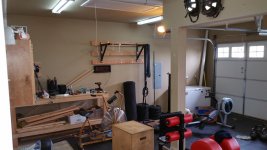
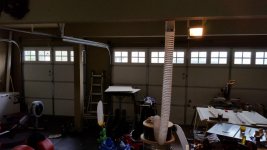
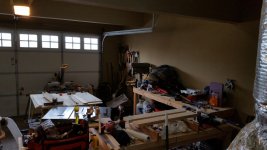
Thanks for the replies! I have attached some pictures for reference on what I have to deal with. I guess ripping down all the old SR would be the best way but I am very hesitant since I have several weight bearing objects already bolted through the SR into the studs (pull up bar, dust collector). How expensive is it to do the spray foam insulation?
 

Attachments

  • garage2.jpg
    garage2.jpg
    143 KB · Views: 34

Scout Driver

Well-known member
Joined
Nov 20, 2009
Messages
4,286
Location
South Dakota
Thanks for the replies! I have attached some pictures for reference on what I have to deal with. I guess ripping down all the old SR would be the best way but I am very hesitant since I have several weight bearing objects already bolted through the SR into the studs (pull up bar, dust collector). How expensive is it to do the spray foam insulation?


Around here, spray foam is the most expensive option available. But everyone that I know that has had it done says it is well worth the extra expense. A huge advantage of spray foam is that it tends to "creep" into areas that fiberglass or foamboard won't get into. The spray foam does a superior job of sealing up a structure.

Scott
 

Voi

Well-known member
Joined
Oct 10, 2010
Messages
5,151
Location
Western South Dakota
How expensive is it to do the spray foam insulation?

I just paid 85 cents per square foot per inch, aka 85 cents per board foot. This was a small job and for closed cell. It was also in a somewhat hard to get to, somewhat rural area. I was expecting to pay much more than that.

We opted against rigid above the roof deck because 1) it's in a high forest fire risk area and didn't want an ember to get between my metal roof and the foam 2) my "rafters" are I-joists which have less than a third of the thermal bridging of solid lumber and 3) we we're already down to inches when it came to squeezing in under height restrictions.
 
To avoid these ads, REGISTER NOW!
Top Bottom