To avoid these ads, REGISTER NOW!

Insulating concrete slab

DIYDAN

Active member
Joined
Nov 4, 2021
Messages
28
Location
Huntsville, AL
Hi,

I'm in the process of building a detached workshop, 28 x 44, in North Alabama (climate zone 3). I will be working in the shop for long periods, so I am well insulating it. The main question I have is insulating the concrete slab. It will be 6" and I do not plan to heat the slab but I want to insulate it effectively. From reading it sounds like I can put vertical insulation underground around the outside of the foundation and 2 feet seems like a standard depth? Is this as effective as insulating under the slab? The footing will be 12" deep. Should I have the foundation fabricators incorporate it, or trench around the perimeter after the foundation is in?

Thanks,

Dan
 
To avoid these ads, REGISTER NOW!

slow84lx

Well-known member
Joined
Apr 8, 2019
Messages
77
Location
Plano, TX
Great questions! I'll follow along.

I've pondered the same as it is not common to insulate the slab in our southern climate.
 

ConCretin

Well-known member
Joined
Jan 20, 2011
Messages
3,378
Location
Central Maine
The purpose of vertical subsurface insulation around the perimeter of a foundation or slab is primarily to prevent frost from penetrating the soils under the slab. I doubt that's a problem for you. You'd spend a lot of money and never see any benefit for insulating under your slab. In fact it might be a detriment because it would block the natural heat from the ground. I'd spend my money elsewhere.
 

yeldogt

Well-known member
Joined
Jan 2, 2012
Messages
18,184
First -- do you need a 6" slab ?

I'm not familiar with AL as far as heat ... but, a slab is a huge heat sink and anytime you need to heat a space the slab fights you .... also depending on the ground configuration the slab can be a problem as it falls under the dew point in humid areas. Isolating the slab is normally done.

6% slab is 50% more sink ...

Doing a quick search it does seem that Al shows a full 2" at the perimeter like what is common in colder climates .... I only see one slab in the AL builders field guide --- looks to show 6 mil poly and 1" foam under the slab (picture is 1/2 the listed 2") Google around and get information from both the state and builders associations in AL or nearby state -- that's the best information.

Air sealing is always the most important
 
Last edited:

yeldogt

Well-known member
Joined
Jan 2, 2012
Messages
18,184
The purpose of vertical subsurface insulation around the perimeter of a foundation or slab is primarily to prevent frost from penetrating the soils under the slab. I doubt that's a problem for you. You'd spend a lot of money and never see any benefit for insulating under your slab. In fact it might be a detriment because it would block the natural heat from the ground. I'd spend my money elsewhere.
The builders guide seems to be concerned about moisture and dew/point -- mold.

I insulated my garage floor w/ 1" at the jersey shore just to reduce the condensation ... and it does seem to work. Not for heat
 
OP
D

DIYDAN

Active member
Joined
Nov 4, 2021
Messages
28
Location
Huntsville, AL
First -- do you need a 6" slab ?

I'm not familiar with AL as far as heat ... but, a slab is a huge heat sink and anytime you need to heat a space the slab fights you .... also depending on the ground configuration the slab can be a problem as it falls under the dew point in humid areas. Isolating the slab is normally down.

6% slab is 50% more sink ...

Doing a quick search it does seem that Al shows a full 2" at the perimeter like what is common in colder climates .... I only see one slab in the AL builders field guide --- looks to show 6 mil poly and 1" foam under the slab (picture is 1/2 the listed 2") Google around and get information from both the state and builders associations in AL or nearby state -- that's the best information.

Air sealing is always the most important
Thank you. I will search the resources you listed. A little more info on the workshop, I'm using 2x6 walls, 24" on center for more insulation. Exterior will have 1" insulation and then full depth brick. I'm also using trusses that are slightly raised to get more insulation along the eaves.

The reason to go with 6" is mainly to plan for the future if I decide to use it for large vehicles or heavy equipment. It seemed like something that was worth the extra money up front.
 

yeldogt

Well-known member
Joined
Jan 2, 2012
Messages
18,184
Thank you. I will search the resources you listed. A little more info on the workshop, I'm using 2x6 walls, 24" on center for more insulation. Exterior will have 1" insulation and then full depth brick. I'm also using trusses that are slightly raised to get more insulation along the eaves.

The reason to go with 6" is mainly to plan for the future if I decide to use it for large vehicles or heavy equipment. It seemed like something that was worth the extra money up front.

There is never "one answer" for the whole country. As LLWillysfan gets at .... it's a question of where you put your money for the most bang.

There may be a need for a thicker slab ... Only you know what will be used. I know lots of people with standard slabs and equipment ....
 

wssix99

Well-known member
Joined
Mar 2, 2011
Messages
5,155
Location
Chicago, IL
Here's a good source of general information: (not tied to a business trying to make money off of you) https://foundationhandbook.ornl.gov/handbook/section4-1-insulation.shtml

If you are not going to heat the slab, are you going to heat the work space? (This is the most important thing to consider.)

As noted above, the concrete is a huge heat sink, so it's always going to feel "cold" if the temperature of the room is less than your body heat. The only way to get a warm slab that is comfortable to lay down on (working underneath a car, etc.) is to have radiant heat.
 
OP
D

DIYDAN

Active member
Joined
Nov 4, 2021
Messages
28
Location
Huntsville, AL
Here's a good source of general information: (not tied to a business trying to make money off of you) https://foundationhandbook.ornl.gov/handbook/section4-1-insulation.shtml

If you are not going to heat the slab, are you going to heat the work space? (This is the most important thing to consider.)

As noted above, the concrete is a huge heat sink, so it's always going to feel "cold" if the temperature of the room is less than your body heat. The only way to get a warm slab that is comfortable to lay down on (working underneath a car, etc.) is to have radiant heat.
Thanks for the link. Yes, I'll be heating the workspace when I'm working, around 8 hours a day. I'll probably try to keep it from getting below 60F. Luckily I won't be working on the floor. My goal is to minimize the amount of energy used to heat it by insulating in effective areas. I'm curious if the slab temperature will make a significant difference in the energy used.

I may end up using a small forklift in the future so that was a reason for 6" over 4" slab.
 

topp64

Well-known member
Joined
Jan 29, 2013
Messages
126
Location
Des Moines, Iowa
I agree with LLWillysfan. You'd be better to spend the money elsewhere because I seriously doubt that in your location there would be a noticeable difference.
 

racecougar

Well-known member
Joined
Jan 26, 2021
Messages
4,976
Location
Missouri
To throw a little personal experience in: My 30' x 60' shop is only heated when I'm in it (and heated via air, not in-pad), and at times, it can be as long as a week without me setting foot in there. I did a 4" slab, and I did not insulate under the slab nor outside the foundation walls. Even when we have a week of highs in the 20's and lows in the single digits, the air temp inside the shop will not drop below 38-40F. I've observed this for three years now, and I have to attribute that to the fact that the building itself is well insulated and that leaving the pad uninsulated allows for some heat transfer/stability from the ground. Likewise, in the Summer, the air temp within the shop remains well below the average outside temp, likely for the same reason.

I'm well North of you in Missouri. As you're not heating the slab, I wouldn't insulate it. Take advantage of the relatively stable ground temp beneath your pad.
 

ConCretin

Well-known member
Joined
Jan 20, 2011
Messages
3,378
Location
Central Maine
The builders guide seems to be concerned about moisture and dew/point -- mold.

I insulated my garage floor w/ 1" at the jersey shore just to reduce the condensation ... and it does seem to work. Not for heat
That's an interesting point. It makes sense that a slab cooled from the soils below would create more condensation than one closer to air temps. It's not an issue up this way but I can see how it would be further south.
 
To avoid these ads, REGISTER NOW!

yeldogt

Well-known member
Joined
Jan 2, 2012
Messages
18,184
To throw a little personal experience in: My 30' x 60' shop is only heated when I'm in it (and heated via air, not in-pad), and at times, it can be as long as a week without me setting foot in there. I did a 4" slab, and I did not insulate under the slab nor outside the foundation walls. Even when we have a week of highs in the 20's and lows in the single digits, the air temp inside the shop will not drop below 38-40F. I've observed this for three years now, and I have to attribute that to the fact that the building itself is well insulated and that leaving the pad uninsulated allows for some heat transfer/stability from the ground. Likewise, in the Summer, the air temp within the shop remains well below the average outside temp, likely for the same reason.

I'm well North of you in Missouri. As you're not heating the slab, I wouldn't insulate it. Take advantage of the relatively stable ground temp beneath your pad.
You will have sun gain .. and there could be some transfer. The problem .... you can't overcome physics. Once you wish to raise the temp above the slab temp .... heat will flow from warm to cold. The slab wants heat ... it's going to want stability. Now the ground is your enemy ....
 

racecougar

Well-known member
Joined
Jan 26, 2021
Messages
4,976
Location
Missouri
You will have sun gain .. and there could be some transfer. The problem .... you can't overcome physics. Once you wish to raise the temp above the slab temp .... heat will flow from warm to cold. The slab wants heat ... it's going to want stability. Now the ground is your enemy ....
Sun gain in this specific location is very slight. Agreed that the slab will want to hold at the ground temp; it does. Bringing the air temp (not slab temp) up to 60 from 40 is quick and easy, as heated air biases its transfer upwards. I actually use two large air circulators to push heat back down from the ceiling. I'm not saying that there isn't loss present, but rather that not insulating the slab has worked out well in this particular climate. Now if I had in-slab heating, it would be a completely different story.

Don't overlook the benefit in the summer; that stable, cooler ground temp is a nice bonus.
 
OP
D

DIYDAN

Active member
Joined
Nov 4, 2021
Messages
28
Location
Huntsville, AL
Sun gain in this specific location is very slight. Agreed that the slab will want to hold at the ground temp; it does. Bringing the air temp (not slab temp) up to 60 from 40 is quick and easy, as heated air biases its transfer upwards. I actually use two large air circulators to push heat back down from the ceiling. I'm not saying that there isn't loss present, but rather that not insulating the slab has worked out well in this particular climate. Now if I had in-slab heating, it would be a completely different story.

Don't overlook the benefit in the summer; that stable, cooler ground temp is a nice bonus.
Thanks. What do you use for air circulators? I haven't decided on a heat source yet, possibly electric. I'll have 100 amp service in the shop. Our house does not have gas or propane.
 

racecougar

Well-known member
Joined
Jan 26, 2021
Messages
4,976
Location
Missouri
Thanks. What do you use for air circulators? I haven't decided on a heat source yet, possibly electric. I'll have 100 amp service in the shop. Our house does not have gas or propane.


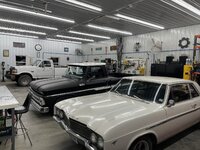
The white one is a 30" Schaefer: https://schaeferventilation.com/pro...n-fans/fixed-mount-circulation-fans/30cfo-he/

The one in the corner is a Dayton. IIRC, it's a 24" unit.

The other rear corner (off the right hand side of the screen) is wired for a circulator, but I never put one up there, as the pallet racking off screen would likely block a fair bit of the air from it.

My place is all electric as well. Thus far, I use a double head tank top propane heater to bring the space up to temp when I go out there (which doesn't take long with at least one circulator running) and a little 240V 5kW Dayton electric heater to maintain. In the summer, I use two 5kW window units to cool the building when I'm out there. Eventually I plan to install a mini-split, as it would be great to have everything controlled via a thermostat. In the meantime, this has worked quite well for the past few years. The fact that the building is well sealed and well insulated is key.


IMG_2246.jpg
 

NUTTSGT

Super Moderator
Staff member
Joined
Sep 14, 2009
Messages
50,855
Location
Northern Central Ohio
I didn't insulate under my slab but I did put 3/4" on the outside of the foundation and another 3/4-1" along the interior of the foundation to the footer. The interior was used as the screed line when we poured the floor.
 

EngineerNate

Well-known member
Joined
Oct 19, 2019
Messages
206
Location
Bristol, TN
Ground contact rated foam under the slab is typical if you want to insulate the slab.

If your climate is primarily heating dominated, this can be well worth it. The heat sink comments are dead on, but remember this can work for you as well as against. If you insulate the slab well and keep the shop heated, that heat sink will work to keep the shop at a more constant temp and once everything is stabilized, your system won't have to work as hard to maintain temperature as you've stored all that heat in the slab.

If you're in a cooling dominated climate, you might want to leave it uninsulated so the slab can shed heat to the ground, which is the world's biggest heat sink even in the summer. I wouldn't recommend that for a house so much, since cold floors can be uncomfortable even in the summer, but in a shop you're not likely to be barefoot much.
 
OP
D

DIYDAN

Active member
Joined
Nov 4, 2021
Messages
28
Location
Huntsville, AL
The white one is a 30" Schaefer: https://schaeferventilation.com/pro...n-fans/fixed-mount-circulation-fans/30cfo-he/

The one in the corner is a Dayton. IIRC, it's a 24" unit.

The other rear corner (off the right hand side of the screen) is wired for a circulator, but I never put one up there, as the pallet racking off screen would likely block a fair bit of the air from it.

My place is all electric as well. Thus far, I use a double head tank top propane heater to bring the space up to temp when I go out there (which doesn't take long with at least one circulator running) and a little 240V 5kW Dayton electric heater to maintain. In the summer, I use two 5kW window units to cool the building when I'm out there. Eventually I plan to install a mini-split, as it would be great to have everything controlled via a thermostat. In the meantime, this has worked quite well for the past few years. The fact that the building is well sealed and well insulated is key.


IMG_2246.jpg
Thanks for the info. That heat setup sounds good. I’ll probably do the same.
 
OP
D

DIYDAN

Active member
Joined
Nov 4, 2021
Messages
28
Location
Huntsville, AL
Thank you everyone for the advice. It sounds like insulating the slab is not important and I need to consider the impact over the summer equivalently. I may be influenced a little by the fact that it is winter and it may be an unusually cold winter. We've only been here a year.

I didn't realize the building code requirements about in ground insulation and termites in "very heavy" termite infestation areas. If anyone is considering this, the IRC code is R318.4
 

NUTTSGT

Super Moderator
Staff member
Joined
Sep 14, 2009
Messages
50,855
Location
Northern Central Ohio
Yes, take into account termites. It's hard to give everyone the best possible information as it can differ from place to place, state to state, across the pond and our friends down under. This is why it's recommended to put a general location in your profile, it helps others help you.

I like Nate's comments. I always tell people (in cold climates) get the heat in the 'crete.
 

wssix99

Well-known member
Joined
Mar 2, 2011
Messages
5,155
Location
Chicago, IL
Yes, I'll be heating the workspace when I'm working, around 8 hours a day. I'll probably try to keep it from getting below 60F. Luckily I won't be working on the floor. My goal is to minimize the amount of energy used to heat it by insulating in effective areas.

In that case, don't insulate the slab. During that 8 hours, as the room goes from cold to warm, the concrete (no matter what is underneath it) is going to **** up heat over a long period of time. You would only see significagant benefits from insulation if you were keeping the slab at a constant heated temperature.

While the slab will be sucking up heat, it does it slowly. You will have faster heat loss through walls, windows, and doors - so you should concentrate there. Even simple things like adding window treatments make big differences. (Drapes over your windows may not be the decor you are going for, but you could do cool things with a cow hide, etc. - anything to cover the glass.)

It looks like you have good reason to insulate the ground around the building, which should give you some small amounts of help on the heating bill.


I may end up using a small forklift in the future so that was a reason for 6" over 4" slab.

Check out this thread, which talks about considerations for this: https://www.garagejournal.com/forum/threads/slab-thickness-for-forklift.487825/

The extra 2" is expensive and there is a big difference between pneumatic and solid tires on the forklift. If there are forklifts that you can get with lower tire pressures, (under 90 psi) then you should be able to stay with 4". If you want hard tires, you should think about a thicker floor. (The hard tires put more pressure down.)
 
To avoid these ads, REGISTER NOW!
Top Bottom