To avoid these ads, REGISTER NOW!

Insulating garage loft/ hobby room

Radio Joe

Member
Joined
Mar 25, 2009
Messages
10
Location
Laurens, SC
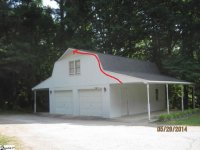
Hi everyone. Been lurking for a while but haven't posted much. I need some quick suggestions. I just bought a house in South Carolina with a large garage that has a loft above it. The plan is to eventually insulate the entire garage but right now I need to focus on the loft only.

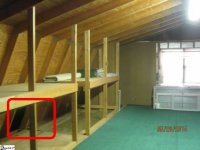
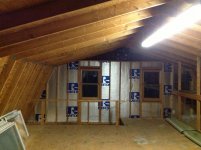
The loft is a completely open area and has a ridge vent in the highest point of the roof but because there are car ports built onto both sides of the garage, there is no soffit vents. Instead it looks like the only ventilation besides the ridge vent is a large ventilation fan mounted on one wall near the peak.

The plan was to use fiberglass roll insulation in between all the rafters and then drywall on top of that. After doing some reading, I'm a bit worried if I need to install some type of ventilation to the ridge vent.

To me it seems like I don't need venting since there isn't any soffit vents so I could install the fiberglass rolls and be good. Am I mistaken? Seems like I could remove that fan too if I installed the fiberglass.

Cost is a concern

Thoughts?
 

Attachments

  • image.jpg
    image.jpg
    146.1 KB · Views: 91
To avoid these ads, REGISTER NOW!

Jlbc212

Well-known member
Joined
Dec 7, 2013
Messages
1,530
Location
Northeast MA
Do what TurboMustang suggested and add some ventilation along the soffits. This flow of air from the soffits to the ridge will help to cool the roof deck. If you have asphalt shingles on the roof, it will greatly extend the life of the shingles. It will also reduce the heat in the loft during the warmer months.
 

laser3kw

Well-known member
Joined
Nov 17, 2012
Messages
7,276
Location
northen IL
google images "attic vent chute" and you will see what they are referring to and how they are installed.


attic vent chute link

here is an example:


soffit-vent-chutes-1.jpg
 

KCarGuy

Well-known member
Joined
Feb 5, 2009
Messages
2,075
Location
50 miles outside Chicago, illinois
Yes. The Main Air flow that you will want is up through your Soffits, past your roof line and out your roof. a ridge vent is better than Roof Vents. But anything is better that nothing.
 

JACDes

Well-known member
Joined
Dec 23, 2014
Messages
204
Location
IL
if the space is conditioned (heated) you don't have to vent the roof, if this was a true attic space then yes you want some air flow to prevent moisture problems from the warm air rising into the unconditioned space in the winter time.

BUT SC has mild winters, I would not worry about it.

you probably want to keep the fan for the heat of summer.

I would spray to the underside of the deck with closed cell foam and be done with it.
modern method is you treat the roof plane just like wall.
 
Last edited:

jpcjguy

Well-known member
Joined
Jan 6, 2014
Messages
1,477
Location
Richmond, VA
I agree with JACDes. Venting the roof for shingle life has been proven unnecessary. Most of the major shingle manufacturers fully warranty their product regardless if you have venting or not(closed cell foam). From what I found, the studies regarding vented vs. not vented resulting in an insignificant temperature difference between the two. I am researching this for my house walk up attic space which I will be converting to a playroom. But as usual - YMMV
 
OP
R

Radio Joe

Member
Joined
Mar 25, 2009
Messages
10
Location
Laurens, SC
Hi Everyone- Thanks for the feedback. I really do appreciate your time to offer suggestions!

Some more info

Will the spot ever be heated/Cooled- Yes... shortly. I plan to spend a LOT of time in the area so the plan is to heat/cool the entire garage but the focus mainly on the loft area.

Soffits- I was a bit unclear on this. See the attached picture. My garage has a carport added to each side. The end of the carports do have soffit vents, but the car port eves do not connect to the main room with the exception of 2 holes cut into the main room for access to each carport eve.

Closed cell spray foam is out of the question for me... just dont have the cash for it. Just for this room would be around $1500.00 and that about my entire budget.

The baffles are cheap and I can install them, I just dont think they would be doing anything. Absolute BEST case is they would pull air from the garage area below.. until I put up a ceiling in there.

In case anyone is concerned- the plan is to not have a RUNNING car in the garage space- Projects only. So exhaust gas wouldnt be a problem.

So Should I install the baffles anyway or just stuff the area with 6" fiberglass?
 

Attachments

  • 45_1280667_3_1402004373_636x435.jpg
    45_1280667_3_1402004373_636x435.jpg
    40.6 KB · Views: 29
Last edited:
To avoid these ads, REGISTER NOW!

jpcjguy

Well-known member
Joined
Jan 6, 2014
Messages
1,477
Location
Richmond, VA
So how is the angled space above the carport attached to the garage? Could you have air flow like in the attached pic? I am no means an air flow expert but maybe a possibility with baffles?
 

Attachments

  • gambrel.jpg
    gambrel.jpg
    67.7 KB · Views: 12
OP
R

Radio Joe

Member
Joined
Mar 25, 2009
Messages
10
Location
Laurens, SC
So how is the angled space above the carport attached to the garage? Could you have air flow like in the attached pic? I am no means an air flow expert but maybe a possibility with baffles?

No- there is one small access hole cut into the main area but thats it. I have attached the picture. One big hole on each side to access the inside of the carport eves.

After reading here and discussing with some guys here at work, seems like best course of action would be to take a hole saw, drill 2 holes in between each rafter so air from the carport eves can get into the main area and then baffle from those holes to the ridge vent. that should give me the airflow needed incase of any moisture and it doesn't add significantly to the cost of the project.

anyone disagree?
 

Attachments

  • garage_access.jpg
    garage_access.jpg
    35.9 KB · Views: 34

jpcjguy

Well-known member
Joined
Jan 6, 2014
Messages
1,477
Location
Richmond, VA
No- there is one small access hole cut into the main area but thats it. I have attached the picture. One big hole on each side to access the inside of the carport eves.

After reading here and discussing with some guys here at work, seems like best course of action would be to take a hole saw, drill 2 holes in between each rafter so air from the carport eves can get into the main area and then baffle from those holes to the ridge vent. that should give me the airflow needed incase of any moisture and it doesn't add significantly to the cost of the project.

anyone disagree?

So the airflow would match my picture, correct? The air would go from the area above carport through the drilled 2 holes between each rafter and up the baffles to the ridge vent.
 

K'ledgeBldr

Well-known member
Joined
Aug 22, 2011
Messages
1,925
Location
Johns Creek, GA
...seems like best course of action would be to take a hole saw, drill 2 holes in between each rafter so air from the carport eves can get into the main area and then baffle from those holes to the ridge vent. that should give me the airflow needed incase of any moisture and it doesn't add significantly to the cost of the project.

anyone disagree?

No. That would be the correct course of action. BUT!

Yeah, there's always a but. The rafter cavity is not deep enough for R-19 batts AND a baffle. You'll need to add a 2" rip to the face of the rafter to yield a 7-1/2" deep cavity. And for added insulating properties use unfaced batts then cover with 1" XPS board, taped seams. The XPS has a vapor barrier. This will give you approx. a R-24 for the walls/ceiling (drywall is installed directly over the XPS).

And since spray foam is out (which would be the superior choice for the floor), remember this- the minimum requirement is R-19. However, if you have at least 2X10's for the floor joists you can install R-30. The MAIN THING- seal the area! The ceiling of the space below! And make sure there are no holes to either the outside or the attic spaces of the carports- it needs to be a totally dead airspace! Or as much as creatively as possible ( this is the biggest reason why people have heating and cooling issues with bonus rooms over garages.
 
Last edited:

JACDes

Well-known member
Joined
Dec 23, 2014
Messages
204
Location
IL
There are no "minimum requirements" for insulation in an accessory structure.

those only apply to residential / commercial structures

A detached garage by definition is an accessory structure.

That being said you could just do 3.5 of closed cell foam, for R17 which will be more effective than any amount of fiberglass batt you install yourself.

or just use R19 batts without any baffles. you are going to heat / cool the space regardless. so the room will be a conditioned space. if you are worried about the carport roofs just install a couple of roof vents on the car port roofs. You only need 2 or 3 on each side.
 

K'ledgeBldr

Well-known member
Joined
Aug 22, 2011
Messages
1,925
Location
Johns Creek, GA
There are no "minimum requirements" for insulation in an accessory structure.

those only apply to residential / commercial structures

My point of reference was to show minimal requirements to obtain a respectable comparison to comfort level. And to go one step further, I bet if this "project" were to be permitted, those "requirements" would be enforced. The OP maybe using it as a project room but the AHJ may look at it as living space; sans a bath.
 
OP
R

Radio Joe

Member
Joined
Mar 25, 2009
Messages
10
Location
Laurens, SC
My point of reference was to show minimal requirements to obtain a respectable comparison to comfort level. And to go one step further, I bet if this "project" were to be permitted, those "requirements" would be enforced. The OP maybe using it as a project room but the AHJ may look at it as living space; sans a bath.

Im not sure what the "AHJ" is, I assume some govt agency that checks building codes, but the space will be a work area. Tools and work benches shelves of parts ect. So doubt that will be a problem.

So the baffles and the insulation can not touch each other? or is the concern that the insulation will smash the baffles to the point of closing them off? The plastic ones look like they are molded with ridges to prevent collapsing.

I just dont want to do it without and then rot the wood on my roof out due to moisture. After I install it, and cover with Drywall or OSB it willbe hard to tell if there is a problem until its too late...
 

jpcjguy

Well-known member
Joined
Jan 6, 2014
Messages
1,477
Location
Richmond, VA
Im not sure what the "AHJ" is, I assume some govt agency that checks building codes, but the space will be a work area. Tools and work benches shelves of parts ect. So doubt that will be a problem.

So the baffles and the insulation can not touch each other? or is the concern that the insulation will smash the baffles to the point of closing them off? The plastic ones look like they are molded with ridges to prevent collapsing.

I just dont want to do it without and then rot the wood on my roof out due to moisture. After I install it, and cover with Drywall or OSB it willbe hard to tell if there is a problem until its too late...

AHJ - Authority Having Jurisdiction.

The insulation is against the baffles. The required depth for the necessary R-value is greater than the space you have in the rafters, especially incorporating a 1" baffle. You cannot mash the insulation in there - hence the recommendation of adding a 2" rip on the edge of the rafter to increase the cavity depth.
 

JACDes

Well-known member
Joined
Dec 23, 2014
Messages
204
Location
IL
My point of reference was to show minimal requirements to obtain a respectable comparison to comfort level. And to go one step further, I bet if this "project" were to be permitted, those "requirements" would be enforced. The OP maybe using it as a project room but the AHJ may look at it as living space; sans a bath.

A detached garage by definition is as an accessory building,

An accessory building is not a habitable structure because it is accessory to the principal use which is the home that has bedrooms, bathrooms, kitchen, etc intended for HUMAN OCCUPANY.

therefore insulation and interior finishes are not even required for an accessory building.
If a homeowner wants to make those betterments to an accessory building for his convenience that is their choice and certainly not something a home-owner needs a permit for.

Anyone who thinks otherwise is simply mis-informed because no Building Dept. or AHJ can legally enforce energy code on an accessory building.

A "coach house" is another matter and without a bathroom /sleeping / kitchen quarters this hardly qualifies as one.
 
Last edited:
To avoid these ads, REGISTER NOW!
Top Bottom