To avoid these ads, REGISTER NOW!

Insulating Garage

QPike

Member
Joined
Jun 27, 2023
Messages
5
Hi, new to this site and looking for advice for a DIY job.

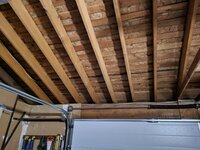
I have a West facing garage and the roof is not insulated and exposed inside. I would like to install some insulation to help moderate the temperatures in the summer and winter. If I get insulation and install it to the roof and use vapor barrier, would that help? Or would I also need to add drywall as well? Would I have to install baffles/venting under the roof and into the soffits/eaves?
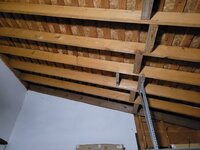
 

Attachments

  • WhatsApp Image 2023-06-27 at 3.36.00 PM (1).jpeg
    WhatsApp Image 2023-06-27 at 3.36.00 PM (1).jpeg
    262.2 KB · Views: 42
  • WhatsApp Image 2023-06-27 at 3.36.00 PM.jpeg
    WhatsApp Image 2023-06-27 at 3.36.00 PM.jpeg
    345.4 KB · Views: 42
To avoid these ads, REGISTER NOW!

The Cobbler

Super Moderator
Staff member
Joined
Oct 24, 2013
Messages
25,993
Location
Niagara Region, Ontario, Canada
anytime insulation is added properly it helps to moderate inside temperatures .
insulating the rafter bays with baffles will only help if you have a ridge vent . if the air is trapped the baffle won't do anything
there are some people that claim as long as the insulation is tight to the roof line you don't need an air passage. I know spray foam can be applied right to the roof decking with no air passage .
Many years ago I insulated a dormer on a roof with no air gap on the roof, years afterwards there was no discernible difference in the shingles that were vented & the ones that weren't
 

billconner

Well-known member
Joined
Jul 20, 2021
Messages
6,971
Location
Thousand Islands NYS
Any discussion of this is predicated on the climate you are in. So need that. Also, the use - activities and frequency - has bearing on your question.

Sure, kraft paper faced fibreglass in the rafters will help, and limited heating in cold weather, no car washing, storing firewood, or significant moisture through slab, you'd probably be fine.
 
OP
Q

QPike

Member
Joined
Jun 27, 2023
Messages
5
anytime insulation is added properly it helps to moderate inside temperatures .
insulating the rafter bays with baffles will only help if you have a ridge vent . if the air is trapped the baffle won't do anything
there are some people that claim as long as the insulation is tight to the roof line you don't need an air passage. I know spray foam can be applied right to the roof decking with no air passage .
Many years ago I insulated a dormer on a roof with no air gap on the roof, years afterwards there was no discernible difference in the shingles that were vented & the ones that weren't
Thanks. That was what I was led to believe as well that I could add insulation right up to the roof. In fact, my living room is sloped as well and sealed up with insulation and drywall. The shingles have not had any performance issues the past 20 years.
 
OP
Q

QPike

Member
Joined
Jun 27, 2023
Messages
5
Any discussion of this is predicated on the climate you are in. So need that. Also, the use - activities and frequency - has bearing on your question.

Sure, kraft paper faced fibreglass in the rafters will help, and limited heating in cold weather, no car washing, storing firewood, or significant moisture through slab, you'd probably be fine.
Thanks for the info. Western Canada weather. Warm/hot (70-80F) during summers; mild/cold (20-40F)in the winters; in between wet and rainy. The garage is dry storage and enclosed. No heating/cooling in the garage. On a concrete slab and never felt damp.
 

billconner

Well-known member
Joined
Jul 20, 2021
Messages
6,971
Location
Thousand Islands NYS
Do what you suggest. You could skip vapor barrier but if it stopped leaks - convection - it might be worth it. You just don't have the warm moist interior air that is the problem vapor barriers try to solve.
 
OP
Q

QPike

Member
Joined
Jun 27, 2023
Messages
5
Do what you suggest. You could skip vapor barrier but if it stopped leaks - convection - it might be worth it. You just don't have the warm moist interior air that is the problem vapor barriers try to solve.
another quick question.... the inside roof line goes right into the eaves. should i add insulation right up to that part or just seal it off with some wood? i have a roof vent and side vent in my garage to allow for airflow and the eaves would be redundant?
 
To avoid these ads, REGISTER NOW!

billconner

Well-known member
Joined
Jul 20, 2021
Messages
6,971
Location
Thousand Islands NYS
I would close/cover the all the vents if you want to moderate temperature. Seal the eaves off. Wood or even rigid foam, easy to cut and fit and adds insulation.
 

FredWanaker

Well-known member
Joined
Mar 27, 2021
Messages
1,470
Location
NorCal
the only thing I don't like about insulating ceilings like that is out of sight out of mind. In the many appraisals I saw, it was always that style that had rot because there were both no air movement to dry things out, and no one could inspect the underside for stains as the roof aged. I would be inclined to try to build some form of ceiling with storage and an inspection hatch to look for leaks once in awhile. I realize that the span will be an issue but an engineer may be able to solve it easily.
 
OP
Q

QPike

Member
Joined
Jun 27, 2023
Messages
5
the only thing I don't like about insulating ceilings like that is out of sight out of mind. In the many appraisals I saw, it was always that style that had rot because there were both no air movement to dry things out, and no one could inspect the underside for stains as the roof aged. I would be inclined to try to build some form of ceiling with storage and an inspection hatch to look for leaks once in awhile. I realize that the span will be an issue but an engineer may be able to solve it easily.
Good suggestion. The plan is to add insulation to the roof and vapor barrier. Any leaks would be noticeable and I still could access the underside to inspect. This isn't any different than what my sloped living room roof is like and that has been sealed off with drywall and panelling.
 

CoronadoBruin

Well-known member
Joined
Jun 24, 2023
Messages
49
Location
SoCal Mountains & Desert
IINM, you're not in a high-humidity area so you're good to go with insulation without additional work, and with or without Kraft-faced (I would use it; much cleaner look). You originally had wood shake roofing as I see skip sheathing but that was covered with OSB and replaced with (most likely) comp shingles. Leaks will not be an issue. Go insulate now and sin no more.

(recently retired carpenter and general contractor with 45 years experience)
 

Firebrick43

Well-known member
Joined
May 12, 2015
Messages
14,218
Location
West central Indiana
You can NOT install anytype of insulation tight against the roof deck except spray foam. All other types will lead to rot. It needs to have a 2" gap and have a vent top and bottom if its fiberglass or rock wool5dce85e9307438a4d79be8ffc88e2119.png
 

CoronadoBruin

Well-known member
Joined
Jun 24, 2023
Messages
49
Location
SoCal Mountains & Desert
That (your photo) doesn't happen in a low humidity locale such as the Southwest (Nevada, SoCal, Arizona, and New Mexico), and I've insulated against roof decks literally hundreds of times in SoCal, in thousands of units (apartments, condos, townhouses, duplexes, SFRs, commercial, etc., many with flat roofs, most Type V but also concrete and steel), including ocean front property without one problem. Elsewhere, yes, but not here or any other low humidity area. If you read his post, his living room sloped ceiling is insulated and drywalled, identical situation to his garage, and it's an older house (early '80s or older if Canada did away with shake at the same time as California) as evidenced by the skip-sheathing visible in the photos, and with no apparent damage in the living room. He is (most likely) in a low-humidity environment, thus his living room is fine, and his garage will be, too.

My mountain house is in an identical situation as the OP with an 8:12 slope and ****-joint clear cedar on the underside of the roof rafters, and nary a mark or hint of rot after over 40 years, with the rafter bays fully insulated with fiberglass batt insulation, Kraft-faced. Building in dry locales is a completely different animal than building in a wet one.

I can't quite make out the trees and the location from your photo but, if that is in the West, it is in the PNW, which is a very wet area and, no, I would not insulate directly against the roof deck there. If the OP is in western BC, I also would not insulate against the roof, but, again, he has no indication of damage in the living room after thirty or forty years, ergo....
 

Firebrick43

Well-known member
Joined
May 12, 2015
Messages
14,218
Location
West central Indiana
That (your photo) doesn't happen in a low humidity locale such as the Southwest (Nevada, SoCal, Arizona, and New Mexico), and I've insulated against roof decks literally hundreds of times in SoCal, in thousands of units (apartments, condos, townhouses, duplexes, SFRs, commercial, etc., many with flat roofs, most Type V but also concrete and steel), including ocean front property without one problem. Elsewhere, yes, but not here or any other low humidity area. If you read his post, his living room sloped ceiling is insulated and drywalled, identical situation to his garage, and it's an older house (early '80s or older if Canada did away with shake at the same time as California) as evidenced by the skip-sheathing visible in the photos, and with no apparent damage in the living room. He is (most likely) in a low-humidity environment, thus his living room is fine, and his garage will be, too.

My mountain house is in an identical situation as the OP with an 8:12 slope and ****-joint clear cedar on the underside of the roof rafters, and nary a mark or hint of rot after over 40 years, with the rafter bays fully insulated with fiberglass batt insulation, Kraft-faced. Building in dry locales is a completely different animal than building in a wet one.

I can't quite make out the trees and the location from your photo but, if that is in the West, it is in the PNW, which is a very wet area and, no, I would not insulate directly against the roof deck there. If the OP is in western BC, I also would not insulate against the roof, but, again, he has no indication of damage in the living room after thirty or forty years, ergo....
I have seen multiple houses that have no indication from the inside that there is any issue. The issue is brought to light when they go to reroof and find soft spots.
 
To avoid these ads, REGISTER NOW!
Top Bottom