To avoid these ads, REGISTER NOW!

Insulating/sealing a pole building with lap siding?

jarero

Member
Joined
Jan 7, 2015
Messages
8
I guess this will be both an introduction and a question.

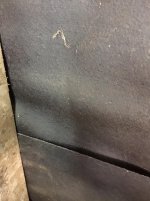
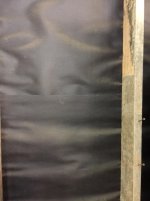
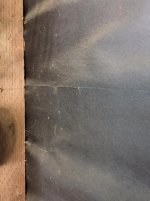
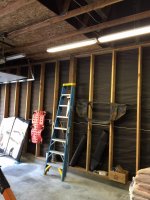
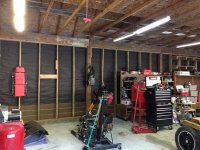
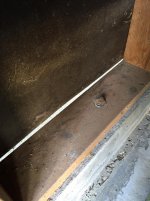
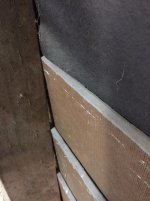
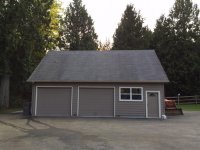
I bought a house a year ago that came with an unfinished shop. It is 24' x 36' and is a pole style building with all wood construction. When I moved in the house last year the shop became the storage and staging area for just about everything. I am finally getting a chance to clear things out and get organized. The shop will be used for mainly for automotive work so I will eventually want to get a lift and all that good stuff but for now I want to get the walls/ceiling done so it is weather tight. The previous owner of the house built the shop and had originally sided it with T111 but torn that off 2 years ago and put on hardi lap siding nailed directly to the poles and framed exterior walls. Between the siding and the framing there appears to be some type of roofing felt applied in most areas (but not all). I have never see this type of construction before and probably would have put sheathing on the exterior walls. Since it is a pole building though I don't suppose it needs that for sheer strength.

My question to all you good and knowledgeable folks is what is the best way to get these walls sealed up and insulated before I put up my OSB on the inside?
 

Attachments

  • IMG_0081.jpg
    IMG_0081.jpg
    143.8 KB · Views: 51
  • IMG_0061.jpg
    IMG_0061.jpg
    144.5 KB · Views: 29
  • IMG_0062.jpg
    IMG_0062.jpg
    97.4 KB · Views: 32
  • IMG_0063.jpg
    IMG_0063.jpg
    144.9 KB · Views: 36
  • IMG_0065.jpg
    IMG_0065.jpg
    138.1 KB · Views: 44
  • IMG_0074.jpg
    IMG_0074.jpg
    143.3 KB · Views: 58
  • IMG_0073.jpg
    IMG_0073.jpg
    140.2 KB · Views: 60
To avoid these ads, REGISTER NOW!
OP
J

jarero

Member
Joined
Jan 7, 2015
Messages
8
More pictures....
 

Attachments

  • IMG_0070.jpg
    IMG_0070.jpg
    144.8 KB · Views: 20
  • IMG_0059.jpg
    IMG_0059.jpg
    132.1 KB · Views: 19
  • IMG_0060.jpg
    IMG_0060.jpg
    131.9 KB · Views: 21

bazzateer

Well-known member
Joined
Oct 8, 2009
Messages
6,075
Location
Watford, Great Britain
I'd fill the studs with insulation leaving a small air gap between the paper (tar-paper?) and the insulation. Then vapour barrier then OSB. Same for the ceiling.
 
OP
J

jarero

Member
Joined
Jan 7, 2015
Messages
8
I'd fill the studs with insulation leaving a small air gap between the paper (tar-paper?) and the insulation. Then vapour barrier then OSB. Same for the ceiling.

Thanks for the reply. So if I went that route there wouldn't be anything sealing between the lap siding and the insulation?

I also forgot to mention that I live on the Washington State coast about an hour north of Seattle so it is very wet here. Not sure if that makes a difference?
 

theoldwizard1

Well-known member
Joined
Feb 22, 2011
Messages
43,132
Location
SE MI
The "best" solution is to have a professional spray foam all of the joints, but not fill the cavity. Better yet, have then apply about 1" on the tar paper and Hardi Board. Spray foam will act a a vapor barrier.

One nice thing about doing it this way is that you can fill the rest of the cavity with cheaper insulation (fiberglass or even wet cellulose) and you can hold off on that for a year or so.
 
To avoid these ads, REGISTER NOW!
OP
J

jarero

Member
Joined
Jan 7, 2015
Messages
8
The "best" solution is to have a professional spray foam all of the joints, but not fill the cavity. Better yet, have then apply about 1" on the tar paper and Hardi Board. Spray foam will act a a vapor barrier.

One nice thing about doing it this way is that you can fill the rest of the cavity with cheaper insulation (fiberglass or even wet cellulose) and you can hold off on that for a year or so.

Are you talking about expandable spray foam? My budget will likely not allow for a professional to do this for a while. Is this something that can be a DIY?

Thanks!
 

Voi

Well-known member
Joined
Oct 10, 2010
Messages
5,142
Location
Western South Dakota
I have never see this type of construction before...

I can't say I've ever been in a pole building like this either. It looks like the framed walls sit on a poured curb but the curb only goes between the poles? Do the poles go into the ground or are they held to the slab with brackets?

I ask because I wonder if the original T111 siding was acting as sheathing and providing an important structure to the building? There are no girts if I understand correctly?

Also makes me wonder if the stud spacing is standard for any sort of bat type insulation? Is it 16" or 24" OC? Or what? If not some sort of blown insulation might be your best bet. But I'd want to know if I needed some sort of structure to replace what the T111 was providing first.
 
OP
J

jarero

Member
Joined
Jan 7, 2015
Messages
8
I can't say I've ever been in a pole building like this either. It looks like the framed walls sit on a poured curb but the curb only goes between the poles? Do the poles go into the ground or are they held to the slab with brackets?

I ask because I wonder if the original T111 siding was acting as sheathing and providing an important structure to the building? There are no girts if I understand correctly?

Also makes me wonder if the stud spacing is standard for any sort of bat type insulation? Is it 16" or 24" OC? Or what? If not some sort of blown insulation might be your best bet. But I'd want to know if I needed some sort of structure to replace what the T111 was providing first.

Great questions and I will attempt an answer:

The poles do go into the ground beyond the footing wall that is poured between them. As far as how far they go down I have no idea. I would have to do a little digging to find out. The walls are 24" OC so that should make insulating an easier task. If the T111 was providing a structural need would the OSB walls on the inside (once I put them up) provide the same benefit?
 

Voi

Well-known member
Joined
Oct 10, 2010
Messages
5,142
Location
Western South Dakota
Great questions and I will attempt an answer:

The poles do go into the ground beyond the footing wall that is poured between them. As far as how far they go down I have no idea. I would have to do a little digging to find out. The walls are 24" OC so that should make insulating an easier task. If the T111 was providing a structural need would the OSB walls on the inside (once I put them up) provide the same benefit?

I didn't even notice the trusses lined up over every stud or post so I should've known it was 24' spacing.

I also see there are six bays between every post adjacent walls so I take it the pole spacing is 12' throughout the building?

I don't know the answer to your question about sheathing on the interior. There are some really knowledgeable folks here so maybe they can answer that part of the question.

Back to insulation, the only way to DIY spray foam is with the froth packs as far as I know. The price comes out about the same on a board foot basis as having a pro spray it. At least that was the case the last time I checked.

Wet pack cellulose is said to be a good DIY project because the materials are cheap but there is a lot of labor involved. I have sprayed insulation into attics and into drywall covered wall cavities but have never worked with wet pack cellulose so don't know what the learning curve is like.
 

DC73

Well-known member
Joined
Dec 27, 2014
Messages
1,627
Location
Lubbock TX
Thanks for the reply. So if I went that route there wouldn't be anything sealing between the lap siding and the insulation?

I also forgot to mention that I live on the Washington State coast about an hour north of Seattle so it is very wet here. Not sure if that makes a difference?

With insulation and vapor barriers (retarders), climate definitely makes a difference. Some climates don't need vapor barriers of any kind. Others require an external to the wall vapor barrier while cold climates may require the vapor barrier to be on the inside. You don't want to get this detail wrong. It has to be right for your climate. Walls have to be able to breathe to one side or the other at a minimum. The felt paper is already a vapor retarder. Putting a vapor barrier on the interior could result in moisture being trapped inside the wall. The wrong kind of paint could even be too much of a vapor barrier in some climates and with some construction methods.

The best thing you can do is to visit these two sites and do some reading:

Building Science (go to the "Information" section")

Green Building Advisor

You can visit the Q&A forum on GBA and pose insulation and vapor barrier questions to the experts. Make sure you tell them your location so they can give you correct advice for your climate.

Personally, I'd consider mineral wool insulation (Roxul brand). It's fire resistant, sound resistant, easy to install, and breathes but seals better than fiberglass against air infiltration. It is more expensive than fiberglass but is a much better insulation in my opinion.

Good luck.

DC
 
To avoid these ads, REGISTER NOW!
Top Bottom