To avoid these ads, REGISTER NOW!

Insulating vaulted ceiling in pole building (standard trusses)

525playa

Member
Joined
Mar 25, 2019
Messages
6
Location
WA
Hello all! I am finally getting around to finishing the inside of my 24x36 pole building. My initial thought with this building was to vault the ceilings. I have seen quite a few folks install vaulted metal ceilings, but I live in the Pacific Northwest and I want to make sure that I have enough venting and insulation in the space between the ceiling and roof. Our winters can get to the teens and summers can crack 100+ on the annual heat waves.

To give some context, I don't necessarily need this to be a super comfortable living space. Eventually, I will install a mini-split and pellet stove for climate control - but this would only be used while I'm in there working (mainly to take the edge off the temps!).

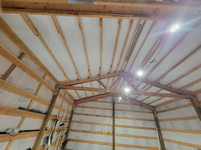
When it was built, this building just had some type of rolled out insulation on the purlins, then the metal roof on top with a 10 foot ridge vent. There is bird blocking vents installed in the 18" rake overhang. I have 2 metal walls and 2 walls that are T1-11. I ended up installing 1.5" R-tech polystyrene foam board in all the spaces between the girts, then taped all the seams. I am in the process of building stud walls on top of the girts, then maybe batt insulation (not sure if this is worth it).

Here is the plan I came up with. Please feel free to offer recommendations - I am open to hear your thoughts. I'm not super experienced in this area and just did what made sense in my head :LOL:.

  1. Install 2x4s (flat side down), perpendicular under the purlins, 24" OC to give some structure to mount stuff and additional air space for venting.
  2. Install some type of roll out underlayment on the 2x4s
  3. 1.5" foam board next - I made it pink in the attached picture, but the pink foam is expensive, so I was thinking of going with 1.5" R-tech polystyrene foam board.
  4. Install a ceiling, either drywall or metal.
 

Attachments

  • Vaulted ceiling.png
    Vaulted ceiling.png
    147.8 KB · Views: 56
  • Media (1).jpg
    Media (1).jpg
    389.1 KB · Views: 54
To avoid these ads, REGISTER NOW!

Firebrick43

Well-known member
Joined
May 12, 2015
Messages
14,026
Location
West central Indiana
Just making sure you were not calling rafters, “trusses”.

So why do you want to make you life living hell, waste money, and build an inferior ceiling system in both ventilation and insulation by doing a cathedral ceiling in between trusses?

Just thinking about cutting the ceiling panels makes me want to kick the dog and it’s not my project.
 

racecougar

Well-known member
Joined
Jan 26, 2021
Messages
5,046
Location
Missouri
Is there only venting on the gable ends, not at the soffits?

What is present currently (insulated roof deck with venting below open to the interior space) doesn't make much sense from a heating perspective.
 

billconner

Well-known member
Joined
Jul 20, 2021
Messages
6,963
Location
Thousand Islands NYS
I think you're ignoring the existing insulation and relying on just the foam, correct? The existing insulationis outside the venting. And I can't tell but the vent channels you are creating with new 2x4s do connect with soffit and ridge vents? The existing vinyl gives me dome pause as a double vapor barrier but not much. Not much different than roofing.

I do not understand what roll out underlayment is for or maybe what you mean, as to me it's a padding between sub floor and finish floor, mostly for noise. I dont see anything wrong with just the rigid foam across the new 2x4s.

I'd rather see the 2x4s on edge for a deeper vent channel, or even 2x3s, but is a smaller "target" for ceiling screws.

Will you block in the trusses? I think the weak point is gaps around the trusses that will allow warmer, moister interior air where the pressure from its buoyancy is greatest into the vent space and condenser on the top chords of the wood trusses. Not sure how you keep them dry. Your could box the top chords in rigid foam - or spray - and do some drywall or even coil stock around them.
 
OP
5

525playa

Member
Joined
Mar 25, 2019
Messages
6
Location
WA
I know this may not make a lot of sense for me to do, but I really appreciate your input. I'll try to address comments as I see them :)

@Firebrick43 - I built the building, then had a thought for vaulted ceilings afterwards - I want to avoid a dropped ceiling and work with what I have. I'm looking for some guidance on how I can make this whole situation a little bit less inferior. Agreed that this will be hell to do and since I don't have a dog to kick, myself will have to to :LOL:

@racecougar - You hit the nail on the head. Venting is only the bird blocking vents at the gable ends + the 10' ridge vent. I realize the vents to the open space doesn't make much sense from a heating perspective, which is why I'm trying to do what I can to separate the vents from the open interior.

@billconner - What is existing is the rolled out insulation before the metal roof was installed. I was just trying to add foam to help to some degree. As it sits right now, all I have for venting is the bird blocking vents at the gable ends + the 10' ridge vent, which are all open to the interior of the building - I added another pic of the ridge vent. You are right that I am trying to create a vent channel and if you think the 2x4 on edge will help, I'm all for it. I was trying to make the target area of the ceiling screws idiot proof, but I'm sure I can work with it! When I said "underlayment", I really meant like like a plastic vapor barrier or roof underlayment - for some reason I thought this might be good to keep the venting area separate from the foam, but I could be way off. I was thinking of blocking the bottom side of the top chords of the trusses. Whatever ceiling I install could be tight/caulked to the truss to keep the air separate :dunno:

1726295293448.png
 
To avoid these ads, REGISTER NOW!

billconner

Well-known member
Joined
Jul 20, 2021
Messages
6,963
Location
Thousand Islands NYS
I'm not sure what bird blocking vents on gable end are but are you saying there are no soffit or eave vents? Without a low vent in the vent channel, they won't do much.

I know of no reason to put vinyl or anything between foam and vent channel. Most vent channels are made of rigid foam. It doesn't wind wash like fiborous insulation.

As far as the ridge vent only in center 10' - you really should truncate the top - a small flat area end to find - so all the vent channels connect and can exhaust through that ridge vent.

Understanding more I'm leaning towards firebricks proposal to add framing at lower chord, put in a metal liner panel ceiling, and dump 10 or 15 inches of cellulose on it. Any vents in gables and the short ridge should vent this attic space.

Or remove most of the fibreglass and white vinyl, add 2x2s perpendicular to the outline, spray foam, and drywall.
 

racecougar

Well-known member
Joined
Jan 26, 2021
Messages
5,046
Location
Missouri
I'm not sure what bird blocking vents on gable end are but are you saying there are no soffit or eave vents? Without a low vent in the vent channel, they won't do much.
Bingo. From what the OP is saying and showing us, the only venting is a 10' ridge vent in the center of the building and vents along the gable ends, all exposed to the interior side of the insulation package. It doesn't make sense, nor is a path forward out of this mess particularly straightforward. Adding soffit venting would require pretty substantial changes to his framing. Sealing it all up and spray foaming it would require that he rip down the insulation already installed. It isn't the right way to go about it, but putting up a ceiling and blowing in insulation may be his only semi-reasonable path now, though I think I'd at least add a big gable vent on either end to try to get some worthwhile ventilation in the attic.

All this operates under the large assumption that the trusses can support a ceiling.

1726489053722.png
 
OP
5

525playa

Member
Joined
Mar 25, 2019
Messages
6
Location
WA
This is all making sense to me, thank you. So I think I really need to tackle the lack of soffit vents. In the absence of soffit vents and my current framing not making it easy to add any - in theory, if I added like 6 of these vents on each of the 36' side walls and piped into the air space I am trying to create, do you think this might take the place of soffit vents? I'm thinking I might need to block off the gable vents.

I will definitely be boxing off the trusses to seal between the airspace and the open area below.


1727242720449.png
 

Attachments

  • 1727242385898.png
    1727242385898.png
    178.7 KB · Views: 17

racecougar

Well-known member
Joined
Jan 26, 2021
Messages
5,046
Location
Missouri
Those are not going to offer nearly enough airflow. They don't list a NFA, as they're not intended for this use, but applying the typical 3% to their area, you'd need to install ~60 of them instead of 6.

Have you verified that the trusses are rated to carry a ceiling/insulation (have you found the bottom chord rating)?
 

chinboys

Well-known member
Joined
Jun 20, 2011
Messages
434
If you aspire to cool or heat the building at minimum annual costs, then get a Manual J calculation based on the amount of R-value insulation in the walls and ceiling.
If it were my space, I would go with 2 inches of closed-cell spray insulation to stop drafts (incoming and outgoing) on the walls and beneath the roof panels. I would add additional insulation (ease of install, cost per ft2) to the walls with a vapor barrier.
I would create a space between the bottom of the roof panels and the ceiling of the space to have soffit and ridge vents (powered attic ventilator) vent the "hot" air. I would add an R-42 or greater to the ceiling with an air moisture barrier.

You can play around with the types and rating of the insulation, thus their costs to calculate the worst case loads for cooling and heating.
You can also have a blower door test done to further prove the building's envelope has been air-sealed.
And lastly, have a thermal image scan to see where the heat or cool losses are.

Yes, it will be expensive in the short run but less expensive in the long run.
 

racecougar

Well-known member
Joined
Jan 26, 2021
Messages
5,046
Location
Missouri
If you aspire to cool or heat the building at minimum annual costs, then get a Manual J calculation based on the amount of R-value insulation in the walls and ceiling.
If it were my space, I would go with 2 inches of closed-cell spray insulation to stop drafts (incoming and outgoing) on the walls and beneath the roof panels. I would add additional insulation (ease of install, cost per ft2) to the walls with a vapor barrier.
I would create a space between the bottom of the roof panels and the ceiling of the space to have soffit and ridge vents (powered attic ventilator) vent the "hot" air. I would add an R-42 or greater to the ceiling with an air moisture barrier.

You can play around with the types and rating of the insulation, thus their costs to calculate the worst case loads for cooling and heating.
You can also have a blower door test done to further prove the building's envelope has been air-sealed.
And lastly, have a thermal image scan to see where the heat or cool losses are.

Yes, it will be expensive in the short run but less expensive in the long run.
He'll need to seal off the existing venting and pull down the existing roll insulation in order to spray foam it. He doesn't have soffits to vent. We don't know that his trusses can support a ceiling. The building certainly isn't air-sealed; the existing venting goes directly to the interior side of the existing minimal insulation.
 
To avoid these ads, REGISTER NOW!
Top Bottom