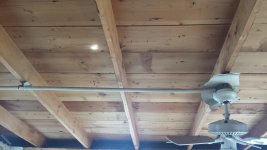
You can't put fiberglass insulation directly in contact with the bottom of the roof UNLESS there is adequate foam insulation on the top of the roof which it sounds like there is not.
The problem is that moisture in the air will move through the fiberglass and condense on the under side of the roof when it is cold. Putting a vapor barrier under the roof first doesn't change anything as it will then be the surface the water vapor condenses on. Putting a vapor barrier on the outside of the fiberglass is not advised because you then create a situation where moisture could be trapped between the vapor barrier and the shingles, leading to rot, mold, etc.
You could use closed cell spray foam on the bottom of the roof as it will insulate the roof deck from below keeping it warm enough that it will no longer be the condensing surface. Water vapor won't move much through closed cell foam anyway. Closed cell foam can be expensive so you could do what they call "flash & batt", which is to spray a layer of closed cell foam sufficient to stop water vapor from condensing on the bottom of the roof deck and then you can finish with fiberglass, mineral wool or other batt insulation.
Some people recommend a vent channel from the soffit to the roof peak before insulating.
Recommend you research insulating cathedral ceilings and unvented attics on
BuildingScience.com and
GreenBuildingAdvisor.com. There should be a chart on one or both of those sites that tells you how thick foam insulation needs to be either above the roof or below the roof to avoid the condensation issue. The amount is different for different climates.
DC