To avoid these ads, REGISTER NOW!

Insulation, air sealing and existing walls

Bert_

Well-known member
Joined
Dec 24, 2016
Messages
9,778
Location
NW Iowa
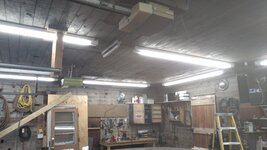
Recently I've been thinking about getting my garage sealed up better, maybe even a little insulation. The building is 24x38, it was moved and turned into a garage in the late 70's but was probably built 100 years ago. There is no vapor barrier or air sealing anywhere. The interior is completely lined with nailed tongue and groove 1x6's.

I have zero desire to pull down the 1x6's. A lot of them would get destroyed if I tried.

The attic is accessible and currently has an inch or two of vermiculite insulation. I thought about blowing insulation up there before but it really needs a vapor barrier. Creating a vapor barrier around the ceiling joists is a challenge.

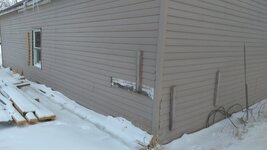
The walls may be simpler. The exterior is shiplap over the studs then wood bevel siding and finally vinyl over the top. The vinyl is coming off the nails in several spots and really need something done soonish. I could take it down to the shiplap then put on 3/4 or 1" styrofoam with taped seams and put whatever siding I decide back on top. Simple, stops air movement and gives me some insulation.

What does everyone think? Ideas are welcome. Doing nothing is probably still an option.
KIMG3179.JPG
 
Last edited:
To avoid these ads, REGISTER NOW!

billconner

Well-known member
Joined
Jul 20, 2021
Messages
6,971
Location
Thousand Islands NYS
I don't have a good solution for vapor barrier but if you can see wall cavities from attic, I'd dense pack cellulose in walls. It does a pretty good job of air sealing and is tolerant to moisture. Ceiling - I think I'd put poly over vermiculite and than a lot of cellulose on top. Exterior is largely cosmetic but sure, an inch or 2 of rigid foam would be terrific as well as minimize in wall condensation.

Of course any means of limiting interior moisture would help.
 

T444e

Well-known member
Joined
Feb 25, 2016
Messages
456
There are vapor barrier paints but I have no experience with them and don't know if they would work on wood. May be something to research.
 

Vahispd

Well-known member
Joined
Nov 21, 2012
Messages
141
Location
SE VA
One possibility for the attic is spray foam, and I think closed cell is a vapor barrier? Probably the most expensive solution though. You may be able to have a thin layer of foam sprayed to seal the ceiling and act as the vapor barrier, then use some other insulation to meet the r-value you want.
Another idea is to cut vapor barrier to fit between the ceiling joists and spray foam the barrier pieces to seal against the joists. Pick up a foam gun so you can control the bead size of the foam and use the larger cans. You can use 6 or 10 mil plastic for your vapor barrier, or rigid foam sheets might work. DIY allows you to work at your pace too.

I like your idea to add rigid foam on the outside of the garage, which is probably your best bet without opening up the walls.

Nice looking garage too BTW. Is the framing rough cut lumber?
 
OP
B

Bert_

Well-known member
Joined
Dec 24, 2016
Messages
9,778
Location
NW Iowa
One possibility for the attic is spray foam, and I think closed cell is a vapor barrier? Probably the most expensive solution though. You may be able to have a thin layer of foam sprayed to seal the ceiling and act as the vapor barrier, then use some other insulation to meet the r-value you want.
Another idea is to cut vapor barrier to fit between the ceiling joists and spray foam the barrier pieces to seal against the joists. Pick up a foam gun so you can control the bead size of the foam and use the larger cans. You can use 6 or 10 mil plastic for your vapor barrier, or rigid foam sheets might work. DIY allows you to work at your pace too.

I like your idea to add rigid foam on the outside of the garage, which is probably your best bet without opening up the walls.

Nice looking garage too BTW. Is the framing rough cut lumber?
Having an inch of foam sprayed in the attic has been a thought. I have talked to a few people who have had some done but I should really just get a formal quote. This would definitely be the fastest and least labor.

If I cut foam board for between the joints I could even go 1/2". I had thought about plastic but I just can't see how to make it seal with so many joints.

Really to do anything in the attic I think the vermiculite has to be removed. Not really looking forward to that, usually has asbestos in it.

I wouldn't call it rough cut, the boards have a pretty smooth surface. It was painted kind of a silvery grey a very long time ago. I wouldn't mind painting it again just to get better light reflection but I can never really decide, I like the well worn look.
 
OP
B

Bert_

Well-known member
Joined
Dec 24, 2016
Messages
9,778
Location
NW Iowa
There are vapor barrier paints but I have no experience with them and don't know if they would work on wood. May be something to research.
I don't think that will seal the roughly 3000 feet of tongue and groove joints?

I could probably caulk each joint but I can't imagine the time it would take. I guess a positive would be I would not have to remove the vermiculite.
 
OP
B

Bert_

Well-known member
Joined
Dec 24, 2016
Messages
9,778
Location
NW Iowa
Retrofit low expansion spray foam in the wall cavities.
Maybe I'll be willing to have an inch sprayed in the attic but it's not going to happen in the walls. Way too much expense to be worth it.

I can heat it now when I am out there. I saved a house furnace a few years ago so I set the thermostat to 50-55 and that's really nice.

I am really hoping that if I got it sealed up it would hold 32* or so. As it sits it usually stays at 32 till mid December. I've had the heat on a couple days this week and now it's been staying 20-25*. This is February and we have had some warm days but also a few highs around zero.
 
OP
B

Bert_

Well-known member
Joined
Dec 24, 2016
Messages
9,778
Location
NW Iowa
They drill holes from either inside or outside, and inject the foam. This is NOT a spray process.

My house is ~1,400 sf ranch, and the quote was ~$5,500.00.
I can't see spending 5500 just for insulation in the walls. It will never pay for itself. I'll just turn up the thermostat and live with it. Maybe in a house but not my garage.
 
OP
B

Bert_

Well-known member
Joined
Dec 24, 2016
Messages
9,778
Location
NW Iowa
Then why bother asking the question, eh?
I think there are alternatives that cost less.

The siding needs to come off and be nailed back up at a minimum. That is an opportunity to add maybe r5 exterior insulation which would also stop air movement. It wouldn't cost much more than the insulation itself at about $600. That's an amount I am perfectly willing to spend.

I have several spots where the siding came loose from the wall. The first spot happened a couple years ago. This year I noticed another big section is loose. I just screwed a 2x4 over the loose spots so it didn't blow off but it needs something done no matter what I do with insulation.
 

Attachments

  • KIMG3186.JPG
    KIMG3186.JPG
    386.9 KB · Views: 40
To avoid these ads, REGISTER NOW!

danski0224

Well-known member
Joined
Jan 29, 2005
Messages
13,541
Location
Near Naperville, IL
Adding insulation to the exterior will cause changes in door and window jambs. If the soffits are not deep, that can be another issue.

Then there is the issue of wavy siding due to nailing it into/through foam.

Good luck.
 

pcmeiners

Well-known member
Joined
Aug 13, 2009
Messages
7,963
Location
In the only town in Pennsylvania, Bloomsburg.
There are vapor barrier paints but I have no experience with them and don't know if they would work on wood. May be something to research.

ANY full coat of oil based paint is a vapor barrier, but insulate the wall cavity first. As to the attic, a thick layer of cellulose ( at least 10") will air seal itself, little moisture will get through it.
 
OP
B

Bert_

Well-known member
Joined
Dec 24, 2016
Messages
9,778
Location
NW Iowa
ANY full coat of oil based paint is a vapor barrier, but insulate the wall cavity first. As to the attic, a thick layer of cellulose ( at least 10") will air seal itself, little moisture will get through it.
You know I think I read that several years ago when I was going to blow insulation in my house. Everyone around here kept trying to talk me out of it saying fiberglass was so much better. I never made up my mind or got anything done on that project either.

So cellulose will stop air movement even with a ceiling that has lots of little gaps and cracks?
 

sparky 1971

Well-known member
Joined
Oct 9, 2018
Messages
8,023
Location
Central Iowa
I think cellulose blown in right on top of the vermiculite would take care of the attic. You could also blow cellulose into the walls after the vinyl comes off. It's a time consuming, thankless job but pretty easy. 1-1/2" hole at the top and bottom of the wall and blow the cavity full then plug them and put the siding back on. I've seen several old houses that had it done through the existing wood siding and the plugs look like **** but with your vinyl having to come off anyway, it would be ideal and cheap as long as you don't figure in the time factor.


dscheidt

Well-known member
Joined
Apr 26, 2017
Messages
2,909
You know I think I read that several years ago when I was going to blow insulation in my house. Everyone around here kept trying to talk me out of it saying fiberglass was so much better. I never made up my mind or got anything done on that project either.

So cellulose will stop air movement even with a ceiling that has lots of little gaps and cracks?

It will reduce it, but it's not a proper air sealing. Given the existing insulation needs to be treated like it's asbestos bearing, it's probably the way to go. blow in as much as you can physically fit -- that will both increase the insulation r-value but also reduces the air movement through the insulation .
 

pcmeiners

Well-known member
Joined
Aug 13, 2009
Messages
7,963
Location
In the only town in Pennsylvania, Bloomsburg.
So cellulose will stop air movement even with a ceiling that has lots of little gaps and cracks?
Cellulose does not stop air and moisture travel 100% but after it a short time it settles and stops most air movement and moisture; unlike fiberglass, especially fiberglass batts.
If you have a decent depth of cellulose ( 6" or more) condensation will not be an issue. The negative, if it get wet, it can take down ceiling Sheetrock, and it take a long time to dry, and can hide small leaks. Added advantages, fire resistant, sound dampening, rodent do not like it. I have fiberglass from a previous owner in my attic, rodents love it.
 

theoldwizard1

Well-known member
Joined
Feb 22, 2011
Messages
43,311
Location
SE MI
Recently I've been thinking about getting my garage sealed up better, ...

I have zero desire to pull down the 1x6's (T&G) . A lot of them would get destroyed if I tried.
Dad had a cabin put north (MI). Same situation. He DID remove the the knotty pine T&G, but lost about 25% of it. And it took FOREVER !

The attic is accessible and currently has an inch or two of vermiculite insulation. I thought about blowing insulation up there before but it really needs a vapor barrier. Creating a vapor barrier around the ceiling joists is a challenge.
The only solution to get a vaper barrier in the attic is 2" of spray foam on the underside of the roof deck.

Don't get to hung up on the vapor barrier ! Adding insulation always helps. 4"-6" additional in the attic will make a big difference.
 
OP
B

Bert_

Well-known member
Joined
Dec 24, 2016
Messages
9,778
Location
NW Iowa
At the moment I like the idea of cellulose in the attic. Insulates, stops most air movement, and it's cheap. If some moisture gets into it the attic should dry pretty well to the top.

I'm still not sold on cellulose in the wall. At least not without a real vapor barrier. Seems like a good way to end up with a damp wall.
 

pcmeiners

Well-known member
Joined
Aug 13, 2009
Messages
7,963
Location
In the only town in Pennsylvania, Bloomsburg.
If you make holes in each stud, almost top and bottom of each stud (one foot from top and bottom), pack each hole (machine noise will bogg down if packed), you not going to have condensation in the wall cavity; it does settle a bit over years. If you do not pack it or leave voids from chocks within the stud cavities, all bets are off. Easy enough to know if there are chocks in a stud area, the cavity boggs down too quick. Again water leaks are an issue with cellulose, just as it is an issue with blown fiberglass insulation, just worse. As to insulation value, cellulose is far superior to fiberglass, especially at low temperatures and as far as air infiltration. Lastly fiberglass ***** as to itching and requires multiple washes to get it removed from clothes; as to irritation, a tiny bit of fiberglass goes along way in making one uncomfortable.
 
To avoid these ads, REGISTER NOW!
Top Bottom