To avoid these ads, REGISTER NOW!

Insulation / Condensation concerns

Enjoytheride

Member
Joined
Aug 10, 2015
Messages
14
I'm in the process of finishing off the inside of my 30' x 40' pole barn and second guessing myself in regards to insulation and condensation.

A few details first.

Full ridge vent and pergola
Air baffles for soffit air flow
Vapor barrier under metal roof
4" concrete floor with vapor barrier
2x4 framing flush with front of 6x6 post
R19 insulated walls / attic will be blown in
Future climate control planned with mini split
Location S.E. Pa.

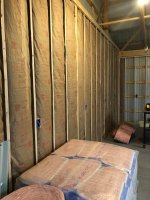
The R19 insulation touches the interior of the metal siding (see photo) at certain points.

My concern is that I'm fooling myself to think condensation will not be an issue on the interior of the metal walls once finished and climate controlled. . . ?

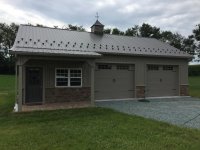
Please review the photos. . any feedback or experience would be appreciated!

Thanks in advance!
 

Attachments

  • IMG_1045.jpg
    IMG_1045.jpg
    145.1 KB · Views: 151
  • IMG_0542.jpg
    IMG_0542.jpg
    129.5 KB · Views: 139
  • IMG_0540.jpg
    IMG_0540.jpg
    144.1 KB · Views: 139
To avoid these ads, REGISTER NOW!

850xpeps

Well-known member
Joined
Aug 6, 2017
Messages
1,365
Your vapour barrier must be on the warm side of the insulation.

For your ceiling you install vapour barrier on trusses and then sheet metal. R19 will not be enough for the ceiling. Min r50 is code in Canada. I’m not sure what the reason is for the paper back insulation? It doesn’t fill the space properly like batts do. And you still need a vapour barrier imo on the outside of it. We also seal joints in the vapour barrier with accoustical sealant and tape. Limit air leakage which is what causes moisture. I don’t think there is an issue with the insulation touching the tin. There is still some air movement there.

Very nice exterior love the look.

I’ve never understood the reasoning behind a pole shed? When you must frame inside the poles anyway why not just build a stick framed building?
 

stm317

Well-known member
Joined
Aug 8, 2017
Messages
1,339
Ideally, you'd have a moisture barrier like Tyvek between the metal and insulation. Foam board insulation between the girts would help too. If you move the flaps on the insulation to the short 'ends' of the framing, rather than securing it to the sides of the studs it will probably pull it closer to the interior of the building and keep it from touching the metal. That won't eliminate moisture, but it would keep condensation from wicking into the insulation.
 
OP
E

Enjoytheride

Member
Joined
Aug 10, 2015
Messages
14
Thanks. . I'm real pleased with the outside and how it fits with the house. My decision to go with a pole barn was because of the cost factor. Even with me framing the inside. . . a stick build would have been considerably more with foundation and such. The pole building and floor cost $31,500. I was quoted a basic stick build at $40,000

Your vapour barrier must be on the warm side of the insulation.

For your ceiling you install vapour barrier on trusses and then sheet metal. R19 will not be enough for the ceiling. Min r50 is code in Canada. I’m not sure what the reason is for the paper back insulation? It doesn’t fill the space properly like batts do. And you still need a vapour barrier imo on the outside of it. We also seal joints in the vapour barrier with accoustical sealant and tape. Limit air leakage which is what causes moisture. I don’t think there is an issue with the insulation touching the tin. There is still some air movement there.

Very nice exterior love the look.

I’ve never understood the reasoning behind a pole shed? When you must frame inside the poles anyway why not just build a stick framed building?
 

850xpeps

Well-known member
Joined
Aug 6, 2017
Messages
1,365
Thanks. . I'm real pleased with the outside and how it fits with the house. My decision to go with a pole barn was because of the cost factor. Even with me framing the inside. . . a stick build would have been considerably more with foundation and such. The pole building and floor cost $31,500. I was quoted a basic stick build at $40,000


Even with stud infill? Which to me takes more time than building one long wall.

What would a stick built require for foundation? all I would do here is a thickened edge slab probably 16”-24” down and likewise in then slope up to slab thickness. Easy done in one shot. Much easier to finish in the open than inside a building as well.
 
OP
E

Enjoytheride

Member
Joined
Aug 10, 2015
Messages
14
A foundation is required in our area. . .


Even with stud infill? Which to me takes more time than building one long wall.

What would a stick built require for foundation? all I would do here is a thickened edge slab probably 16”-24” down and likewise in then slope up to slab thickness. Easy done in one shot. Much easier to finish in the open than inside a building as well.
 

stm317

Well-known member
Joined
Aug 8, 2017
Messages
1,339
Even with stud infill? Which to me takes more time than building one long wall.

What would a stick built require for foundation? all I would do here is a thickened edge slab probably 16”-24” down and likewise in then slope up to slab thickness. Easy done in one shot. Much easier to finish in the open than inside a building as well.

A pole building gives more flexibility with time and budget. My 32x48 pole building went from empty lot to closed up shell with slab in 5 working days. After that, I had a dry place to store stuff while I work to finish the inside at my own pace as time and money allow.
The total finished cost might've been close between stick built and pole barn with a finished interior, but with a pole building I can do everything in stages, instead of having to spend all of that money upfront.
 

yeldogt

Well-known member
Joined
Jan 2, 2012
Messages
18,184
What's the VB under the roof? Typically people use the wrapped insulation with finished pole buildings -- this protects the product from the moisture from inside (people and wet equipment) and outside (rain and moisture from humidity) A typical stick building would have a rain screen product on the sheathing that would allow for vapor transfer?

People should use the savings with pole construction to upgrade to foam -- end of problems.
 
To avoid these ads, REGISTER NOW!

JamesW84

Well-known member
Joined
Jul 13, 2015
Messages
827
Location
Springfield, MO
I've been researching this pretty heavily the past couple weeks. You can find lots of threads about it here and other places. I'd say do like yeldogt said and install house wrap air barrier between the metal and the girts (remove the metal a wall at a time, do house wrap, then replace metal). Make sure to seal it up good. On a side note, I read a few threads about "regrets or things you would have done differently if you could do over"...house wrap (air barrier) was on there a few times. If it were me, I'd probably consider removing the girts, put house wrap on the stud walls, then put the girts back and then metal to give the metal some air, but I'm not sure that's necessary

Some recommend on the inside, poke holes or remove the kraft paper and use a plastic vapor barrier sealed well to keep moisture from passing. If your kraft paper is sealed well, it should serve as a vapor barrier as long as you don't get it torn. You'll have to put OSB, Drywall, plywood or something on the inside.
 

matt_i

Well-known member
Joined
Mar 14, 2008
Messages
10,726
Location
SE Michigan
First, great looking place, I really like the stone detail.

A possibility is to abandon the kraft paper and go with Roxul. It "fits" more tightly which leaves less of a possibility of an air draft being able to bathe the inside of the metal with a moist air jet. Also will not harbor organic growth, such as mold which can grow in the fiberglass if it gets wet. The Roxul also has a higher R-value per inch.

Back to where the moisture is coming from, in my opinion its going to be from high-humidity air originating outside...in a residence where there's cooking, washing, showering, etc that all punches up the internal humidity is typically not a thing in a workshop/garage.

You could reuse the fiberglass in the attic, where "more is more" and who cares where it came from.
 

tonyciambrone

Well-known member
Joined
Nov 4, 2015
Messages
1,152
Location
Northern Illinois
First, great looking place, I really like the stone detail.

A possibility is to abandon the kraft paper and go with Roxul. It "fits" more tightly which leaves less of a possibility of an air draft being able to bathe the inside of the metal with a moist air jet. Also will not harbor organic growth, such as mold which can grow in the fiberglass if it gets wet. The Roxul also has a higher R-value per inch.
.

If you must use batt type insulation Roxul/ Mineral Wool is the best imo. It can be compression fit, the r value is higher, it is easier to cut straight, deadens sound, more fire resistant, especially vs kraft paper. I used it for the first time a few weeks ago and I am sold on it. A bit pricier and harder to transport large quantities because it doesn't compress.
 

Radix2

Well-known member
Joined
May 28, 2014
Messages
1,853
Location
the thumb!, MI
If you are going to finish the inside with drywall, taped and painted, you are good to go. What you have is close to what 90% of new construction has. Metal siding is not going to make a huge difference over sheathed/sided (ok it may be more leaky, but that leaves a path to dry too...not much can be done to seal metal panels anyway)

The issue with vapor barriers is to prevent warm wet air from the inside from getting to your cold outside surface and condensing. House-wrap on the outside won't help that. A finished drywall interior will, your climate control on the inside will. Cellulose will have less airflow and will help as well.

So my opinion is if you are worried, put your efforts into detailing the inside to prevent air and moisture migration to the outside, this is also the right thing to do to lower your heating and cooling costs.

And as said above, consider if you have high moisture activities inside at all, standing water, cooking, etc. if it is shop type activities and exterior vented heating sources, it should be better than typical living areas to start with.
 
Last edited:

yeldogt

Well-known member
Joined
Jan 2, 2012
Messages
18,184
A proper building breaths -- it's alive. Don't kill it with plastic VB. Buildings need to breathe from both inside and out ...... that's why foam works so well.

Encapsulated insulation is an engineered product and can't be easily duplicated -- it works if not damaged. The insulation is protected from moisture inside and out --

A wet car will bring in a lot of moisture
 

JamesW84

Well-known member
Joined
Jul 13, 2015
Messages
827
Location
Springfield, MO
A proper building breaths -- it's alive. Don't kill it with plastic VB. Buildings need to breathe from both inside and out ...... that's why foam works so well.

Encapsulated insulation is an engineered product and can't be easily duplicated -- it works if not damaged. The insulation is protected from moisture inside and out --

A wet car will bring in a lot of moisture

Spray foam is an air barrier also. How would spray foam let a building breathe better than a plastic vapor barrier?

You want your vapor barrier on the warm inside. A double vapor barrier is not a good idea. Pressing fiberglass up against metal (vapor barrier) with plastic on the inside is not recommended from the research I've done, which is why the house wrap is used to keep the fiberglass off of the metal and to allow a little air space.

I'm no expert.
 

850xpeps

Well-known member
Joined
Aug 6, 2017
Messages
1,365
A proper building breaths -- it's alive. Don't kill it with plastic VB. Buildings need to breathe from both inside and out ...... that's why foam works so well.

Encapsulated insulation is an engineered product and can't be easily duplicated -- it works if not damaged. The insulation is protected from moisture inside and out --

A wet car will bring in a lot of moisture


Improper but started off right. Yes a building needs to breathe. Don’t trap moisture between 2 vb. One on the inside of insulation is all that’s needed. A moisture barrier on the outside to shed water. Spray foam is good to stop any air leakage. However when you don’t let the air move through the walls you need an hrv to swap inside air with outside air but maintain the warmth in the air.
 

TTTTTT

Well-known member
Joined
Jun 23, 2014
Messages
164
Location
Steenburg Lake, Ontario
A proper building breaths -- it's alive. Don't kill it with plastic VB. Buildings need to breathe from both inside and out ...... that's why foam works so well.

Encapsulated insulation is an engineered product and can't be easily duplicated -- it works if not damaged. The insulation is protected from moisture inside and out --

A wet car will bring in a lot of moisture
Wrong on that depending on climate. Any cold climate must have a vapour barrier or a seal of some kind which is exactly what closed cell spray foam does even only a few inches. You must stop air flow from cold to the warm side. Experiencing -30 c this year a few times illustrated all to clearly in a few spots. Warmer climates that may stay above freezing would be a different story.

Sent from my HTC One M9 using Tapatalk
 
To avoid these ads, REGISTER NOW!
Top Bottom