Hello everyone, I’ve been scrolling through the forums on this and found most people agree the foamular 250xps is what most people are using. Most the threads were fairly old so wanted to see if that’s still the consensus? Is 25psi enough? My concrete is gonna be 5” thick monolithic slab with rebar with 4’ deep footers. Looked at the foamular 400 xps but the price almost doubles and if I need it I’ll do it just wanna make sure before spending the extra coin. The shop is gonna have heavy equipment in it but don’t see anything over 30-40k lbs coming into it. Thanks


You are using an out of date browser. It may not display this or other websites correctly.
You should upgrade or use an alternative browser.
You should upgrade or use an alternative browser.
Insulation foam board for monolithic slab
- Thread starter Tadd33
- Start date
softailgarage
Well-known member
Monolithic slab? Like "A Space Odyssey" ? or Easter Island?
Most people are using XPS because of tradition that started from an earlier belief that forces moved through concrete at 45° angles from a point load. It’s a waste of money. EPS is fine, but you can take the individual wheel or track segment loads from your heaviest potential piece of equipment and figure it out for yourself based on the formula in this article linked below. I’ve seen jet hangers and warehouses built with EPS under slab. I think more important would be a higher psi mix (4000psi), rebar (18” spacing or more), thicker concrete (6” or more), soil quality and compaction. Also you might consider using Mono slab ez forms if you are doing the forming yourself to save money, so you aren’t wasting concrete in footers and can put that into a thicker slab.
article: https://www.structuremag.org/?p=1812
Or
 www.insulfoam.com
article: https://www.structuremag.org/?p=1812
Or
Right-sizing Under-slab Insulation – Insulfoam
Originally published in Structure Magazine, Structural Economics section, April 2014 Structural Economics: cost benefits, value engineering, economic analysis, life cycle costing and more... Applying the Theory of Plates on Elastic Foundations to Save Material Costs.
www.insulfoam.com
billconner
Well-known member
25 psi is 3600 psf. Consider average soil has a bearing capacity of 2000 psf or so. A parking garage has a code required design load of 40 pad. Even EPS has more bearing strength than most soils under foundations.
Now, if you are interested in being "green", look into Glavel - a foamed recycled glass that is both insulation and base.
Now, if you are interested in being "green", look into Glavel - a foamed recycled glass that is both insulation and base.
ConCretin
Well-known member
25 psi is fine for your application. You can use either XPS or EPS as long as it meets ASTM C578. Just out of curiosity, I assume you are using radiant in-floor heat?
Did I read correctly that your 'footers' are going to be 4' deep? That doesn't sound like a traditional monolithic slab, which has thickened edges for load bearing and doesn't provide inherent frost protection unless you add insulation to create a SFPF. Depending on your soil conditions, this could be challenging to build. If you don't mind me asking, what is the idea behind this design?
Did I read correctly that your 'footers' are going to be 4' deep? That doesn't sound like a traditional monolithic slab, which has thickened edges for load bearing and doesn't provide inherent frost protection unless you add insulation to create a SFPF. Depending on your soil conditions, this could be challenging to build. If you don't mind me asking, what is the idea behind this design?
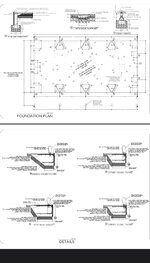
Gotcha thank you guys. And yes using radiant floor heating and so we did a 4 foot over excavate and back filled and tested and compacted in 6” lifts with road base. And they call for insulation under the slab and around the edges of the foundation. Had a local engineering firm design a foundation for me but they weren’t very helpful with what insulation board to use.
Attachments
ConCretin
Well-known member
Thanks for the additional info. Interesting project. Those are some pretty massive footings under the steel columns. Your steel building must be imposing some major loads to the foundation. Either that or it is seriously over designed.
What stage are you in? I'm curious about the construction sequence and how difficult it will be to shape those deep haunches between the column locations. I wouldn't want to be a contractor trying to build something that looks like what the plans show.
What stage are you in? I'm curious about the construction sequence and how difficult it will be to shape those deep haunches between the column locations. I wouldn't want to be a contractor trying to build something that looks like what the plans show.
billconner
Well-known member
Beefy slab.