To avoid these ads, REGISTER NOW!

Insulation / heat reflective approach

nonhog

Well-known member
Joined
Nov 6, 2007
Messages
2,449
Location
Arizona (Tucson)
Been reading (a bunch) re: radiant heat barriers as well as insulation .
Want both ! I have a loft that gets pretty hot in summer , so it makes sence to use a reflective barrier but most do little or nothing for heat retention .
Has anybody ran into this ?
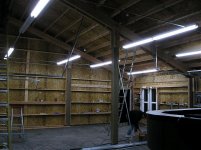
I have a pole building with half metal /half osb walls , mention this because the walls in the loft are half and half . The ceiling is open rafters with osb sheets under the metal roof.
I am thinking I would put up a barrier near the roofing(with air space) then insulate below that ?
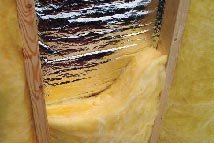
Hope these pictures help !
 

Attachments

  • P1010305.jpg
    P1010305.jpg
    68.7 KB · Views: 200
  • Shop lights.jpg
    Shop lights.jpg
    56.3 KB · Views: 130
To avoid these ads, REGISTER NOW!

yotachad

Member
Joined
Sep 16, 2008
Messages
20
Not to change the subject but man check out the white spots closer you have a couple ghost orbs in your race track pic!
 

Torque1st

MEMBER EMERITUS
Joined
Sep 14, 2008
Messages
5,668
Location
KC Metro, Kansas
The radiant foil barrier will need to be perforated or it will act as a vapor barrier along with the one toward the room allowing moisture to collect inside your insulation.
 

timgr

Well-known member
Joined
Dec 19, 2006
Messages
544
Location
Medford, MA USA
I used the aluminized double bubble next to the occupied space, and fiberglass between the ADB and the roof sheathing. My garage is stick-built, but the principle is the same. In my case, the ADB acts as a moisture barrier, and is seam-sealed with aluminum tape and glued down at the edges with silicone. I put a lot of effort into sealing all the possible air infiltration points.
 

Torque1st

MEMBER EMERITUS
Joined
Sep 14, 2008
Messages
5,668
Location
KC Metro, Kansas
It looks like he wants to use the radiant towards the roof to reflect the heat from the roof surface in the summer. I have thought about the same thing for my roof. Even perforated the foil will reflect the infra-red radiation.
 
OP
N

nonhog

Well-known member
Joined
Nov 6, 2007
Messages
2,449
Location
Arizona (Tucson)
Not to change the subject but man check out the white spots closer you have a couple ghost orbs in your race track pic!

Should never built over that buriel grounds :shocking:

I used the aluminized double bubble next to the occupied space, and fiberglass between the ADB and the roof sheathing. My garage is stick-built, but the principle is the same. In my case, the ADB acts as a moisture barrier, and is seam-sealed with aluminum tape and glued down at the edges with silicone. I put a lot of effort into sealing all the possible air infiltration points.

Got pics ?
 
OP
N

nonhog

Well-known member
Joined
Nov 6, 2007
Messages
2,449
Location
Arizona (Tucson)
Just when I think I am getting close to figuring it out, something changes
I may go with this company http://www.insulation4less.com/

There site shows some differant approaches :headscrat More studying !
I'm thinking I'd sheetrock my ceiling and my "wood" walls and maybe put up
pegboard over the FBF (DBF) that would be over my metal walls ?

The big question now boils down to the placement of the radiant barrier on the ceiling "IF" moisture goes through sheetrock would'nt the sheetrock be at risk being on the room (warm) side of the vapor barrier (radiant barrier) or is that why some are suggesting to slice the radiant barrier ?
Is this just an issue on ceilings ? see wall picture..........

I see to many sides to this :shocking:
 

Attachments

  • install_cathmethod2.jpg
    install_cathmethod2.jpg
    20.5 KB · Views: 83
  • install06.jpg
    install06.jpg
    13.7 KB · Views: 66
To avoid these ads, REGISTER NOW!

timgr

Well-known member
Joined
Dec 19, 2006
Messages
544
Location
Medford, MA USA
FBF is foil-bubblewrap-foil, DBF is double-bubble-foil, ADB is aluminized-double-bubble ...

You can get perforated foil. If I weren't going to use the foil as a vapor barrier, I'd use plastic sheet under the sheetrock. In the picture, the rigid insulation acts as a vapor barrier I presume.

I don't think it matters whether you place your foil on the hot or cold side of the fiberglass batts. Either approach should be equally effective. I'd guess that making the air gap on the attic side is easier than installing all that strapping, so the usual approach is to put the reflective barrier in the attic.
 

Dragster Racer

Well-known member
Joined
Feb 9, 2008
Messages
1,891
Location
Morrison, IL
I would think that it depends on what you are trying to reflect. You can only reflect heat, so are you trying to keep heat out, or in? That was my only thought. It's pretty interesting stuff.
 
OP
N

nonhog

Well-known member
Joined
Nov 6, 2007
Messages
2,449
Location
Arizona (Tucson)
I would think that it depends on what you are trying to reflect. You can only reflect heat, so are you trying to keep heat out, or in? That was my only thought. It's pretty interesting stuff.

Well both here in the Northwest we have long (mild) winters , so heat in .
AND we have 2-3 weeks:):) of heat every summer , so heat out. :thumbup:
just want to be efficient !
 

timgr

Well-known member
Joined
Dec 19, 2006
Messages
544
Location
Medford, MA USA
I only have my physical intuition to test this with, but here's how I picture it.

The fiberglass insulation is not really a barrier to heat - instead it is like a maze that slows the rate of heat transfer across it. Given enough time, temperatures on both sides of the insulation will come to an equilibrium. Insulation's value is that it slows the rate of heat transfer so that, once the interior is at the temperature that you want, you only have to add or remove a small amount of heat in order to keep up with the heat transfer.

The reflective barrier is just that - a barrier. Some of the heat coming in will be infrared radiation, and the barrier reflects some of that back toward its source.

Let's say that it's summer, and you want to block heat coming through the roof. If you put the barrier close to the roof and the insulation next to the living space, the barrier will reflect some heat and keep the outer surface of the insulation cooler. This means that the temperature gradient across the insulation is reduced, and the smaller the gradient, the lower the rate of heat loss.

Now let's say you want to heat the living space. The same principles apply, but this time, the barrier reflects heat back at the insulation, raising the temperature of its outside surface. Again, this reduces the temperature gradient across the insulation which slows the rate of heat loss.

I'm pretty sure the heat transfer across the insulation is a linear process, ie the greater the gradient, the faster the rate. However it may be that the efficiency of the barrier is dependent on the temperature - even if this were true, I don't think there's enough difference in absolute temperature at the barrier between these cases to make a difference. Recall that 0 degrees C is 273 degrees absolute (Kelvin) so the largest chang we would see is about -40 to 40 C, 233 to 313K, which is about a 25% change. Even if this matters, I think it's likely a second order effect.

So I think it does not matter much, if at all, which side you put the barrier on.
 

BeemerBarn

Member
Joined
Dec 17, 2011
Messages
18
Hi Nonhog! and all participants of this thread

I am a new member who discovered this great forum while browsing the web few hours ago.

Just read this thread and wondered how Nonhog fixed his problem and if he was satisfied with the result?

In fact I have the same issue, I need insulation for let's say %70 heat in summer and %30 for "winter cold" as I am based in Los Angeles in the valley near Pasadena, CA.

My concrete slab is without insulation, my roof is kind of barn shaped and the building is made of %100 wood... Its a 2.5 cars garage with a second floor under the roof used as office space and storage.

I'll be interested to learn from your experience.

Have a nice weekend!
Cheers
Fred
 
To avoid these ads, REGISTER NOW!
Top Bottom