Hello - I will soon be getting a 30'x45' metal building installed in the next couple months. The building will be split into a 30'x15' section that will serve as a "cabin" and occasionally be heated on weekends during hunting season or when I am out working at my property. The other 30'x30' section will be used to store a work truck, tractor, etc. I may run a heater in that section once in a great while. I was planning on having woven R-17 installed on the entire roof and the walls of the 30'x15' section, and to save some money, having double installed on the 3 exterior wall sections of the 30'x30' side. I know nothing about insulation, so would this causing any problems by having different types of insulations on the walls of the building? Would I be better off just going with the woven r-17 in the entire building (buy once, cry once)? Those 2 insulations are my only options during install from the builder. I do not want to use spray foam, and I also considered getting vinyl faced batt installed after the building was construction, however my preference is to have the insulation installed during the build process as I have heard that is the better route to go then patching it in. Does any one have any insight or advice they could offer? Thanks in advance!

You are using an out of date browser. It may not display this or other websites correctly.
You should upgrade or use an alternative browser.
You should upgrade or use an alternative browser.
Insulation question for new metal building
- Thread starter blong99
- Start date
readhead
Well-known member
Woven insulation is a new term to me. Maybe a regional thing. I always encourage my customers to use vinyl faced fiberglass. The main consideration is that it will never be as inexpensive as when the building is erected.
What type of building are you having installed? Tube steel, cold formed or red iron?
What type of building are you having installed? Tube steel, cold formed or red iron?
Sorry for my ignorance in construction knowledge. The building is from Carolina Carports, so my guess is tube steel. A friend knows a guy that does metal building construction and he recommends the vinyl faced fiberglass as well. Unfortunately, with the company I am using, this is not an option during construction.
dcg9381
Well-known member
Since foam isn't an option..
Most of your heat loss/gain is going to be on the roof. That's why you see recommended R values much higher for attics/roofs than exterior walls.
Where are you? The question that always comes up is condensation. Up north we've used "mixed" insulation (closed cell foam with bat insulation) with great success in garage/apartment type arrangements, foam up north may necessitate an ERV/HRV. With other insulation types it's not as big a deal.
The other common construction is some sort of exterior or interior foam board, then bat insulation behind it.
Yes, you can R-17 the entire building and then as you build out inside basically double insulate the "living space"..
Most of your heat loss/gain is going to be on the roof. That's why you see recommended R values much higher for attics/roofs than exterior walls.
Where are you? The question that always comes up is condensation. Up north we've used "mixed" insulation (closed cell foam with bat insulation) with great success in garage/apartment type arrangements, foam up north may necessitate an ERV/HRV. With other insulation types it's not as big a deal.
The other common construction is some sort of exterior or interior foam board, then bat insulation behind it.
Yes, you can R-17 the entire building and then as you build out inside basically double insulate the "living space"..
jack stand
Well-known member
I've always wondered on these buildings that are insulated by the erection crew that typically roll out wide rolls over the the exterior of the framing. Compressing f/g insulation (by sandwiching it between the exterior metal and the framing) makes it no longer much of an insulator a depending on the spacing of the "framing" members, what are you really getting for your money?
The labor for this type of "insulation" is next to zilch unless it's windy that day, and the f/g material is not far from it either.
How much is this insulation going to cost you?
The labor for this type of "insulation" is next to zilch unless it's windy that day, and the f/g material is not far from it either.
How much is this insulation going to cost you?
dcg9381
Well-known member
I've always wondered on these buildings that are insulated by the erection crew that typically roll out wide rolls over the the exterior of the framing. Compressing f/g insulation (by sandwiching it between the exterior metal and the framing) makes it no longer much of an insulator a depending on the spacing of the "framing" members, what are you really getting for your money?
The labor for this type of "insulation" is next to zilch unless it's windy that day, and the f/g material is not far from it either.
How much is this insulation going to cost you?
Where it gets compressed, the thermal bridging is probably high. But same thing if you insulate with bat. Foam is different as you cover the framing.
I don't trust the guys who build buildings to steer me right for insulation, but definitely some insulation (even the blanket type) is better than the alternative.
FLIR camera would probably tell the tale.
Thanks for all of the replies. The building will be in NE Kansas. With a discount they have going, the woven r-17 looks like it is going to run about $2.50/sqft. The spray foam estimate I got was $2.40 (2" thick closed cell) and 3" vinyl faced batt was between $1.75 and $2.00 (and that was going to have to be installed after the building was constructed so issues where the siding and frame meet.
jack stand
Well-known member
And the insulation value very low on either side of the "pinch" until it's back to its rated loft or thickness. This could you easily be 12"-16" of very compromised insulation value throughout the whole structure.Where it gets compressed, the thermal bridging is probably high.
It all depends on what comfort he's looking for, and what it's costing him. If he's any type of a DIY guy, I'd suggest finding some inexpensive used p-iso from a commercial re roof and cut and fit in between or over the tubes. Tight fitting and glue should hold it in.
jack stand
Well-known member
Spray foam all the way.Thanks for all of the replies. The building will be in NE Kansas. With a discount they have going, the woven r-17 looks like it is going to run about $2.50/sqft. The spray foam estimate I got was $2.40 (2" thick closed cell) and 3" vinyl faced batt was between $1.75 and $2.00 (and that was going to have to be installed after the building was constructed so issues where the siding and frame meet.

Not only will it be multiple times better comfort and heating or cooling, but I'll also add tremendous strength to the building.
I run away from that "woven" **** for that price as fast as I could.... right over to the spray guys door step!
jack stand
Well-known member
Hey @blong99
I also am not familiar with the term "woven". I assume that it's some sort of roll out fiberglass with a woven cover.
The only advantage to this stuff is it's easy (little labor) to install and requires no additional interior framing to support conventional f/g batts.
The insulating performance is underwhelming, but it can always be improved on later with additional insulation. Imho this stuff should be WELL UNDER $1/sf.
You can have a premium insulation job closed cell spray foam) for a 10c/sf savings for a sub par quickie fiberglass job, do it.
If this woven stuff is not what I described above, then I'm just full of **** and please excuses me.
I also am not familiar with the term "woven". I assume that it's some sort of roll out fiberglass with a woven cover.
The only advantage to this stuff is it's easy (little labor) to install and requires no additional interior framing to support conventional f/g batts.
The insulating performance is underwhelming, but it can always be improved on later with additional insulation. Imho this stuff should be WELL UNDER $1/sf.
You can have a premium insulation job closed cell spray foam) for a 10c/sf savings for a sub par quickie fiberglass job, do it.
If this woven stuff is not what I described above, then I'm just full of **** and please excuses me.
Thanks for everyone's feedback! Since I will not be heating the building most of the time, my primary concern is condensation/vapor. I would just hate for it to start rusting prematurely. I cannot find much on the Woven R-17. Here is a description I found and they say it is about 3/4" thick. One positive is it does look pretty good installed (since I will not be enclosing the inside of the building).
" This is a mixture of aluminum foil, bubble material, and woven material, which combine to produce the R17 rating. Woven insulation has a higher R-value rating and is a better option for controlling the temperature in a metal building."
" This is a mixture of aluminum foil, bubble material, and woven material, which combine to produce the R17 rating. Woven insulation has a higher R-value rating and is a better option for controlling the temperature in a metal building."
Attachments


readhead
Well-known member
Thanks Okay, I haven’t heard it called woven but I have used it and it performs pretty well. The radiant barrier works very well.
It is generally recommended that if a building isn’t going to be insulated during erection then a thermal break tape should be installed on all the secondary steel to separate the sheeting from the framing. Unfortunately most people don’t go for the tape because they are trying to save money by insulating later.
It is generally recommended that if a building isn’t going to be insulated during erection then a thermal break tape should be installed on all the secondary steel to separate the sheeting from the framing. Unfortunately most people don’t go for the tape because they are trying to save money by insulating later.
misterfixit
Well-known member
I'll give my 2 cents worth. I have 2 buildings, the first is our home, a 'barndominium', metal frame welded construction with R-panel exterior. When I built that I put the 6' wide rolls of insulation in, the insulation was the bubble wrap with a foil backer. In my opinion based on that experience I will say that that bubble insulation is just barely better than nothing. It's too thin and just doesn't do much.
The other building I have is a shop, same type welded frame with R-panel exterior. In that one I had closed cell foam sprayed in, about 1" thick on walls and ceiling. That makes a huge, and I mean huge improvement! I will never use any of the roll insulation again. The spray foam does cost more but there are many advantages, the main one is that the closed cell foam seals everything. Imagine spraying bed liner over the interior of the wall. It helps stiffen it up walls, quietens down wind and rain, and removes all drafts. The draft thing is a biggie.
The other building I have is a shop, same type welded frame with R-panel exterior. In that one I had closed cell foam sprayed in, about 1" thick on walls and ceiling. That makes a huge, and I mean huge improvement! I will never use any of the roll insulation again. The spray foam does cost more but there are many advantages, the main one is that the closed cell foam seals everything. Imagine spraying bed liner over the interior of the wall. It helps stiffen it up walls, quietens down wind and rain, and removes all drafts. The draft thing is a biggie.
All metal building that dont have spray foam will start to produce condensation, i also did metal building close cell 4” on ceiling 3” on walls. Expensive but well worth it, with any thing else you will get some moister and over time effect the insulation. Make sure if you were to use it check for leaks first go through rain season. You could always flash and batt that would still be better than strait up insulation. Spray 2” of stray foam then batt it. The spray foam will seal any crack or air gaps.
kj_mustang
Well-known member
I would bet a very large sum of money on that insulation not coming close to R-17 rating. 2" thick foam sheets are only R-10
readhead
Well-known member
The radiant barrier contributes quite a bit to the R rating.
I will mention again that I am a great proponent of spray foam under the right conditions. It provides great thermal and draft protection. But. In the metal building business we are seeing extreme failures with spray foam. I will acknowledge that there are a lot of people on this forum that a very pleased with the results of the installation of spray foam and they should be. The problem we as builders are seeing is rust and corrosion from trapped moisture. To complicate the problem all the damaged components that need to be replaced are “glued” together by the foam.
Part of the problem is that it doesn’t show itself for years and when it does it is to late to do anything but replace the damaged components. Several manufacturers will void warranties on material if foam is applied and myself and many contractors will void any warranties if foam is applied. The problem seems to be most prevalent in humid and costal areas but cases have shown up all over the country. I had a situation here where we had to replace several sheets and the problem was traced back to high humidity due to parking vehicles in the building during the winter.
My intent is not to alarm anyone but to make new builders aware of potential issues and to inform those with existing conditions to keep an eye out for damage. The things to watch for on existing buildings is bubbling and rust coming through on the outside of the sheets.
I will mention again that I am a great proponent of spray foam under the right conditions. It provides great thermal and draft protection. But. In the metal building business we are seeing extreme failures with spray foam. I will acknowledge that there are a lot of people on this forum that a very pleased with the results of the installation of spray foam and they should be. The problem we as builders are seeing is rust and corrosion from trapped moisture. To complicate the problem all the damaged components that need to be replaced are “glued” together by the foam.
Part of the problem is that it doesn’t show itself for years and when it does it is to late to do anything but replace the damaged components. Several manufacturers will void warranties on material if foam is applied and myself and many contractors will void any warranties if foam is applied. The problem seems to be most prevalent in humid and costal areas but cases have shown up all over the country. I had a situation here where we had to replace several sheets and the problem was traced back to high humidity due to parking vehicles in the building during the winter.
My intent is not to alarm anyone but to make new builders aware of potential issues and to inform those with existing conditions to keep an eye out for damage. The things to watch for on existing buildings is bubbling and rust coming through on the outside of the sheets.
dcg9381
Well-known member
Closed cell may add strength, but it's the most expensive insulation you can buy and isn't as good a value in terms of R value per dollar over open cell.Spray foam all the way.
Not only will it be multiple times better comfort and heating or cooling, but I'll also add tremendous strength to the building.
I run away from that "woven" **** for that price as fast as I could.... right over to the spray guys door step!
In the end, you shouldn't need foam to help hold your building together.
I'm a big fan of the "hybrid" insulation idea, especially in budget conscious situations.
If I do another and I'm really budget stretched, I'll probably have the roof deck done in open cell and handle the walls myself with bat or cellulose.
racecougar
Well-known member
Wholeheartedly agreed.I would bet a very large sum of money on that insulation not coming close to R-17 rating. 2" thick foam sheets are only R-10
Mike65
Well-known member
When we built our metal garage in southern Va we had it insulated with spray foam. Here is a couple pics of the walls, the ceiling.


jack stand
Well-known member
Check me on my understanding of the definition of "metal building". Is this the light guage galvanized sq. tube frame with the "Ag" type panels run horizontally?The radiant barrier contributes quite a bit to the R rating.
I will mention again that I am a great proponent of spray foam under the right conditions. It provides great thermal and draft protection. But. In the metal building business we are seeing extreme failures with spray foam. I will acknowledge that there are a lot of people on this forum that a very pleased with the results of the installation of spray foam and they should be. The problem we as builders are seeing is rust and corrosion from trapped moisture. To complicate the problem all the damaged components that need to be replaced are “glued” together by the foam.
Part of the problem is that it doesn’t show itself for years and when it does it is to late to do anything but replace the damaged components. Several manufacturers will void warranties on material if foam is applied and myself and many contractors will void any warranties if foam is applied. The problem seems to be most prevalent in humid and costal areas but cases have shown up all over the country. I had a situation here where we had to replace several sheets and the problem was traced back to high humidity due to parking vehicles in the building during the winter.
My intent is not to alarm anyone but to make new builders aware of potential issues and to inform those with existing conditions to keep an eye out for damage. The things to watch for on existing buildings is bubbling and rust coming through on the outside of the sheets.
I'm not clear about the apparent leaking or the presence of moisture.
To the rust or corrosion, could this be from fastener leaking?
It is possible that with an insufficient depth of spray foam the "dew point" is at the exterior metals inside surface (captured) and should have been applied to a deeper depth? (discounting wet or snow encrusted vehicles, that's a whole different chapter)
I respect your opinion being a tradesman in the business with a seemingly honest concern for your business and customer.
jack stand
Well-known member
In the OP's case, the foam is 10c s/f cheaper than the snake oil! And the closed cell is impervious to vapor transmission. (Corrosion)Closed cell may add strength, but it's the most expensive insulation you can buy and isn't as good a value in terms of R value per dollar over open cell.
In the end, you shouldn't need foam to help hold your building together.
I'm a big fan of the "hybrid" insulation idea, especially in budget conscious situations.
If I do another and I'm really budget stretched, I'll probably have the roof deck done in open cell and handle the walls myself with bat or cellulose.
dcg9381
Well-known member
The snake oil is a standard insulation type for all red iron buildings around here. It certainly does "something" over no insulation.. But advertised R value? I think not.In the OP's case, the foam is 10c s/f cheaper than the snake oil! And the closed cell is impervious to vapor transmission. (Corrosion)
readhead
Well-known member
Jack stand, it isn’t a metal building problem, although it shows up mostly in metal buildings. Post frame buildings are having the same problem. This is a fairly recent problem because it takes several years to show up as damage. This is similar but different to the synthetic stucco disaster about twenty five years ago.
There doesn’t seem to be a clear cause. There is the thought that moisture is getting through cracks in the foam or that moisture is being carried in from the compressor in the spray equipment. When it is sprayed directly on the inside of the sheets the moisture remains and eventually works its way out through the metal. I have seen pictures of purlins and girts completely rusted away.
Obviously this isn’t a universal problem because there are a lot of buildings that are fine but why take the chance.
There doesn’t seem to be a clear cause. There is the thought that moisture is getting through cracks in the foam or that moisture is being carried in from the compressor in the spray equipment. When it is sprayed directly on the inside of the sheets the moisture remains and eventually works its way out through the metal. I have seen pictures of purlins and girts completely rusted away.
Obviously this isn’t a universal problem because there are a lot of buildings that are fine but why take the chance.
My Old Tools
Well-known member
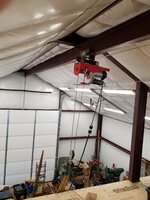
readhead
Well-known member
That is a common installation to get an R38 in the roof. It is not difficult in any way.
Joemctag
Well-known member
There is a vinyl-faced glass fiber blanket insulation (I think, 5’ wide rolls, with an obvious, crossed fiber in the vinyl ), that is being furnished with some metal buildings. My neighbor got such in North Carolina a couple years ago.Woven insulation is a new term to me. Maybe a regional thing. I always encourage my customers to use vinyl faced fiberglass. The main consideration is that it will never be as inexpensive as when the building is erected.
What type of building are you having installed? Tube steel, cold formed or red iron?
I guess his won’t tear easily like my own, ten-year old stuff that’s not reinforced. I think mine just has a bad batch of facing. It tears easily. When Iworked in metal buildings 40 years ago, I don’t remember such a problem.
Hobby_Man22
Well-known member
There aren't that many. Maybe 4 on a 20ft tall building. So at 2" wide that's 8" in 20ft that isn't insulated well. There are more than 4 on the roof though, so idk. They drop the stuff off from the roof and then put the panel on. It has vinyl on one side and insulation on the other held on by adhesive I think.Where it gets compressed, the thermal bridging is probably high. But same thing if you insulate with bat. Foam is different as you cover the framing.
I don't trust the guys who build buildings to steer me right for insulation, but definitely some insulation (even the blanket type) is better than the alternative.
FLIR camera would probably tell the tale.
toyotadriver
Well-known member
- Joined
- Dec 30, 2010
- Messages
- 1,586
You will not be very happy with the insulation the builder is offering. Is this going to be a metal frame building? 1 inch of foam sheets over the outside, while lower R value than what they are promising with their "insulation", will make you much happier and you can spray foam it later if you want to.
I'm new to the GJ but have been reading all of the threads I can about insulating an inexpensive, pre-fabbed, light gauge metal, detached garage/shop. I live in South Carolina (very humid summers). Many of you have hit all around what I'm proposing to do, but I can't find the answer I'm needing in regard to a hybrid option I am contemplating. My building is 24'x35'x9' with a vertical roof (1" hat channels screwed to 2 1/2" tube framing). I am on a small budget and want to use the Great Stuff to seal the very small crack at the ridge, the corrugations at the eaves and the corrugations at the horizontal wall panels, essentially "sealing off" all airflow. I plan to use 3/4" plastic HVAC strapping at 2' centers to hold R-13 faced fiberglass insulation in place, with the vapor retarder facing the inside of the garage. With no airflow, I want to know if I push the insulation all the way up to the metal roofing, not touching the roofing at the hat channels, will I get condensation there and will it be enough to cause problems down the road? The other option is to not use the Great Stuff foam at the ridge and eaves, and use spacers for my strapping to hold the insulation away from the metal roof, allowing the flow of air and vapor, though I don't see how much air will flow through the small opening in the ridge (1/4" maybe). This will introduce the problem of unwanted pests (wasps to name one) coming into my garage/shop. I plan to heat and cool the building for comfort all year long and I haven't found the answer about which way I should go on this.
My idea works well and is cheap...if you're not drywalling the garage and you don't mind looking at the brown paper vapor retarder on the inside of the insulation. I'm running a test since I've seen condensation without any insulation. I've isolated one bay from floor to ceiling and made the turn at the ceiling to go up the underside of the roof for about 3 feet. Where the wall meets the roof is where I was getting condensation. I've sealed up the one bay with Great Stuff and allowed no airflow. Now all I need is another warm day when it gets cool at night. If the adjacent, uninsulated bay sweats because I have airflow, and my insulated bay doesn't, I'll know to block off all of my corrugations with Great Stuff. If my insulation gets wet on the pink side, where it touches the metal, I probably need more airflow to keep it dry.
1/4atatime
Well-known member
Sorry to reopen this thread but did anyone come to a conclusion about the best bang for the buck insulation for these types of buildings? I'm contemplating doing the double bubble on the roof for condensation purposes and then coming back later and doing additional insulation on sides and roof. But not sure if doing it on the roof on top of the double bubble is a good idea. I like the idea of spray foam but definitely worried about long term affects if moisture does make it inside the foam.