To avoid these ads, REGISTER NOW!

Insulation: Vapor Barrier question

Joined
Jan 11, 2023
Messages
15
Location
SW Ohio
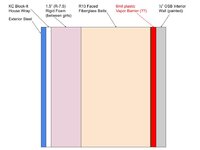
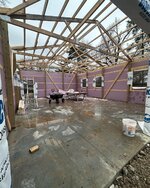
I'm in the process of constructing a 24x32x10 (768 sqft) post frame kit in SW Ohio and thinking ahead to finishing out the interior, specifically the location of my vapor barrier. I've installed 1.5" rigid foam board between the girts and added KC Block-it housewrap. My understanding is that the housewrap is my primary air barrier (and is not a vapor barrier) but I'm planning to fill all of the gaps in the rigid foam with expanding foam and/or caulk where needed to further cut down on air movement. This brings me to my conundrum regarding the vapor barrier, because my understanding is that in some applications the rigid foam would be considered a vapor barrier?

I plan to "stick frame" the interior and install R13 faced fiberglass batts. All of the videos and instructions I've seen for my climate say to put the vapor barrier on the interior side between the insulation and wall covering (1/2 OSB), but with the rigid foam I don't want to create a trap for moisture between the plastic sheet and the rigid foam if it's acting as a vapor barrier as well.

Ceiling will be insulated with R-30 blow-in (cellulose) and it seems pretty straight forward, to install the visqueen on the bottom of the truss between the ceiling covering (OSB) and the blow-in (vented soffit with baffles and ridge). Most of the time the space will sit unconditioned or temporary heat, but long term plans would be to install a mini-split.

I guess this is all a long way of asking, do I still install the 6mil plastic between the batts and the wall covering?
 

Attachments

  • A57CEB75-C077-4D00-85A9-D66701271C44.JPG
    A57CEB75-C077-4D00-85A9-D66701271C44.JPG
    638.5 KB · Views: 90
  • ED35064A-C27F-4FB2-94A8-8FDA7938D696.JPG
    ED35064A-C27F-4FB2-94A8-8FDA7938D696.JPG
    744.2 KB · Views: 87
  • postframe wall assembly.jpg
    postframe wall assembly.jpg
    39.6 KB · Views: 111
To avoid these ads, REGISTER NOW!

Jakemedic

Well-known member
Joined
Jul 26, 2013
Messages
721
Location
Cornfields of SE Iowa
You could have easily built a stick built building if you are putting in 2x4 walls. Ask your supplier for 8’ rolls of R19. Saves tons of efforts building walls. Then add a good vapor barrier on the inside. Benefits are many, but limiting the thermal breaks of 2x4 walls is primary.
 

Attachments

  • 439E681C-7674-4271-8E92-04B1DCFCB2B4.jpeg
    439E681C-7674-4271-8E92-04B1DCFCB2B4.jpeg
    721.6 KB · Views: 110
OP
A
Joined
Jan 11, 2023
Messages
15
Location
SW Ohio
You could have easily built a stick built building if you are putting in 2x4 walls. Ask your supplier for 8’ rolls of R19. Saves tons of efforts building walls. Then add a good vapor barrier on the inside. Benefits are many, but limiting the thermal breaks of 2x4 walls is primary.
I've considered finishing the interior with this method as well, but still leaves the question if my rigid foam is considered a vapor barrier and adding the plastic sheeting to the interior creates a 2nd vapor barrier which means any moisture that makes it into the wall cavity would be trapped?
 
Last edited:

beemerphile

Well-known member
Joined
Jul 9, 2021
Messages
727
Location
Danielsville, GA USA
"Barrier" is such a harsh term. Think in terms of a vapor "retarder". Rigid foam with sealed joints is a significant vapor retarder. You are correct to be concerned about moisture entrapment between the two barriers. I think you should leave off the poly for the interior walls.
 

Chetter

Well-known member
Joined
Nov 30, 2008
Messages
243
Location
Northern Ohio
I did what you have done so far but I installed 1/2" OSB over the girders when I was done installing the styrofoam in between the girders. I used heavy mil plastic sheeting on the bottom of the rafters and then rolled out attic blanket Owens Corning insulation on top of the plastic sheeting and then placed 1" thick 4'x8' sheets of styrofoam on the bottom of the rafters to further insulate the ceiling. That was back 1996 and I heat the garage 24/7 during the winter and there has been no issues with condensation issues. insulated my garage doors, put up door seals, and installed Green Garage door hinges that keep the doors tight against the seals even on those windy days here in northeast part Ohio. The whole point to building pole style was to help keep costs down and that is why I didn't do stick interior walls, if I was to do that, I may as well have just done it that way from the start using 2x6 studs instead of 2x4's so there would be more room for insulation, but then costs would have gone significantly as well. I have no regrets in how I built my garage and has served me well for 27 years now.
 

jollygreengiant

Well-known member
Joined
Nov 10, 2013
Messages
2,354
Location
Ontario, Canada
The big question is what type of foam did you use? EPS and unfaced XPS are considered to be vapour retarder and not a full barrier, so you will still have some vapour movement through them. It doesn't look like you used ISO sheets, which are an actual vapour barrier. If you used either EPS or unfaced XPS then you will still have vapour movement and yes you need to use the plastic vapour barrier underneath the OSB. Though if you are using the plastic vapour barrier then you don't need to use faced fiberglass batts.
 
OP
A
Joined
Jan 11, 2023
Messages
15
Location
SW Ohio
The big question is what type of foam did you use? EPS and unfaced XPS are considered to be vapour retarder and not a full barrier, so you will still have some vapour movement through them. It doesn't look like you used ISO sheets, which are an actual vapour barrier. If you used either EPS or unfaced XPS then you will still have vapour movement and yes you need to use the plastic vapour barrier underneath the OSB. Though if you are using the plastic vapour barrier then you don't need to use faced fiberglass batts.
I used 1.5 inch Owens Corning FOAMULAR extruded polystyrene (XPS) insulation. I wondered if I needed unfaced batts with the plastic (I've seen people use both)
 
OP
A
Joined
Jan 11, 2023
Messages
15
Location
SW Ohio
"Barrier" is such a harsh term. Think in terms of a vapor "retarder". Rigid foam with sealed joints is a significant vapor retarder. You are correct to be concerned about moisture entrapment between the two barriers. I think you should leave off the poly for the interior walls.
I don't think we're supposed to use the "r" word anymore either :ROFLMAO:. I appreciate the clarification in terminology

 

Denwood

Well-known member
Joined
Sep 22, 2014
Messages
4,183
Location
Thunder Bay, Ontario, Canada
I would leave off the interior poly as installing it leaves a situation where the wall cannot dry inwards, or outwards. Given your climate zone and R7.5 at the sheathing..R13 stud walls should not create a dew point issue with condensation in your walls.

Recent building science speaks to WRB barrier on the outside of your building, with an air gap which you can create by adding 3/4" vertical strapping over your wrap, and then the steel.
 

jollygreengiant

Well-known member
Joined
Nov 10, 2013
Messages
2,354
Location
Ontario, Canada
I would leave off the interior poly as installing it leaves a situation where the wall cannot dry inwards, or outwards. Given your climate zone and R7.5 at the sheathing..R13 stud walls should not create a dew point issue with condensation in your walls.

Recent building science speaks to WRB barrier on the outside of your building, with an air gap which you can create by adding 3/4" vertical strapping over your wrap, and then the steel.

That would be a recipe for disaster in my climate. Here, we need to stop vapour before it enters at the inside wall. Otherwise you will have condensation inside of the wall.

The rigid foam that he's used is a vapour retarder, not a barrier. So it will still allow some vapour to pass through, which will let the wall dry to the outside.
 

billconner

Well-known member
Joined
Jul 20, 2021
Messages
6,941
Location
Thousand Islands NYS
The rigid foam that he's used is a vapour retarder, not a barrier.
1.5" of XPS has a perm rating below 1.0 so by definition us a class 1 vapor retarder. Read Joe Lstiburek article above for a better explanation.

Where the OP lives, 1 1/2" of XPS is probably enough to prevent condensation but the girts would still cause condensation. Some spray foam over them if not a block of XPS would help that.
 
OP
A
Joined
Jan 11, 2023
Messages
15
Location
SW Ohio
That would be a recipe for disaster in my climate. Here, we need to stop vapour before it enters at the inside wall. Otherwise you will have condensation inside of the wall.

The rigid foam that he's used is a vapour retarder, not a barrier. So it will still allow some vapour to pass through, which will let the wall dry to the outside.

Once the foam is sealed, it will not be permeable to the point of allowing drying. ... and he's in Ohio, not Ontario :)

According to the spec sheet 1" XPS has a perm rating of 1.5, but water vapor permeance decreases as thickness increases and I can't find the specific number for 1.5" XPS. Assuming 1.5" XPS has 50% (~.75 perm) less permeance I would think it would fall into a Class II – Low permeability vapor retarders (rated greater than 0.1 perms and less than or equal to 1.0 perms)
 
OP
A
Joined
Jan 11, 2023
Messages
15
Location
SW Ohio
1.5" of XPS has a perm rating below 1.0 so by definition us a class 1 vapor retarder. Read Joe Lstiburek article above for a better explanation.

Where the OP lives, 1 1/2" of XPS is probably enough to prevent condensation but the girts would still cause condensation. Some spray foam over them if not a block of XPS would help that.

Reviewing https://www.buildingscience.com/doc...insights-newsletters/bsi-026-they-all-laughed it seems like figure 5 most closely resembles my assemble and this jumps out at me: "Easy, replace the 6 mil polyethylene with a kraft faced fiberglass batt and keep the R-5 vapor closed exterior continuous insulation. Replace the Class I vapor retarder with a Class II vapor retarder. The IRC allows you to do this."

So that would suggest I should air seal my exterior foam, adding foam over girts from the interior, install faced batts (paper toward people/interior) and skip the interior plastic sheet?
 

jollygreengiant

Well-known member
Joined
Nov 10, 2013
Messages
2,354
Location
Ontario, Canada
1.5" of XPS has a perm rating below 1.0 so by definition us a class 1 vapor retarder. Read Joe Lstiburek article above for a better explanation.

Where the OP lives, 1 1/2" of XPS is probably enough to prevent condensation but the girts would still cause condensation. Some spray foam over them if not a block of XPS would help that.

Straight from the Foamular data sheet:

Foamular.PNG

Now this is for 1" thick foam but the manufacturer uses the same perm rating for the 1.5" and 2" thick foam boards as well. That would classify it as a class II, a class I is below 0.1 perms. But yes, definitely need something over top of those foam boards where they meet the girts.


Once the foam is sealed, it will not be permeable to the point of allowing drying. ... and he's in Ohio, not Ontario :)

It will still be semi permeable, it has a perm rating of 1.5 so it will still be able to dry to the outside. Though I see your point about location. I thought SW Ohio would be pretty similar climate wise to my location in Ontario but he is likely outside the climate bubble of the great lakes so it could be quite different.

Reviewing https://www.buildingscience.com/doc...insights-newsletters/bsi-026-they-all-laughed it seems like figure 5 most closely resembles my assemble and this jumps out at me: "Easy, replace the 6 mil polyethylene with a kraft faced fiberglass batt and keep the R-5 vapor closed exterior continuous insulation. Replace the Class I vapor retarder with a Class II vapor retarder. The IRC allows you to do this."

So that would suggest I should air seal my exterior foam, adding foam over girts from the interior, install faced batts (paper toward people/interior) and skip the interior plastic sheet?

Technically you could do that and still be OK in regards to code. I don't like faced batts as there are way too many leaks past the facing. With a plastic vapour barrier you can do a really good job at sealing it and making a continuous barrier.
 
To avoid these ads, REGISTER NOW!
OP
A
Joined
Jan 11, 2023
Messages
15
Location
SW Ohio
Are you both heating and air conditioning?
Ideal world, yes... but most likely it sit unconditioned most of the time, and only heated in the winter on an as needed basis. Cooling would just be windows and fans. Would probably be worth considering a dehumidifier full time when sitting unused?
 
Last edited:
OP
A
Joined
Jan 11, 2023
Messages
15
Location
SW Ohio
Technically you could do that and still be OK in regards to code. I don't like faced batts as there are way too many leaks past the facing. With a plastic vapour barrier you can do a really good job at sealing it and making a continuous barrier.

Is there an alternative to plastic (class I) that falls into class II (which is what faced batts are rated) that I could consider using?
 

billconner

Well-known member
Joined
Jul 20, 2021
Messages
6,941
Location
Thousand Islands NYS
I'm inclined to think you'll be fine as long as no significant sources of moisture like no vapor barrier under slab, washing vehicles, or storing firewood. And iirc you have a more traditional ceiling - where pressure is greatest - with poly on interior.

I've wondered about poly on top half of wall - above to the neutral pressure plane - allowing lower half to more easily dry inward.
 
OP
A
Joined
Jan 11, 2023
Messages
15
Location
SW Ohio
What's you interior wall? Some plywood or OSBs seem to fall in that range. Anything with alkyd paint.
10 foot wall. Current plan is to do 1/2 OSB Painted walls and ceiling, although I am considering doing a 3' waiscott in steel on the bottom to match the exterior.
 
OP
A
Joined
Jan 11, 2023
Messages
15
Location
SW Ohio
I'm inclined to think you'll be fine as long as no significant sources of moisture like no vapor barrier under slab, washing vehicles, or storing firewood. And iirc you have a more traditional ceiling - where pressure is greatest - with poly on interior.

I've wondered about poly on top half of wall - above to the neutral pressure plane - allowing lower half to more easily dry inward.
Correct, soffit and ridge vented attic with poly between ceiling material (drywall or OSB) and blow-in cellulous insulation
 

Denwood

Well-known member
Joined
Sep 22, 2014
Messages
4,183
Location
Thunder Bay, Ontario, Canada
Your moisture concerns in a garage used as a shop would be pretty small, however if you're parking in there with a wet/snow covered vehicle, different story as that will result in a lot of moisture with a high RH as it will likely be cooler in there when not heated.

This is a quick/easy read would should give you an idea of where the dew point (in your wall) would fall on your coldest day: https://continuingeducation.bnpmedi...inuous-insulation-in-framed-exterior-walls/3/

I should mention that poly inside with continuous exterior insulation is the norm here, and it gets "safer" as you increase the R value of continuous exterior insulation. In other words, if you add R15-20 on the outside, then dew point concerns inside go away. You don't by code have to use a class 1 vapour retarder if the continuous exterior insulation exceeds the value specified in your climate zone. For us in 7A, it's in the R15-20 range at exterior that would allow a Class II interior vapour retarder.

Bill L, basically summarizes the situation (Poly on the inside, non-permeable on the outside) as not being a disaster, particularly if you very carefully air seal on the inside. But he is also a big exterior insulation/external air seal proponent, for good reason.

In other words, current building science favours insulation on the outside (like adding 6" of Roxul) vs interior insulation for efficiency. That way your structure stays warm, there are no moisture issues, and thermal bridging losses can be reduced considerable. This way you can build a 2x3 or 2x4 wall with no insulation inside, just to run electrical etc. This also brings your envelope penetrations down to zero.

Is this overkill with a garage with a larger leaky R5-10 door(s)? Maybe.

Is your slab insulated?
 
Last edited:
OP
A
Joined
Jan 11, 2023
Messages
15
Location
SW Ohio
Your moisture concerns in a garage used as a shop would be pretty small, however if you're parking in there with a wet/snow covered vehicle, different story as that will result in a lot of moisture with a high RH as it will likely be cooler in there when not heated.

This is a quick/easy read would should give you an idea of where the dew point (in your wall) would fall on your coldest day: https://continuingeducation.bnpmedi...inuous-insulation-in-framed-exterior-walls/3/

Is this overkill with a garage with a larger leaky R5-10 door(s)? Maybe.

Is your slab insulated?
Single 9x8 garage door is rated R6.3.

Slab has poly under, but it is uninsulated

Based on the chart for my climate zone, R-5 exterior + R13 wall cavity would be good, and I shouldn't use poly interior? Planning on using latex painted OSB.

1673630173625.png
 

Denwood

Well-known member
Joined
Sep 22, 2014
Messages
4,183
Location
Thunder Bay, Ontario, Canada
If you are essentially air sealing the outer R5 (and not adding any more exterior insulation), code may actually require you to use a class 1 vapour retarder (poly) for your zone. Looking at your building, and given that it is a garage (not lived in), I think the risk of using poly would be quite low. If you are careful about extending it your ceiling, then you will see the benefit of better air sealing too and it will be easier to deal with your ceiling if your stick frame walls also use poly.

Water issues will 99% of the time be at your windows and doors, so take extra care to tape them, do your sill pans, steel drip rails etc. If the water can't get in, then drying issues with respect to vapour retarders go away too.
 

lazyriverrat

Well-known member
Joined
Mar 16, 2015
Messages
54
Location
Nebraska
I used 1 1/2 between the girts, then 2" xps over that with seams foamed (buy the gun, u wont regret it) then unfaced insulation to fill the rest of the cavity. No poly on the inside. I am happy with what I have. I have taken a heat camera out several times and have been satisfied. I can faintly make out the post. It looks far superior to the walls of my house where I can clearly see every stud.
 

theoldwizard1

Well-known member
Joined
Feb 22, 2011
Messages
43,106
Location
SE MI
Spray foam all joints/connections from the steel to the wood. If you can afford it, apply 2" over the entire interior surface. Use fiberglass batts or rolls. If you apply skim or heavy plastic to the inside of the posts and girts, you can blow in fiberglass or cellulose. You do need some kind of interior sheathing if there is no facing.

The absolute BEST insulation between two surfaces is a vacuum, which is not practical. Non- moving air is second best. Fiberglass insulation is mostly air.
 

billconner

Well-known member
Joined
Jul 20, 2021
Messages
6,941
Location
Thousand Islands NYS
Fiberglass insulation is mostly air.
Compare cellulose to fibreglass and you'll see that cellulose is much better at preventing air movement through it - convection loss - and much more opaque to light - radiant loss. You can test this yourself by blowing through it and shining a flashlight through it. Unfortunately, the cellulose industry is much less well funded than the fibreglass industry.

And as far as fire, when tested, the same walls insulated with each, cellulose performs better.
 

theoldwizard1

Well-known member
Joined
Feb 22, 2011
Messages
43,106
Location
SE MI
Compare cellulose to fibreglass and you'll see that cellulose is much better at preventing air movement through it - convection loss - and much more opaque to light - radiant loss.
You may be correct, but if you can "seal" both sides of fiberglass insulation, then there bis no air movement.

The ski hill in Saudi Arabia use about 3m of "dead air" as insulation.
 

billconner

Well-known member
Joined
Jul 20, 2021
Messages
6,941
Location
Thousand Islands NYS
There is more air movement within the fiberglass than in cellulose from warm to cold side. Cellulose is just much smaller fibers.

Plus blown in, cellulose fills every nook and cranny of the cavity. How many wires, pipes, blocking, etc. is fiberglass cut to fit perfectly around?
 

Denwood

Well-known member
Joined
Sep 22, 2014
Messages
4,183
Location
Thunder Bay, Ontario, Canada
I would agree 100% on cellulose. Not only does it decrease air movement and resist fire spread better, but it is far superior for noise suppression. It also retains R value much better as temperatures decrease, particularly in attics. I blew it into our 100 year old walls (no insulation there to begin with) then added about R80 to our attics after a 2" air seal with closed cell foam.

Aside from the insulation value, the drop in sound transmission was surprising, literally overnight.
 

Hobby_Man22

Well-known member
Joined
Nov 16, 2020
Messages
3,581
Location
tx
Does that vinyl backed insulation have a vapor barrier? The kind they install in metal buildings where it's pinched in between the panels and the purlins.
 
To avoid these ads, REGISTER NOW!
Top Bottom