To avoid these ads, REGISTER NOW!

insulation

mitymouse

Active member
Joined
Nov 20, 2011
Messages
28
I have started to notice alot of guys on here say not to use fiberglass do to building sweating, I thought if I left an air gap between the glass and the metal I would be ok I have not started covering the walls yet, so now is a good time if I need to change my direction.
If I pull the glass down, can I put up a thin layer of styrofoam board then glass and vapor barrier. or will the styrofoam trap vapor?

how is it that steel builings have fiberglass insulation pinched between the purlins and the steel and they dont have problems?
 
To avoid these ads, REGISTER NOW!

trbomax

Well-known member
Joined
Mar 21, 2010
Messages
2,556
Location
starvation lake,mi.
Metal is a perfect vapor barrior and it transfers heat well. That is why moisture condenses on the inside so well.The only way to stop that from happening is to put thin sheet foam over the building before the steel goes on. Then you can use FG without a problem. Sheet foam between the wall girts on the inside will help,but moisture will still condense where the foam doesnt touch the steel. Its been my experience that then rot and fastener corrosion sets in. After 10 years or so the whole wall will be falling off the frameing. I know this to be true because it happened to me,two times,two different buildings.

edit) the screws holding the steel on are not what corrodes ,its the nails in the frameing . First the heads corrode off, then everything gets loose.
 
Last edited:
OP
M

mitymouse

Active member
Joined
Nov 20, 2011
Messages
28
I have a steel roof...vented attic...with a stell liner I wanted to do blow in on top of that
 

K'ledgeBldr

Well-known member
Joined
Aug 22, 2011
Messages
1,925
Location
Johns Creek, GA
How is it that steel builings have fiberglass insulation pinched between the purlins and the steel and they dont have problems?

The 'lack' of problems isn't in the R-value of the insulation; it's the fact that the vapor barrier is continuous. Obviously the R-value is diminished where it's compressed but, it's more important to have a vapor barrier with as few seams as possible.
Check this out-
http://www.naima.org/insulation-resources/metal-building-insulation.html
 

fireguy

Well-known member
Joined
May 25, 2008
Messages
530
One of the items on my to do list is insulate the shop. The building I am renting has the thin fiberglass wrapped in plastic insulation between the wooden rafters and the sheet metal skin. The sheet metal wall have no insulation of any kind. It takes lots of wood to keep the shop warm when the temps drop below 32°F. I want to get started on the insulation, as we have time.
1. As the roof has some insulation, can I just add more fiberglass and not worry about a vapor barrier? Faced or unfaced? Can we use plastic baler twine to hold the insualtion in place?
2. As the walls have no insulation or vapor barrier, what do I use for a vapor barrier? Glue foam board to the metal? Just poke the foam board in and let the fiberglass hold the foam board in place? Or do I use plastic sheeting and staple it to the 2 x 4 studs? Is an air space needed between the metal and the vapor barrier? The wall insulation will be covered with plywood, except at the gable ends. The gable end insulation will be held in place with baling twine
 
OP
M

mitymouse

Active member
Joined
Nov 20, 2011
Messages
28
Im back to thinking about droping the fiberglass putting up thin foam board (to keep the fiberglass from wicking water from the metal). putting the glass back up then a vapor barrier and topped with osb.......sound about right to you all?
 
OP
M

mitymouse

Active member
Joined
Nov 20, 2011
Messages
28
The 'lack' of problems isn't in the R-value of the insulation; it's the fact that the vapor barrier is continuous. Obviously the R-value is diminished where it's compressed but, it's more important to have a vapor barrier with as few seams as possible.
Check this out-
http://www.naima.org/insulation-resources/metal-building-insulation.html

cant seem to open the link you forwarded, Thank you anyhow,...So here is where im at tell me what you guys think, I work on alot of steel buildings around here and all of then use the fiberglass insulation with attached vaporbarrier sandwiched between the metal skin and the purlins and none seem to have problems. I have the fiberglass in place on the inside of the purlins so its is not touching the metal and provides an airgap between the glass and metal. now I will add the vapor barrier (6 mill visqueen) with taped seems to provide a somewhat seemless barrier then sheath the walls with osb.
Im pretty sure this should be fine but im looking for input, to avoid rework.
 

green.bubbly

Well-known member
Joined
Dec 14, 2008
Messages
2,156
Location
Lafayette, LA
cant seem to open the link you forwarded, Thank you anyhow,...So here is where im at tell me what you guys think, I work on alot of steel buildings around here and all of then use the fiberglass insulation with attached vaporbarrier sandwiched between the metal skin and the purlins and none seem to have problems. I have the fiberglass in place on the inside of the purlins so its is not touching the metal and provides an airgap between the glass and metal. now I will add the vapor barrier (6 mill visqueen) with taped seems to provide a somewhat seemless barrier then sheath the walls with osb.
Im pretty sure this should be fine but im looking for input, to avoid rework.

I am not going to tell you what to do or not to do. Do a Google search and you will read all you ever want to read on this subject to the point that you will be left with your head spinning. When you find two people that agree, let me know. :)

Moisture will condense on cold metal. Keep the moisture away from the metal and there will be nothing to condense. That is why on the steel buildings you see with the FG wrapped in plastic, there is not a problem. There is no way for moisture to contact the inside of the metal and therefore no condensation.


This is not exclusive to metal. An uninsulated and unconditioned wood shed roof will door the same thing if the wood gets cold enough. You may not have water dripping from the wood but that is because the condensation is somewhat absorbed into the wood. But get out a moisture meter and that wood shed roof will be saturated.

So for discussion, lets look at this scenario. You have steel on the exterior of the wall. On the inside, you stick frame your wall and fill the cavity with FB. The interior of the wall is then covered in Sheetrock and a moisture barrier paint. How is any moisture going to get in the wall to be able to condensate with the cold steel?
 
OP
M

mitymouse

Active member
Joined
Nov 20, 2011
Messages
28
I couldnt agree more, I have done the google thing. which is why i figured id get better answers here, I understand what your getting at...i guess I was just looking for a hole in my theory. thanks again for all the input gentlemen
 

rburke65

Well-known member
Joined
Nov 10, 2007
Messages
12,349
Location
Canfield, Ohio
So, before I do a major no-no....when the weather breaks in the spring, I'll be putting up a garage with OSB on the entire out side......roof and walls, and then metal on the roof and walls. Is there a problem with this plan. The inside will have attic truss and the garage will be insulated. Thanks in advance.
 

Bull

Super Moderator
Joined
Dec 12, 2005
Messages
16,189
Location
MA
I am not going to tell you what to do or not to do. Do a Google search a The interior of the wall is then covered in Sheetrock and a moisture barrier paint. How is any moisture going to get in the wall to be able to condensate with the cold steel?

Are all quality latex interior paints going to serve this purpose, or are there special formulations?

I have been reading a bit here and there about this topic lately. I think I am going to caulk the heck out of any seams I have, too, both prior to and after hanging rock, to keep the moisture on the inside.
 

trbomax

Well-known member
Joined
Mar 21, 2010
Messages
2,556
Location
starvation lake,mi.
Are all quality latex interior paints going to serve this purpose, or are there special formulations?

I have been reading a bit here and there about this topic lately. I think I am going to caulk the heck out of any seams I have, too, both prior to and after hanging rock, to keep the moisture on the inside.[/QUOTE

caulking up every crack and seem is great if you have the patience to do it. Stopping air exchange between the hot/cold areas is as important as the VB in the first place.I always sheet in foam on both sides of the structure and caulk or foam weld everything I can see.That way the FG in between the foam cannot get wet.In addition I use a reflective 3/8" foam wrap with all joints either taped or caulked with BIG STRETCH. This is even more important if you are useing steel as the finish cover because the wind will really whistle a tune blowing thru those panel joints!
 

Bull

Super Moderator
Joined
Dec 12, 2005
Messages
16,189
Location
MA
Are all quality latex interior paints going to serve this purpose, or are there special formulations?

I have been reading a bit here and there about this topic lately. I think I am going to caulk the heck out of any seams I have, too, both prior to and after hanging rock, to keep the moisture on the inside.[/QUOTE

caulking up every crack and seem is great if you have the patience to do it. Stopping air exchange between the hot/cold areas is as important as the VB in the first place.I always sheet in foam on both sides of the structure and caulk or foam weld everything I can see.That way the FG in between the foam cannot get wet.In addition I use a reflective 3/8" foam wrap with all joints either taped or caulked with BIG STRETCH. This is even more important if you are useing steel as the finish cover because the wind will really whistle a tune blowing thru those panel joints!

I don't suppose you have any pics of these processes, maybe photos that you took as you worked on your own stuff?

Some of us are simple, visual learners :lol:
 

green.bubbly

Well-known member
Joined
Dec 14, 2008
Messages
2,156
Location
Lafayette, LA
Bull, I have not researched which paints are actually vapor barriers yet. I will be at that stage in a couple of months. I would go to a Sherwin Williams or similar store for advice on the paint to use.

I just received 40 sheets of 1/2" reflective styrofoam insulation. My wife has been tasked with cutting pieces to place between the girts on the walls and they will have all the seems caulked. Ideally, I would have liked to have had full insulation up between the steel sheets and the girts but that did not happen.

So my plans are to have the 1/2" foam sheets caulked to the girts which will leave about a 1/2" airspace between the foam and the steel. Then I will use fiberglass to filling the stick framed wall cavity. Then cover it all with 5/8" sheet rock and vapor barrier paint.
 

Mavawreck

Well-known member
Joined
Jan 30, 2011
Messages
1,835
Location
Durham NC
So for discussion, lets look at this scenario. You have steel on the exterior of the wall. On the inside, you stick frame your wall and fill the cavity with FB. The interior of the wall is then covered in Sheetrock and a moisture barrier paint. How is any moisture going to get in the wall to be able to condensate with the cold steel?

I'm not trying to give you a hard time...

But I would not see the issue being bulk water movement from outside into the wall. Rather I would worry about condensation forming inside of the wall due to air movement between the fiberglass and the inside of the metal wall. What is stopping air movement originating from the top and bottom plates (or any hole) moving in between the steel and fiberglass? It is really difficult to create an air tight assembly. You can of course caulk the heck out of it which I agree is a great idea. Or invest in a foam gun, buy a case of one part cans and go to town.

http://www.amazon.com/dp/B0002YOMJE/?tag=atomicindus08-20

We've got several similar to that from 12" to 24" barrels. They're fun.

But you are still going to see some air movement. So how much air movement is necessary for condensation to occur and how much condensation does it take to cause a problem? I do not know.
 
Last edited:
To avoid these ads, REGISTER NOW!

Kevin54

MEMBER EMERITUS
Joined
Jan 12, 2005
Messages
29,341
Location
Urbana, Ohio
So, before I do a major no-no....when the weather breaks in the spring, I'll be putting up a garage with OSB on the entire out side......roof and walls, and then metal on the roof and walls. Is there a problem with this plan. The inside will have attic truss and the garage will be insulated. Thanks in advance.

If it were me, just for an additional safety factor, I would wrap the roof and walls with 15lb. felt. Then any chance in hell of it sweating would protect the OSB from getting water on it. Some will say do nothing at all. Others will say that the black will attract heat. Everyone has a different opinion on how they would do it. I'm just sayin' if it were me.......:beer:
 

mossy66

Active member
Joined
Dec 22, 2010
Messages
32
Location
Lake Villa, Illinois
At work they have a steel building that used to hold temporary office space used while construction was going on. It was recently gutted and used for warehousing spare parts. What they did was to have a company come in and spray on insulation. I believe it was a layer of cellulose (ground up newspaper?) followed by a layer of something more durable to keep the first layer from coming off easily. It looks like the fireproofing insulation that is sprayed on the structural steel of a building, but is much more durable. It works really well.

I don't know what it cost though, but it may be worth looking into.

Gerry
 

GR14

Active member
Joined
Feb 25, 2011
Messages
32
So for discussion, lets look at this scenario. You have steel on the exterior of the wall. On the inside, you stick frame your wall and fill the cavity with FB. The interior of the wall is then covered in Sheetrock and a moisture barrier paint. How is any moisture going to get in the wall to be able to condensate with the cold steel?


I don't think you want two moisture barriers. That will only serve to trap moisture in the wall causing mold and wood rot and rust. You will never seal it well enough to keep all moisture out of the cavity and if you could, there would still be all the moisture that was there when you sealed it.
 

czr12x

Well-known member
Joined
Mar 2, 2011
Messages
77
Location
WI/IL stateline
I am interested in what the correct way would be to insulate as well. I would like to heat my space someday. I have a steel roof only. They installed the plastic bubble type layer between the wood planks and the steel roof. that is supposed to be a vapor barrier of some sort said the packaging.

you can buy allot rolls for the price of spray insulation.
 

trbomax

Well-known member
Joined
Mar 21, 2010
Messages
2,556
Location
starvation lake,mi.
I don't suppose you have any pics of these processes, maybe photos that you took as you worked on your own stuff?

Some of us are simple, visual learners :lol:

I am working on some walls right now. I have some of the frameing done and have started to document what I'm doing. I could start a thread on it. How do I find a thread ,for the purpose of adding to it) if I have not put anything up for a couple days w/o going back thru the whole list looking for it? I'm not very computer literate!
 

slickgt1

Well-known member
Joined
Oct 11, 2010
Messages
1,674
I am working on some walls right now. I have some of the frameing done and have started to document what I'm doing. I could start a thread on it. How do I find a thread ,for the purpose of adding to it) if I have not put anything up for a couple days w/o going back thru the whole list looking for it? I'm not very computer literate!

Go to User CP
See below subscribed threads.
Below that, you should see show all subscribed threads.
Look in there.
 

slickgt1

Well-known member
Joined
Oct 11, 2010
Messages
1,674
you should be automatically subscribed to every thread you start or reply to.

If you disabled that in your User CP (control panel), you can still manually subscribe to the thread. Look all the way to the top of the threat page. Any thread you are in, will have this. Click on the drop down arrow by Thread Tools, and you will see the option to subscribe to a thread. This is great when you want to subscribe without hitting the reply button.
 

slickgt1

Well-known member
Joined
Oct 11, 2010
Messages
1,674
Now to check your subscription options:

Go to User CP,
right hand side, to to Edit Options
In the Messaging & Notification area, the Default Thread Subscription Mode box, make sure anything else is selected except for Do Not Subscribe, and you will be subscribed to every thread you reply to or start.

I have No Email Notification on mine. Because when I get into the site, I just click on User CP, and it shows you all the threads that were replied to, which I was part of.

Hope this helps.
 
Last edited:

trbomax

Well-known member
Joined
Mar 21, 2010
Messages
2,556
Location
starvation lake,mi.
The auto thing must be disabled because there are no threads in my subscribed list,but thats ok. I am going to start a new thread to document what I'm doing . It will be titled "wall construction" and be in "garage gallery". Nothing will go up untill later tonight as I am heading down there to work on it now.
 

Mavawreck

Well-known member
Joined
Jan 30, 2011
Messages
1,835
Location
Durham NC
I don't think you want two moisture barriers. That will only serve to trap moisture in the wall causing mold and wood rot and rust. You will never seal it well enough to keep all moisture out of the cavity and if you could, there would still be all the moisture that was there when you sealed it.

You do not want two vapor barriers, the terminology of vapor, moisture, and air barriers gets convoluted very quickly. What works in one climate often does not work in another. In the southeast it is preferable for the exterior to be more permeable than the interior so that moisture is encourage to wick outwards. It may be reverse in the north. That is why I made my previous comment about air movement inside of the cavity and breathable house wraps. Even with closed cell insulation, the application is seldom perfect enough to make a complete air barrier. I've seen situations where this has led to pooling of condensation and rotting roof decks.

With that, I know little about metal buildings and I am interested in hearing about how this works. It almost seems like it should be addressed similarly to metal roofing over rigid insulation where there is a drainage plane in between the metal and an air barrier which is against the interior space.
 

Highbeam

Well-known member
Joined
Feb 15, 2011
Messages
2,292
Location
Mt Rainier foothills, WA
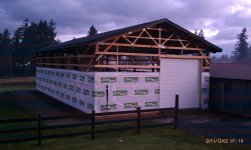
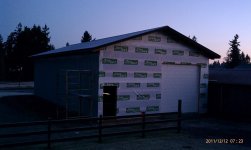
Here's mine. Just about done with the metal. I applied housewrap to the outside of the girts. Then metal directly onto that. The fasteners holding the girts to the posts are hot dip galvanized since the posts are PT 6x8s.

The plan is to frame the inside between the posts, FB, then sheetrock. The only real vapor barrier will be on the inside. The shop will be heated and not cooled.

The housewrap is to slow the wind and any wind driven moisture from making it into the wall. The housewrap also attaches to the mud girt to seal up all the holes where the corrugations of the metal lift away from the girts.

At the top of the sidewalls there are bird block soffit vents to allow air into the attic space, a continuous ridge vent on top. I don't like metal roofs, I used comp on top of OSB sheets.

I plan to use FB insulation of a thickness that does not touch the metal. This cavity in the wall will be open to the attic to let trapped moisture out. Reason is that the 6x8 posts are set with the 8" dimension within the wall and my wall framing will be smaller than 8".

The housewrap is cheap and seems to offer the benefit of reducing condensation on the inside of the metal.
 

Attachments

  • shop12-1-11.jpg
    shop12-1-11.jpg
    100.2 KB · Views: 12
  • shop12-12.jpg
    shop12-12.jpg
    80.4 KB · Views: 11

green.bubbly

Well-known member
Joined
Dec 14, 2008
Messages
2,156
Location
Lafayette, LA
I don't think you want two moisture barriers. That will only serve to trap moisture in the wall causing mold and wood rot and rust. You will never seal it well enough to keep all moisture out of the cavity and if you could, there would still be all the moisture that was there when you sealed it.


You are correct. I spoke with my lumber yard who also does insulation. Along the gulf coast, the vapor barrier should be towards the exterior side. The fiberglass should be UNFACED and no interior vapor barrier should be used.


So my only concern right now is the 1/2" airspace that will exist between my foam board and the steel. The bottom of the steel will be sealed with spray foam to reduce any wind/moisture. insects from entering. The foam board will be caulked around all edges.

So I am planning for very minimal air moving in that cavity. Any existing moisture in the cavity will not be enough to cause any condensation or moisture issues.
 
To avoid these ads, REGISTER NOW!
Top Bottom