To avoid these ads, REGISTER NOW!

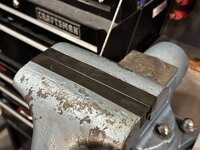
Interchangeable jaws for a Wilton vise.

Grant Gunderson

Well-known member
Joined
May 17, 2013
Messages
2,317
Location
Bellingham, WA
I use a lot of soft jaws and various shaft clamps when working on bike suspension and seat posts, etc. The problem is none of them stay in place in the vise jaws, even with magnets. Plus I always have to take the copper jaw covers off to use them.
IMG_2161.jpeg
Many times when you are using the shaft clamps, you often wish you had a third hand to hold the part, shaft clamps and then turn the vice handle. It's a pain in the *** I tend to deal with a lot.

So the plan is to cut some new primary jaws with a dovetail and ball detents and then cut corresponding dove tails on all of my existing soft jaws / shaft clamps. My vise is a 6-½" Wilton tradesman. The vice is a nice size for what I do, but with this project, the 6.5" jaws are a bit of a pain as I can't just buy one 12" piece of stock material.

So I went down to the local hardware store and south two 12" ¾ x ¾ sections of mild steel key stock, and a 3 piece of ½ x ¾ brass bar. I'd like to have copper for a set of the soft jaws, but copper bar is stupid expensive, so I'll have to wait until I find some for a price I am willing to pay. The nice thing about this idea, is I can always make new jaws for it easily down the road.
image.jpeg
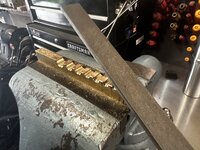
I started by using my abrasive saw to rough cut the key stock to size.
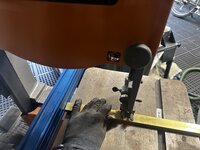
image.jpeg
My 14" ridged woodcutting bandsaw with a bi-metal blade made quick work of rough cutting the brass bar down.
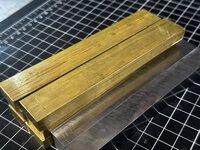
image.jpeg
image.jpeg
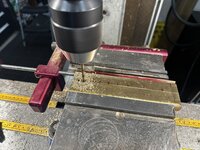
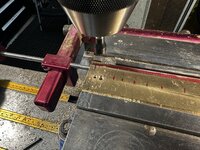
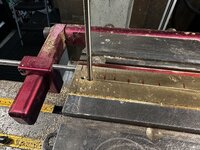
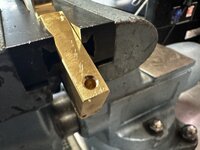
I then faced the ends to the correct length. Using a work stop on the vise made quick work of getting everything to the correct length, and serves as a reference for future operations. I then faced all of the sides of the key stock. I probably could have skipped on facing the key stock, but I figured I should just do it the correct way the first time.
image.jpeg
I then machined a ¼ by ¼" grove in the center of the machine stock. I need to make a space for the dove tail shaft to move when it does its operation next.
image.jpeg
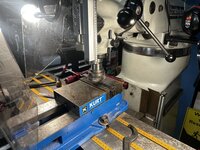
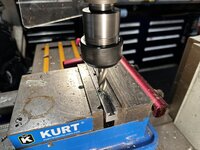
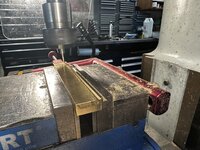
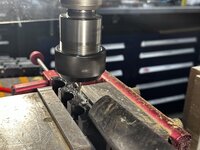
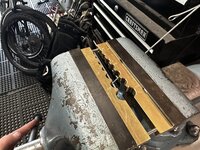
The dove tail is going to get cut by a ½" 45 degree cutter. This will be a very big cut for that size of cutter and it has to happen in one pass. So I filled the channel with anchor lube to keep things cool.
image.jpeg
I set the X-axis feed on the mill to the lowest setting possible and crossed my fingers the cutter wouldn't break!
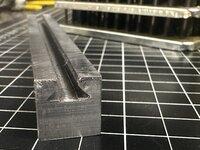
image.jpeg
An hour latter and I had each dove tail channel cut.
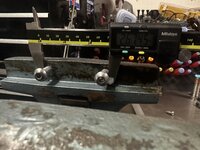
image.jpeg
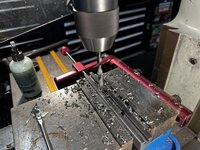
I then needed to determine the spacing for the mounting bolts. I just measured the outside of the bolts, then subtracted 5/16" (bolt size) from it.
 
To avoid these ads, REGISTER NOW!
OP
G

Grant Gunderson

Well-known member
Joined
May 17, 2013
Messages
2,317
Location
Bellingham, WA
image.jpeg
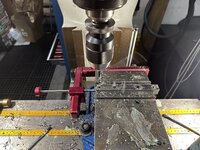
For hole drilling operations I like to use a wavy parallel instead of my expensive starrett ones incase I hit it with the through holes.
image.jpeg
5/16" mounting holes get through drilled.
image.jpeg
I then counter bored the holes using a ⅝" end mill. I am using hex button head screws as they are lower profile than a SHCS, so a typical counter bore bit wouldn't work.
image.jpeg
image.jpeg
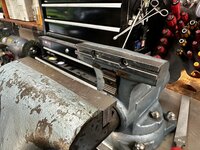
Test fit worked. ⅝" bar stock would have been the perfect size here, but no one had it in stock in town. I don think the lower gap will be an issue for the type of work I typically do.

In order to keep the soft jaws and shaft clamps from sliding out of the dovetails ends I need to add some ball detents. I am going to use a 3/16" ball bearing, and a ¼-20 set screw and some springs to make these. It's all stuff that I had on hand.
image.jpeg
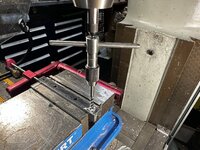
The first step is to blind drill all of the holes for the tap, using the quill stop on the mill. You want to stop as close to breaking though as possible without actually breaking through.
image.jpeg
Each hole then gets tapped. I like using a tap guide and my Starrett tap handle for this.
image.jpeg
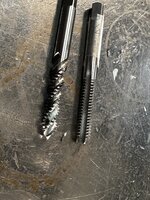
I am a really big fan of these spiral taps as they remove the chips from the hole, cut nicer and are way less likely to break. Since these are blind holes, I then followed that tap with a bottoming tap.
image.jpeg
Finally I drilled a through hole with a #13 drill so the ball will just poke through.
image.jpeg
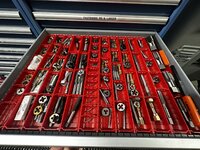
Having an absolutely complete set of drills in every size is really nice for projects like this! I dont use the number or letter bits that often, but when you need them, you need them
 
OP
G

Grant Gunderson

Well-known member
Joined
May 17, 2013
Messages
2,317
Location
Bellingham, WA
image.jpeg
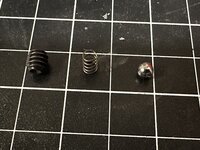
And here is the parts of the ball detents. I had to cut a longer spring down to fit this application, but it should work fine.
image.jpeg
You can adjust the ball detent pressure by how far to screw in the set screw in the back, or by changing the spring out for a stiffer or lighter one. I think I have them set for a firm but easy to remove pressure.
image.jpeg
I then broke all of the edges with a file, and then buffed them with my Baldor buffer.
image.jpeg
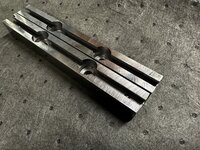
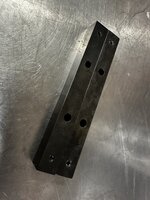
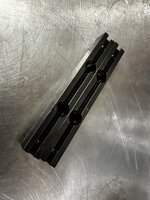
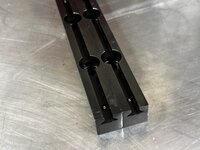
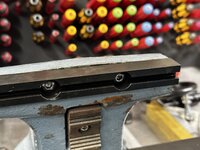
I then blued them to help prevent corosrsion. Here you can see the set screws holding the ball detents in the back side.
image.jpeg
image.jpeg
I might need to do another coating of the blueing acid to even out the finish at some point, but I think this is acceptable.
image.jpeg
image.jpeg
image.jpeg
With the steel mounting blocks done, next up is working on the brass jaw inserts.
image.jpeg
After facing all of the Jaw inserts so they are nice and square, I then used an ⅛" end mill to cut a receive groove for the dovetails. I was going to cut all of my existing shaft clamps too, but I broke my last ⅛" mill, so gotta wait for more to arrive.
 
OP
G

Grant Gunderson

Well-known member
Joined
May 17, 2013
Messages
2,317
Location
Bellingham, WA
image.jpeg
I then used a ½" 45 degree dovetail cutter to cut the dove tails.
image.jpeg
In order to fine tune the fit, I used a red Sharpe on them and then inserted it into the steel jaw holders to see where and how much material needed to get taken off for the final pass. I do not want any play.
image.jpeg
I then drilled one 3/16" under sized hole and one over sided hole in the face of each of the shaft clamp jaws.
image.jpeg
I then pressed in some 3/16" stainless alignment pins.
image.jpeg
With the pins holding the alignment of the jaws together, I then clamped them back In the mill and proceeded to drill under sized holes for each shaft clamp size.
image.jpeg
I then chamfered both sides of each hole, so there will be no sharp edges.
image.jpeg
Finally I reamed each hole to the correct size. I then removed the alignment pins and milled .030 off of each jaw face.
image.jpeg
image.jpeg
The main edges all got knocked down with a non-ferris specific file.
image.jpeg
I then rounded the edges of each shaft bore.
 
OP
G

Grant Gunderson

Well-known member
Joined
May 17, 2013
Messages
2,317
Location
Bellingham, WA
image.jpeg
I chamfered the edges of the corresponding holes for the alignment pins.
image.jpeg
And drilled the recess for the ball detent stops. and test fit them.
image.jpeg

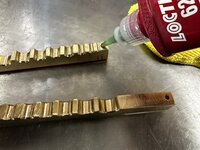
Retaining compund gets added and the alignment pins get pressed in.

image.jpeg
The alignment pins ensure that you always clamp each shaft square in the clamps.
image.jpeg
image.jpeg
I'm now set to service some new suspension componets after fox switched from a 9mm under shaft to a ⅜ during covid production.

Once my the new end mills order arrived I'll do a full metric set. I also broke down and ordered some Copper bar to make a set of flat soft saws and I will most likely modify the stock Wilton steel ones to fit this system as well.
 
To avoid these ads, REGISTER NOW!

F-22

Well-known member
Joined
Jan 23, 2022
Messages
1,830
Really nice work on everything, and it's a joy to see all those nice tool.

The spiral tap does remove chips and does it all in one go, but in my experience it's more fragile and easier to snap than a regular straight flute. My most used are the gun-point type of tap, but those instead push the chips down and are most suitable for through-holes. For regular holes you need to blow out the chips more often.

And sometimes the three stage taps are just the best for hand-use, even if they take more time...
 
OP
G

Grant Gunderson

Well-known member
Joined
May 17, 2013
Messages
2,317
Location
Bellingham, WA
Really nice work on everything, and it's a joy to see all those nice tool.

The spiral tap does remove chips and does it all in one go, but in my experience it's more fragile and easier to snap than a regular straight flute. My most used are the gun-point type of tap, but those instead push the chips down and are most suitable for through-holes. For regular holes you need to blow out the chips more often.

And sometimes the three stage taps are just the best for hand-use, even if they take more time...
IMG_2918.jpeg
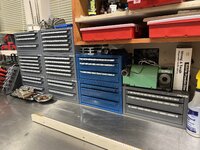
I have an entire Lista drawer full of various taps. Each time I need a specific size I tend to purchase the correct tap if I don’t have it for that application. I really need to order a set of the spiral flute bottom taps. I have been having really good luck with the YG-1 brand. They are exceptional quality for the price.
 

senlow

Well-known member
Joined
Apr 26, 2008
Messages
2,228
Location
Wheat Ridge, Colorado
image.jpeg
I then needed to determine the spacing for the mounting bolts. I just measured the outside of the bolts, then subtracted 5/16" (bolt size) from it.
Wow, that's an excellent quick change jaw system. I really like it.

I'll offer a tip for simpler measurement of bolt spacing with digital calipers:
  • Measure the bolt diameter.
  • Zero the calipers to the bolt diameter.
  • Measure across the outside of the two bolts.
  • You now have the center to center distance between the bolts with NO calculations.
One can use a similar technique to measure between holes. This, of course, works only with two diameters of the same size.
 
To avoid these ads, REGISTER NOW!
Top Bottom