To avoid these ads, REGISTER NOW!

Internal npt thread repair

jstroede

Well-known member
Joined
Oct 28, 2010
Messages
1,080
Location
Kansas City
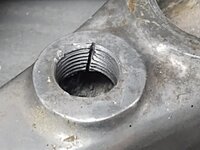
Ok, working on an intake manifold that someone thought would be a good idea to put a steel 1/2 npt plug in a nice polished intake. The motor sat for years, and coolant severely corroded this plug to the point that it was basically fused into the aluminum. I drilled it out with the largest bit I had which was 43/64. I made a couple light cuts with a hack saw blade and went to try and break it out and it sheared off below the surface. I kept working at it and finally got it out, but I ended up cutting into the aluminum more than I wanted to. I ran a tap in a thread or so deeper than it was, which is now about as deep as it can go. It cleaned up all the threads pretty nicely other than my cut. What are my options here? Structurally it is good. I just want to make sure it won't leak. It is an engine so it needs to be good for 250 plus degrees. Do I go to some sort of epoxy and retap? It is is not as deep as it looks, but is still deeper than I wanted. I think it looks worse than it is. I can't really go bigger, or deeper. Of course the brass plug next to it can out with a little heat and an impact. Looking for ideas and you guys always seem to have good ones.

Thanks.

John
 

Attachments

  • IMG_20220111_234939376.jpg
    IMG_20220111_234939376.jpg
    164.8 KB · Views: 86
To avoid these ads, REGISTER NOW!

nutjob

Well-known member
Joined
May 8, 2008
Messages
804
Location
NE, PA
If you need to go the Heilcoil route the drill size for 1/2 NPT is 13/16" See if this size would remove the groove.

Kevin
 

Monza Harry

Well-known member
Joined
Dec 29, 2018
Messages
1,433
Location
Windsor ON
As Mario points out [JB Weld] would likely do just fine! As would any Premium brand epoxy sealants would. Everything else will get deeper down the "Rabbit Hole" so to speak weld re-cut, open up to 3/4 NPT etc..
For future consideration next time try a pipe reamer or even make a reverse rotation one from an old dull tap and a little judicial use of some fire [Torch even a "Turbo Propane after drilling out of course] will help way more than you might think! Harry
 
OP
J

jstroede

Well-known member
Joined
Oct 28, 2010
Messages
1,080
Location
Kansas City
As Mario points out [JB Weld] would likely do just fine! As would any Premium brand epoxy sealants would. Everything else will get deeper down the "Rabbit Hole" so to speak weld re-cut, open up to 3/4 NPT etc..
For future consideration next time try a pipe reamer or even make a reverse rotation one from an old dull tap and a little judicial use of some fire [Torch even a "Turbo Propane after drilling out of course] will help way more than you might think! Harry

Yeah, this thing was gnarly unlike any I have had to remove. I have removed many plugs from blocks, cylinder heads, and intakes through the years. This one was one of the worst. I think it was a bare steel plug. I tried every tool I had in the box on my way up through drilling it out. I used heat, easy outs, internal pipe removal tools, etc. It was an internal hex that originally stripped out due to being very corroded I think. In retrospect, I probably should have welded a nut on it as my first try, but I really didn't think it was going to be that hard to remove. The part that really screwed me was when it sheared off below the surface. I should have not drilled it so large and used the saw to cut it deeper. Normally it is a brass plug that strips, and once you drill the majority of it out it peels right out. Not this thing though. I think it is because it sat for so long in nasty coolant. A bunch of the coolant passages in the block of this motor are clogged too. I think they ran block sealer in it and it sat for years. Thousands of dollars in parts though so I will take the time and clean it up right. Reason number 548 why you shouldn't let things sit....
 

rlitman

Well-known member
Joined
Oct 18, 2010
Messages
24,577
Location
Long Island
JB Weld is probably fine. I'd be more worried that the tap will either drop chunks inside (perhaps no an issue if you have the manifold off), or rip out epoxy chunk entirely in places (potentially affecting the seal).

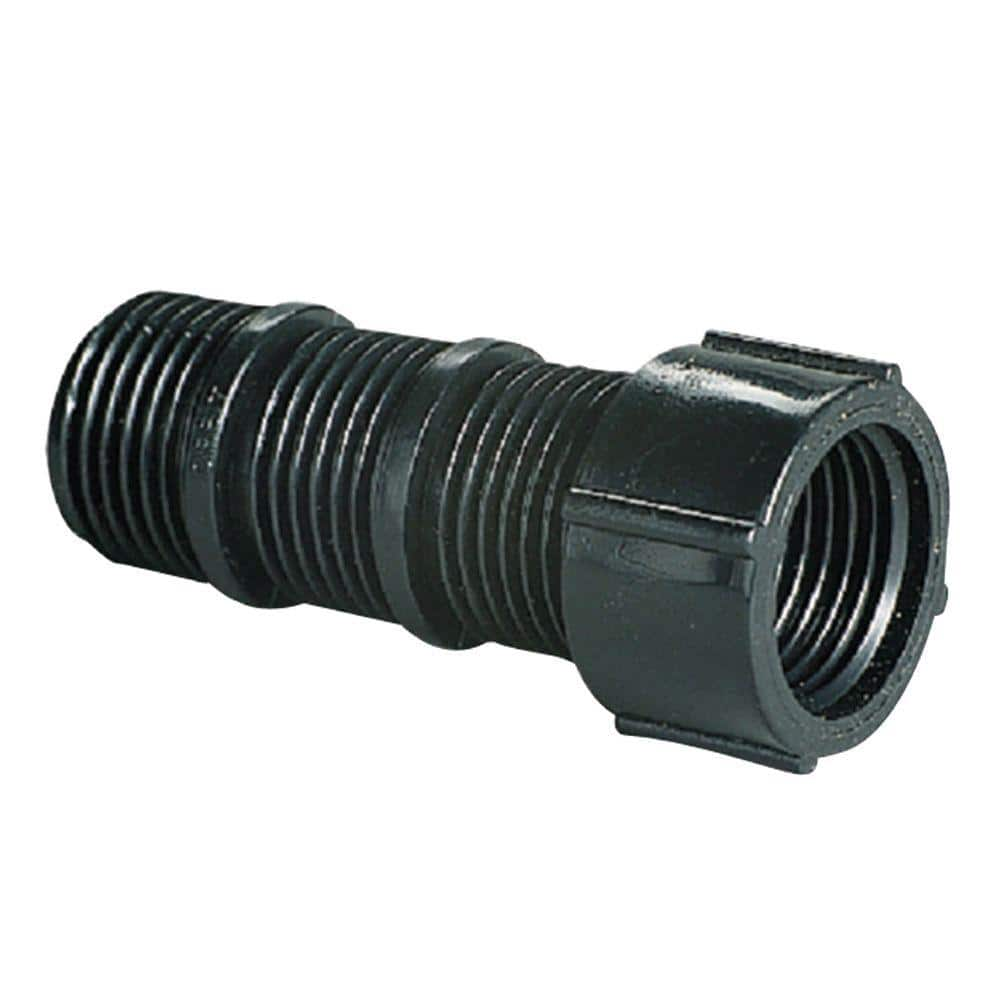
If it were me, I'd apply the epoxy, and then hand screw in a marlex plastic sprinkler fitting, leaving that in place while the epoxy cures as a thread form to get you closer to finished shape before tapping. Go to Home Depot and look at the sprinkler parts in the plumbing section. There'll be grey and blue PVC fittings for sprinkler irrigation, but the PVC will stick to the epoxy. Look for the really cheap black adapters. The cheapest option will be a "cut off sprinkler riser" for like 65 cents.

These black plastic parts are polyethylene, that will not stick to the epoxy. ;)
 
OP
J

jstroede

Well-known member
Joined
Oct 28, 2010
Messages
1,080
Location
Kansas City
JB Weld is probably fine. I'd be more worried that the tap will either drop chunks inside (perhaps no an issue if you have the manifold off), or rip out epoxy chunk entirely in places (potentially affecting the seal).

If it were me, I'd apply the epoxy, and then hand screw in a marlex plastic sprinkler fitting, leaving that in place while the epoxy cures as a thread form to get you closer to finished shape before tapping. Go to Home Depot and look at the sprinkler parts in the plumbing section. There'll be grey and blue PVC fittings for sprinkler irrigation, but the PVC will stick to the epoxy. Look for the really cheap black adapters. The cheapest option will be a "cut off sprinkler riser" for like 65 cents.

These black plastic parts are polyethylene, that will not stick to the epoxy. ;)

Interesting. I actually thought about running in a brass fitting part way while the jb weld was uncured to partially form it, then removing the fitting so it wouldn't be too much. After it is cured, then I would run the tap through it to finalize it.

The intake is off the engine, along with everything else. I wasn't planning on pulling it all the way down but after finding things like this, I am glad I did. All the parts are getting deep cleaned so shavings are of zero concern. I just want to have confidence that it isn't going to leak when I put it back together.

John
 

dogdog

Well-known member
Joined
Nov 15, 2011
Messages
12,711
yea jb weld might be sensitive to heat I think... you might need to make sure the epoxy you used is high heat resist. weld or braze it then retap.
 

rlitman

Well-known member
Joined
Oct 18, 2010
Messages
24,577
Location
Long Island
jb weld is for hacks. Tig weld it or find someone to tig weld it and re-tap it with an npt tap.
I have a TIG welder that's plenty capable of this job, and I LOVE using it. I've found all sorts of stupid excuses around the house to use it (including welding the handle of my Mexican cast aluminum lemon squeezer back on after I snapped it off by squeezing a lemon too hand). I'd still be using JB weld here.

And if I were welding it, there's no way I'd do it that way. Hypothetically, with a larger damaged area, I'd grind the area flat, countersink the hole like I'd chamfer a crack so that I get full penetration when welding it shut. Weld it shut with a backer on one side, grind out the other side and repeat, grind until the hole has been "disappeared", then drill it out, and then TIG weld in a weldable threaded bung.

There's probably enough meat on that boss to skip all but the last two steps and just drill and weld on a bung.
It's a viable option, but stupidly overkill. On modern cars this part is all too often made of plastic that's not as strong or heat resistant as the JB weld itself.

But tapping aluminum when the metal is a mix of some casting alloy and your filler, and each side of the hole will be in different proportions; pass. I'd trust the JB welded threads over the threads resulting from that. Especially when we're talking about fixing a saw cut and not a fully stripped out thread. Remember that the filled in parts are actually going to be held in place by the male threads.

Plus, you're making the big assumption that the casting is even weldable. Sure, it probably is, but if not you'll be seeking a replacement.

yea jb weld might be sensitive to heat I think... you might need to make sure the epoxy you used is high heat resist. weld or braze it then retap.
What? The highest heat this will see is coolant temperature. This isn't an exhaust.
 

MoonRise

Well-known member
Joined
Nov 5, 2010
Messages
4,027
Location
NJ
As mentioned, the 'real' fix is to put actual aluminum in there.

Drill/mill out the damaged thread, insert an aluminum rod/tube of the proper alloy and dimensions and use a press fit, machine the proper edge/corner chamfers to allow the next step to be done (might want to do this before the previous step :lol: ), TIG weld the rod/tube to the manifold using the chamfers (see previous step) to enable proper weld depth, drill/mill proper hole and tap all new threads.

Assuming that the original cast aluminum manifold is weldable. :lol: Some cast aluminum is weldable, some is weldable with difficulty (multiple passes with 'floating' the crud up in the weld puddle and grinding that out and repeating until you can finally get an actual weld bead to happen), and some is not really weldable (too much crud, casting porosity, etc).

Another possible route is to mill/drill out the old damaged threads and face off the boss nice and flat. Tap for standard threads (not tapered pipe NPT threads) and install a plug that seals via a gasket or o-ring (think oil drain plug).

You can maybe get a skilled TIG welder to just weld in some aluminum where you cut through the threads, and then retap the threads.

If you want to use an epoxy as the fix, original JB Weld is rated to withstand "up to 550F when fully cured".


But the epoxy will only be about 1/4 (or less) as strong (tensile or shear strength) as the original aluminum of the manifold.
 

u2slow

Well-known member
Joined
Nov 20, 2011
Messages
3,583
Location
BC
We use a metallic epoxy putty at work called Devcon for metal repair. If JB weld has a formulation with metal in it, probably same thing. Don't expect to be able to unthread the plug again...
 

joe49

Well-known member
Joined
Sep 25, 2009
Messages
1,883
Location
Tonica, Il
I would chase the thread a little deeper, then just pipe dope it well and let that set up over night.
(option 2) use a aluminum solder at the cut, when cooled chase the threads, then pipe dope drying over night. (option 3) Tig only the cut, chase threads and dope over night. But why bother, pressure is low anyway. Don't hack it with JB Weld. Just to add tig sounds like the real proper way to go. But any one that has a clue knows what a can of worms it can be with AL castings lots of **** will float up in the weld pool and turn it into a much bigger problem. Casting isn't cracked so keep it simple.
 
Last edited:

dogdog

Well-known member
Joined
Nov 15, 2011
Messages
12,711
....
What? The highest heat this will see is coolant temperature. This isn't an exhaust.
how many use you think JB weld can withstand in that area ? it is not a epoxy once and sealed once situation. It's a threaded area gets plugs inserted, teeth meeting and metal stretching area, it gets fatigue and wear fast. . Even if jb weld says constant 500F... how long? Just not a long term solution.
 

rlitman

Well-known member
Joined
Oct 18, 2010
Messages
24,577
Location
Long Island
how many use you think JB weld can withstand in that area ? it is not a epoxy once and sealed once situation. It's a threaded area gets plugs inserted, teeth meeting and metal stretching area, it gets fatigue and wear fast. . Even if jb weld says constant 500F... how long? Just not a long term solution.
Constant temperature of 500F means indefinitely. Coolant will NEVER exceed 250F. Physics are still the law.

That is not an area subject to fatigue or wear.
 

dogdog

Well-known member
Joined
Nov 15, 2011
Messages
12,711
Constant temperature of 500F means indefinitely. Coolant will NEVER exceed 250F. Physics are still the law.

That is not an area subject to fatigue or wear.

lol how many screwing you think that hole will get ?:p
 
To avoid these ads, REGISTER NOW!

rlitman

Well-known member
Joined
Oct 18, 2010
Messages
24,577
Location
Long Island
lol how many screwing you think that hole will get ?:p
I'd be comfortable with at least one. You're right, in that if you plan to remove whatever is in there at a later time, the epoxy may come out with it, but then again, it may not.

Anyway, this is an NPT fitting, not Lego. It's not made for daily reassembly and it's just getting plugged. Epoxy is a well regarded technique for aluminum thread repair, even if frowned upon by some here who just don't know better. Plus welding will leave visible scars on a part that should otherwise polish up nicely.

Now if you want to say that JB Weld is hack simply because it's found in a hardware store, I've got a drawer full of Belzona metal repair products that I'd be reaching for first.


rustyjames

Well-known member
Joined
Dec 28, 2008
Messages
1,077
Location
central nj
I'd either go with epoxy or drill/tap oversize before trying to weld it. Cast aluminum can be a PIA to weld sometimes, especially in a hole that small.
 

BillK

Well-known member
Joined
Aug 24, 2006
Messages
9,296
Location
Beautiful Southern Maryland
I have fixed several with JB Weld and never had a comeback. Most on Marine engines which are notorious for corrosion like that. The guys that say JB Weld is a "hack" repair might be correct for certain repairs but this is the perfect example of a great use for it. Plenty of 5.7 Chevy Vortec engines with that problem where the heater hose quick connect goes in.

Make sure and use the JB Weld and not the JB Quick.
 

ez-duzit

Well-known member
Joined
Jun 24, 2013
Messages
5,094
Location
Marina del Rey
Surprised at how many true hacks there are on this site. JB Weld? What a bunch of hacks!

So simple to tig weld it and re-tap. One and done. Correctly.
 

ez-duzit

Well-known member
Joined
Jun 24, 2013
Messages
5,094
Location
Marina del Rey
Meanwhile the hacks are done with the repair and have moved on...

Seriously, if it lasts then it's not wrong.
Hacks just don't know any better. They don't know or care if it lasts. If they hack a good part, they need another hack to "fix" it. And if their hack appears to get them out of immediate trouble, let the next guy take care of their blunders.
 

Bert_

Well-known member
Joined
Dec 24, 2016
Messages
9,690
Location
NW Iowa
Hacks just don't know any better. They don't know or care if it lasts. If they hack a good part, they need another hack to "fix" it. And if their hack appears to get them out of immediate trouble, let the next guy take care of their blunders.
I know and care. I would jb weld it no question.
 

dogdog

Well-known member
Joined
Nov 15, 2011
Messages
12,711
Maybe it's my luck with epoxy stuff on moving/mating parts. or I just buy cheaper version jb welds, they don't seems to last in those places. It's one thing if you are sealing it for ever , it's another if you plan to remove that plug . and that is way too less meat to form anything strong IMO.

1/2 npt pipe od is about .85 inches which is about 21mm or 22mm... since you had some cut outs of that thread, I would oversize and see if there is any 25mm maybe a 23mm ? oil drain plugs and re-tap to that . or Time-sert route.


or go find a 1/2 NPT angle ball shut off valve that fits that like the ones for air compressors and use that ball valve as drain and seal that thread with epoxy... then you won't be "moving" or just a brass street elbow and plug.... but looks ghetto though.

Or just a 1/2 to 3/8 reducer and jb weld the damaged threads. that is even better than just jb weld trying to rethread.
 
Last edited:

Jlarson

Well-known member
Joined
Mar 27, 2015
Messages
738
Location
AZ
I'd be comfortable with at least one. You're right, in that if you plan to remove whatever is in there at a later time, the epoxy may come out with it, but then again, it may not.

Anyway, this is an NPT fitting, not Lego. It's not made for daily reassembly and it's just getting plugged. Epoxy is a well regarded technique for aluminum thread repair, even if frowned upon by some here who just don't know better. Plus welding will leave visible scars on a part that should otherwise polish up nicely.

Now if you want to say that JB Weld is hack simply because it's found in a hardware store, I've got a drawer full of Belzona metal repair products that I'd be reaching for first.


Yeah we've used Belzona stuff on plenty of real repairs, not just some car part lol. Loctite also offers a thread repair epoxy kit. I'll use repair inserts too sometimes. We TIG weld a bunch of repairs but it has to make good sense, not going to weld everything or epoxy everything, case by case.
 

Hawke

Well-known member
Joined
Aug 24, 2007
Messages
151
Location
Sydney Australia
JB weld for me. It’s easy, cheap, quick and works. About 20 years ago, I got a pinhole in the dry sump oil tank of my race car. I used JB weld as a temporary measure that weekend at the track. 20 years later, still not leaking. Oil temps sometimes hit 300 degrees.
 

Bigblue&Goldie

Well-known member
Joined
Mar 12, 2009
Messages
10,662
Location
AZ
I'd just epoxy it. I remember seeing the ugliest, most beautiful intake manifold a long time drag racer made. He literally ran the manifold through a bandsaw (cutting it in half) so he could better port/reshape the internals. It was a combination of aluminum and epoxy topped with a plywood carburetor spacer.....not a single weld. He had many national class records, so it must've worked.
 

dutchgray

Well-known member
Joined
Sep 28, 2014
Messages
6,461
Location
Dorset. England.
Surprised at how many true hacks there are on this site. JB Weld? What a bunch of hacks!

So simple to tig weld it and re-tap. One and done. Correctly.
A lot more people have the skills to fix it with epoxy than do with TIG welding.
I know I couldn't TIG it with my level of welding skill.
 

gearhead1

Well-known member
Joined
Oct 14, 2013
Messages
1,935
Location
NC
I’d try either J B Weld or epoxy, I’ve had great success with both. Try either bypressing it in the crack with a popsicle stick. Or mix J B Weld and put in a syringe to get it in the crack.

I’d go with epoxy first with the pop sickle stick, and I’d press some on the bottom. That way when the pressure pushes against it, it is supported and the localized load is dispersed. I’ve had good luck with this. I can draw a sketch if necessary.

My cousin has a repair shop and a big truck came in with an auxiliary power take off (the kind that bolt on the side of a manual transmission). Customer did not want to wait the time for a new shaft, had to have the truck. It was a special since the PTO shaft had a gear on one end like it was one piece. It had an area on the shaft that was severely worn down. He cleaned it, put on epoxy putty, and let it cure. Then he put it in the lathe and machined down the epoxy to the same diameter as the rest of the shaft. I asked him about it, and he said he’s never had one come back. I thought that was a pretty neat repair. Epoxy is strong stuff.
 

welder4956

Well-known member
Joined
Apr 8, 2010
Messages
3,056
Location
Birmingham, AL USA
A small cut like that across the threads, I would use an epoxy repair unless you have access to a AC TIG welder. And this time put a brass plug in, not steel. If you have access to a AC TIG welder and since you want to plug it anyway, just grind the threads out first then weld it up solid and grind it smooth. No need to drill and tap if you plan to plug it.
 

cannuck

Well-known member
Joined
Nov 30, 2021
Messages
4,592
Location
Rural SK
Is this part going to be on a judged resto or show? Need to keep looking as before?

A few cautions about "re-threading" a hole: IF you do a weld or epoxy fix into the crack and then try to pick up the original thread, almost impossible to do. If you weld the whole thing (which is what I would prefer to do) the resulting welded area might not take a clean thread as it can be fairly soft. I would consider the risk on the casting being non-weldable as fairly small.

Given that you can stand to have something not as original, I would go with the Timesert solution, except that SS inserts in Al castings can cause some serious corrosion issues, so plain carbon steel is actually a better choice.

One of the earlier suggestions of use epoxy formed around the sprinkler insert is actually a fantastic idea. I would think that going that way and using same epoxy after filling to glue the new fitting permanently in place by slathering the threads with it WITHOUT any further re-tapping. If you can tolerate the look of something NOT as original, I would suggest putting a 1/2 x 3/8 NPT reducing bushing as the permanent installation and be able to install a 3/8 plug that is easily removeable in the hole. I make a lot of fuel tanks and such with 5052 H32 and sometimes 6061 in T6 condition and I usually put a brass bushing into the aluminum with a permanent anaerobic sealant on the outside of the busing and then use something non-setting such as Loctite 567 on the plug or instrument being mounted. Works like a damn and stuff can stay in use for decades with dozens of R&R functions.

I would treat a Timesert NPT insert the same way.
 

rlitman

Well-known member
Joined
Oct 18, 2010
Messages
24,577
Location
Long Island
...No need to drill and tap if you plan to plug it.
You make a reasonable point. I know I could easily TIG weld it shut and smooth it out so that when polished, the hole would be magically gone. But because the filler corrodes differently than the base metal, it will reappear in short order unless you live in a high desert.
... I would consider the risk on the casting being non-weldable as fairly small...
If I had a nickel for every time I've been fooled by aluminum castings that turned out to be magnesium . . . I'd have half a dollar in my pocket. I agree that it's a small risk, but at least give it a vinegar test before you pick up the torch.
 

APEowner

Well-known member
Joined
Oct 2, 2009
Messages
4,164
Location
Sunny, New Mexico
If I just wanted to fix it and get on with life I'd use LOCTITE® PC 3967 Form-A-Thread. If I wanted something that looked pretty I'd bore out a hole, TIG in a plug, machine the weld flat, drill and re-tap or, if I was just going to plug it I'd stop after the machining process
 

welder4956

Well-known member
Joined
Apr 8, 2010
Messages
3,056
Location
Birmingham, AL USA
You make a reasonable point. I know I could easily TIG weld it shut and smooth it out so that when polished, the hole would be magically gone. But because the filler corrodes differently than the base metal, it will reappear in short order unless you live in a high desert.
Automotive castings are typically A356 grade aluminum, which has about 7% silicon and 0.35% magnesium added. Silicon is added to increase fluidity for the casting during the pour. Magnesium is added for strengthening. Neither are added for corrosion resistance. ER4043 has slightly less silicon (5%), but not enough difference to cause a corrosion issue with automotive coolant that already has corrosion inhibitors. Not enough difference to worry about. There are plenty of welded aluminum intakes that have no corrosion issues.
 
To avoid these ads, REGISTER NOW!
Top Bottom