To avoid these ads, REGISTER NOW!

IR compressor flipping breaker

1dumbquestion

Active member
Joined
Jun 18, 2012
Messages
26
Hey all, not sure if this is the place to ask but figured there was a lot of knowledge on here. I've got a 5hp IR T-30 compressor. It flips my panel breaker when it gets to around 60psi. I pulled the pump and opened it up, seems very clean and smooth. Put it back together and still the same thing. So, I pulled the line and let the machine run without being able to build pressure and it runs well beyond the time it would take to fill with no problems. I'm thinking maybe the extra force required with a somewhat filled tank is causing the motor to overwork and flip it but I don't want to just throw a motor on if it's not the problem. Ideas? Thanks, 1
 
To avoid these ads, REGISTER NOW!

GeneralDisorder

Well-known member
Joined
Sep 20, 2012
Messages
306
Breaker size? Wire sizing and length to machine? Voltage at motor?

If those check out you need to put an amp meter on it and check current draw. Could be a bad motor.

GD
 

bobcatdan

Well-known member
Joined
Jan 4, 2011
Messages
9,948
Location
Kaukauna,WI
I have had to get the 7.5 HP motor on my T30 rebuilt twice in the last two years. I have yet to come up with a problem with the compressor. It ran fine for eight years so the first time, I was OK with it, not happy, but it happens. The second time, the rebuild was still in warranty by a week.
 

larry_g

Well-known member
Joined
Apr 28, 2007
Messages
16,872
Location
oregon
Has this compressor ever worked in this configuration, or is it new to you? What is the FLA rating on the motor tag and what current are you pulling when the breaker trips? Without good solid information requested above and current draw when tripping all your going to get is guesses, some good some questionable.

lg
no neat sig line
 

C96

Well-known member
Joined
Nov 30, 2013
Messages
1,251
As others have mentioned, not enough information given on your part.

It’s strange that the circuit breaker supplying power to the compressor is tripping as opposed to the motor overload protection device. Normally the overload protection will cut power to the motor when there is excessive currant draw above the full-load currant rating of the motor. 125% comes to mind if your motor has a service factor of not less than 1.15 and a temp. rise not over 40° C. equipped with a mag starter. It’s possible your breaker is on the threshold of being undersized and or has become fatigued unable to hold the load. Check all your electrical connections and make sure they are tight. This is assuming the compressor has been running fine and you’re just now having problems. It could even be a bad capacitor.

There are many factors that can cause your problem; I like to start with the most sensible, easiest and cheapest first.

Like b-body-bob stated, check valve or unloader problems are common.
 

Rookie2

Well-known member
Joined
Feb 27, 2013
Messages
1,925
Location
Western Pa.
I'm not an expert on compressors but I stayed in a holiday inn express a long time ago. I would change both the starting and the run capacitors as a quick test. Or find a digital voltmeter with microfarads scale and actually measure them.
 
OP
1

1dumbquestion

Active member
Joined
Jun 18, 2012
Messages
26
I can see by all the questions that I need to find some things out before I continue. The compressor is new to me and no idea of how it ran before. I had an electrician buddy do the wiring as it's running 3 phase so I wasn't too confident. I know he used old breakers and disconnect he had laying around. I'll get him back to do some testing before I start throwing parts at it. Thanks for all the input, 1
 

justme-

Well-known member
Joined
May 24, 2014
Messages
787
Location
Boston suburbs
3 phase is a different animal from regular wall plugs. Possibly no capacitors at all since I don't think they are needed with phase input. Anyway a start cap has no effect on the motor once its running more than about 5 seconds, so don't toss cash away by changing it. The caps aren't likely to be the cause if the motor runs unloaded. Its a winding, bearing, belt too tight, or incoming supply issue. Again 3 phase changes some diagnosis but should be same suspected areas.
 

larry_g

Well-known member
Joined
Apr 28, 2007
Messages
16,872
Location
oregon
3 phase is a different animal from regular wall plugs. Possibly no capacitors at all since I don't think they are needed with phase input. Anyway a start cap has no effect on the motor once its running more than about 5 seconds, so don't toss cash away by changing it. The caps aren't likely to be the cause if the motor runs unloaded. Its a winding, bearing, belt too tight, or incoming supply issue. Again 3 phase changes some diagnosis but should be same suspected areas.

Please take the above information with a grain of salt. The poster knows nothing of what he is talking about.

lg
no neat sig line
 

Greatbear

Well-known member
Joined
Jan 17, 2008
Messages
1,702
Location
Columbia/Fulton, MD
This can happen when a two-stage compressor has a faulty valve in the secondary (small) cylinder. If either the intake or exhaust valve is leaking or broken, it prevents the secondary cylinder from boosting the pressure from the primary and sending it to the tank. The primary cylinder has to do all the work, and in many cases the primary isn't able to pump more than 50-70 pounds. Ant more than this and it will overload the motor and trip breakers or overload devices in the motor. There is usually an interstage pressure relief in the piping between cylinders to vent excess pressure when this happen, but it is often not enough to prevent overloads.

It's best to measure the current draw of the motor with the tank at low pressure and see how high it gets as it nears the pressure where the breaker trips. At this point, feel the temperature of both cylinders. If the primary is far hotter, you have an air issue.
 
OP
1

1dumbquestion

Active member
Joined
Jun 18, 2012
Messages
26
Update: put the AC on hold while putting out other fires.

So. My first thought on what was happening was off. So what really happens is I run the compressor, it fills to the shutoff pressure, when the tank drops to about 60 it clicks back on. This is the point at which the motor can't get going again. It wants to but doesn't quite have it and then flips the breaker. If I drain the tank it will do it all over again. Thoughts? Capacitor? Thanks, 1
 

joel63

Well-known member
Joined
Oct 9, 2012
Messages
1,907
Location
Central FL
Update: put the AC on hold while putting out other fires.

So. My first thought on what was happening was off. So what really happens is I run the compressor, it fills to the shutoff pressure, when the tank drops to about 60 it clicks back on. This is the point at which the motor can't get going again. It wants to but doesn't quite have it and then flips the breaker. If I drain the tank it will do it all over again. Thoughts? Capacitor? Thanks, 1

Unloader not working? :headscrat
 

ripperd

Well-known member
Joined
Jul 2, 2014
Messages
2,044
Location
Twin Cities, MN
Update: put the AC on hold while putting out other fires.

So. My first thought on what was happening was off. So what really happens is I run the compressor, it fills to the shutoff pressure, when the tank drops to about 60 it clicks back on. This is the point at which the motor can't get going again. It wants to but doesn't quite have it and then flips the breaker. If I drain the tank it will do it all over again. Thoughts? Capacitor? Thanks, 1

There is a valve that should be releasing the pressure between the compressor and the tank once the compressor stops running. This is probably not releasing the pressure, so the compressor has to fight the 60psi to get moving.

http://www.air-compressor-guide.com/learn/air-compressor-parts/air-compressor-unloader/
 

Charles (in GA)

Well-known member
Joined
Jan 11, 2006
Messages
12,489
Location
50 mi south of Atlanta
Update: put the AC on hold while putting out other fires.

So. My first thought on what was happening was off. So what really happens is I run the compressor, it fills to the shutoff pressure, when the tank drops to about 60 it clicks back on. This is the point at which the motor can't get going again. It wants to but doesn't quite have it and then flips the breaker. If I drain the tank it will do it all over again. Thoughts? Capacitor? Thanks, 1

Very different situation from what was first described (or incompletely described).

Unloader not working? :headscrat

Very possibly.

There is a valve that should be releasing the pressure between the compressor and the tank once the compressor stops running. This is probably not releasing the pressure, so the compressor has to fight the 60psi to get moving.

http://www.air-compressor-guide.com/learn/air-compressor-parts/air-compressor-unloader/

Most modern compressors have a unloader valve that is part of the pressure switch. When the pressure switch shuts off the motor, it then relieves the pressure on the head. This allows the pump to turn freely for a turn or two when it starts up next time.

Pressure is prevented from getting back to the head from the tank by a check valve at the tank inlet. If the check valve is leaking slightly, the unloader could be working properly, but then the head is re-pressurized by pressure leaking up from the tank.

Question for the OP????????????? Do you hear a loud hiss of air from the pressure switch (or whatever is used for a head unloader) each time the compressor shuts off????????????

If YES, I would go for the tank inlet check valve, if NO, I would look at the unloader. On larger compressors, it could be a centrifugal or oil pressure operated valve rather than a pressure switch variety.

Charles
 
OP
1

1dumbquestion

Active member
Joined
Jun 18, 2012
Messages
26
finally back to my compressor trouble. So looked online and it seemed that there was an unloader on the end of the crankshaft. When I pulled the cover there was nothing there. I did find on the back of the pressure shut off switch is a thing that looks like a valve spring on an engine. Not sure if this is part of the adjustment for the shutoff or part of an unloader. I do not hear any hissing when the machine is charged and sitting. I also don't see anywhere for there to be a check valve, as all the lines look to go through normal pipe fittings. Thoughts, 1
 

C96

Well-known member
Joined
Nov 30, 2013
Messages
1,251
So looked online and it seemed that there was an unloader on the end of the crankshaft. When I pulled the cover there was nothing there.

LOl… this is a problem. Post some pictures if you can, it will make it easier to diagnose.

Once we see what parts are missing, we can help you get it back in order.
 
OP
1

1dumbquestion

Active member
Joined
Jun 18, 2012
Messages
26
LOl… this is a problem. Post some pictures if you can, it will make it easier to diagnose.

Once we see what parts are missing, we can help you get it back in order.

LOL... what I meant was that I have a different model than the ones with an unloader on the crankshaft. The only exploded view I found online had the cintrifugal unloader and the front plate had lines coming out. My front plate is solid (except the oil sensor). My tank says T30 and the compressor is marked 242-5N. Does this help at all? Thanks, 1
 
Last edited:
To avoid these ads, REGISTER NOW!

scw1991

Well-known member
Joined
Mar 28, 2010
Messages
506
If it's a 242-5n it was superseded by the 2475-N5. That line coming off the crankcase (flywheel side) is a crankcase vent only, not an unloader valve.
 
Last edited:

redmondjp

Well-known member
Joined
Nov 25, 2014
Messages
2,318
Location
Redmond, WA
I agree with the above posters that it sounds like the unloader is not functioning. Check the picture in this link - it shows a typical pressure switch with built-in unloader valve (that large spring that you mentioned is what sets the pressure on/off range).

http://www.pirate4x4.com/forum/toyota-truck-4runner/103926-check-valve-w-unloader.html#post1117485

Typically there is a 1/4" copper or aluminum pipe that connects from the unloader valve on the pressure switch to a port on the check valve right at the entrance to the tank. When the pressure switch reaches its upper setting, it turns off the motor and opens the unloader valve, discharging the pressure in the main line from the compressor pump to the tank.

The setup described above is used on the least expensive compressors. On the next step up the unloader line may connect directly to the head(s) of the compressor (controlled by either the above-mentioned pressure switch, or by a centrifugal valve on the end of the compressor pump crankshaft). On some of the pressure-lubricated compressor pumps (the rolls-royce models), the centrifugal unloader is omitted and oil pressure is used (through same-sized 1/4" lines) to unload the valves on the compressor head(s).


If you do have the unloader valve built into the pressure switch, inspect it to see if it is working. When the pressure switch hits its upper limit, an arm will move up against the end of the unloader valve which has a tiny round pintle protruding from it about 1/8". Depressing this pintle releases pressure in the unloader system.

[general knowledge note/caution] If the compressor is turned off before the pressure switch hits its limit, the unloader valve does NOT activate. Manually releasing the pressure on the pump output by depressing the unloader valve pintle will then allow the compressor to restart.

Get back to us with what you find.
 
OP
1

1dumbquestion

Active member
Joined
Jun 18, 2012
Messages
26
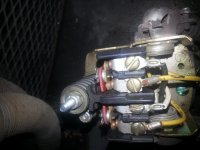
Ok. so I looked at the link from the 4wd forum. I have a very close looking pressure shut off valve but it does not have a line coming out of the bottom or a fitting for said line. I do not have any lines coming from my crank front plate. There is a manual valve at the tank, at the coiled line that runs from head to head, and the opposite side of the tank as a drain. There is a 1/4" line running from the primary head to the back of the crank housing. I've attached a couple of pics. Thanks for all the attempts to help, 1
 
OP
1

1dumbquestion

Active member
Joined
Jun 18, 2012
Messages
26
pics.
 

Attachments

  • pic 1.jpg
    pic 1.jpg
    146.3 KB · Views: 27
  • pic 2.jpg
    pic 2.jpg
    139.8 KB · Views: 26
  • pic 3.jpg
    pic 3.jpg
    140.7 KB · Views: 26

MacMcMacmac

Well-known member
Joined
Oct 21, 2014
Messages
1,581
Location
canada
There is no unloader on your compressor. Install a pressure switch with a needle valve unloader on it. Run a 1/4" copper line from the needle valve to some point in the system after the high pressure discharge valve but before the check valve. Most in-tank check valves will have a 1/8" NPT port for the unloader line. Simply install a 1/8" NPT, 1/4" compression fitting and attach the copper line from the unloader needle valve to it. When the compressor cuts out, the pressure switch will trip the needle valve and blow off the pressure upstream of the check valve so the pump does not start with pressure in it. Some IR pumps have a port in the HP cylinder next to the discharge port for a compression fitting to be installed, check to see if there is a pipe plug in it, or if yours has one at all. It is usually easier to fit the compression fitting in there than try to wrangle it into the check valve port in the tight confines they are usually situated in.
 
OP
1

1dumbquestion

Active member
Joined
Jun 18, 2012
Messages
26
My machine does have an 1/8" NPT plug on the side of the HS head. I can utilize that if needed. I just have a hard time seeing why I need to do this, the machine was built to work as made without modifications. Not sure of the compressors age but I'm sure it worked as built for thousands of hours. I'd rather fix whatever is broken or not working then add a fix to whatever is going on. Thoughts?
 

Scsmith42

Well-known member
Joined
Nov 20, 2014
Messages
132
Location
New Hill, NC
My machine does have an 1/8" NPT plug on the side of the HS head. I can utilize that if needed. I just have a hard time seeing why I need to do this, the machine was built to work as made without modifications. Not sure of the compressors age but I'm sure it worked as built for thousands of hours. I'd rather fix whatever is broken or not working then add a fix to whatever is going on. Thoughts?


Every compressor that I have ever seen (with the exception of rotary screw compressors) had some type of unloaded valve in the system. Yours should have one somewhere or else it has been bypassed by a previous owner.

That does not explain why the compressor is tripping the breaker at 60psi though. What size wire and breaker is feeding it?


Scott
 

redmondjp

Well-known member
Joined
Nov 25, 2014
Messages
2,318
Location
Redmond, WA
Every compressor that I have ever seen (with the exception of rotary screw compressors) had some type of unloaded valve in the system. Yours should have one somewhere or else it has been bypassed by a previous owner.

That does not explain why the compressor is tripping the breaker at 60psi though. What size wire and breaker is feeding it?


Scott

But it does explain it in the posts above, Scott - his compressor has no functioning unloader so it can't restart once it has built up pressure. The existing line from the head which now connects to nothing (and most likely used to connect to a "continuous run" unloader which would be typical if that compressor pump was transplanted from a gas-engine-powered compressor) is the giveaway.

MacMcmacmac above nailed it - he needs to install a new pressure switch that has a built-in unloader valve. I was just at my local hardware store yesterday looking at one made by Square-D for $28. Once the unloader is functioning properly, if it is still tripping the breaker after that, then there is something else to go looking for.
 

Jrican

Well-known member
Joined
Oct 29, 2012
Messages
141
Location
Lincoln, Nebraska
Update: put the AC on hold while putting out other fires.

So. My first thought on what was happening was off. So what really happens is I run the compressor, it fills to the shutoff pressure, when the tank drops to about 60 it clicks back on. This is the point at which the motor can't get going again. It wants to but doesn't quite have it and then flips the breaker. If I drain the tank it will do it all over again. Thoughts? Capacitor? Thanks, 1

Make sure the check valve is not leaking by. You should hear a hiss when the moter stops. if so maybe the check valve is letting air pressure leake back into the compressor, the motor starts, can't generate the torque to make it turn, and then the breaker trips.

some will have a small hole (orifice) in the check valve of tank feed line that alows pressure to bleed off between cycles, (no need for unloader).
 
Last edited:

C96

Well-known member
Joined
Nov 30, 2013
Messages
1,251
I believe this is what you’re looking for if you don’t want to go the other route.

This is very simple and you won’t have to alter, add or change anything except install this in the tank.

Should be able to remove the discharge line where it enters the tank, screw this in, and then screw the discharge line onto the unloader check valve.

Click on both pictures for more information on each and how to get one.


I think Grainger’s carry them as well

Good Luck :thumbup:
 

Jrican

Well-known member
Joined
Oct 29, 2012
Messages
141
Location
Lincoln, Nebraska
This is almost every air compressor you will ever see.
the unloader, and the check valve are not the same thing.
make shure the check valve is 'checking' the flow, and that the unloader is unloading, or that the orifice is flowing.
View media item 45306
 

Scsmith42

Well-known member
Joined
Nov 20, 2014
Messages
132
Location
New Hill, NC
But it does explain it in the posts above, Scott - his compressor has no functioning unloader so it can't restart once it has built up pressure. The existing line from the head which now connects to nothing (and most likely used to connect to a "continuous run" unloader which would be typical if that compressor pump was transplanted from a gas-engine-powered compressor) is the giveaway.


MacMcmacmac above nailed it - he needs to install a new pressure switch that has a built-in unloader valve. I was just at my local hardware store yesterday looking at one made by Square-D for $28. Once the unloader is functioning properly, if it is still tripping the breaker after that, then there is something else to go looking for.


Perhaps I am missing something. I fully understand a missing unloaded will prevent a restart; however a missing unloaded will not prevent the compressor from starting at empty and reaching full pressure, which is usually 125 lbs for a single stage and 175 for a two stage pump. Usually there is a 20 lb delta, give or take, for the restart psi, so a single stage compressor should try to restart around 105 psi, give or take.

The way that I read the original post was that when the compressor started from zero and tank pressure reached 60psi the breaker tripped. It's not even reaching the proper psi for the pressure switch to activate and kick out.


Scott
 
OP
1

1dumbquestion

Active member
Joined
Jun 18, 2012
Messages
26
Scsmith42: that was my original thought but when I revisited the machine I found that it would fill to around 130 from an empty tank, shut down, and then when tank pressure dropped to about 60 it would attempt to kick on and would then flip the breaker. This new info is what lead the forum to think unloader/check valve. Of which I was unfamiliar.

scw1991,MacMcMacmac; I'm not trying to be an ***, I just am with the understanding that a factory built machine should work as built until something wears/breaks and can then be repaired and you shouldn't have to add/modify to make it work. I did not consider that the pump could have been taken from another machine and I might need to alter it's set up to make it work. I'm here to learn and holy hell you guys have been teaching class. I'll be back at the shop next week and make some additions. Thanks for all the help, 1
 

C96

Well-known member
Joined
Nov 30, 2013
Messages
1,251
the unloader, and the check valve are not the same thing.

Oh yes they are in my post #32 above. You probably didn’t click on the pictures to read the information. It’s a combination unloader & check valve all in one.

1dumbquestion look at your compressor and see if it might already have a combination unloader/check valve, it’s possible it does and it’s just not working properly. Sometimes you can get lucky by taking them apart and cleaning them.

You might even find them on ebay :D
 

MacMcMacmac

Well-known member
Joined
Oct 21, 2014
Messages
1,581
Location
canada
To be honest, I have seen piston compressors work for years with the unloader non-functional. Our shop compressor was one.... It was an IR, Type 30, 10HP v-twin, and the flywheel would bounce back and forth when it stopped, due to the elasticity of the trapped air. You know the old saying about the children of cobblers having no shoes...well, it was one of those things I was going to "get to" when I had the chance, but as the repair of everyone else's compressor came first, getting to it took quite awhile, but when I did finally adjust the unloader, I swear that machine would sigh in relief whenever it shut off.

Bear in mind, the wiring and switchgear in our shop was of industrial quality, and sized big enough that I often tested larger machines with heavier amp draw off of that same starter. It was also a very high quality motor.

Despite all this, it was very hard on the motor, and very hard on the power bill, especially when I was running a bead blaster all day. These may be the same reasons your machine could have worked for years without a proper unloader but it is certainly not the correct way to do it. The components your sparky friend installed were probably sized for the expected load, not of the overload it is now experiencing. It is also used stuff, so who knows if it all might be a bit tired. You already did some good troubleshooting by turning the machine by hand and seeing that it turns easily, so I would suggest to you that mechanically you are ok. You just need to give the compressor the help it needs to restart by blowing down the pump and discharge line with the unloader.
 

Scsmith42

Well-known member
Joined
Nov 20, 2014
Messages
132
Location
New Hill, NC
Scsmith42: that was my original thought but when I revisited the machine I found that it would fill to around 130 from an empty tank, shut down, and then when tank pressure dropped to about 60 it would attempt to kick on and would then flip the breaker. This new info is what lead the forum to think unloader/check valve. Of which I was unfamiliar.

ok - the thread responses are starting to make more sense.

I think that most of us would agree that your problem is either the unloader or the check valve. On my 7.5hp CH compressor, the check valve is mounted directly to the compressor tank and the main output line from the compressor is attached to it. There is a second smaller copper line that runs from the check valve to the pressure switch

This may have been explained before, but the purpose of the unloader is to relieve the pressure off of the compressor after it shuts off. This allows the compressor motor to be able to spin up w/o trying to immediately compress air.

The purpose of the check valve is to allow the unloader to relieve the compressor head pressure w/o emptying the tank.

I've seen instances where an unloader would not function properly when the check valve was bad, so it could be either.

As others have mentioned, photo's showing the compressor, pressure switch, and all plumbing would be beneficial.
 
To avoid these ads, REGISTER NOW!
Top Bottom