To avoid these ads, REGISTER NOW!

Is insulating a stem wall worth it.

wewiserangers

Active member
Joined
Mar 6, 2011
Messages
39
Working out the details on a 42x64x16 building. Fully insulated. The space will be broken up into a 42x48 shop and a 16x42 living area.

We will heat/cool the living space with a mini split and will likely do a tube heater in the shop.

Currently planning no insulation under the floor but thinking of adding 2" foam on the exterior of the stem wall vertically against the wall.

Does insulating the stem wall make a big difference?
 
To avoid these ads, REGISTER NOW!

billconner

Well-known member
Joined
Jul 20, 2021
Messages
6,962
Location
Thousand Islands NYS
I believe including the crawl space within the thermal envelope should be mandatory. Vapor barrier in ground and insulated walls to at least that depth.

Just calculate the square footage of the stem walls and compare it to the square footage of the floor. Almost always much less area and area equals loss.
 

jack stand

Well-known member
Joined
Feb 29, 2012
Messages
3,328
Location
Lakes Region Maine
You didn't mention your location.
There's a zillion folks down south right now that are learning about insulation or lack of it.
My suggestion is to find someone you know with an un insulated building on a slab on grade condition. Take a infrared heat gun along measuring the exterior perimeter and stem wall if exposed.
If you're in the deep south it's probably not a concern on average.
At minimum just laying down 2" foam around the perimeter (under the slab) coming in 4' is mainly a material expense. Not any meaningful labor to lay it down but you'll realize the benefits. Now an involved exterior stem wall true "thermal break" can get expensive.
Take several weeks of cold against any concrete and that cold is carried right inside and will last until late spring. All along the way, fighting against your heater.👍
 

jblnut

ALLIANCE MEMBER
Joined
Jan 17, 2015
Messages
6,990
Location
In the Middle of MN
Location depends a small amount here but if you’re asking about insulation you must be somewhere it can get cold. Almost everyone is/was somewhere it got cold this past week. Insulation is one of those “buy once cry once” things. You will likely never wish you’d have insulated less.

Insulate everything you can. I don know the R-value of what’s in my shop but I have 2” blue foam vertically underground for 3’ around the perimeter with 4” under the floor on the outside 8’ all the way around and 2” through the center. The walls have 8” blankets between the posts with an 1-1/2” layer of blue foam between the perlins all the way around the outside walls to add a little extra in there. It is 54x72x18 and can almost be heated by a fart and a candle.

It was -26f a few days ago and hasn’t broken above 0f since Thursday and it’s nice and cozy in there with the in floor circulators running 25% of the time to keep it warm.
 

PoorUB

Well-known member
Joined
Mar 29, 2021
Messages
11,626
Location
Fargo, ND
I agree with the other posts? Location?

Insulation is one of the lowest priced, and best return you can do on a building. I think, minimally I would insulate vertically around the foundation, and perhaps the first 5 feet or so under the slab.

In my part of the country I can not imagine building a slab on grade without insulation under the slab and floor heat. If nothing else a bit of floor heat around the perimeter of the building to keep the cold at bay. When I worked for an HVAC company we did many buildings with floor heat the first 5-10 feet around the outside walls of the building instead of baseboard heat. Often that was run on slab temp and set at 75F or maybe 80F, barely enough to add heat to the building, but it kept the floor warmer and more comfortable.
 

jollygreengiant

Well-known member
Joined
Nov 10, 2013
Messages
2,354
Location
Ontario, Canada
I wish my stem walls were insulated, it would have prevented the nice layer of frost/ice I now have on the interior side of the concrete.

As another poster alluded to, concrete will act as a heat sink. In the fall and early winter, they will hold heat. But slowly they will cool down, until they become cold. Once that happens they will stay cold until well into spring, which will take more heating to counteract.
 

Innovate1

Well-known member
Joined
Jul 28, 2014
Messages
4,288
Location
Illinois near St. Louis, Missouri
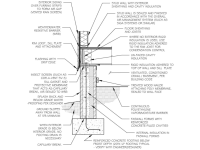
From faswall.com

StemWall-1-1-800x600.png
I don't see how that applies to the OP's building which I think would be a slab floor. Insulating the stem wall is more complicated with a slab. Some do it on the outside but then you have to cover the foam with something weatherproof. I put 2" foam on the inside of the foundation wall and under the slab and ran it about 2/3 of the way up where the slab would be and tapered the top to get more of a thermal break between the floor and foundation. But the concrete crew took some of it out. And I still have cold foundation walls about 8" tall around the outside. Would be nice to cover those but it would need to be covered there too. Haven't see a way to get continuous insulation that seems practical...
 
To avoid these ads, REGISTER NOW!

billconner

Well-known member
Joined
Jul 20, 2021
Messages
6,962
Location
Thousand Islands NYS
I don't see how that applies to the OP's building which I think would be a slab floor. Insulating the stem wall is more complicated with a slab. Some do it on the outside but then you have to cover the foam with something weatherproof. I put 2" foam on the inside of the foundation wall and under the slab and ran it about 2/3 of the way up where the slab would be and tapered the top to get more of a thermal break between the floor and foundation. But the concrete crew took some of it out. And I still have cold foundation walls about 8" tall around the outside. Would be nice to cover those but it would need to be covered there too. Haven't see a way to get continuous insulation that seems practical...
Well,on first read I thought stem wall was below the floor, but I know it can be a curb or couple of courses above a slab on grade. I don't know which here.

If it's a slab on grade and the stem is on top of the slab, it's going to be thicker almost always than stick wall above it. I like the idea of offsetting to exterior, so interior is flush, add foam, and treat it as a feature with different siding. You can find some historical precedents for this. And If rather have the thermal mass on the interior. But that's me.
 

Overboost44

Well-known member
Joined
Apr 29, 2020
Messages
85
Location
MD
I don't see how that applies to the OP's building which I think would be a slab floor. Insulating the stem wall is more complicated with a slab. Some do it on the outside but then you have to cover the foam with something weatherproof. I put 2" foam on the inside of the foundation wall and under the slab and ran it about 2/3 of the way up where the slab would be and tapered the top to get more of a thermal break between the floor and foundation. But the concrete crew took some of it out. And I still have cold foundation walls about 8" tall around the outside. Would be nice to cover those but it would need to be covered there too. Haven't see a way to get continuous insulation that seems practical...
I think you are right wrt the OP's building. I like this method and as @billconner mentioned you could fill the CMU's with foam. Never thought of that idea.
 

Innovate1

Well-known member
Joined
Jul 28, 2014
Messages
4,288
Location
Illinois near St. Louis, Missouri
I think you are right wrt the OP's building. I like this method and as @billconner mentioned you could fill the CMU's with foam. Never thought of that idea.
Not clear to me what you are referring to as "this method"... Filling the blocks with foam still has a LOT of bridging - I would expect adding foam filling to make a small difference but that's just a guess. Someone has probably modeled or measured the effect. As for putting the insulation on the outside and making a step in the siding that explains it down to slightly above ground level. The insulation needs to extend into the ground and several feet below - that introduces issues about how to protect the foam. It can be covered but that introduces pathways for termites and other bugs that will be covered so no way to see it.
 

beltfeed

Well-known member
Joined
Jan 22, 2006
Messages
223
Location
USA
I don't think I suggested filling blocks with foam. Very little value.
Correct, foam filling the cores does not offer any thermal break for the block webbing areas and mortar. For my 46' X 70' I added foam board for 32" on the inside vertical and 24" High PSI rating under the floor around the perimeter. I used 12" wide blocks below the floor then went to 8" split faced blocks from the bottom of the floor up.


1769630734045.png

1769631140949.png

Red string was where the high PSI foam board went under the floor pour.
1769631225800.png
 

Overboost44

Well-known member
Joined
Apr 29, 2020
Messages
85
Location
MD
Not clear to me what you are referring to as "this method"... Filling the blocks with foam still has a LOT of bridging - I would expect adding foam filling to make a small difference but that's just a guess. Someone has probably modeled or measured the effect. As for putting the insulation on the outside and making a step in the siding that explains it down to slightly above ground level. The insulation needs to extend into the ground and several feet below - that introduces issues about how to protect the foam. It can be covered but that introduces pathways for termites and other bugs that will be covered so no way to see it.
I was referring to your method that I like. And I misread Bill Conner as saying fill the blocks with foam.
I don't think I suggested filling blocks with foam. Very little value.
See above. My apologies.
 

dscheidt

Well-known member
Joined
Apr 26, 2017
Messages
2,888
It was -26f a few days ago and hasn’t broken above 0f since Thursday and it’s nice and cozy in there with the in floor circulators running 25% of the time to keep it warm.
What’s your design temperature up there? And what sort of controls do you have? I’d expect -26 to be a temperature that’s well within the output the boiler can modulate down to, even if it was a bit oversized. Longer cycles at an output that approximates the heat loss are more efficient because the first few minutes are not condensing.
 
To avoid these ads, REGISTER NOW!
Top Bottom