To avoid these ads, REGISTER NOW!

Is my voltage drop too high?

nojohnny101

Member
Joined
Oct 9, 2023
Messages
13
Location
Triangle Area, NC
I think I know the answer but I wanted someone to just double check me. I plan on running 2-2-2-4 al in 2" inch PVC conduit buried below 18" about 350 feet from my main panel (200amp service) to a sub panel in my shed. The sub panel is a 100amp panel but I planned on putting a 90am breaker in there. My loads are going to be very low; LED lights, charging batteries for power tools, and charging my electrical lawn equipment (which is probably the biggest draw right now which is 30amps on 120v circuits).

I was originally going to run 12g THWN wires out to the shed (4 circuits) but the voltage drop was going to be too large. I can get 2-2-2-4 easily so I thought I would go with that but then pulling the numbers in, using a "90 amps" as the current at the end of the run (an impossible scenario but I thought I should use that if that is what the breaker is going to be), and the voltage drop came out to 7.7% (over the recommended 4%).

soo.....

- is this correct?
- can I still do this plan but just maybe down size the breaker in sub-panel to something more realistic for my loads like a 50-60 amp breaker?
- did I make a mistake in my calculations?

appreciate the help! let me know if you need any more information.
 
To avoid these ads, REGISTER NOW!
OP
N

nojohnny101

Member
Joined
Oct 9, 2023
Messages
13
Location
Triangle Area, NC
the breaker in the sub panel is just a means of disconnect . it can be basically any amperage . the breaker in your main panel is the one that protects
Sorry I had that backwards. That's right, it's just more of a convenience for me if I ever have to service the panel.

Is there a breaker I can put at the main panel that will make the voltage drop at that distance with 2-2-2-4 al?
 

The Cobbler

Super Moderator
Staff member
Joined
Oct 24, 2013
Messages
26,133
Location
Niagara Region, Ontario, Canada
convenience & probably code ... to have a disconnect
run some numbers and see what is an acceptable voltage drop on the given amp breaker and install it . doesn't sound like your needs are very high, nor did ypu spend a lot of time on calculating this before you bought the wire.
 
OP
N

nojohnny101

Member
Joined
Oct 9, 2023
Messages
13
Location
Triangle Area, NC
Appreciate the replies. By acceptable are you talking about per code (5% from point of service to point of use)? And since I'm not going to be running any 240v loads, does this change amount of acceptable voltage drop?
 

wyliesdiesels

Well-known member
Joined
Aug 14, 2012
Messages
20,192
Location
Modesto, CA
Sorry I had that backwards. That's right, it's just more of a convenience for me if I ever have to service the panel.

Is there a breaker I can put at the main panel that will make the voltage drop at that distance with 2-2-2-4 al?
breakers dont limit voltage drop. all they do is limit current (amps). wire size is what limits voltage drop.

if you want even 50a with minimal voltage drop at that distance that size wire is too small...

how did you come up with your voltage drop amount? I have the formula listed in the electrical FAQs if you want to calc it by hand
 

Innovate1

Well-known member
Joined
Jul 28, 2014
Messages
4,323
Location
Illinois near St. Louis, Missouri
You can put a smaller breaker in the main panel to limit current to a reasonable voltage drop. Since you don't have any big loads a smaller breaker shouldn't be any issue. If your biggest load is 30A then 12 would never be big enough even with short distance. With 2 Aluminum you could use a 40A breaker which gives 3.6% drop. If you want 60A you need to go to 1/0.
 

Innovate1

Well-known member
Joined
Jul 28, 2014
Messages
4,323
Location
Illinois near St. Louis, Missouri
Appreciate the replies. By acceptable are you talking about per code (5% from point of service to point of use)? And since I'm not going to be running any 240v loads, does this change amount of acceptable voltage drop?
Code doesn't dictate voltage drop but 3% is often used as the desireable limit. You could go a bit higher without any issue IMHO. My numbers were based on 240V circuit with 120V loads split across both hot lines - some from line 1 to neutral and some from line 2 to ground. If you do them all on one side you should use 120V in the voltage drop calculator but your percent will double for the same wire and current.
 
OP
N

nojohnny101

Member
Joined
Oct 9, 2023
Messages
13
Location
Triangle Area, NC
Soooo, I have since learned (learning lots on this project) that 50 amp breakers that fit my main panel can't accept anything larger than a 6 gauge wire.

So does that mean I have to go up to a 100amp breaker that will large enough to accept the #2 al feeder wire. If I have to do this, I would not have any protection from the voltage dropping? My loads are very low so I know this won't be a problem, just trying to understand the situation. I know I probably should have gone with a bigger wire, but in the case of someone who only wanted to do a 50 amp sub panel at my distance (350ft) and they used 2-2-2-4 wire, what kind of breaker would they use?

hope this makes sense. appreciate the help
 
OP
N

nojohnny101

Member
Joined
Oct 9, 2023
Messages
13
Location
Triangle Area, NC
Splice on some #6 wire to connect to the breaker. They also make ends that take a big wire and have a smaller pin just for such situations but I forget the proper name.
Can you help me understand this? If I have #6 (copper I assume) on the end of my #2 al that would have to be rated for how much? The reason I used #2 al was because of distance, load, and voltage drop. can you help me understand how splicing #6 for the last 12 inches in the panel would not negatively affect this?

also what kind of splice would be the best to use to downsize the wire to #6?
 

Innovate1

Well-known member
Joined
Jul 28, 2014
Messages
4,323
Location
Illinois near St. Louis, Missouri
6 or 8 inches of #6 cu is going to have negligble voltage drop at 50 or 60A. Think about wiring a short run to a 60A load - #6 copper for the whole run would be fine as long as it's not a long distance. But your very long run needs to be larger to lessen voltage drop. You do need to be careful about mixing copper and aluminum. You could also use a short section of aluminum wire as long as it is rated for the current of the breaker - I think that's #4 Al for 60A. You can use bigger than the required size if you want - it just needs to be big enough for the breaker rating and small enough to fit in the breaker terminals. What you use for the splice needs to be approved for both copper and aluminum and cover both sizes of wire. There are screw terminal splices that would probably be best for this but I haven't used them and not that familiar with them. Here's a discussion of splicing large wires and you can search for others.
https://www.garagejournal.com/forum/threads/feeder-splice.465848/

There are also pin terminals that take a large wire and have a smaller pin for the breaker but most I have see are crimp on and require special tools to apply so not DIY friendly.
 
To avoid these ads, REGISTER NOW!

dave*99

Well-known member
Joined
May 5, 2009
Messages
4,324
Location
Coastal NJ
A Siemens 70A cb accepts up to 2/0.

The voltage drop increases in proportion to the load. If your loads never go beyond 50A, there is no concern.
OP-
Read this.
Understand this.
Do this.

No reason to add splices to downsize the breaker to have some "influence" over voltage drop. As long as the breaker is the correct ampacity to protect the wire and your LOADS are low enough to stay below the desired maximum voltage drop, you are good to go.
 

Innovate1

Well-known member
Joined
Jul 28, 2014
Messages
4,323
Location
Illinois near St. Louis, Missouri
I don't see anywhere that the OP has stated what brand of panel they have. I just looked up 40A Homeline breaker and it is rated for up to #2 cu or al. So smaller pigtails may not even be needed. But if the right size breaker can't fit the wire then just putting in a larger breaker to fit the oversize wire seems like a poor way to go although I don't think a code violation. Future loads could be added until voltage drop becomes an issue. Surprised there hasn't been more input from others here that work in the field.
 

mm08822

Well-known member
Joined
Jan 13, 2012
Messages
6,225
Location
NJ
I don't see anywhere that the OP has stated what brand of panel they have. I just looked up 40A Homeline breaker and it is rated for up to #2 cu or al. So smaller pigtails may not even be needed. But if the right size breaker can't fit the wire then just putting in a larger breaker to fit the oversize wire seems like a poor way to go although I don't think a code violation. Future loads could be added until voltage drop becomes an issue. Surprised there hasn't been more input from others here that work in the field.
A 70A cb would give 4%vd = 10v............So, 240+ - 10 = 230+. It's not a code violation but a practical solution (to a problem that doesn't exist). Why would anyone add splices if they can be avoided??

The Siemens cb was an example.
 
OP
N

nojohnny101

Member
Joined
Oct 9, 2023
Messages
13
Location
Triangle Area, NC
Thanks everyone for the replies. As I stated earlier, the most my loads are going to be at any given time is 30 amps plus some led lights. And that technically is not a "continuous load" because the chargers that would pull 30 amps only charge at that rate for at the most 60 minutes. That technically is classified as a "non-continuous load" correct?

Regardless, I will not be going above that. @Innovate1 I appreciate the explainer on the splicing. It makes sense what you said as the distance is so short. I went ahead and returned the 50 amp breaker and bought a 70amp breaker which accepts #2 al. My main panel is an Eaton 200amp BR type. The 50 double pole BR type breaker only accepted up to #6 I believe.

So I think I feel comfortable after this discussion going with the 70 amp breaker and just realizing that if my loads every increase enough to see larger voltages drops, then I need to pull a big wire through my PVC pipe.

I guess as you can see, I was trying to get a breaker small enough that would trip before my voltage dropped too much. So I guess my motivation for that was I was unsure of what would happen when voltage drops. Is it really dangerous (like fire hazard, etc.) or is it just potentially dangerous to sensitive electronics that are receiving that voltage?
 

theoldwizard1

Well-known member
Joined
Feb 22, 2011
Messages
43,503
Location
SE MI
My loads are going to be very low; LED lights, charging batteries for power tools, and charging my electrical lawn equipment (which is probably the biggest draw right now which is 30amps on 120v circuits).
Use a 50A-60A breaker in your main panel. With those loads, you will never exceed 7% voltage drop.
 

dave*99

Well-known member
Joined
May 5, 2009
Messages
4,324
Location
Coastal NJ
The sub panel is a 100amp panel but I planned on putting a 90am breaker in there.

So I think I feel comfortable after this discussion going with the 70 amp breaker and just realizing that if my loads every increase enough to see larger voltages drops, then I need to pull a big wire through my PVC pipe.

Just to be clear on this point ----

The 70A breaker in the main panel protects the wire between the main and sub panels. The sub panel main breaker then becomes a disconnect switch. And you want that. But the current rating of that disconnect switch can be equal or greater than that of the 70A breaker in the main.

So the sub can have 70A, 90A, 100A, 200A it does not matter. It's just a switch in this application. If the sub came with 100A, use it rather than buying additional parts.
 
Last edited:
OP
N

nojohnny101

Member
Joined
Oct 9, 2023
Messages
13
Location
Triangle Area, NC
Just to be clear on this point ----

The 70A breaker in the main panel protects the wire between the main and sub panels. The sub panel main breaker then becomes a disconnect switch. And you want that. But the current rating of that disconnect switch can be equal or greater than that the 70A breaker in the main.

So the sub can have 70A, 90A, 100A, 200A it does not matter. It's just a switch in this application. If the sub came with 100A, use it rather than buying additional parts.
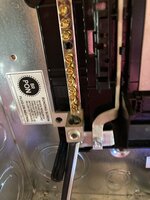
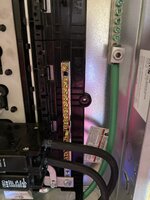
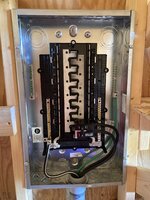
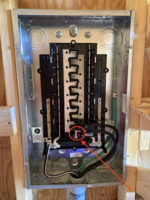
thanks for clarifying that. that is what I plan on doing. 70 amp breaker at the main panel that accepts my #2 al then the 100amp breaker at the sub panel. the sub panel came with the 100 amp breaker and a lug large enough on the neutral bar to accept the #2 al. I added another lug to the grounding bars I had to purchase so it would take my #4 ground. I finished connecting the mains to the sub panel yesterday I'll take a picture to show everyone. I used Noalox in the sub for all the connections and plan to in the main panel although I recently understand it is not required by code anymore.

I also removed the bonding screw in the sub panel as I know that the neutrals and grounds have to be separate.
 
OP
N

nojohnny101

Member
Joined
Oct 9, 2023
Messages
13
Location
Triangle Area, NC
You need 2 ground rods wired to that panel too.
Thanks. yep haven't put those in yet. I have two 8 ft. galvanized rods that I will connect and space at least 6 feet apart. This sub panel is not connected to the main panel yet. I'll make sure to do that before I turn anything on of course.
 
To avoid these ads, REGISTER NOW!
Top Bottom