To avoid these ads, REGISTER NOW!

Is my welder plug wired wrong?

fordluver4x4

Active member
Joined
Jan 20, 2020
Messages
28
Location
Pennsylvania
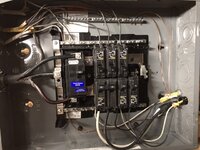
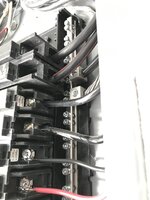
I recently added some additional circuits in my panel box. When I had the panel open I noticed my welder outlet is wired black and white to the breaker (correct) but the ground wire goes to the neutral bar not the ground bar. Should I switch the ground wire to the ground bar or leave it on the neutral bar? This was wired by the garage builder. Also, I’ve used this outlet and it’s worked fine, it just doesn’t seem to be correct to me.


09572B27-CC56-48E6-BB11-DFFE821B7F7B.jpeg
 
Last edited:
To avoid these ads, REGISTER NOW!
OP
F

fordluver4x4

Active member
Joined
Jan 20, 2020
Messages
28
Location
Pennsylvania
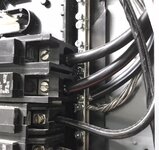
It is a sub-panel, and I’m showing my electrical ignorance here, but I don’t know if it’s bonded or not. In the sub-panel red and black go to hot, white to neutral, bare to ground, in main panel where the power comes from black and red go to hot, white and bare go to neutral. This also seems wrong to me, seems ground should go to ground... I would say I’m sure the builder knows more than me and I shouldn’t 2nd guess him, then I see things like where he cut strands off the white so it would fit in the neutral bar... should I correct that? I could separate the strands into two holes in the neutral bar. I’ve included a few pictures below.

2A95B767-5365-4530-BE7C-BAD55FE97915.jpeg
D9EE4D66-D21A-4174-94E4-219A8EACFD09.jpeg

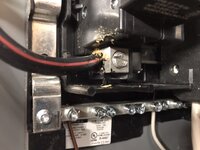
final question, what’s this black goo on the end of the black, red, and white in the sub-panel? It looks almost like melted wire insulation but wouldn’t make sense for it to be where it is is it melted.
F11E4772-DF0A-4494-9FFB-6CD1DF2C1BF2.jpeg
 

pattenp

Well-known member
Joined
Jun 4, 2008
Messages
10,175
Location
Virginia - USA
In a subpanel the neutral bar is isolated, not connected to the panel, so the ground wire needs to move to the ground bar. In the main panel the neutral bar is not isolated which is correct and both grounds and neutrals can go to the same bar. Only subpanels have isolated neutral.
I don't know what the black goog is. You may want to redo that connection.
 

Solarphil

Well-known member
Joined
Mar 21, 2017
Messages
47
You have a subpanel, no there is no bond there (which is correct, bond is back at the main), so the neutral and grounds should be kept separate.

Yes, the ground wire should go to the ground bus. Looks like you might have enough slack to simply move it, you might need to shuffle a few ground wires to free up the closest position.

Check the other end of the circuit, the wiring at the receptacle. The ground wire should be landed on the green terminal, and the black and white should be on the brass L1 and L2 terminals. If the ground wire was landed on a silver terminal and is being pressed into service as a neutral conductor, then don’t let your builder ever do anything electrical for you again. If that’s the case then your receptacle (and welder?) need a neutral, and you need one more conductor. Not fun.

Yes, you should correct the trimmed neutral. Wire strands should never be trimmed back to make things “fit.” Your panelboard manufacturer probably offers a lug kit that has a larger ~1/0 barrel lug with prongs that fit into two consecutive bus bar holes, that’s the right way to fix this. Splitting the wire into two bundles is also a reasonable field solution, better than what you’ve got now.

The black goo is antioxidant gel. It should be used on any aluminum termination.
 

gearhead1

Well-known member
Joined
Oct 14, 2013
Messages
1,935
Location
NC
All of the welders I’ve seen with a 3 prong cord are 240. Each hot leg goes on the flats and the round is ground NOT neutral.

4 prongs are different, the hot legs are the same, the L-shaped one is ground and the one in the opposite position from neutral is ground.

The above is correct, sub panels do not have the ground bar and neutral bar connected. This used to not be the case but the code changed.

I have no idea what that crud is. Noalox is gray, so it’s not that.
 

wyliesdiesels

Well-known member
Joined
Aug 14, 2012
Messages
19,994
Location
Modesto, CA
I recently added some additional circuits in my panel box. When I had the panel open I noticed my welder outlet is wired black and white to the breaker (correct) but the ground wire goes to the neutral bar not the ground bar. Should I switch the ground wire to the ground bar or leave it on the neutral bar? This was wired by the garage builder. Also, I’ve used this outlet and it’s worked fine, it just doesn’t seem to be correct to me.

(sorry about the sideways picture)
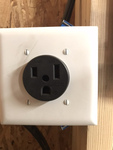
yes the ground wire from the welder receptacle should land on the ground bar IF the welder outlet is a nema 6-** type outlet. can you post a pic of the outlet?

It will work fine because a welder doesnt need a neutral and the ground wire only has current on it when there is a fault. It is not used for normal operation
It is a sub-panel, and I’m showing my electrical ignorance here, but I don’t know if it’s bonded or not. In the sub-panel red and black go to hot, white to neutral, bare to ground, in main panel where the power comes from black and red go to hot, white and bare go to neutral. This also seems wrong to me, seems ground should go to ground... I would say I’m sure the builder knows more than me and I shouldn’t 2nd guess him, then I see things like where he cut strands off the white so it would fit in the neutral bar... should I correct that? I could separate the strands into two holes in the neutral bar. I’ve included a few pictures below.


final question, what’s this black goo on the end of the black, red, and white in the sub-panel? It looks almost like melted wire insulation but wouldn’t make sense for it to be where it is is it melted.
The subpanel does not appear to be bonded. It should not be. if it was there would be a bonding strap that connects it to the enclosure or a green screen on the bar

The goo is most likely no-alox. Ive seen it black in some brands.

the cut strands is a huge no-no. shows that whoever installed it doesnt know what theyre doing.

cut the wire and start fresh. but all the strands should go in the same lug. if the lug is too small then you will need a drop in lug, listed for use in your panel. check the panel label for part numbers.
You have a subpanel, no there is no bond there (which is correct, bond is back at the main), so the neutral and grounds should be kept separate.

Yes, the ground wire should go to the ground bus. Looks like you might have enough slack to simply move it, you might need to shuffle a few ground wires to free up the closest position.

Check the other end of the circuit, the wiring at the receptacle. The ground wire should be landed on the green terminal, and the black and white should be on the brass L1 and L2 terminals. If the ground wire was landed on a silver terminal and is being pressed into service as a neutral conductor, then don’t let your builder ever do anything electrical for you again. If that’s the case then your receptacle (and welder?) need a neutral, and you need one more conductor. Not fun.

Yes, you should correct the trimmed neutral. Wire strands should never be trimmed back to make things “fit.” Your panelboard manufacturer probably offers a lug kit that has a larger ~1/0 barrel lug with prongs that fit into two consecutive bus bar holes, that’s the right way to fix this. Splitting the wire into two bundles is also a reasonable field solution, better than what you’ve got now.

The black goo is antioxidant gel. It should be used on any aluminum termination.
a 240v welder wouldnt need a neutral. if the outlet has a neutral and no ground its the wrong style outlet for a welder. no need to add a neutral. just change the receptacle to the correct one- nema 6-50r

anti-oxidant gel is not required for every termination. it is only required if the manufacturer calls for it
 
OP
F

fordluver4x4

Active member
Joined
Jan 20, 2020
Messages
28
Location
Pennsylvania
WOW! This board is awesome, thanks for all the reply / info.

So what I gather is:

  1. Move the welder outlet ground wire to the ground bar (I have extra wire I can move into the panel if needed).
  2. As far as I can tell the outlet is wired correctly, black and white to the top prongs, ground to the bottom.
  3. buy lugs for the neutral and ground (both have trimmed strands) that go into 2 holes on the neutral bar and have one larger hole big enough for the whole wire.
  4. The ground in the main panel should stay on the neutral bar, not move to the ground bar? (this one I still don't understand, but I'll believe you).
  5. The black goo should stay (the other crusty stuff is saw dust stuck in the goo). There is no goo on the other end of these wires (in the main panel) is that ok?
Does that cover it?
 
Last edited:

nadogail

Well-known member
Joined
Jan 23, 2009
Messages
31,933
Location
Coronado, CA
My welder is powered from a main panel, so I can get buy with a 3 wire supply and a 50 Amp breaker.

If I were using a Sub Panel, I would have to use 4 conductor 8 gauge cable.
 

sparky 1971

Well-known member
Joined
Oct 9, 2018
Messages
7,967
Location
Central Iowa
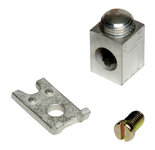
Looks like everything has been answered except for how to correct the cut strands in the main panel. Your panel is a Square D Homeline, the box stores should carry a neutral lug adapter. Menard's carries two styles, Home Depot and Lowes probably have the same. It's a lug that bolts to the neutral bar, giving you a hole big enough to fit the wire in. I believe #4 is the largest that will fit a factory hole, and I think what you have is a #2.
 

Attachments

  • neutral.jpg
    neutral.jpg
    20.2 KB · Views: 12
  • neutral lug.jpg
    neutral lug.jpg
    16.7 KB · Views: 11
Last edited:
To avoid these ads, REGISTER NOW!

wyliesdiesels

Well-known member
Joined
Aug 14, 2012
Messages
19,994
Location
Modesto, CA
My welder is powered from a main panel, so I can get buy with a 3 wire supply and a 50 Amp breaker.

If I were using a Sub Panel, I would have to use 4 conductor 8 gauge cable.
huh? a 240v welder doesnt need a 4-wire feeder or outlet even if powered off a subpanel.
 

gearhead1

Well-known member
Joined
Oct 14, 2013
Messages
1,935
Location
NC
My welder is powered from a main panel, so I can get buy with a 3 wire supply and a 50 Amp breaker.

If I were using a Sub Panel, I would have to use 4 conductor 8 gauge cable.
I disagree. My thought is that you wire the welder up the same way. The neutral is not needed on the 240V welder.

Yes code changed and sub panels now must have a ground feeding it from the main panel (which implies 4 wires). The sub panel also has the ground and neutral wires electrically separated.

Side Note: Understand what the neutral is for and where it comes from. I think of it as a center tap on the transformer (power company side). Between neutral and either leg of 240V is how you get 120V. So if you don’t need 120V, then why do you need the neutral?

Maybe some new or industrial welders have a 4 prong plug, but the standard has been the 3 prong. The 3 prong like the picture of the mating outlet the OP posted, does not have a neutral. Most welders I’ve seen do not need a neutral.

Do not get confused with clothes dryers. The new electronic ones are 4 prong, and I suspect the neutral is needed to get to 120V so the dryer manufacturer can more easily get to the control voltage for the circuit board. In the case of welders with circuit boards, the welder manufacturers presumably don’t need the neutral because they already have a big transformer (or IGBT). In other words, they are handling it a different way. My Millermatic 180 MIG has a circuit board but the welder plug does NOT have a neutral, it fits into the outlet like the OP showed.
 
Last edited:

gearhead1

Well-known member
Joined
Oct 14, 2013
Messages
1,935
Location
NC
WOW! This board is awesome, thanks for all the reply / info.

So what I gather is:

  1. Move the welder outlet ground wire to the ground bar (I have extra wire I can move into the panel if needed).
  2. As far as I can tell the outlet is wired correctly, black and white to the top prongs, ground to the bottom.
  3. buy lugs for the neutral and ground (both have trimmed strands) that go into 2 holes on the neutral bar and have one larger hole big enough for the whole wire.
  4. The ground in the main panel should stay on the neutral bar, not move to the ground bar? (this one I still don't understand, but I'll believe you).
  5. The black goo should stay (the other crusty stuff is saw dust stuck in the goo). There is no goo on the other end of these wires (in the main panel) is that ok?
Does that cover it?
I concur with this.

4. Yes, leave the main panel. NEC code changed. The theory behind it is something along the lines of where a fault could originate and allowing that path back.

5. Thanks for clarifying the dust. Yes, some Noalox is black. I’d wipe the dust off (power off at main panel of course). If they’re copper wires, it’s probably ok. If they’re aluminum you need the ‘goo’ at the main (switch power off before moving the wire out applying the ‘goo’ AKA noalox Or oxidation compound).

I’m not a certified electrician, but I do my own and never had a problem with a inspector. I started out like you, asking questions and gain understanding. It‘s not that difficult. I’m no genius and I can make it to code. Wiring up a shopping mall, no way. Wiring up a 100 amp panel in my shop, no problem.
 

gearhead1

Well-known member
Joined
Oct 14, 2013
Messages
1,935
Location
NC
This post is for posterity in case someone is searching in the future: If you are planning to use your welder from a 4 prong dryer outlet, make an adapter cord, just don’t hook up the neutral.

Caveat: This assumes your welder‘s cord is a 3 prong 240V like what the OP has.
 

jeepxj

Well-known member
Joined
Mar 2, 2008
Messages
17,837
This post is for posterity in case someone is searching in the future: If you are planning to use your welder from a 4 prong dryer outlet, make an adapter cord, just don’t hook up the neutral.

Caveat: This assumes your welder‘s cord is a 3 prong 240V like what the OP has.
pretty cheap adapter cords on amazon for 14-50 to 6-50 for welding. 1623591349497.png
 

gearhead1

Well-known member
Joined
Oct 14, 2013
Messages
1,935
Location
NC
Didn’t know they made them, I always made my own but yeah that’s it!
 

wyliesdiesels

Well-known member
Joined
Aug 14, 2012
Messages
19,994
Location
Modesto, CA
I disagree. My thought is that you wire the welder up the same way. The neutral is not needed on the 240V welder.

Yes code changed and sub panels now must have a ground feeding it from the main panel (which implies 4 wires). The sub panel also has the ground and neutral wires electrically separated.

Side Note: Understand what the neutral is for and where it comes from. I think of it as a center tap on the transformer (power company side). Between neutral and either leg of 240V is how you get 120V. So if you don’t need 120V, then why do you need the neutral?

Maybe some new or industrial welders have a 4 prong plug, but the standard has been the 3 prong. The 3 prong like the picture of the mating outlet the OP posted, does not have a neutral. Most welders I’ve seen do not need a neutral.

Do not get confused with clothes dryers. The new electronic ones are 4 prong, and I suspect the neutral is needed to get to 120V so the dryer manufacturer can more easily get to the control voltage for the circuit board. In the case of welders with circuit boards, the welder manufacturers presumably don’t need the neutral because they already have a big transformer (or IGBT). In other words, they are handling it a different way. My Millermatic 180 MIG has a circuit board but the welder plug does NOT have a neutral, it fits into the outlet like the OP showed.
The motor is also 120v. They use the same motor in both the electric and gas models to make manufacturing easier.
I concur with this.

4. Yes, leave the main panel. NEC code changed. The theory behind it is something along the lines of where a fault could originate and allowing that path back.

5. Thanks for clarifying the dust. Yes, some Noalox is black. I’d wipe the dust off (power off at main panel of course). If they’re copper wires, it’s probably ok. If they’re aluminum you need the ‘goo’ at the main (switch power off before moving the wire out applying the ‘goo’ AKA noalox Or oxidation compound).

I’m not a certified electrician, but I do my own and never had a problem with a inspector. I started out like you, asking questions and gain understanding. It‘s not that difficult. I’m no genius and I can make it to code. Wiring up a shopping mall, no way. Wiring up a 100 amp panel in my shop, no problem.
No the code didnt change for main service panels....

No-alox is NOT needed, unless the manufacturer calls for it..... with that being said, it wont hurt to use it...
 

gearhead1

Well-known member
Joined
Oct 14, 2013
Messages
1,935
Location
NC
To clarify, the code changed as far as feeding a sub panel with separate neutral and ground and the neutral and ground should bars should be separated in sub panels. So, as stated, yes, leave the main panel.
 

csp

Well-known member
Joined
Mar 23, 2010
Messages
5,719
Location
Franktown, CO
Shouldn't that white wire have red tape wrapped around each end to indicate that it's actually a hot lead?
 

gearhead1

Well-known member
Joined
Oct 14, 2013
Messages
1,935
Location
NC
Shouldn't that white wire have red tape wrapped around each end to indicate that it's actually a hot lead?
That’s how I do it. When I ran feeder wire to my shop with duplex 4 wires, the ground had a green strip, the others were all the same - black. While still on the spool, I used an ohm meter to identify which was which on both ends, then used red and white tape to identify the neutral from the hots.
 
OP
F

fordluver4x4

Active member
Joined
Jan 20, 2020
Messages
28
Location
Pennsylvania
switch power off before moving the wire out applying the ‘goo’ AKA noalox Or oxidation compound
ok, so the noalox goes on the wire prior to making the connection, not after the connection is made correct? so the noalox will be "between" the wire and the terminal?
 

sparky 1971

Well-known member
Joined
Oct 9, 2018
Messages
7,967
Location
Central Iowa
ok, so the noalox goes on the wire prior to making the connection, not after the connection is made correct? so the noalox will be "between" the wire and the terminal?
Yes. I usually strip the wire, make sure it's gonna fit, then dip the end of the wire in the bottle of noalox. I use the Ilsco brand, it comes in a bottle and doesn't make as much of a mess as the kinds that come in a toothpaste tube.
 
To avoid these ads, REGISTER NOW!
Top Bottom