well, same applies here, you unplug the light and replace it w/another w/a plug.Those may be fine fixtures (I have no idea) but I don't see how you consider that "future proofing". If the fixtures stop working you have to replace the whole fixture. Then you have the problem of whats available at the time not matching the other lights. As I see it future proof is being able to easily replace a minimum amount of stuff with minimal hassle and still have things look good and match. The only thing I consider to meet that is standard base screw in bulbs or 4' tubes. Both are easy to change to LED and both types should be available for a very long time.

You are using an out of date browser. It may not display this or other websites correctly.
You should upgrade or use an alternative browser.
You should upgrade or use an alternative browser.
Is there some standard or "future proof" way to do lights this days?
- Thread starter katit
- Start date
Innovate1
Well-known member
Do what you want and call it what you want but I still think it's a stretch - it doesn't address the point of probably not being able to find matching fixtures in the future when needed. The fixtures are made to a price point which means they aren't likely to meet the years of life they claim.well, same applies here, you unplug the light and replace it w/another w/a plug.
If nothing else is on that breaker that's fine. You are under 66% loading on the circuit which should be good for 80% continuous load. Like others have suggested I would do two lighting circuits. If you have the breaker space I would put them on separate breakers as well. The added cost would of course depend on where you switches and breakers are. With two switches you have to run two sets of wires to the lights but you could use a common wire from the panel to the switches. If you have two circuits at the breaker then you have to double the wires from the panel to the switches.
I missed if it was decided or not but I would go with 4' vs 8' fixtures/tubes. There are simply far more choices/options etc in the 4' length and the value is better.
I missed if it was decided or not but I would go with 4' vs 8' fixtures/tubes. There are simply far more choices/options etc in the 4' length and the value is better.
Understood. There is really no big difference for me as far as wire run, so.. I just though if it's not needed - why overcomplicate with separate breaker.If nothing else is on that breaker that's fine. You are under 66% loading on the circuit which should be good for 80% continuous load. Like others have suggested I would do two lighting circuits. If you have the breaker space I would put them on separate breakers as well. The added cost would of course depend on where you switches and breakers are. With two switches you have to run two sets of wires to the lights but you could use a common wire from the panel to the switches. If you have two circuits at the breaker then you have to double the wires from the panel to the switches.
I missed if it was decided or not but I would go with 4' vs 8' fixtures/tubes. There are simply far more choices/options etc in the 4' length and the value is better.
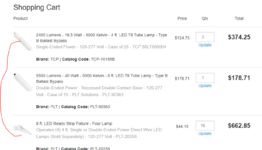
And yes, I am going with 4ft bulbs - this is my cart (box of 8ft is to retrofit my other garage)
billconner
Well-known member
So it begs the question of how much are you willing to pay for future proofing. What's acceptable in 5 or 10 years - only the exactly the same color, distribution, and illuminance? And are you sure what you put in now is what you want to be stuck with forever, or at least in your future?Do what you want and call it what you want but I still think it's a stretch - it doesn't address the point of probably not being able to find matching fixtures in the future when needed. The fixtures are made to a price point which means they aren't likely to meet the years of life they claim.
I'm fine with $7.00 fixtures plugged into a switched receptacle, compared to LED ready strip fixtures at much higher prices - 5 or 10 or 20 times more expensive? Especially if in 5 years I can replace them with fixtures that use much less electricity. And no one has mentioned the integral LED fixtures are generally more or much more energy efficient (albeit may not be significant if they're to work on ICE vehicles.
 )
)I guess we all have different definitions of future proofing. As LED fixture prices continue to drop, if a single light bugs someone for not matching the "decor" of a workshop after replacing it with another, the price to entry of doing them all to match isn't a lot (someone just posted a link to several fixtures for $99). Point is, there's no rewiring, no ballast installations, no electrical boxes, etc.... w/these types, just plug and play.Do what you want and call it what you want but I still think it's a stretch - it doesn't address the point of probably not being able to find matching fixtures in the future when needed. The fixtures are made to a price point which means they aren't likely to meet the years of life they claim.
Last edited:
should be good....I think 12A continuous is allowed? that's 1440w. I'd worry about lumens more than wattage or pricing w/LED (unless your shop is huge). Use a calculator, I think I went w/LAB level of brightness:On a side - question about capacity.
One bulb 18.5W
15fixutures * 4bubls * 18.5W = 1110Watt
9.25 AMP
Is it safe then to put it on one 15A breaker?
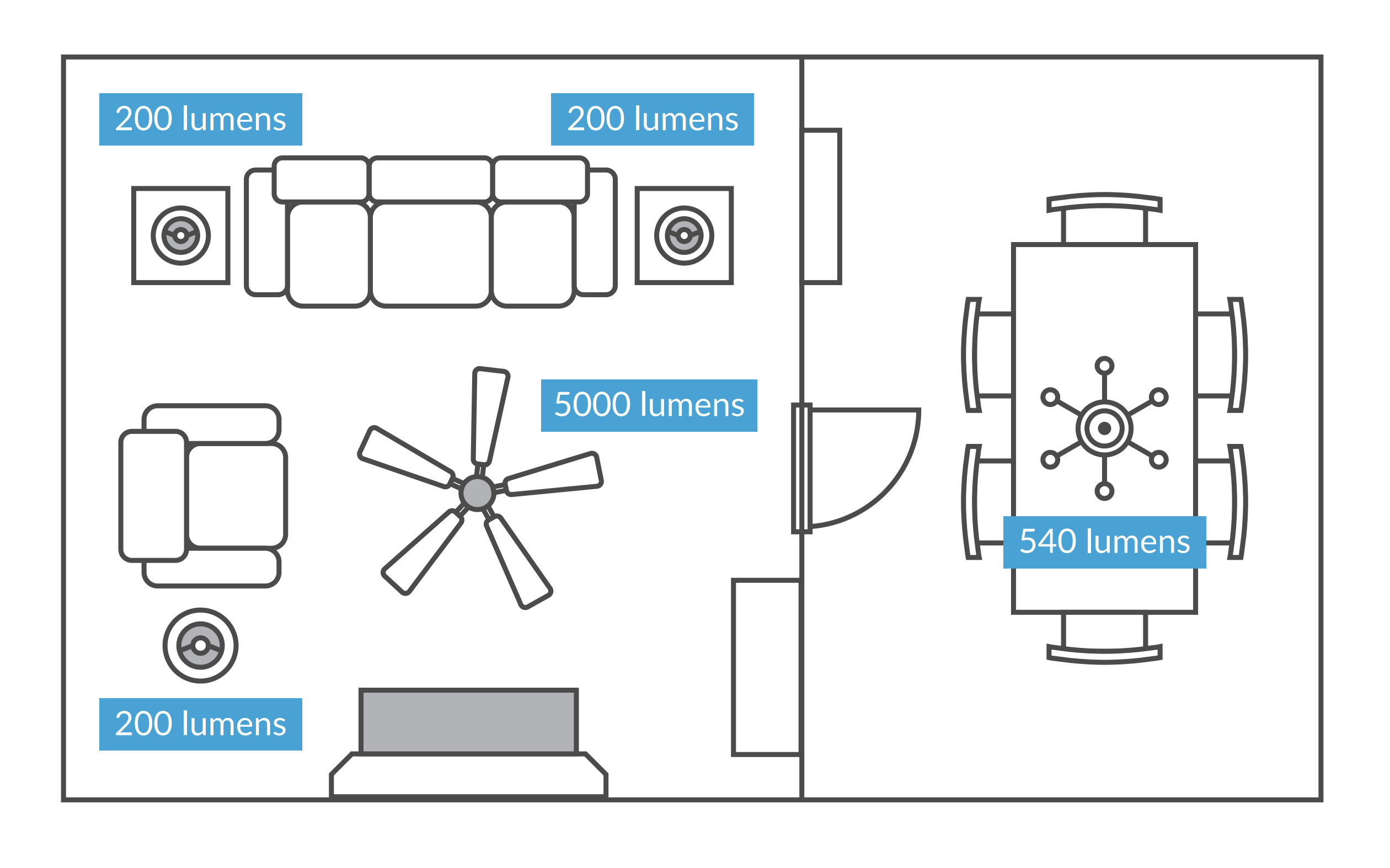
Calculate the Light Needed for Any Space
Determining the right amount of light for a room comes down to simple math.
 www.alconlighting.com
Last edited:
Let's be honest, one country rules LED production and it's not us. You're just paying for branding after a certain point. I've had my 12$ strips for 5 yrs now and they've only gone out where I smashed them w/the stapler.So it begs the question of how much are you willing to pay for future proofing. What's acceptable in 5 or 10 years - only the exactly the same color, distribution, and illuminance? And are you sure what you put in now is what you want to be stuck with forever, or at least in your future?
I'm fine with $7.00 fixtures plugged into a switched receptacle, compared to LED ready strip fixtures at much higher prices - 5 or 10 or 20 times more expensive? Especially if in 5 years I can replace them with fixtures that use much less electricity. And no one has mentioned the integral LED fixtures are generally more or much more energy efficient (albeit may not be significant if they're to work on ICE vehicles.
RegeSullivan
Well-known member
It simpler to just plug in new lights. Future proofing also involves lighting needs as your shop evolves even just moving things for better work flow. Corded lighting also gives the ability to move things around a few feet which can make a tremendous difference. As well, adding additional lights where needed by mounting and plugging them is incredibly easy and effective. I accidentally came to this conclusion 30ish years ago after installing 4 boxes in the ceiling of my garage/shop with the intention of installing 8' florescent fixtures. I needed a temporary solution until the fixtures got delivered so I bought a 10 pack of cheap 4' twin tube corded fluorescent and screewed them to the ceiling after installing 2 duplex outlets in each box. It worked out so well I never installed the 8 footers. It was easy to add or move task lighting as it grew into more shop than garage. When I did my basement wood shop in 2006 I did the exact same setup with a grid of 12 boxes, 2 duplex outlest each... made it really easy to move to LED when they became affordable and reconfiguring for new machines is no big deal. Nothing against hardwired but any changes are more time consuming and complicated with little advantage unless you are concerned about aesthetics.With plug ins you can replace the fixtures but you could do that with anything you choose so I don't see that as future proofing. Tube fixtures with LED tubes aren't really an old design - quite modern in fact. It's the most common thing that is standard today and will be around for a long time. If you are replacing plug in fixtures it isn't that hard to replace hard wired fixtures like the tube fixtures but it's not going to be needed in my lifetime.
A strip light with tubes is a pretty good quality of light for a reasonable cost.
Show me a plug in light that isn't complete garbage.
It simpler to just plug in new lights. Future proofing also involves lighting needs as your shop evolves even just moving things for better work flow. Corded lighting also gives the ability to move things around a few feet which can make a tremendous difference. As well, adding additional lights where needed by mounting and plugging them is incredibly easy and effective. I accidentally came to this conclusion 30ish years ago after installing 4 boxes in the ceiling of my garage/shop with the intention of installing 8' florescent fixtures. I needed a temporary solution until the fixtures got delivered so I bought a 10 pack of cheap 4' twin tube corded fluorescent and screewed them to the ceiling after installing 2 duplex outlets in each box. It worked out so well I never installed the 8 footers. It was easy to add or move task lighting as it grew into more shop than garage. When I did my basement wood shop in 2006 I did the exact same setup with a grid of 12 boxes, 2 duplex outlest each... made it really easy to move to LED when they became affordable and reconfiguring for new machines is no big deal. Nothing against hardwired but any changes are more time consuming and complicated with little advantage unless you are concerned about aesthetics.
Show me a plug in light that isn't complete garbage.
billconner
Well-known member
I've had a plug in fluorescent that worked fine for 20 years. $10 iirc. Does it matter if I your opinion it's garbage? Sure was easier to relocate also.A strip light with tubes is a pretty good quality of light for a reasonable cost.
Show me a plug in light that isn't complete garbage.
Define "work". The fluorescent ones always under drove the lamps. They were dim and often flickered compared to a fixture with a better ballast.I've had a plug in fluorescent that worked fine for 20 years. $10 iirc. Does it matter if I your opinion it's garbage? Sure was easier to relocate also.
billconner
Well-known member
It was plenty bright and I never saw it flicker. But I'm only a professional lighting designer for over 40 years.
Fav Onefour
Well-known member
I look at it this way.A strip light with tubes is a pretty good quality of light for a reasonable cost.
Show me a plug in light that isn't complete garbage.
All fixtures are plug in if you want. They all need power. If you want to add a cord, it's your choice.
In my shop areas, I put in switched outlet runs in case I wanted to run a bunch of stand lights etc. I figure it would be simple enough to just plug in whatever lights and turn off the whole works with a switch. I have a bad habit of working in the shop until I'm completely shot. We're talking barely enough energy to stand. When I get to that point, I just want to turn off the lights and close the door. The outlets in one shop were empty for awhile.
Seems like I make about a thousand million trips to the big box lumber stores in a week. (Probably relates to the level of being tired at the end of the day.) Anyhow, I happened to see some 4' LED strips that were almost free during one of those dang trips and picked up a few.
I had not intended to use buy those fixtures when I did the wiring. In the end I'm glad I did at least some outlets. Life is a little easier after that step.
sparky 1971
Well-known member
I look at it this way.
All fixtures are plug in if you want. They all need power. If you want to add a cord, it's your choice.
In my shop areas, I put in switched outlet runs in case I wanted to run a bunch of stand lights etc. I figure it would be simple enough to just plug in whatever lights and turn off the whole works with a switch. I have a bad habit of working in the shop until I'm completely shot. We're talking barely enough energy to stand. When I get to that point, I just want to turn off the lights and close the door. The outlets in one shop were empty for awhile.
Seems like I make about a thousand million trips to the big box lumber stores in a week. (Probably relates to the level of being tired at the end of the day.) Anyhow, I happened to see some 4' LED strips that were almost free during one of those dang trips and picked up a few.
I had not intended to use buy those fixtures when I did the wiring. In the end I'm glad I did at least some outlets. Life is a little easier after that step.
Plug in shop lights make adequate task lighting, I have a few above individual tools such as my miter saw, drill press, and parts washer. There's no way I would want to try to light my whole shop with them, the light output isn't great and I think all of those cords are going to look like ****. And...I don't care about this one but garage ceiling receptacles are supposed to be GFCI protected which could make for a really dark shop under the right circumstances.
Fav Onefour
Well-known member
Most of my lighting is hard wired fixture stuff with additional outlet locations.
I can't argue that plug in isn't the answer for a whole shop. I see it as an option to expand and move lighting. It allows for a little more flexibility. I have a couple shop spaces with pretty low ceilings and anything hanging fixtures creates tighter headroom. One of those has a couple hanging fixtures over a saw table work area. Those wouldn't work in the open sections.
@sparky 1971 , It's funny you mention the hanging cords. l usually hang fixtures directly beneath the plugs. I bet those cheapo fixtures still have the original twist ties on the cords. I had not heard that garage ceiling circuits need GFCI. I guess it kinda follows the reasoning with walls. It's also a little confusing. There must be gazillions of door openers running on straight circuits.
Future proofing means plenty of circuits and light locations for myself.
I am firm believer in multiple switched circuits so that lighting doesn't need to be full on every time I walk in. I have a couple spaces where I use slave switches off the main circuit. The extra switches are right in the work areas and yet I'm able to shut down the whole works at the door. I also like the flexibility of using different light color for some work areas. That is a little easier with more light zones.
I have to ask a side question. Why does it seem like so many people have issues tripping GFCI? I have tons of those things and it's extremely rare to trip one. Even then, it's usually if I do something I shouldn't. On the other hand, I have some arc fault GFCI circuits in one place. Those are terrible. Are people installing those by mistake?
I can't argue that plug in isn't the answer for a whole shop. I see it as an option to expand and move lighting. It allows for a little more flexibility. I have a couple shop spaces with pretty low ceilings and anything hanging fixtures creates tighter headroom. One of those has a couple hanging fixtures over a saw table work area. Those wouldn't work in the open sections.
@sparky 1971 , It's funny you mention the hanging cords. l usually hang fixtures directly beneath the plugs. I bet those cheapo fixtures still have the original twist ties on the cords. I had not heard that garage ceiling circuits need GFCI. I guess it kinda follows the reasoning with walls. It's also a little confusing. There must be gazillions of door openers running on straight circuits.
Future proofing means plenty of circuits and light locations for myself.
I am firm believer in multiple switched circuits so that lighting doesn't need to be full on every time I walk in. I have a couple spaces where I use slave switches off the main circuit. The extra switches are right in the work areas and yet I'm able to shut down the whole works at the door. I also like the flexibility of using different light color for some work areas. That is a little easier with more light zones.
I have to ask a side question. Why does it seem like so many people have issues tripping GFCI? I have tons of those things and it's extremely rare to trip one. Even then, it's usually if I do something I shouldn't. On the other hand, I have some arc fault GFCI circuits in one place. Those are terrible. Are people installing those by mistake?
sparky 1971
Well-known member
Most of my lighting is hard wired fixture stuff with additional outlet locations.
I can't argue that plug in isn't the answer for a whole shop. I see it as an option to expand and move lighting. It allows for a little more flexibility. I have a couple shop spaces with pretty low ceilings and anything hanging fixtures creates tighter headroom. One of those has a couple hanging fixtures over a saw table work area. Those wouldn't work in the open sections.
@sparky 1971 , It's funny you mention the hanging cords. l usually hang fixtures directly beneath the plugs. I bet those cheapo fixtures still have the original twist ties on the cords. I had not heard that garage ceiling circuits need GFCI. I guess it kinda follows the reasoning with walls. It's also a little confusing. There must be gazillions of door openers running on straight circuits.
Future proofing means plenty of circuits and light locations for myself.
I am firm believer in multiple switched circuits so that lighting doesn't need to be full on every time I walk in. I have a couple spaces where I use slave switches off the main circuit. The extra switches are right in the work areas and yet I'm able to shut down the whole works at the door. I also like the flexibility of using different light color for some work areas. That is a little easier with more light zones.
I have to ask a side question. Why does it seem like so many people have issues tripping GFCI? I have tons of those things and it's extremely rare to trip one. Even then, it's usually if I do something I shouldn't. On the other hand, I have some arc fault GFCI circuits in one place. Those are terrible. Are people installing those by mistake?
The GFCI requirements for garage ceilings is fairly new, I want to say it came about with the 2011 code but could be wrong by a code cycle or two. GFCI's don't really have much nuisance tripping, but there's always the chance one will see something it doesn't like and it gets dark. AFCI's are a scam, I wire a new house about every other code cycle just to remind myself that I hate it, but I've been on enough service calls to think that a lot of contractors are using dual function AFCI/GFCI breakers for everything, including areas where GFCI is required, but AFCI isn't (garages, unfinished basements, and bathrooms). The only reason I can come up with is to eliminate some of the thinking.
alfredeneuman
Well-known member
The continuous load is for commercial use because the lights are expected run more than 3 hours at a time.should be good....I think 12A continuous is allowed? that's 1440w.
Residential can be loaded to the full 1800 watts.