To avoid these ads, REGISTER NOW!

Is this a 15 amp outlet?

OP
M

mechaniac86

Active member
Joined
Apr 27, 2015
Messages
27
Location
Lafayette, LA
Ok, so I think my project is finally complete. Below is a diagram of exactly how the devices are wired. According to my little circuit tester, everything is wired correctly. All outlets are working.

Just to be sure not to bypass the GFI, I fed the three other devices (2 garage wall outlets, and the office nook outlet) from the second non-GFI ceiling receptacle (that is fed directly from the GFI).


To avoid these ads, REGISTER NOW!

mm08822

Well-known member
Joined
Jan 13, 2012
Messages
5,901
Location
NJ
Ok, so I think my project is finally complete. Below is a diagram of exactly how the devices are wired. According to my little circuit tester, everything is wired correctly. All outlets are working.

Just to be sure not to bypass the GFI, I fed the three other devices (2 garage wall outlets, and the office nook outlet) from the second non-GFI ceiling receptacle (that is fed directly from the GFI).



OP, read the last 2 sentences of post 37.
 

CJ7VFR

Well-known member
Joined
Jan 13, 2015
Messages
2,939
Location
Central New Jersey
What are you going to use the USB ports on the one receptacle for? If you wrote about it before, I didn't see it.

Just curious.

Jim
 

MemphisR32

Well-known member
Joined
Oct 9, 2014
Messages
155
What are you going to use the USB ports on the one receptacle for? If you wrote about it before, I didn't see it.

Just curious.

Jim

Curious also as to why the USB on the ceiling? Maybe powering a camera system or some battery charger?
 

yeldogt

Well-known member
Joined
Jan 2, 2012
Messages
18,184
When was a dedicated circuit for a garage door opened required to have GFI?
 

dscheidt

Well-known member
Joined
Apr 26, 2017
Messages
2,890
When was a dedicated circuit for a garage door opened required to have GFI?

2008 NEC, I believe. All 15 and 20 A 120 V receptacle outlets must be GFCI protected, even if they're not accessible, even if they're single outlets on a circuit for a dedicated use. The GFCI must be accessible, which means among other things, "not on the ceiling".
 

yeldogt

Well-known member
Joined
Jan 2, 2012
Messages
18,184
2008 NEC, I believe. All 15 and 20 A 120 V receptacle outlets must be GFCI protected, even if they're not accessible, even if they're single outlets on a circuit for a dedicated use. The GFCI must be accessible, which means among other things, "not on the ceiling".

That's why I asked ... my memory was that if a outlet had to be GFI -- it had to be "accessible" and 9' up in the air is not. I guess every opener needs a GFI breaker or tied into a wall? Personally I like the opener on it's own circuit -- my guy at the shore always put them with the refrigerator circuit if the panel was tight.

Also in the USA we use plugs to limit Amps -- the 15 amp outlet are capable of taking a 20amp load. Internals are the same as the 20amp in every one I have looked at.
 

hammlm

Well-known member
Joined
Jun 21, 2005
Messages
676
Location
SE PA
Re: Adding Outlets in Garage

What's the best way to connect 4 #12 wires? Another one of my junction boxes is using these for #14 wire...


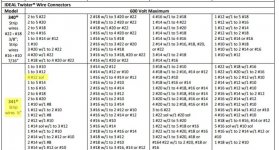
A little late, but the standard-issue Ideal Brand Tan Twister wirenut (model 314) is rated for 4 #12AWG solid. Also rated for quite a bit more, which is why its so popular and has been for so long. If you're going to do 4 solid #12's --- strip longer than the recommended strip length, twist generously, and cut the resultant twisted bundle to 1/2" as directed.

twister_341.jpg
 
Last edited:
OP
M

mechaniac86

Active member
Joined
Apr 27, 2015
Messages
27
Location
Lafayette, LA
Curious also as to why the USB on the ceiling? Maybe powering a camera system or some battery charger?

I'm not sure yet, but who knows. They were cheap at Costco. I also have one of those new Ryobi module garage door openers that I haven't installed yet. Maybe the USBs will come in handy after the install.

When was a dedicated circuit for a garage door opened required to have GFI?

My house was built in 2009. Originally, my ceiling garage door opener was NOT a GFI, nor was it protected by one because it was upstream from the GFI in the garage wall. (correct me if I'm wrong).

I assumed that since it wasn't "required," that it would not have to be "accessible." However, in hindsight, I'm realizing that the garage GFI feeds the back porch outlet that is required to be GFI-protected.

My solution I guess would be to replace the ceiling outlet with a non-GFI and put a GFI back on the wall (downstream from the ceiling outlet, but upstream of the porch outlet). Does this sound right??

A little late, but the standard-issue Ideal Brand Tan Twister wirenut (model 314) is rated for 4 #12AWG solid. Also rated for quite a bit more, which is why its so popular and has been for so long. If you're going to do 4 solid #12's --- strip longer than the recommended strip length, twist generously, and cut the resultant twisted bundle to 1/2" as directed.

twister_341.jpg

So cut 1/2" from the wire nut after twisting it on to the wires?
 
To avoid these ads, REGISTER NOW!

arkieguide

Well-known member
Joined
Aug 10, 2017
Messages
50
As a unlimited master electrician and Elec. Eng. - I find it hard to teach basic electricity online. Good advice ask a friend who is an electrician to help - so what if it costs you a 6 pak. that is cheep help.
 

dscheidt

Well-known member
Joined
Apr 26, 2017
Messages
2,890
I'm not sure yet, but who knows. They were cheap at Costco. I also have one of those new Ryobi module garage door openers that I haven't installed yet. Maybe the USBs will come in handy after the install.


My house was built in 2009. Originally, my ceiling garage door opener was NOT a GFI, nor was it protected by one because it was upstream from the GFI in the garage wall. (correct me if I'm wrong).

I assumed that since it wasn't "required," that it would not have to be "accessible." However, in hindsight, I'm realizing that the garage GFI feeds the back porch outlet that is required to be GFI-protected.

My solution I guess would be to replace the ceiling outlet with a non-GFI and put a GFI back on the wall (downstream from the ceiling outlet, but upstream of the porch outlet). Does this sound right??

No, all GFCIs have to be readily accessible. I would use a GFCI breaker. Bit more money, but much less work.

So cut 1/2" from the wire nut after twisting it on to the wires?

Strip the wires long, twist them together with linesman's pliers, then trim them to length. After that, you'd put the wirenut on. If you are twisting before the wire nut, this is what you need to do, every time.
 

rick carpenter

Well-known member
Joined
Jan 20, 2011
Messages
3,776
Location
Huntsville, East Texas
So I've been adding outlets in my garage when I came across this...


This is the outlet that my garage door is plugged into. It is on a 20 amp circuit and it has 12 ga Romex going to the receptacle. Everything I've read has said that the 20 amp outlets have the extra little cutout in the the slots. Do ALL 20 amp outlets have this extra little cutout? In other words, is the outlet shown above definitely a 15 amp outlet?

The house was built in 2009 if that's relevant.

Prolly the original electrician simply had one fewer 20 amp receptacles than he counted on.

I'd take that USB receptacle you have and switch it with one in your bedroom behind a nightstand, or if it's the right color put it in your kitchen. I've read the entire thread, lots of good Q&A!
 
OP
M

mechaniac86

Active member
Joined
Apr 27, 2015
Messages
27
Location
Lafayette, LA
Thanks for all the great feedback everyone! One more question. What's the appropriate way to hide these wires? They were from a previously installed alarm system.


PT Doc

Well-known member
Joined
Nov 12, 2010
Messages
3,197
You could get a low volt trim and cover the wires with blank plate. Those wires could come in handy.
 
OP
M

mechaniac86

Active member
Joined
Apr 27, 2015
Messages
27
Location
Lafayette, LA
If you want to save them, low voltage trim ring and plate.

If you want to abandon, wire cutter and spackle.

So I'd be ok with just cutting the wires, stuffing them into wall, and spackling over?

I'll probably use trim plate where control panel was mounted, but want to patch are where motion sensor was mounted.
 

sberry

Banned
Joined
Jun 18, 2005
Messages
35,747
Location
Brethren, Michigan
I think there is a lot of good teaching going on here. We regularly see stuff from the real world where guys should know better, even inspectors. There are lotso masters here, if advice is bunged up its quickly straightened out. Thousands of installs done correctly due to the work here on correct grounding and bonding that would never got instructed in the real world especially after the instructor got a 6 pack.
My early mentors were smart enough, sometimes too much so and in hindsight couldn't teach squat and often really didn't know themselves.
I did a lot of faulty work before I really study on the net. It looked great but didn't always get it right. Because the design and workmanship was good no one noticed. I saw a job the other day, absolutely beautiful install, ,,,, wired wrong.
 
Last edited:

CJ7VFR

Well-known member
Joined
Jan 13, 2015
Messages
2,939
Location
Central New Jersey
So I'd be ok with just cutting the wires, stuffing them into wall, and spackling over?

I'll probably use trim plate where control panel was mounted, but want to patch are where motion sensor was mounted.

If you cut the wires, before you stuff them into the wall, add some tape over each cut end of each wire to cover them. Even though they are low voltage, it is always a good idea to cover the cut ends of exposed wiring with something, "just in case".

Jim
 
To avoid these ads, REGISTER NOW!
Top Bottom