
You are using an out of date browser. It may not display this or other websites correctly.
You should upgrade or use an alternative browser.
You should upgrade or use an alternative browser.
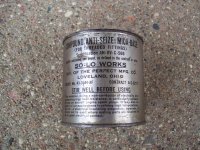
Is this military anti-seize?
- Thread starter Mick56
- Start date

rlitman
Well-known member
I'm thinking that the mica has settled out of the oil. It'll probably stir back in and still be usable after all these years.
Private Lugnutz
Well-known member
The US Army Air Forces often embedded the year in order numbers. Very good chance that is 1943. And the "A.C." in the contract number is very likely Air Corps.Can you tell from the numbers how old it is?
Private Lugnutz
Well-known member
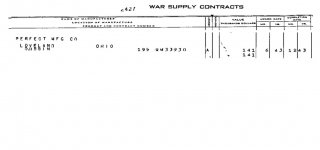
The company shows up in my WWII contracts listings. The had a contract worth $141,000 making dubbin (leather softener) for the US Army Quartermaster Corps in 1943. Doesn't mean your can isn't wartime. My source doesn't include orders less than $50,000 in value.
Attachments
Provincial
Well-known member
Mica flakes in oil was used to lubricate threads of aviation spark plugs up to and including WWII. Since the can references "threaded fittings," I believe that this product was more of a general purpose material. It could have been used on spark plug threads just as well as other threads.
pancho400cid
Well-known member
Very interesting!
I found a link to a manual for the Allison V-1710 E as used on Bell P-39's that specifically mentions using AN-VV-C-556 anti-seize on the spark plug threads:
Can't get link to post. Will update ASAP.
.....
I found a link to a manual for the Allison V-1710 E as used on Bell P-39's that specifically mentions using AN-VV-C-556 anti-seize on the spark plug threads:
Can't get link to post. Will update ASAP.
.....
Last edited:
Provincial
Well-known member
BG Spark Plug Company promoted mica anti-seize. They used mica for insulating material for their spark plugs into the WWII era. It was their "trademark" design feature.
toolchaser
Well-known member
Formica was developed initially as a synthetic substitution "for mica", hence the name. I think it was for electric insulation in components, not the flake form as seen in anti-seize. That's my useless fact for today....
rlitman
Well-known member
Formica was developed initially as a synthetic substitution "for mica", hence the name. I think it was for electric insulation in components, not the flake form as seen in anti-seize. That's my useless fact for today....
Except that Formica is made mostly FROM mica. It's not synthetic. It is mica embedded in phenol formaldehyde resin (the same early synthetic plastic used with wood fibers to make bakelite).
Oh, and the electrical insulating sheets, flake used in anti-seize and even the windows in kerosene and wood stoves are all the same material. Mica has a LOT of uses.
Last edited:
I did stir it a little, it is thick on the bottom.
I'd use a paint can shaker at the local hardware store.
Good luck!
rlitman
Well-known member
I'd use a paint can shaker at the local hardware store.
Good luck!
If you want to use it, yeah, that's probably the only good option now. Manually stirring, you'd have to stir to the point that the stirrer wears through the can. Properly shaken, it'll turn into a perfect peanut buttery consistency in about 5 minutes.
I keep my pneumatic paint shaker in my garage and use it often. Not just on paint!
rlitman
Well-known member
One thing that confuses me. The Mica has insulating properties, so using it on spark plugs would tend to insulate them from the engine? But don't the plugs need to be grounded to work?
It's like dielectric grease. There will still be enough metal-on-metal contact somewhere in the threads.
If you want to use it, yeah, that's probably the only good option now. Manually stirring, you'd have to stir to the point that the stirrer wears through the can. Properly shaken, it'll turn into a perfect peanut buttery consistency in about 5 minutes.
I keep my pneumatic paint shaker in my garage and use it often. Not just on paint!
Yea, I guess that's the bigger question: "Should" you use it?
Debcrow
Well-known member
There is plenty of modern anti seize around. I would leave it in the can like it is, pretty neat. Would be nice to have in a display in a vintage plane museum.
ttpete
Well-known member
Modern anti-seize is metallic and will short out spark plugs. Champion makes a non-metallic type for plugs in their aviation line.
Private Lugnutz
Well-known member
Good catch, RJ. That is an Army Navy spec in Federal Standard Stock Catalog format, begun during WWII to standardize common supplies and parts. MILSPEC started after WWII during the KW era. That helps add to the wartime dating I already gave him in post #4 and #5.
d42jeep
Well-known member
I’ve been using conventional anti-seize on spark plug threads, particularly on those screwing into aluminum heads with no shorting problems since 1967. I’m careful to only apply it to the threads, however.
-Don
-Don
pancho400cid
Well-known member
Do I understand correctly?
The reason for the non-conductive anti-seize is that if a gob gets into the plug gap it won't short the spark plug out?
The spark plug body has to be grounded for the plug to fire. Apparently, even though the anti-seize is reducing the contact some, there is enough contact between the female threads in the cylinder head and the male threads in the spark plug to ground the plug body including negative plug electrode(s)?
The reason for the non-conductive anti-seize is that if a gob gets into the plug gap it won't short the spark plug out?
The spark plug body has to be grounded for the plug to fire. Apparently, even though the anti-seize is reducing the contact some, there is enough contact between the female threads in the cylinder head and the male threads in the spark plug to ground the plug body including negative plug electrode(s)?
rlitman
Well-known member
Do I understand correctly?
The reason for the non-conductive anti-seize is that if a gob gets into the plug gap it won't short the spark plug out?
The spark plug body has to be grounded for the plug to fire. Apparently, even though the anti-seize is reducing the contact some, there is enough contact between the female threads in the cylinder head and the male threads in the spark plug to ground the plug body including negative plug electrode(s)?
100% correct.
I'll still use metallic anti-seize on my spark plugs, but remember that this was made for aircraft, where a misfire is far more likely to end in death than in a car.
Provincial
Well-known member
When I was learning to work on aircraft 50+ years ago, the experienced mechanics refused to use the non-metallic anti-seize on spark plugs, choosing to use the metallic type and being very careful to not get any on the electrodes. They found that the non-metallic type was far more likely to result in destroyed threads in the cylinder heads. This was in an era where bronze thread inserts were common on aluminum cylinders, and Helicoil stainless threads were just entering service.
The military often had to "fool-proof" procedures due to turnover/lack of experience of personnel.
The military often had to "fool-proof" procedures due to turnover/lack of experience of personnel.