To avoid these ads, REGISTER NOW!

J.H. Williams and World War II

David Jackson

Well-known member
Joined
Jul 4, 2014
Messages
471
Location
Magalia, California
It is interesting to me to follow AA on tool dates and to fit a few JHWs I have into the date formats. I have run across kind of a puzzler, if I remember correctly AA has JHW round shank box end wrenches giving way to oval shanks in about 1940.
Various posts about various toolmakers have pointed out that mid to late wartime chrome, which most used to finish their hand tools, was a war material so tool makers resorted to other ways to finish their wares. Some went to paint and I have attached a few photos of two examples of that finish.
I started wondering if electrolysys, to remove rust, would also remove paint, still wondering about that and then thought of some round shank black painted wrenches I have which don't fit the date pattern.
I wonder what others may know about that which I don't.
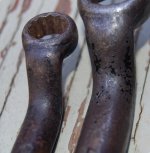
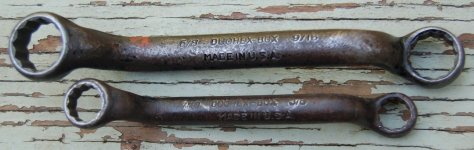
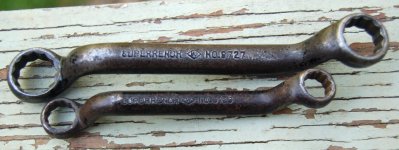
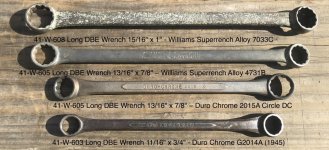
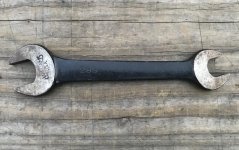
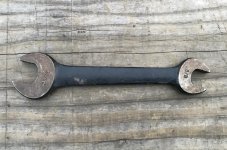
The first three photos are of wrenches with gray, or tan seems to me, paint; both marked "Alloy Steel" so late war time seems to fit;
The last four photos are of round shank Duohex-Box wrenches with traces of black paint. The paint is hard to see in the photos, especially on the smaller wrench, but it is there. I would have thought those wrenches pre war except for the black paint.
 

Attachments

  • 1 Superrench side.jpg
    1 Superrench side.jpg
    112.8 KB · Views: 28
  • 7 Black on both.jpg
    7 Black on both.jpg
    93.7 KB · Views: 18
  • 6 .jpg
    6 .jpg
    85.4 KB · Views: 23
  • 5 9000s numbers side.jpg
    5 9000s numbers side.jpg
    106.9 KB · Views: 22
  • 4 9000s superrench side.jpg
    4 9000s superrench side.jpg
    124.8 KB · Views: 20
  • 3 Superrench side ends.jpg
    3 Superrench side ends.jpg
    148.1 KB · Views: 26
  • 2 Numbers side.jpg
    2 Numbers side.jpg
    57.4 KB · Views: 24
To avoid these ads, REGISTER NOW!

Private Lugnutz

Well-known member
Joined
Mar 30, 2012
Messages
30,595
Location
The Authentic Jersey Shore
The first three photos are of wrenches with gray, or tan seems to me, paint; both marked "Alloy Steel" so late war time seems to fit;
That's not paint; it's cadmium.

David Jackson said:
The last four photos are of round shank Duohex-Box wrenches with traces of black paint. The paint is hard to see in the photos, especially on the smaller wrench, but it is there. I would have thought those wrenches pre war except for the black paint.
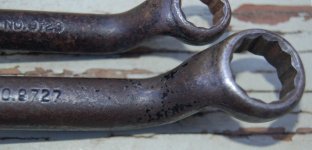
Williams used a baked black enamel finish on wrenches for decades prior to WWII, more typically carbon steel wrenches. Extensively. Other OEMs did as well.
 
OP
D

David Jackson

Well-known member
Joined
Jul 4, 2014
Messages
471
Location
Magalia, California
Hi Lugz,

Well there goes another theory! I was hoping someone would chime in who knows more about this than I do.

I thought cadmium was closer to a dull kind of light gray finish; when this stuff was all over the tool it would have been shiny kind of tan.

So, black enamel, were all the tools they sold of certain era enameled in black or would that have been a choice of the buyer? I have 8 short Duohex marked wrenches and only 2 have black paint (enamel?).

I thought there was kind of a finish progression, 1st. plain, 2nd. chrome, 3rd various wartime finishes and that black was one of those wartime finishes. Chrome again after the war but not as shiny as prewar.

Thanks for the knowledge!

Regards,

David J.
 

Private Lugnutz

Well-known member
Joined
Mar 30, 2012
Messages
30,595
Location
The Authentic Jersey Shore
I thought cadmium was closer to a dull kind of light gray finish; when this stuff was all over the tool it would have been shiny kind of tan.
It looks like cadmium to me from afar. But I could be wrong. Some Navy wartime tools were painted ocean grey, including Williams. I have some DBE's. It can have a light hospital green tinge almost. It could be that as well. Hard to tell from here. But my first thought was cadmium.

David Jackson said:
So, black enamel, were all the tools they sold of certain era enameled in black or would that have been a choice of the buyer?
As I said, typically the carbon steel wrenches (Superior line) were finished in baked black enamel. They had two main wrench lines: Superior (carbon steel) and Superrench (alloy steel).

David Jackson said:
I thought there was kind of a finish progression, 1st. plain, 2nd. chrome, 3rd various wartime finishes and that black was one of those wartime finishes. Chrome again after the war but not as shiny as prewar.
Nope. Many early tools from many OEMs were finished in baked black japan or enamel. And most early (pre-war) tools that were plated were nickel-plated. Then chrome. Cadmium was also a popular economy line finish before the war. Cadmium, phosphates, and paint are not foolproof wartime identifiers. The wrench has to be wartime model and style, too. The only finish that is foolproof as wartime is black oxide. It was invented in late 1941 specifically in reaction to the plating restrictions. All the others pre-existed the war.
 
Last edited:

d42jeep

Well-known member
Joined
Oct 22, 2014
Messages
16,553
Location
Northern California
I have a wartime Williams DBE wrench with gray paint on it. My assumption is that it was likely a wrench used and painted by the Navy. The carbon steel Superior Williams wrenches were black finished prewar, wartime and postwar. Here are a couple examples. The Superior wrench is postwar.
-Don
Edit. Another of Lugz and my famous cross posts!
 

Attachments

  • 30237FB0-4210-434A-970D-6ED01AB18ADE.jpg
    30237FB0-4210-434A-970D-6ED01AB18ADE.jpg
    154.7 KB · Views: 29
  • 9F65247B-5792-493E-8E81-1A70C684204F.jpg
    9F65247B-5792-493E-8E81-1A70C684204F.jpg
    151.9 KB · Views: 23
  • 7153AF02-0551-46A0-AC0F-12538A095385.jpg
    7153AF02-0551-46A0-AC0F-12538A095385.jpg
    154.1 KB · Views: 26
  • 9D28130B-DE74-49BA-ABEB-ABC8A647E8F5.jpg
    9D28130B-DE74-49BA-ABEB-ABC8A647E8F5.jpg
    155.6 KB · Views: 24
Last edited:
OP
D

David Jackson

Well-known member
Joined
Jul 4, 2014
Messages
471
Location
Magalia, California
It looks like cadmium to me from afar. But I could be wrong. Some Navy wartime tools were painted ocean grey, including Williams. I have some DBE's. It can have a light hospital green tinge almost. It could be that as well. Hard to tell from here. But my first thought was cadmium.


As I said, typically the carbon steel wrenches (Superior line) were finished in baked black enamel. They had two main wrench lines: Superior (carbon steel) and Superrench (alloy steel).


Nope. Many early tools from many OEMs were finished in baked black japan or enamel. And most early (pre-war) tools that were plated were nickel-plated. Then chrome. Cadmium was also a popular economy line finish before the war. Cadmium, phosphates, and paint are not foolproof wartime identifiers. The wrench has to be wartime model and style, too. The only finish that is foolproof as wartime is black oxide. It was invented in late 1941 specifically in reaction to the plating restrictions. All the others pre-existed the war.


Well, well, well. This becomes somewhat complicated, more so than I ever imagined. I had thought, based on what I thought I got from AA, that there was just a change from Chrome Alloy to Alloy Steel in JHW wrenches. I have to rummage a bit to see; I may have two wrenches with the same number, one Chrome Alloy and the other Alloy Steel and I had thought one predated the other not that there were two lines. The only period catalog I have seen, #401 I think, does not mention two lines, or if it does I just missed that completely.
And, did Williams make black oxide wrenches?
 
Last edited:

Private Lugnutz

Well-known member
Joined
Mar 30, 2012
Messages
30,595
Location
The Authentic Jersey Shore
I had thought, based on what I thought I got from AA, that there was just a change from Chrome Alloy to Alloy Steel in JHW wrenches. I have to rummage a bit to see; I may have two wrenches with the same number, one Chrome Alloy and the other Alloy Steel and I had thought one predated the other not that there were two lines.
You're confusing a steel composition change within the Superrench line (from Chrome-Alloy to Alloy) with two different lines: carbon steel (Superior) and alloy steel (Superrench). By "alloy" I don't mean "Alloy", with a capital "A" (a wartime marking for a low dose triple alloy New Emergency steel), but any combination of chromium with molybdenum or vanadium.
 
To avoid these ads, REGISTER NOW!
OP
D

David Jackson

Well-known member
Joined
Jul 4, 2014
Messages
471
Location
Magalia, California
You're confusing a steel composition change within the Superrench line (from Chrome-Alloy to Alloy) with two different lines: carbon steel (Superior) and alloy steel (Superrench). By "alloy" I don't mean "Alloy", with a capital "A" (a wartime marking for a low dose triple alloy New Emergency steel), but any combination of chromium with molybdenum or vanadium.

Yes, I guess I am confusing the two. If I understand you correctly, from '30 MOL to '54 MOL JHW sold a separate line of double box wrenches, some 15% angle, long and short, and perhaps offset box ones as well, which were made of a higher grade of steel than the Superrenches I am familiar with. I have never even seen a picture of one of those.

DJ
 

Private Lugnutz

Well-known member
Joined
Mar 30, 2012
Messages
30,595
Location
The Authentic Jersey Shore
Not higher, lower. Carbon steel (AISI 1xxx). "Superior" didn't signify superior to Superrench (AISI 4xxx, 6xxx, and 8xxx). Superior to other OEM's carbon steel lines. I don't think the Superior line included DBE's. Just DOEs, SOEs, spud wrenches, machine/toolpost wrenches, spanners (hook, pin, etc), and fixed socket wrenches.
 

DadsTools

Well-known member
Joined
Jul 27, 2017
Messages
1,852
And, did Williams make black oxide wrenches?

Yes, they did. Now granted, this has nothing to do with the WW2 era or thereabouts being discussed. But I have actually seen a set of black oxide Williams wrenches with my own eyes, never saw another example or vintage catalog listing for them, though I haven't looked real hard for them either. These were what AA calls the "flat" style Superrench from 1959 to the late 1970s (not Snap-on era and before TRW started jerking around with the line and then dumped it). There's an old fellow who goes around to yard sales, flea markets and auctions buying up tools, then he has a garage/yard sale about twice a year when he has a big enough pile, fills the garage and back yard lawn. He has most of a combo set with a couple of sizes missing. I've been trying to buy them for a couple of years but he wants too much money for them. They have a B at the end of the normal model numbers. Again, nothing to do wit the earlier style wrenches--the 1960 catalog easily found online makes no mention of black finishes for end wrenches, so it must be uncatalogued or were introduced later.
 
OP
D

David Jackson

Well-known member
Joined
Jul 4, 2014
Messages
471
Location
Magalia, California
Not higher, lower. Carbon steel (AISI 1xxx). "Superior" didn't signify superior to Superrench (AISI 4xxx, 6xxx, and 8xxx). Superior to other OEM's carbon steel lines. I don't think the Superior line included DBE's. Just DOEs, SOEs, spud wrenches, machine/toolpost wrenches, spanners (hook, pin, etc), and fixed socket wrenches.

I have a feeling that if I were to see a catalog of the period I would understand better. "Superior" as a brand name is intended to invoke an impression of superior quality, whether or not that is actually the case is moot. Correct?

Do higher numbers in AISI numerology mean anything other than different composition of different alloys? They must and I know nothing about all that. If Superrenches are made of an alloy with higher numbers does that reflect anything about the quality of the steel, or is it simply that different numbers reflect different purposes for which that alloy is developed?

Pardon my ignorance here, it is almost absolute.

DJ
 
Last edited:
OP
D

David Jackson

Well-known member
Joined
Jul 4, 2014
Messages
471
Location
Magalia, California
Will do re AISI. I looked at catalog 401 and I did see adjustable wrenches listed as Carbon Steel and Superadjustable. Based on what you have been telling me today the Carbon Steel one would be less expensive?
Also, on the back cover it says Carbon Steel and Alloy both available in all wrench types though I only saw the Carbon Steel listed in adjustable wrenches.

DJ
 

Private Lugnutz

Well-known member
Joined
Mar 30, 2012
Messages
30,595
Location
The Authentic Jersey Shore
I looked at catalog 401 and I did see adjustable wrenches listed as Carbon Steel and Superadjustable. Based on what you have been telling me today the Carbon Steel one would be less expensive?
Yes, as I said. The Superjustable, like all the Super line, was made from alloy steel.

On your original question I found a note on page 30 of the 1939 pamphlet saying that DBE wrenches were available in "baked grey enamel" at a lower price on request.
 
To avoid these ads, REGISTER NOW!
Top Bottom