Mike, I worked around a crane like you want in a machine/fab shop. I have also worked around jib cranes that were mounted on the vertical post of a steel-framed building, and free-standing jib cranes. Each has it's strong points.
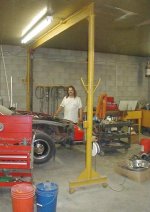
The "outboard support" design gets you the greatest capacity with a low ceiling height, since nothing has to extend above the boom, although most designs put the upper bearing a little above it. It also distributes the load between two points, one on each end of the beam. Even when the load is near on end, some of the load is transferred to the other beam. The outboard support requires that the floor be clear where it runs, and also that the floor be a uniform distance below the beam at any point the tires contact. Notice that the design in the youtube video is basically this design with the outboard support omitted. That greatly limits the lift capacity of the crane.
A freestanding jib crane takes a large footing in order to handle the tipping forces applied at the base. This is because it has no connection to any part of the building structure. It can work under a low ceiling if the boom is stout enough, or it is braced from below, putting the braces in compression from the load. Compression bracing interferes with using the crane close to the rotation point.
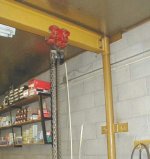
A traditional jib crane is either built with a dedicated column, or attached to a column that is part of the building structure. I have been around both types. I suspect that some of those built using the building column were added to an existing building that had not been engineered for that use, but they seemed to hold up their design load anyway.
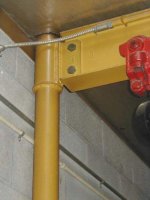
I have more faith in those built with a separate I-beam or tubular column that transfers the load directly to the floor, rather than use the building column. This type transfers the tipping load to the building column through a bracket attched between the vertical crane column and the building. I have been around these attached to both steel columns and concrete (block or tilt-up) walls, and all seem to not stress the building enough to cause concern.
The most common jib crane design uses a tension rod hinged above the beam and anchored with a hinge to the vertical column. This requires quite a bit of extra height, and results in either a very tall ceiling or a limited clearance under the beam. I prefer this design if ceiling height permits because it has no obstructions to moving the hoist or work anywhere below the beam, and can clear obsticles on the floor.
When building an "outboard support" design, it is imperative to mount the wheels so that they track the arc of travel without scuffing. Otherwise it becomes difficult to swing the beam when loaded. I have never seen one with a single wheel, probably because such a design would allow the wheel to move out from under the support column and let the beam carry the whole weight without it's support. I have never seen swivelling casters on such a design, either.
It sounds like a fun project! I will be adding a conventional jib crane to my shop in the future. For now i make do with a forklift and the Autocrane on my service truck.