You are using an out of date browser. It may not display this or other websites correctly.
You should upgrade or use an alternative browser.
You should upgrade or use an alternative browser.
Jib hoist
- Thread starter clawman
- Start date
zkdiesel
Well-known member
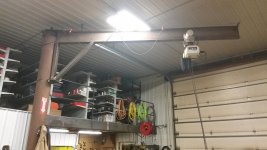
Love mine. My shop capabilities are greatly expanded with it. Unloading and loading items is one of the best features with one hand by yourself. Requires lots of prep but for me was worth it with a free crane and trolley
zkdiesel
Well-known member
bad_idea
Well-known member
I had an I beam mounted running across the ceiling in my last garage, 8' from the back wall. It was supported by posts within the wall cavity. Absolutely loved it. I'll be installing one in my next garage, after I build it. Great for unloading heavy things from the truck and yanking engines. Basically a gantry crane. I prefer my setup over a JIB, as it involves less engineering and cheaper to setup. Make sure the beam is locked in solid, and will handle the load. Good to go. JIB crane involves a lot more engineering as it puts ALOT of load on it's mounts.
Bad_idea do you have any pictures of your old hoist?
I much prefer gantry cranes, but I worked with much heavier equipment. The main downfall of a jib boom is its inherent lower lift capacity. But if your using it for say half to 1ton they are very handy. When I'm lifting over a ton or two I prefer a gantry.
Having said that, when I was getting quotes for my shop I asked for it to support a 5 ton gantry. Holy schnikies! Did that get expensive! So after much thought, I got a fork lift. It will not only lift what the crane will, it will grab stuff from pallet racks, which neither type of hoist will do.
I much prefer gantry cranes, but I worked with much heavier equipment. The main downfall of a jib boom is its inherent lower lift capacity. But if your using it for say half to 1ton they are very handy. When I'm lifting over a ton or two I prefer a gantry.
Having said that, when I was getting quotes for my shop I asked for it to support a 5 ton gantry. Holy schnikies! Did that get expensive! So after much thought, I got a fork lift. It will not only lift what the crane will, it will grab stuff from pallet racks, which neither type of hoist will do.
deberly12
Well-known member
Well I don't own one and I haven't spent many hours with my hands on the remote but as an engineer I have spent alot of time around them and studying them. Actually the last place I worked was a manufacturer of mobile cranes. (Everything from boom trucks to crawlers) we had more shop cranes than I can count we even had several 50 yes 5 ...0.. ton bridge cranes. We had some jibs as well.
There are three main differences:
Loading: Bridge cranes load their supports almost perfectly vertical. Jibs have huge bending forces. Building are designed to support downward force. A bridge cranes will just increase this load. They are usually not designed to handle a bending moment on the internal beams requiring much more extensive engineering.
Controls: bridge cranes function with up down N S E W. Many have all of these directions powered. Jibs movement is up down in out and around. I have never seen a jib that is powered for anything other than up and down.
Reach. A bridge can theoretically reach every inch of your shop. Because a Jib has a circular motion it will not reach every corner....or probably any corner.
Typically a jib is used at a particular workstation to perform a specific task. ie. Lift item A off of cart and onto weld table. Bridge cranes are usually used for more general lifting needs as they are more versatile.
You also have the option of the rolling gantry crane. These are simple and cheap but effective.
Sent from my XT1635-01 using Tapatalk
There are three main differences:
Loading: Bridge cranes load their supports almost perfectly vertical. Jibs have huge bending forces. Building are designed to support downward force. A bridge cranes will just increase this load. They are usually not designed to handle a bending moment on the internal beams requiring much more extensive engineering.
Controls: bridge cranes function with up down N S E W. Many have all of these directions powered. Jibs movement is up down in out and around. I have never seen a jib that is powered for anything other than up and down.
Reach. A bridge can theoretically reach every inch of your shop. Because a Jib has a circular motion it will not reach every corner....or probably any corner.
Typically a jib is used at a particular workstation to perform a specific task. ie. Lift item A off of cart and onto weld table. Bridge cranes are usually used for more general lifting needs as they are more versatile.
You also have the option of the rolling gantry crane. These are simple and cheap but effective.
Sent from my XT1635-01 using Tapatalk
matt_i
Well-known member
Typical jib crane prep is a massive concrete footing underneath. Epoxy anchor bolts, then a lot of shimming to get the column level so the arm rotates correctly and doesn't auto-find the lowest point. They can be attached to the wall as well but it requires engineering too to gain enough strength.
As mentioned above the single-supported cantilevered design isn't a strong one. Just like any structure, when you can double-support the stresses go way down, and also the ease of construction goes up. The jib can cover a lot of area though. I see them typically used for light duty assist hoist duty <500lbs.
Most versatile hoist in my opinion? A forklift.
As mentioned above the single-supported cantilevered design isn't a strong one. Just like any structure, when you can double-support the stresses go way down, and also the ease of construction goes up. The jib can cover a lot of area though. I see them typically used for light duty assist hoist duty <500lbs.
Most versatile hoist in my opinion? A forklift.
cvairwerks
Well-known member
The longer the boom, higher the capacity and taller the mast, the numbers start getting scarry. We had some big ones at work. Mast top was about 30 feet above the floor, 16 foot booms and 500 lb, moving load capacity at the tip. The masts were 20 or 24" columns and were socketed in concrete blocks 10'x10'x14' deep. When they reconfigured the floor, the demolition guys jack hammered down about 6', then torched the sockets off and backfilled as necessary for the new 30" thick floors.
RWorth
Well-known member
One more vote for a forklift, I had one for 20 years, extremely handy for work and storing heavy items on pallet shelving. It was an antique and I didn't use it enough to keep it working properly so I junked it last year. Now I'm looking for another, this time I may try to find an electric one.
Right now I have a 2000lb electric chain hoist on an I-beam down the center of the shop, front to back. Very handy but you have to work under the beam which makes it limited. I also use one or both posts of my 2 post lift as a boom lift. Which also makes a nice adjustable height table or rack. The other thing I have that is very handy is a hydraulic lift table that is also very handy, I'm guessing it's about a 500lb unit on wheels.
Right now I have a 2000lb electric chain hoist on an I-beam down the center of the shop, front to back. Very handy but you have to work under the beam which makes it limited. I also use one or both posts of my 2 post lift as a boom lift. Which also makes a nice adjustable height table or rack. The other thing I have that is very handy is a hydraulic lift table that is also very handy, I'm guessing it's about a 500lb unit on wheels.
zkdiesel
Well-known member
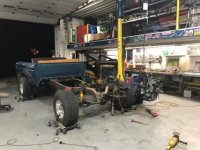
Forklifts work well but still prefer my jib crane for things not on pallets in the 200-1500 lb range. Way easier when by yourself to control. I have a large skidsteer in background of my jib cranes that acts as my forklift but I still prefer to use the crane for most lifting of items in the shop...One more vote for a forklift, I had one for 20 years, extremely handy for work and storing heavy items on pallet shelving. It was an antique and I didn't use it enough to keep it working properly so I junked it last year. Now I'm looking for another, this time I may try to find an electric one.
Right now I have a 2000lb electric chain hoist on an I-beam down the center of the shop, front to back. Very handy but you have to work under the beam which makes it limited. I also use one or both posts of my 2 post lift as a boom lift. Which also makes a nice adjustable height table or rack. The other thing I have that is very handy is a hydraulic lift table that is also very handy, I'm guessing it's about a 500lb unit on wheels.
bad_idea
Well-known member
I don't have any pictures of my beam setup. It was VERY simple. I beam (vertical measurement was ~6" IIRC) up against the ceiling, supported by posts within the wall. Think of a Gantry built into place. I restricted all lifts to straight up, no side loading.
d300
Well-known member
I am building a jib for my shop and I have a 5k forklift as well. The jib is super handy for removing stuff from a pickup and, in my case, dropping in and retrieving blocks and such from my hot tank.
The design is critical. They will collapse if over loaded so pick a max load for the design and do not exceed it.
The design is critical. They will collapse if over loaded so pick a max load for the design and do not exceed it.
driftpin
Well-known member
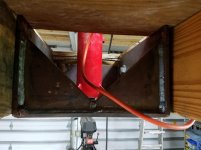
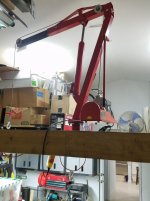
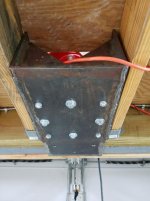
Here's one I put in my shop, I used a 1 ton winch to make it easier to power up/down heavy loads. The hoist is also rated at 1 ton. The space is a 2 car, the loft is 60" at the ridge beam, that's all I had for space. The loft is the rear half of the garage space, roughly, about 240 sq ft. The engineer designed the floor of the loft to support heavy loads. The hoist steel mounting box is bolted to a 4" x 8" X 1/2" wall thickness steel box beam which is running side-to-side, and which supports the front of the loft joists. The beam is welded to flitch plates set into the wall, and the wall at the flitch plates is an 8" X 24" solid concrete pour up to the tie beam and down to the foundation. The pivoting base of the hoist is set-into a 3/8" welded steel 'shoebox' which sits in-between the central floor joists of the loft. I'm going to design a cable guide for the pulleys so the cable cannot jump the track, and I'd like to install the winch switch to shut-down the power when the tackle approaches the cantilever pulley.
The steel 'shoebox' for the foot of the jib hoist uses 3/4" dia. hex machine screws on each side to anchor to the floor joists. At the end closest-to the 4" X 8" steel box beam, the 'shoebox' is through-bolted to the steel box beam.
I'm not lifting V8 blocks into the loft, but I have used it to store complete motorcycle engines, which are < 300 lbs and when I get them up into the loft, I pivot the hoist, and power-down onto a wheeled dolly, and move it to disperse the load across the structure of the loft.
I doubt I'll ever use it to lift > 300 lbs up there, so with the jib hoist and the electric winch being rated at 2,000 lbs I have a comfortable safety margin. The 3/4" grade 8 machine screws are rated at 20 tons each fastener for shear strength and more-than 26 tons for each fastener for tension capability strength.
The steel 'shoebox' for the foot of the jib hoist uses 3/4" dia. hex machine screws on each side to anchor to the floor joists. At the end closest-to the 4" X 8" steel box beam, the 'shoebox' is through-bolted to the steel box beam.
I'm not lifting V8 blocks into the loft, but I have used it to store complete motorcycle engines, which are < 300 lbs and when I get them up into the loft, I pivot the hoist, and power-down onto a wheeled dolly, and move it to disperse the load across the structure of the loft.
I doubt I'll ever use it to lift > 300 lbs up there, so with the jib hoist and the electric winch being rated at 2,000 lbs I have a comfortable safety margin. The 3/4" grade 8 machine screws are rated at 20 tons each fastener for shear strength and more-than 26 tons for each fastener for tension capability strength.
Attachments
Last edited:
RWorth
Well-known member
Here's one I put in my shop, I used a 1 ton winch to make it easier to power up/down heavy loads. The hoist is also rated at 1 ton. The space is a 2 car, the loft is 60" at the ridge beam, that's all I had for space. The loft is the rear half of the garage space, roughly, about 240 sq ft. The engineer designed the floor of the loft to support heavy loads. The hoist is bolted to a 4" x 8" X 1/2" wall thickness beam which is running side-to-side, and which supports the front of the loft joists. The beam is welded to flitch plates set into the wall, and the wall at the flitch plates is an 8" X 24" solid concrete pour up to the tie beam and down to the foundation. The pivoting base of the hoist is set-into a 3/8" welded steel 'shoebox' which sits in-between the central floor joists of the loft. I'm going to design a cable guide for the pulleys so the cable cannot jump the track, and I'd like to install the winch switch to shut-down the power when the tackle approaches the cantilever pulley.
I'm not lifting V8 blocks into the loft, but I have used it to store complete motorcycle engines, and when I get them up into the loft, I pivot the hoist, and power-down onto a wheeled dolly, and move it to disperse the load across the structure of the loft.
I'm no engineer, but that doesn't look very safe to me.unless you are only lifting things you can carry by hand.
driftpin
Well-known member
No, it's not for lifting heavy weights, as being say, 2000+ lbs. I am using it for lifting a few hundred pounds max, the winch and the hoist are both rated at 2000 lbs, so I have a considerable safety factor. I told the engineer what my plan was for the loft platform, the static load, and my idea of a lift. I had an experienced machinist go over my method of assembly, he made suggestions, and he did the welding and fabrication. The 1/2" wall thickness 4"X 8" steel box beam is capable of bearing much more than the modest weights it's subjected to.
Last edited: