
To avoid these ads, REGISTER NOW!

JIS is an old outdated standard

Ohio Andy

Well-known member
Joined
Jul 31, 2024
Messages
2,245
Location
Columbus, Ohio
I recently was told the following:

JIS is a defunct industrial standard. Modern Philips bits conform to a newer DIN/ISO standard that mandates a profile that works in older JIS as well as SAE Philips. Anything produced after 2008 that claims to be JIS is actually conforming to the new DIN/ISO standard.

Comment was here:


I would not expect a bit set to them specifically include a Phillips and a JIS (like the grip edge) unless it is the older JIS. But if this is true then a newer PH2 should work fine in a JIS screw.

I asked Tekton what standard their drivers supported and the responder did not claim to support any particular standard. Tekton responds really fast (or always had for me), I did not ask anyone else.

Was thinking about asking Vessel or Williams.
 
To avoid these ads, REGISTER NOW!

richfinn

Well-known member
Joined
Jan 29, 2011
Messages
4,809
Location
Leeds, Yorkshire, England
I recently was told the following:

JIS is a defunct industrial standard. Modern Philips bits conform to a newer DIN/ISO standard that mandates a profile that works in older JIS as well as SAE Philips. Anything produced after 2008 that claims to be JIS is actually conforming to the new DIN/ISO standard.

Comment was here:


I would not expect a bit set to them specifically include a Phillips and a JIS (like the grip edge) unless it is the older JIS. But if this is true then a newer PH2 should work fine in a JIS screw.

I asked Tekton what standard their drivers supported and the responder did not claim to support any particular standard. Tekton responds really fast (or always had for me), I did not ask anyone else.

Was thinking about asking Vessel or Williams.

Vessel is the answer you are looking for, their crosshead profile seemingly works on everything perfectly.

I'm not sure that JIS is a defunct standard entirely (Many Japanese Car Batteries still use JIS codes)

I think what's happened is that as Japanese manufacturers set up factories in USA/Europe JIS fasteners gradually fell out of favour and a new standard was adopted that works with DIN/ISO/JIS/SAE standards
 

BrandonV

Well-known member
Joined
Jun 9, 2023
Messages
4,030
Location
Arizona
No the JIS standard still exists and is considered valid. The thing is that the standards have all been aligned by this point.

I contacted the Japanese Standards Association a few months ago to request the original JIS screwdriver specifications from the 1950s. I was surprised to find that the dimensional data in the original standard is identical to the copies of the DIN, ISO, and ASME cross-head screwdrivers from the 1980s onward I was able to locate.

The standards are consistent across the board, meaning all modern cross-head screwdrivers (Phillips) should work interchangeably.

I have yet to locate the original Philips standard from the pre-ASME era, so it's possible that Philips was initially different from the others. That said, this doesn't guarantee that every inexpensive screwdriver meets these standards, but you can generally expect high-quality brands like Vessel, Snap-on, and Proto to perform well as they should meet one of the aforementioned standards.

See https://smallworkshop.co.uk/2022/10/01/japanese-screws-and-fasteners/
 

Jack Ryan

Well-known member
Joined
Jun 2, 2022
Messages
339
Location
Adelaide, South Australia
I recently was told the following:

JIS is a defunct industrial standard.
JIS is the Japanese national standards organisation - it is no more defunct than ISO, DIN and ANSI

Modern Philips bits conform to a newer DIN/ISO standard that mandates a profile that works in older JIS as well as SAE Philips.
I believe the newer ISO standard now conforms more closely to the original Japanese standards.

Anything produced after 2008 that claims to be JIS is actually conforming to the new DIN/ISO standard.
Modern Japanese tools (probably) conform to the current JIS standards, which, as has been mentioned, are equivalent to the relevant ISO standards.

Comment was here:


I would not expect a bit set to them specifically include a Phillips and a JIS (like the grip edge) unless it is the older JIS. But if this is true then a newer PH2 should work fine in a JIS screw.
I believe a newer PH2 is now closer to the original Japanese standard so yes, it "should" fit.

However, the standards include a tolerance and some manufacturers know better so there are still Phillips screwdrivers that don't fit anything properly.

I asked Tekton what standard their drivers supported and the responder did not claim to support any particular standard. Tekton responds really fast (or always had for me), I did not ask anyone else.

Was thinking about asking Vessel or Williams.
I guess Tekton knows better.

I myself, am pretty happy with Vessel.

Jack
 
OP
O

Ohio Andy

Well-known member
Joined
Jul 31, 2024
Messages
2,245
Location
Columbus, Ohio
No the JIS standard still exists and is considered valid. The thing is that the standards have all been aligned by this point.

I contacted the Japanese Standards Association a few months ago to request the original JIS screwdriver specifications from the 1950s. I was surprised to find that the dimensional data in the original standard is identical to the copies of the DIN, ISO, and ASME cross-head screwdrivers from the 1980s onward I was able to locate.

The standards are consistent across the board, meaning all modern cross-head screwdrivers (Phillips) should work interchangeably.

I have yet to locate the original Philips standard from the pre-ASME era, so it's possible that Philips was initially different from the others. That said, this doesn't guarantee that every inexpensive screwdriver meets these standards, but you can generally expect high-quality brands like Vessel, Snap-on, and Proto to perform well as they should meet one of the aforementioned standards.

See https://smallworkshop.co.uk/2022/10/01/japanese-screws-and-fasteners/
Thanks, that is a great link....

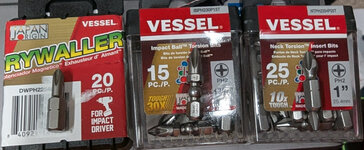
I just received three packages of vessel bits and I intend to open and compare the tips. All are labeled as PH2, but the vender lists over as a drywall bit, which I thought meant it will sit deeper into the head. I bought the different bits to compare
 
OP
O

Ohio Andy

Well-known member
Joined
Jul 31, 2024
Messages
2,245
Location
Columbus, Ohio
JIS is the Japanese national standards organisation - it is no more defunct than ISO, DIN and ANSI


I believe the newer ISO standard now conforms more closely to the original Japanese standards.


Modern Japanese tools (probably) conform to the current JIS standards, which, as has been mentioned, are equivalent to the relevant ISO standards.


I believe a newer PH2 is now closer to the original Japanese standard so yes, it "should" fit.

However, the standards include a tolerance and some manufacturers know better so there are still Phillips screwdrivers that don't fit anything properly.


I guess Tekton knows better.

I myself, am pretty happy with Vessel.

Jack
I have this set... And it had a very interesting screw head retaining device.

IMPACT BALL Torsion Bit 52PCS SET

These are the supposed drywall bits

VESSEL Drywaller Insert Bits 20PC +2X25.4 (1") (TicTac)

These are the ones labeled different

VESSEL - Neck Torsion Insert Bits Ph2X25.4 25Pc (Tictac) (NTPH2254P25T)
 

SwissMetric

Well-known member
Joined
Dec 28, 2024
Messages
186
Location
Switzerland
Cruciform Phillips and cruciform according to JIS are different geometries, many JIS screws feature a small dot, for example many screws used in electronics, from PCs to smartphones and also consumer electronics. Not all JIS screws feature the dot mark.
There are specific screwdrivers, especially in electronics repair tool sets.
Larger JIS crosshead (cruciform) are not that common here.
The JIS wings are sort of less wide than for Phillips, for very small screws Phillips tools don't even fit, for the others using the wrong tool can damage the screwhead and the tool.

Basically tools are geometrically not compatible but I'd have to get a copy of the corresponding JIS, never searched it. ISO standards define the geometry of Phillips and POZIDRIV/SUPADRIV, I saw them some time ago but didn't pay much attention to as they're mainly relevant for tool and screw manufacturers and their accuracy is not that easy to check. That also explains why lots of cheap Chinese screws, including especially also TORX do not formally meet specs per ISO standards, this is valid for material performance, coatings, geometry, etc. E.g. some low(est)-end screews like the Dresselhaus screws sold by Hornbach are illegal as the ISO standard is mentioned on the label but the screws do not have the mandatorily required markings (e.g. for ISO 4762 (formerly DIN 912) Allen (INBUS) screws).

Obviously there are brand-neutral designations for Allen, TORX, Ribe-CV. etc. but I don't use them unless required. Also ISO uses partially incorrectly rounded metric values to designate imperial square drive sizes like 6,3 mm (1/4"), 9,5 mm (3/8"), 12,5 mm (1/2"), 20 mm (3/4") and 25 mm (1"), here I used the "," as decimal separator but in Switzerland we mostly use the "." which is much more convenient (our surrounding countries excepted the Fürstentum Lichtenstein use the "," too).
 
Last edited:

CJM8515

Well-known member
Joined
Mar 8, 2014
Messages
9,288
Location
NJ
all i know is that if it truly was dead, my honda powersports toys would be able to use a phillips to remove screws. go ahead and do that and forget it, rounded right off. grab a vessel screwdriver, no issue. NOW, i will say the high end screwdrivers like snap on I have used dont have these issues. i think their tips conform more towards the JIS type standard than others.
 

SwissMetric

Well-known member
Joined
Dec 28, 2024
Messages
186
Location
Switzerland
@BrandonV:
I'm not sure about the correct use of the dot, I've seen self-threading screws with JIS crosshead with a dot. Maybe I'm wrong assuming that the dot is related to the crosshead geometry. I can't remember having seen JIS crosshead screws excepted for electronics made in Asia, including China.
 

AEAdam

Well-known member
Joined
May 27, 2023
Messages
2,710
Location
SE PA
Standards don't become "defunct". They become superseded and/or are marked OBSOLETE. Obsolete/superseded standards are declared so by the standards agency, not manufacturers who are free to manufacture to whatever std they wish.

Just because the standards change, doesn't mean the hardware will ...soon or ever. The JIS hex head bolt spec is obsolete and lists the ISO as the superseding document. But there are plenty of 12 and 14mm headed bolts out there and there will be for a long time.
 

BrandonV

Well-known member
Joined
Jun 9, 2023
Messages
4,030
Location
Arizona
Obsolete/superseded standards are declared so by the standards agency, not manufacturers who are free to manufacture to whatever std they wish.

Right. At the link above the blog post clearly shows Japanese market JIS drivers that have a vastly different tip profile/shape.

You're 100% correct. (y) Just because a standard exists doesn't mean anyone has to follow it.
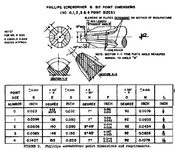
I just found a Department of Defense standard from the early 70s showing a Philips #2 having the same dimensions as a JIS #2.

Crappy driver tips have always been the problem.
 

BrandonV

Well-known member
Joined
Jun 9, 2023
Messages
4,030
Location
Arizona
Which standard was the DOD using?

Jack

They refer to it as Phillips (see below) but as with all the standards I've located, JIS from the 1950s to the present, ISO, DIN, ASME, NAS, you name it. Nothing significantly differs between them.

Either the Phillips standard was different pre-war (yet to be seen) or this whole time manufacturers have made inconsistent and poor fitting tips. As someone else clearly pointed out just because a standard exists doesn't mean you have to follow it. I believe Stanley still sells a very cheap #2 which is dimensionally garbage.

1735963450530.png
 
To avoid these ads, REGISTER NOW!

Jack Ryan

Well-known member
Joined
Jun 2, 2022
Messages
339
Location
Adelaide, South Australia
They refer to it as Phillips (see below) but as with all the standards I've located, JIS from the 1950s to the present, ISO, DIN, ASME, NAS, you name it. Nothing significantly differs between them.

Either the Phillips standard was different pre-war (yet to be seen) or this whole time manufacturers have made inconsistent and poor fitting tips. As someone else clearly pointed out just because a standard exists doesn't mean you have to follow it. I believe Stanley still sells a very cheap #2 which is dimensionally garbage.

Yes, thanks, I see that the standards have (or always were) converged but I don't have access to the standards so I haven't previously been able to make a detailed comparison.

It is pretty clear that some products are garbage and that has nothing to do with the standards. What is unclear to me is why Phillips standard screwdrivers made a mess of Japanese crosspoint screws in the '60s and '70s. On the other hand, JIS standard screwdrivers worked fine in both the Japanese screws and Phillips screws.

Were all of the non-Japanese screwdrivers rubbish? What about the fasteners themselves? Did those standards differ?

On some standards that I have seen, the dimensions were not identical, but were within each other's tolerances.

It will be interesting to see the original Phillips standards.

Jack
 
OP
O

Ohio Andy

Well-known member
Joined
Jul 31, 2024
Messages
2,245
Location
Columbus, Ohio
None were very different, perhaps they were another standard. Or the Stanley No 2 mentioned by Brandon.
I think it was the

Stanley 60-002 Standard Fluted Phillips Tip Screwdriver, 2 Point X 4 Inch

I had a full set and they were horrible. I didn't work worth **** unless I gave them away and then I thought about it and I told them to throw them away and I gave them a bunch of nicer screwdrivers
 

Jack Ryan

Well-known member
Joined
Jun 2, 2022
Messages
339
Location
Adelaide, South Australia
I think it was the

Stanley 60-002 Standard Fluted Phillips Tip Screwdriver, 2 Point X 4 Inch
There must be something odd about them, the images are from 100 paces and no zoom.

I had a full set and they were horrible. I didn't work worth **** unless I gave them away and then I thought about it and I told them to throw them away and I gave them a bunch of nicer screwdrivers
I know what you mean. You would have to really dislike someone to give them a known **** tool.

Jack
 

AEAdam

Well-known member
Joined
May 27, 2023
Messages
2,710
Location
SE PA
Right. At the link above the blog post clearly shows Japanese market JIS drivers that have a vastly different tip profile/shape.

You're 100% correct. (y) Just because a standard exists doesn't mean anyone has to follow it.
This is not what I said but also true. Just because a stds agency cancels a spec doesn’t mean manufacturers stop making them or engineers stop requesting hardware made to the old std.
 

john.k

Well-known member
Joined
Jun 4, 2024
Messages
979
The common JIS only pitches were small screws and commonly used in Jap motorbikes of the 1960s .......and Id also add ,these bikes had a reputation for having 'lead 'screws .......very soft steel screws that the cross point would ream out easily.
 

Odd-job

Well-known member
Joined
Aug 13, 2017
Messages
2,256
Location
SF Bay Area
I used to be more obsessed with "standards" until I realized standards are a little more fluid and dynamic, especially over time, than I appreciated. Health standards and government standards are always at the highest levels and now the standard desirable male is 6 ft tall and earns $*** :)

I would get both the Williams and the Vessels and try them out.
 

dnschmidt

Well-known member
Joined
Oct 3, 2014
Messages
7,261
Location
Phoenix, AZ
Calling the JIS standard dead isn't really what happened it was superseded by DIN 5260 which was itself superseded by another standard the number of which I don't know. HERE'S THE DEAL: Any of the major manufacturers of screwdrivers, and by that I mean P. B. Swiss, Wiha, Wera, TOPTUL or Vessel, and likely many other global manufacturers that are well respected, are using the latest DIN standard that encompasses the original JIS standard. I personally would avoid American made screwdrivers as I've killed a lot of JIS screws using a Craftsman screwdriver. This is why I would not buy the Tekton/Mayhew USA made versions. When I sold TOPTUL their #2 Phillips (built to the DIN 5260 standard) flew out the door like hotcakes once my motorcycle friends found out that they didn’t tear up their Japanese bikes. I easily sold 50 of them to that audience alone.
 
OP
O

Ohio Andy

Well-known member
Joined
Jul 31, 2024
Messages
2,245
Location
Columbus, Ohio
I purchased a few Vessel "PH2" bits. First look at the image of three different Vessel PH2 bits:

vessel_ph2_01_set_of_3.jpg

Left to right:

  1. Drywaller PH2 Model #DWPH2254P20T is Impact Rated with a Cylinder type shape.
  2. PH2 Model #IBPH230P15T is an Impact Ball Torsion with a Cylinder Shape.
  3. PH2 Model #NTPH2254P25T is Not Impact Rated and it has a Pear Shape.
The drywaller bit is the narrowest bit with a diameter of 4.45mm and the others are 6mm and 5.7mm where the flutes end (near the base not the tip). That said, I think that the important measurement is where the flutes stop going at an angle. The pear shaped bit widens out to 6.3mm so it approaches / exceeds the impact ball torsion bit which is just under 6mm. The point is that the "dry wall" bit is extra narrow so I expect that it will drop further into the head, which is what I understand is to happen with a drywall bit (I searched it some time back so don't hold me to it).

The image in a previous post by @BrandonV aboveshows expected dimensions, some of it is difficult to read, but, I converted some of the values to Metric (mm).

My measurements are likely off, but:

  • B=1.5mm (I measured 1.7mm on all three bits)
  • G=2.3mm (I measured 2.2mm on all three bits)
  • F=0.65mm (yeah, could be right)
  • M=1.1mm (yeah, could be right)
  • L=4.76mm, this appears to be minimum Flute length. If I measure from tip to where the flutes flatten, the values are 3mm, 4.9mm, and 4.9mm.
So this looks like the drywall bits sit deeper into the screw head.

I wanted to do this because the non-impact bits look so odd with that pear shaped. Last time I noticed a pear shaped bit was on one particular Stanley screwdriver that worked so bad it was difficult for me to call it Phillips and I made sure they were tossed in the trash.
 

Jack Ryan

Well-known member
Joined
Jun 2, 2022
Messages
339
Location
Adelaide, South Australia
Calling the JIS standard dead isn't really what happened it was superseded by DIN 5260 which was itself superseded by another standard the number of which I don't know. HERE'S THE DEAL: Any of the major manufacturers of screwdrivers, and by that I mean P. B. Swiss, Wiha, Wera, TOPTUL or Vessel, and likely many other global manufacturers that are well respected, are using the latest DIN standard that encompasses the original JIS standard. I personally would avoid American made screwdrivers as I've killed a lot of JIS screws using a Craftsman screwdriver. This is why I would not buy the Tekton/Mayhew USA made versions. When I sold TOPTUL their #2 Phillips (built to the DIN 5260 standard) flew out the door like hotcakes once my motorcycle friends found out that they didn’t tear up their Japanese bikes. I easily sold 50 of them to that audience alone.
That's not what happened either. A Japanese standard is not superseded by a German standard.

The Japanese standards are alive an well (ie current).

The DIN, JIS, AS, NZS and many other national standards are now equivalent to respective international (ISO) standards.

Jack
 

Junkdrawer Dog

Well-known member
Joined
Jan 14, 2019
Messages
1,460
Location
LV NV
very soft steel screws that the cross point would ream out easily.
Yes. These were so soft that I would use a tiny pair of needle nose vise grips to grip the outside of the screw head to crack them loose. Then remove as normal with a screwdriver. That way you could preserve the crosspoint.
 

Beerhippie

Well-known member
Joined
Oct 13, 2023
Messages
9,635
Location
Far NE Oregon
I purchased a few Vessel "PH2" bits. First look at the image of three different Vessel PH2 bits:

vessel_ph2_01_set_of_3.jpg

Left to right:

  1. Drywaller PH2 Model #DWPH2254P20T is Impact Rated with a Cylinder type shape.
  2. PH2 Model #IBPH230P15T is an Impact Ball Torsion with a Cylinder Shape.
  3. PH2 Model #NTPH2254P25T is Not Impact Rated and it has a Pear Shape.
The drywaller bit is the narrowest bit with a diameter of 4.45mm and the others are 6mm and 5.7mm where the flutes end (near the base not the tip). That said, I think that the important measurement is where the flutes stop going at an angle. The pear shaped bit widens out to 6.3mm so it approaches / exceeds the impact ball torsion bit which is just under 6mm. The point is that the "dry wall" bit is extra narrow so I expect that it will drop further into the head, which is what I understand is to happen with a drywall bit (I searched it some time back so don't hold me to it).

The image in a previous post by @BrandonV aboveshows expected dimensions, some of it is difficult to read, but, I converted some of the values to Metric (mm).

My measurements are likely off, but:

  • B=1.5mm (I measured 1.7mm on all three bits)
  • G=2.3mm (I measured 2.2mm on all three bits)
  • F=0.65mm (yeah, could be right)
  • M=1.1mm (yeah, could be right)
  • L=4.76mm, this appears to be minimum Flute length. If I measure from tip to where the flutes flatten, the values are 3mm, 4.9mm, and 4.9mm.
So this looks like the drywall bits sit deeper into the screw head.

I wanted to do this because the non-impact bits look so odd with that pear shaped. Last time I noticed a pear shaped bit was on one particular Stanley screwdriver that worked so bad it was difficult for me to call it Phillips and I made sure they were tossed in the trash.
You'll also notice that the drywaller's bits have an abbreviated tip--it doesn't come to a fine point. I've been using bits of that design for decades for drywall screws and they do work much better.
 
OP
O

Ohio Andy

Well-known member
Joined
Jul 31, 2024
Messages
2,245
Location
Columbus, Ohio
You'll also notice that the drywaller's bits have an abbreviated tip--it doesn't come to a fine point. I've been using bits of that design for decades for drywall screws and they do work much better.
Thanks for that. I didn't do much drywall... I near to replace some in the garage ceiling, not looking forward to that.
 

Beerhippie

Well-known member
Joined
Oct 13, 2023
Messages
9,635
Location
Far NE Oregon
Thanks for that. I didn't do much drywall... I near to replace some in the garage ceiling, not looking forward to that.
If you don't want to buy a dedicated screwgun for dry wall, see if you can find some of these "dimpling bits":

54246085187_f59c8a4268_b.jpg

They do a great job of preventing over-driving the screws and leave a perfect dimple for mudding. I haven't bought them in twenty-odd years as I got too smart for drywall, but they do work.
 
OP
O

Ohio Andy

Well-known member
Joined
Jul 31, 2024
Messages
2,245
Location
Columbus, Ohio
If you don't want to buy a dedicated screwgun for dry wall, see if you can find some of these "dimpling bits":

54246085187_f59c8a4268_b.jpg

They do a great job of preventing over-driving the screws and leave a perfect dimple for mudding. I haven't bought them in twenty-odd years as I got too smart for drywall, but they do work.
I have some of those.... So I should try those first then... Ok
 

Beerhippie

Well-known member
Joined
Oct 13, 2023
Messages
9,635
Location
Far NE Oregon
I have some of those.... So I should try those first then... Ok
Absolutely. It takes a fine touch to set a screw to just the right depth--too deep and you tear through the paper face, making the screw essentially worthless, too shallow and good luck getting the mud to stick. It may look good for now, but it'll pop out later.

With the dimpling bits, it's almost as good as a dedicated gun. But, again, it's been a while and there may be better options now. I don't care, as I outgrew carrying sheets of 5/8" rock and holding them to the ceiling with my head while I got some screws in many years ago.
 
To avoid these ads, REGISTER NOW!
Top Bottom