To avoid these ads, REGISTER NOW!

Jointer Question

Pen & Wrench

Well-known member
Joined
Jan 12, 2015
Messages
657
Location
Huron, SD
Now that I'm retired and starting to do more wood projects, and plan to be building some furniture the time is coming for me to acquire a jointer. So, a couple questions for people that know:

First, I could use a 6 inch jointer but I was thinking the extra width of an 8 inch jointer might be worth the extra cost. What would you recommend, 6 inch or 8 inch?

Second, now you can get the traditional dovetailed tables or a parallelogram design. Budget is a concern but it won't be a show stopper, and I'm willing to pay for something if it is truly worth it. So, would you recommend the traditional dovetail construction or would you go ahead and get the parallelogram design?

Third, would you opt for the knife cutterhead or the helical carbide insert cutterhead? Thanks in advance.
 
To avoid these ads, REGISTER NOW!

jar944

Well-known member
Joined
Jul 26, 2010
Messages
5,898
Location
Northern VA
8" or bigger

Parallelogram. Dovetails are great if the tables are separate like on the big machines, not so much when they are one casting

I wouldn't pay extra for a helical head, but I wouldn't avoid one either.
 

Max

ALLIANCE MEMBER
Joined
Jun 16, 2018
Messages
3,321
Location
Georgia
I’ll second 8” as well. I have a 6” jointer and have found it limiting.
 

Renegade1LI

Well-known member
Joined
Mar 11, 2018
Messages
4,926
Location
long island ny
A good starting point as others have said would be an 8" machine, there is no issue with dovetail tables, just spend the time aligning the tables & setting the cutter head correctly. Depending on how much you use it you may not need a helical head but at least buy good carbide knives. The biggest issues is eliminating snipe, once you get it dialed in you shouldn't have any problems, they are pretty simple machines. I've had a couple grizzlys they were fine, sometimes you can find decent ones used, unfortunately their base level 8" went up a lot in price .
 

JimH74

Well-known member
Joined
Jun 26, 2015
Messages
283
Location
South Central Texas
I've had a 6" and 8" jointer. Much happier with the 8", and there are times I wish it was larger yet. Initially I had the standard knives, but upgraded to a Byrd head, and quite pleased with it. I am not a professional, but as others have said, an 8" is probably the better way to go. Usually cheaper than buying a 6" and then upgrading.
 

cos

Well-known member
Joined
May 3, 2010
Messages
45
8 inch is perfect size for home shop. I would look for a USA made with wedge bed type tables. I have a later model Delta with parallelogram type table risers. Been fine never had to adjust. They are supposed to be safer as table follows the arc of cutter head, keeping distance between table edge and cutter head closer. Had a friend buy a nice 8 inch 3phase powermatic for $600 at a sale. Three phase machines are less money. Look over at owwm forum, tons of info.
 

Showkey

"MEMBER EMERITUS"
Joined
Aug 9, 2014
Messages
8,638
Location
Wausau WI
OP reevaluate your real needs for a jointer.

The a 100 videos and write ups on how get the glue joint quality and parallel edges on rough boards without a jointer.


DIY a rough cutting and drying your lumber or purchasing at a mill or retail outlet.
Then it also comes up on your lumber choices:

S2S – The board has been run through a planer producing two flat faces, but the edges are left rough.

S3S – The board has been surfaced S2S first, then one edge is ripped straight (also known as SLR1E or straight line ripped one edge).

S4S – The board has been surfaced on both faces (S2S) and received a rip on both edges, resulting in a board with two flat and parallel faces and two flat and parallel edges.

S3S and your table saw witha high quality blade solves almost all the situations of home shop.

Surface wide boards by jointer one side planing the top is not always easy in the home shop.

Edge jointer boards does not need an 8” machine. That’s just GJ over kill especially when your just getting started.
 
Last edited:

metlmunchr

Well-known member
Joined
Sep 10, 2011
Messages
1,278
I've had a 6" Jet jointer for about 25 yrs, and as a hobby woodworker there's no way I'd spend the price of an 8" jointer. If you need a jointer to flatten one face of a board, then you also need a planer to flatten the opposite face and cut it parallel to the first face.

If you have a planer, then you don't need a jointer to flatten the faces. All you need is a planer sled, which is as simple as a piece of mdf, some shims, and a hot glue gun. Plenty of videos on YouTube showing the use of a sled. Then you can flatten the first face of boards up to the full width of your planer using the sled, and cut the 2nd face flat and parallel using the planer in the conventional manner.

As Showkey said up above, cutting the face of a board of any significant size flat on a jointer is not an easy task, and the wider and longer the board, the more difficult it becomes. Doing the same job on a planer sled is dead simple with just a bit of practice in locating your shims.

If you pay attention to the direction of feed relative to the grain direction, and use sharp blades, you can get good results with straight blade cutter heads just like others have done for a hundred years prior to the advent of carbide inserted helical heads. No question the helical heads are nice, and the ability to index a single chipped insert versus regrinding a set of blades is a time saver. But, to replace the heads on my 12" planer and 6" jointer would cost $1000+. Neither machine produces surfaces ready to apply finish regardless of the type of cutters used, so I'd rather spend that money on a drum sander. That said, about $250 will buy a set of 6" jointer knives and 12" planer knives, both with carbide edges, and that's definitely a worthwhile investment over the standard HSS knives. This is particularly true if you don't own a grinder capable of sharpening your own knives.
 

jar944

Well-known member
Joined
Jul 26, 2010
Messages
5,898
Location
Northern VA
OP reevaluate your real needs for a jointer.

The a 100 videos and write ups on how get the glue joint quality and parallel edges on rough boards without a jointer.


DIY a rough cutting and drying your lumber or purchasing at a mill or retail outlet.
Then it also comes up on your lumber choices:

S2S – The board has been run through a planer producing two flat faces, but the edges are left rough.

S3S – The board has been surfaced S2S first, then one edge is ripped straight (also known as SLR1E or straight line ripped one edge).

S4S – The board has been surfaced on both faces (S2S) and received a rip on both edges, resulting in a board with two flat and parallel faces and two flat and parallel edges.

S3S and your table saw witha high quality blade solves almost all the situations of home shop.

Surface wide boards by jointer one side planing the top is not always easy in the home shop.

Edge jointer boards does not need an 8” machine. That’s just GJ over kill especially when your just getting started.

None of the options replace a jointer (or hand plane if you hate yourself) for getting a flat face.

S2,3 or 4s lumber is never guaranteed flat, it's just run through a 4 head or 5 head moulder. It's flatter than rough but still not a great start.

8" typically have longer beds than the 6", longer beds make straighter edges.

As Showkey said up above, cutting the face of a board of any significant size flat on a jointer is not an easy task, and the wider and longer the board, the more difficult it becomes. Doing the same job on a planer sled is dead simple with just a bit of practice in locating your shims.

Actually facing a board flat is literally as simple just pushing it across the jointer. That's the point of the jointer, to quickly flatten the face of a board.
 

Showkey

"MEMBER EMERITUS"
Joined
Aug 9, 2014
Messages
8,638
Location
Wausau WI
None of the options replace a jointer (or hand plane if you hate yourself) for getting a flat face.

S2,3 or 4s lumber is never guaranteed flat, it's just run through a 4 head or 5 head moulder. It's flatter than rough but still not a great start.

Depends on where and when you purchased or acquired the lumber.


8" typically have longer beds than the 6", longer beds make straighter edges.


Actually facing a board flat is literally as simple just pushing it across the jointer. That's the point of the jointer, to quickly flatten the face of a board.
Simple……..unless there’s a cup or twist or curly grain and the board is 10-12’ long.
Then with defects and after jointer planer and whole pile of chips and dust 6/4 rough boards end up3/4.

96E4EDA5-413D-4B09-BB95-68666BC16A63.jpeg
 
Last edited:

jar944

Well-known member
Joined
Jul 26, 2010
Messages
5,898
Location
Northern VA
Depends on where and when you purchased or acquired the lumber.


Simple……..unless there’s a cup or twist or curly grain and the board is 10-12’ long.
Then with defects and after jointer planer and whole pile of chips and dust 6/4 rough boards end up 3/4.

If you are trying to joint a 10' twisted board and want all 10' flat and in plane you chose poorly at the yard. The jointer isn't the problem in that situation.

As for a 10' board with curly grain or cup, you would treat it like any other board, those things are not an issue on a jointer.

As for s2s s3s. or s4s being flat, I've never met any I'd consider acceptable for furniture or cabinet work. Moulding blanks, or something to nail on a wall, sure.
 

tj675

Well-known member
Joined
Apr 9, 2019
Messages
905
Location
The Mitten
I can’t recommend enough, get a quality jointer. The 8” jointer is a great start, and look for longer/heavier tables they are better. The helical head will make knife changes much easier than straight, but a good straight knife option would be a terminus/tersa cutter head as previously mentioned.

I buy from a very good hardwood dealer and they will face the boards for me with their 24” Northfield jointer that has a helical head. Not having my own jointer for edge jointing the boards would really limit what I could do.
 

slowtwitch73

Well-known member
Joined
Apr 18, 2019
Messages
5,876
Location
Hellgate
There is no such thing as a jointer that is too wide. I have a 12" jointer and wish I had a 16" jointer, or bigger. I have a Tersa cutterhead, which makes changing knives very easy.
I just picked up an Inca combo machine with 10" 3 blade Tersa head and it is sweet. Agree no such thing as too wide....
 

HenryAZ

MEMBER EMERITUS
Joined
Sep 18, 2012
Messages
1,054
Location
South Congress AZ
8" is a good width for home use. I've used up to 24", but mostly 8" and 12" in our millwork shop (the 24" stayed buried under a lumber pile until we actually needed it).

Lots of things to consider have already been mentioned. I would add that given the choice between 2 otherwise identical 8" jointers, I would choose the one with the greater depth of cut.
 
To avoid these ads, REGISTER NOW!

jar944

Well-known member
Joined
Jul 26, 2010
Messages
5,898
Location
Northern VA
8" is a good width for home use. I've used up to 24", but mostly 8" and 12" in our millwork shop (the 24" stayed buried under a lumber pile until we actually needed it).
.

I know a couple people with 36" jointers. Both use them as benches most of the time.

I'm not a good one to ask. My jointer is a 16" Northfield.

16" is a nice compromise on space vs capacity. When I got my 16" people were surprised I got rid of my 8". Something about the 16" being too large for daily use. Not sure what they were smoking.
 

ldl

Active member
Joined
Mar 19, 2017
Messages
28
Location
Pace Fl
Now that I'm retired and starting to do more wood projects, and plan to be building some furniture the time is coming for me to acquire a jointer. So, a couple questions for people that know:

First, I could use a 6 inch jointer but I was thinking the extra width of an 8 inch jointer might be worth the extra cost. What would you recommend, 6 inch or 8 inch?

Second, now you can get the traditional dovetailed tables or a parallelogram design. Budget is a concern but it won't be a show stopper, and I'm willing to pay for something if it is truly worth it. So, would you recommend the traditional dovetail construction or would you go ahead and get the parallelogram design?

Third, would you opt for the knife cutterhead or the helical carbide insert cutterhead? Thanks in advan

Now that I'm retired and starting to do more wood projects, and plan to be building some furniture the time is coming for me to acquire a jointer. So, a couple questions for people that know:

First, I could use a 6 inch jointer but I was thinking the extra width of an 8 inch jointer might be worth the extra cost. What would you recommend, 6 inch or 8 inch?

Second, now you can get the traditional dovetailed tables or a parallelogram design. Budget is a concern but it won't be a show stopper, and I'm willing to pay for something if it is truly worth it. So, would you recommend the traditional dovetail construction or would you go ahead and get the parallelogram design?

Third, would you opt for the knife cutterhead or the helical carbide insert cutterhead? Thanks in ad

Now that I'm retired and starting to do more wood projects, and plan to be building some furniture the time is coming for me to acquire a jointer. So, a couple questions for people that know:

First, I could use a 6 inch jointer but I was thinking the extra width of an 8 inch jointer might be worth the extra cost. What would you recommend, 6 inch or 8 inch?

Second, now you can get the traditional dovetailed tables or a parallelogram design. Budget is a concern but it won't be a show stopper, and I'm willing to pay for something if it is truly worth it. So, would you recommend the traditional dovetail construction or would you go ahead and get the parallelogram design?

Third, would you opt for the knife cutterhead or the helical carbide insert cutterhead? Thanks in advance.
It is a JOINER, you smoke a joint and join wood???
 

Git

Well-known member
Joined
May 18, 2008
Messages
6,894
Location
S Cal
If the choice is between a 6" or 8" jointer, I think I would go with an 8" and think about buying a wide belt sander down the road. Parallelogram table is the way to go
 

Git

Well-known member
Joined
May 18, 2008
Messages
6,894
Location
S Cal
I just picked up an Inca combo machine with 10" 3 blade Tersa head and it is sweet. Agree no such thing as too wide....

Interesting that you brought up Tersa - I don't think a lot of people realize what it is. They are mainly found on European machines

A Tersa head uses disposable blade that are sharpened on both sides. They literally slide in and out and there is no adjustment needed. Additionally, they come in different grade steels and cutting angles, which allows you to get better results when working with different types of wood. Carbide, High Speed Steel, M42 etc


This is what one of the knives looks like
tersa.jpg
 

slowtwitch73

Well-known member
Joined
Apr 18, 2019
Messages
5,876
Location
Hellgate
Interesting that you brought up Tersa - I don't think a lot of people realize what it is. They are mainly found on European machines

When it came up I was a bit on the fence about it, but after some digging around I figured out the three blade head and extra set of knives made the machine worth getting.
 
  • Like
Reactions: Git

couch67

Well-known member
Joined
Mar 18, 2016
Messages
1,400
Location
Ontario Canada
I have a 6" jointer that serves 80% of my woodworking needs. For the 20% (ie boards wider than 6") I built a planer sled that Metlmuncher refers to above, that will flatten a warped or cupped board. A bit more setup, but this works for a hobbyist like me.
 

alinc100

Well-known member
Joined
May 26, 2013
Messages
3,020
Location
Dearborn,MI
how funny over the water we call them planer / thicknesser
Graham
What then do you call what we,in the US would call a planer?

To the OP If starting from scratch buy an 8" jointer and with the advent of the helical head /carbide cutters it certainly would be my first thought. The European combo machines are great,efficient for space constraints and if the budget allows great machines. One might offset a combo machine with a small 6" jointer to trim an edge or even use a handplane. Not having a lot of experience with the combo machines I assume there is a bit of set-up between the jointer/planer modes.
 

Git

Well-known member
Joined
May 18, 2008
Messages
6,894
Location
S Cal
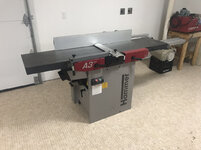
The Hammer A3 is post #23 is a jointer/planer and a Euro Combination machine works the same way. The table hinges on the side, the cutter head stays where it is and you crank the lower table up to plane


jar944

Well-known member
Joined
Jul 26, 2010
Messages
5,898
Location
Northern VA
What then do you call what we,in the US would call a planer?

common differences
US planer = UK thicknesser
US jointer = UK planer.
US shaper = UK spindle moulder

They call a moulder something other than moulder but it's not coming to me.

Thats before you get into the level of rabbit vs rebate..
 

turbowoodworker

Well-known member
Joined
Mar 18, 2012
Messages
3,519
Location
Apex NC
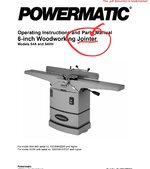
One other consideration is dust collection. The powermatic in the picture above is the best for DC with the closed base. Open base is not so good.
 

dfiler2

Well-known member
Joined
Dec 15, 2014
Messages
2,858
Location
NW Minnesota
I have a 6" jointer and I use it for edging boards, I also have a 15" planer that I would use for the face of the board. I am wondering what you would use a 16" jointer for or even an 8" as opposed to a planer. I have no doubt that there is a very good reason, just wondering what that is.
 

jar944

Well-known member
Joined
Jul 26, 2010
Messages
5,898
Location
Northern VA
I have a 6" jointer and I use it for edging boards, I also have a 15" planer that I would use for the face of the board. I am wondering what you would use a 16" jointer for or even an 8" as opposed to a planer. I have no doubt that there is a very good reason, just wondering what that is.

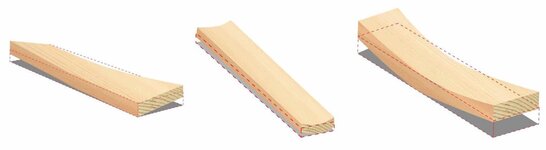
A jointer makes a face flat.

A planer will make a face parallel.

If a board is twisted or bowed and you feed it into a planer, it will come out thinner and still twisted or bowed.
 

dfiler2

Well-known member
Joined
Dec 15, 2014
Messages
2,858
Location
NW Minnesota
When a board is twisted I flatten it with the planer by shimming it, if it's bowed I would straighten it using the table saw. I see what you mean though if you have a jointer like in your avatar, thanks.
 
Last edited:
To avoid these ads, REGISTER NOW!
Top Bottom