
You are using an out of date browser. It may not display this or other websites correctly.
You should upgrade or use an alternative browser.
You should upgrade or use an alternative browser.
Joist Hanger Bar Code?
- Thread starter Frede162
- Start date

Terry D
Well-known member
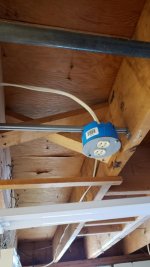
There is nothing wrong with using that kind of box in a unfinished basement for lights not receptacles. What is wrong, is using that metal cover on a plastic box. It is not grounded. I don't believe they make a plastic one like that. Plus you can not support a receptacle just by the center screw. So to be code compliant, you would have to replace that box with a metal one or get the proper plastic box with the proper cover. It looks like the one wire will be to short to use a nail on box to the side of the joist. The one wire is actually not supported correctly either. If that is a concrete floor, it should be GFCI protected
Last edited:
rlitman
Well-known member
There is nothing wrong with using that kind of box in a unfinished basement. What is wrong, is using that metal cover on a plastic box. It is not grounded. I don't believe they make a plastic one like that. So to be code compliant, you would have to replace that box with a metal one or get a proper plastic box with the proper cover. It looks like the one wire will be to short to use a nail on box to the side of the joist. That one wire is actually not supported correctly either. If that is a concrete floor, it should be GFCI protected
That outlet attached to the round box cover can be sold as an assembly, and in such an instance, the cover may indeed be grounded.
Terry D
Well-known member
That outlet attached to the round box cover can be sold as an assembly, and in such an instance, the cover may indeed be grounded.
But its not, unless you drill and tap a 10/32 screw in that cover and attach the ground to it, it is not grounded. that center screw does nothing. Plus the center screw is designed just to hold the cover on, not to support the receptacle
Last edited:
wyliesdiesels
Well-known member
I agree with Terry on this one
plus you didnt buy it as a listed assembly so its not the same thing...
plus you didnt buy it as a listed assembly so its not the same thing...
rlitman
Well-known member
I agree with Terry on this one
plus you didnt buy it as a listed assembly so its not the same thing...
This sort of thing has come up here before. Here's a listed assembly:
https://store.leviton.com/products/...-cover-residential-grade-grounding-brown-1228
But its not, unless you drill and tap a 10/32 screw in that cover and attach the ground to it, it is not grounded. that center screw does nothing. Plus the center screw is designed just to hold the cover on, not to support the receptacle
Ahh that makes sense thank you. The outlet is 1/2 switched and I like the extra room of 2 gang for pigtails. I'll start over with new work 2 gang, affix to the joist, and get a one side blank cover. Many thanks for the advice!
Terry D
Well-known member
This sort of thing has come up here before. Here's a listed assembly:
https://store.leviton.com/products/...-cover-residential-grade-grounding-brown-1228
I guarantee you that metal cover is only grounded when attached to a grounded metal box.
Edit - i stand corrected. The center screw is connected to the yoke. So if the receptacle is grounded, then the cover is also.
Last edited:
This sort of thing has come up here before. Here's a listed assembly:
https://store.leviton.com/products/...-cover-residential-grade-grounding-brown-1228
That's what was in the location. I planned to use it, but opened it and found the outlet cracked. Those assemblies have thin boxes and the only outlet I had on hand would not fit. The only other box I had on hand was the hanger bar....but no cover so I used the metal cover.
I wanted to be safe and not use the cracked outlet, but shot myself in the foot with the metal cover lol.
There is nothing wrong with using that kind of box in a unfinished basement for lights not receptacles. What is wrong, is using that metal cover on a plastic box. It is not grounded. I don't believe they make a plastic one like that. Plus you can not support a receptacle just by the center screw. So to be code compliant, you would have to replace that box with a metal one or get the proper plastic box with the proper cover. It looks like the one wire will be to short to use a nail on box to the side of the joist. The one wire is actually not supported correctly either. If that is a concrete floor, it should be GFCI protected
Understood on the box and center screw. I can run new wire if needed but yeah I'll prob be short. I will tack the wire to the joist with the new box per NEC spec.
The basement is concreate floor and the circuit has a GFCI outlet in the bathroom on the floor above. Does that suffice?
Terry D
Well-known member
Understood on the box and center screw. I can run new wire if needed but yeah I'll prob be short. I will tack the wire to the joist with the new box per NEC spec.
The basement is concreate floor and the circuit has a GFCI outlet in the bathroom on the floor above. Does that suffice?
I edited my one post. I never realized the center screw does connect to the yoke. So if the receptacle has a ground going to it, then the cover is grounded.
I usually don't put devices in round boxes. Is the receptacle in the basement feed off the load side of the GFCI, if so, you are ok. You can test this by tripping the GFCI and seeing if the basement receptacle goes dead. If so, then you are good.
I edited my one post. I never realized the center screw does connect to the yoke. So if the receptacle has a ground going to it, then the cover is grounded.
I usually don't put devices in round boxes. Is the receptacle in the basement feed off the load side of the GFCI, if so, you are ok. You can test this by tripping the GFCI and seeing if the basement receptacle goes dead. If so, then you are good.
Yeah saw you edited. The center screw connects to the metal part of the outlet which is properly grounded. With the GFCI tripped the entire circuit goes dead.
One thing you said made me remember my unease with the center screw being the ONLY thing holding the outlet. I think I'm going to replace the whole box to be safe. It is okay to mix plastic with the other metal boxes in the circuit?
Terry D
Well-known member
Yeah saw you edited. The center screw connects to the metal part of the outlet which is properly grounded. With the GFCI tripped the entire circuit goes dead.
One thing you said made me remember my unease with the center screw being the ONLY thing holding the outlet. I think I'm going to replace the whole box to be safe. It is okay to mix plastic with the other metal boxes in the circuit?
Sure, you can mix plastic boxes with metal boxes. Metal boxes just need to grounded. On that round cover with that receptacle, is the ears on the yoke sandwiched between the box and cover, if so, that would keep the receptacle from falling back into the box in case the center screw failed
Last edited:
Y
Sure, you can mix plastic boxes with metal boxes. Metal boxes just need to grounded. On that round cover with that receptacle, is the ears on the yoke sandwiched between the box and cover, if so, that would keep the receptacle from falling back into the box incase the center screw failed
I broke the ears off but the center part of outlet still hangs over the box and gets sandwiched by the cover so you make a good point.
Terry D
Well-known member
You should be good then. Like I said, I really don't ever put a receptacle in a round box, I guess this is the way they are designed. That way you are not required to nut and bolt the receptacle to the cover
You should be good then. Like I said, I really don't ever put a receptacle in a round box, I guess this is the way they are designed. That way you are not required to nut and bolt the receptacle to the cover
I can see why you don't use round. I just order a 2 gang new work plastic and plate. Prices high and selection limited in the store but Amazon has them. Thanks for the help.