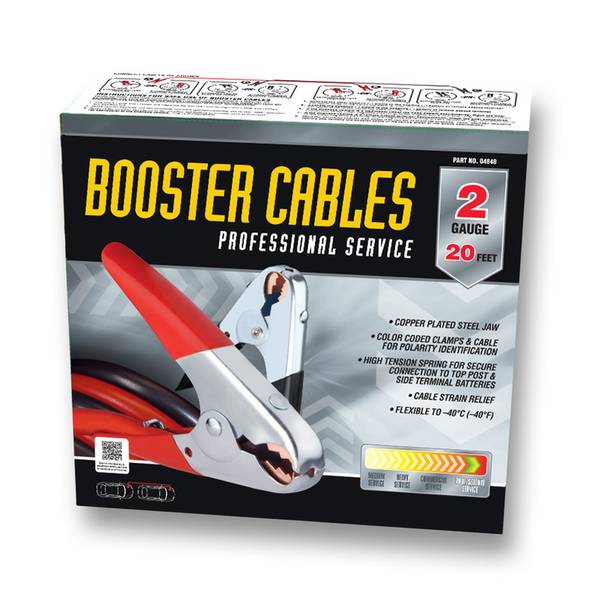
Bigger the gauge the better. Wire gauge numbers go down with thicker cable, but then back up for the really thick stuff.
Even a small engine starter motor will take over 100 amps. I measured my old small car's 1.6L engine as taking about 135 amps to start give or take, in the heat of summer when it's easy to turn over an engine. Bigger engines will be much more, several hundred amps.
There are awful sets of jumper cables at stores, some being only 10 gauge. That's going to burn up quick. They're also useless lengths, about a few feet. Some cables trick you into thinking it's thick wire, but just the cable jacketing is thick. Always pay attention to the actual wire gauge, which should be listed on the package.
To jump a car, you need minimal voltage drop from the donor battery to the dead one. Voltage drop really matters for 12-volt electrics, as drop doesn't care what voltage you start with, it's about the flow of amps over the wire's resistance, with more amps causing more drop. Having 5 volts drop over 120v doesn't matter much. That same drop at 12v can make the difference between cranking and not.
The answer is thick,
thicc copper jumper cables. Big and thick. I have a set of 20-foot 2/0 (two-aught) gauge cables. That's not 2 gauge, it's several gauges thicker. They have solid copper clamps and have never failed me. The dead car cranks at full speed and starts right up, no slow cranking here. Of course that depends on the donor and dead car's levels of terminal and internal cable corrosion. I've seen some nasty unloved cabling, probably causing their dead battery in the first place.
If I was getting cables again, I'd get a set of 25-footers, as there have been situations where the donor car could only get behind the dead one, and 20-foot is just barely enough. It wouldn't be if the dead car was a large pickup, and you could only get behind it (some of the cable's length goes into each engine compartment, reducing the useful length).
Even the largest cable gauges aren't for cranking continuously. Check wire gauge ampacity tables if you're interested, and factor in engine cranking amps. But you just need to crank long enough to get the engine started, without melting the cable or clamps.
I have two sets of 2/0 cables, but I like the ones from
https://www.centurytool.net the best, as they use genuine welding cable and solid copper clamps. Cables this good are expensive compared to a jump pack, at about 3x the cost. But you don't have the concern of the jump pack failing to deliver in the cold, or overheating, or spontaneously catching fire due to lithium battery chemistry, or just wearing out over time. Cables just sit there, at the ready. ProjectFarm has good videos on jump packs.
Getting cables again, I'd get the 602400 which is 25 feet of 2/0 cable with Parrot clamps. They have other models with Mechanic clamps.
Or you could buy the parts and make the cables yourself.
However, thick jumper cables are
heavy. I believe mine are over 40 pounds or so. So that could be considerable for the less able-bodied of us, or it could impact gas mileage hauling them around. They also take up space. So there's definitely a convenience trade-off from a jumper pack.
Using the cables is interesting. For longer cranks, I noticed the connection point between the copper clamps and the battery terminals is the weak point. More so with corrosion. The point at which they touch may start smoking due to low contact surface area. Don't let that go too long, hah.
Edit: Also if you have a helper, make sure they don't touch the connected clamps together as they move the cables around. Ugh. Follow correct connection procedure.