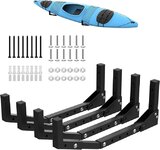
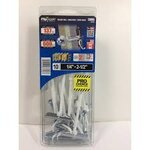
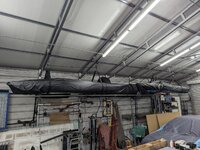
Think that will be enough? I was concerned about the brackets, since they stick out a bit and the kayaks probably weigh 50# im guessing...I was worried taking them on and off, the self tappers levering loose. But maybe im overthinking it.Kayaks aren’t that heavy. I’d use three #12 self tapping screws.
Interesting thought. Floor space is at a premium right now, so Im gonna try the hanging first. Meanwhile im gonna look at welding myself up a caster cart for when i get tired of climbing. Gotta learn the hard way, ya knowmy take is different because I have been there and done that. If you put them on the wall, they will take up the space away from the wall that is say "X width by Y length". That is exactly the same as if they were sitting on the floor on top of one another. If you put them up higher than say 8' so they are out of the way, you will get the floor and wall space back but it will be a hassle to climb a ladder to get to them, move them on and off to use them etc.. So were it me for easy of handling, I would get a mobile floor rack on casters so you can move them around. They will take up the exact same space but it will be easier to move them around over the years. The alternative, if your roof trusses will support them, is to hang them on a pulley system.
That's an interesting thought, could be a way to go. Now I'm gonna go down a rabbit hole of research on in pull out strength of rivnuts...I'd use riv-nuts.
This also doesn't look to be a very big drop. Looks like there's an air gap above the metal cross pieces. I'd be half tempted to just toss a rachet strap through the gap, run it through the handles on the kayak and pull it up there. 2 or 3 clicks on the rachet should hold it in place.Steel is strong. A #12 screw's shear strength is roughly 2000#. 1/4 bolt is north of 7000 #. Way north if you go with Grade 5 or 8.
I'd want a safety factor of at least 5 to 1....but that shouldn't be hard to accomplish.
As other's have said, in the big scheme of "heavy things you don't want to drop on your head", Kayaks aren't all that heavy.
Great info, love it. I guess my concern wouldnt be the bolt shear strength, that would be more than plenty. The question would be the thread shear strength...Steel is strong. A #12 screw's shear strength is roughly 2000#. 1/4 bolt is north of 7000 #. Way north if you go with Grade 5 or 8.
I'd want a safety factor of at least 5 to 1....but that shouldn't be hard to accomplish.
As other's have said, in the big scheme of "heavy things you don't want to drop on your head", Kayaks aren't all that heavy.
This is an interesting idea. I like it cause now we are using the shear strength of the fasteners going in from the side, instead of the shear strength of the threads going through the front. Overkill? Probably, but if its worth doing, its worth overdoing.I would get a few nailing plates, https://www.google.com/search?q=sim...IIsAIB8QXSPNODAuluRQ&sourceid=chrome&ie=UTF-8 and use them to screw into both SIDES of both the upright of the building and the hangers you have. That puts all fasteners into shear and you can use 3-4 fasteners in each plate, 2 to 4 plates per bracket depending on the size of things. Use tec screws.
lg
no neat sig line

Im trying to figure out how you made those brackets to get the pulleys level.... Hard to see in that pic.I just did a couple of months ago, but I didn't get close pics of the mount. I attached mine to the roof trusses with a modified bracket for the pulley system. I started with this hoist kit from Amazon, then added a bracket so the pulleys would be perpendicular to the floor.
![]()
Im trying to figure out how you made those brackets to get the pulleys level.... Hard to see in that pic.

You want to put a fastener that's screwed into sheet metal into shear? I get your concern with screw threads pulling out in tension, but I'll raise that with the concern of tearing through the sheet metal in shear....screw into both SIDES of both the upright of the building...
Dang, that is not at all what i was thinking when you said you were gonna make a "quick sketch"! Thats perfect, thank you!Take a look at this sketch:
The pulley ***'y is bolted thru the steel angle with it's included hardware. The steel angle was trimmed as needed to match the angle of the roof truss. The angle is welded to the flat steel plate, which is then attached to the roof truss with (4) 3/16" steel rivets. My kayaks weigh around 80 lbs each so each of the above is holding about half of the total weight.
Im kind of having trouble understanding. Nothing is screwing into the sheet metal of the building, its all through the square tubing steel stud. Cant really put a nut and washer on the back side of the bracket from the front, theres no access to the middle of the stud obviously, and the other side of the stud is the outside of the building.You want to put a fastener that's screwed into sheet metal into shear? I get your concern with screw threads pulling out in tension, but I'll raise that with the concern of tearing through the sheet metal in shear.
There's nothing stopping the OP from using an ordinary nut, bolt and washer. A washer behind the stud is what you need. Forget rivnuts and putting screws in the sides and all that BS. If you want to up your game, use a nyloc nut.
Oh. I was picturing a C channel. My point though is the stud itself may be thin enough to tear around a fastener in shear, but if you can't get a washer inside, that's not helpful. Sorry....square tubing steel stud...