To avoid these ads, REGISTER NOW!

Keeping ceiling trusses from sagging?

Danman2k06

Member
Joined
Dec 9, 2015
Messages
12
Location
Frederick, Maryland
Hey guys, first post here. Somewhat related to my garage, so bear with me. My wife and I just moved into our 1985 rancher mid-December, and have started to change things around to fit our lives. It's got a single car finished garage, 10.5' ceilings. Engineered trusses in the attic throughout the length of the house. My question actually has to do with the interior.

We have a large wall running in between the kitchen and living room that we wish to remove. It's about a 20' span. Trusses run front to back, the wall is perpendicular to them. We have an engineer coming out this week to tell us whether it supports the roof or not, but I am 99.9% sure it does not. There is a massive metal I-beam in the basement, but it is 4' away from the wall, so no point load.

If it indeed is non-load bearing, should I be worried about ceiling sag once it's gone? I know the roof might not collapse, but I can only help but think that after 30 years of being in the same place, the trusses will sag a tiny bit if it is removed. There is no CLB or other bracing in the attic besides the trusses themselves.

Funny thing is, the garage has the exact same style of trusses, granted a 2' shorter span, and no wall or central support holding them. Maybe I'm overthinking?
 
To avoid these ads, REGISTER NOW!

bad_idea

Well-known member
Joined
Jun 11, 2011
Messages
4,332
Location
Pasquotank, NC
My 1988 ranch has trusses running front to back of my 14x20 garage. They have sagged noticeably due to PO loading **** in the attic above the garage.
 

Falcon67

Well-known member
Joined
Jun 11, 2009
Messages
18,371
Location
Merkel, TX
If the trusses are engineered for the span, you should be OK. If they were expecting a bearing wall - well, you know LOL. Lam or I-beam in your future.
 

bczygan

Well-known member
Joined
Nov 4, 2009
Messages
22,002
Location
DETROIT! Arsenal of Scrappers
Welcome to GJ!

Sag is not the right word, deflect is.

All trusses deflect.

Steel deflects.

Everything deflects.

If the wall is roughly in the middle of the house and perpendicular to the trusses, it is likely load bearing. Photos would help us determine that. But you already have someone coming out.

Not to worry. A beam, either above or below the ceiling line will support your trusses and provide an opening.

Bill
 
Last edited:

matt_i

Well-known member
Joined
Mar 14, 2008
Messages
10,723
Location
SE Michigan
Sounds like your thinking is on the right track based on garage similar to house with a similar clear span. Your structural engineer will then give you the confidence to sleep at night.
 

wssix99

Well-known member
Joined
Mar 2, 2011
Messages
5,156
Location
Chicago, IL
If it indeed is non-load bearing, should I be worried about ceiling sag once it's gone?

No, because the bottom chord (the part that your ceiling attaches to) of the truss is under constant tension and is pulled tight like a violin's bow string. It should have been built at the factory so that it is straight and level once its installed and loaded.
 
OP
D

Danman2k06

Member
Joined
Dec 9, 2015
Messages
12
Location
Frederick, Maryland
Hey guys thought I'd post an update. Things are moving slower than we had hoped (of course). The engineer has been jerking us around for the past few weeks, ever since we had the big snow storm in MD. In the meantime, we removed all the sheetrock from the section we want to take out and had the electrician come take a look. Lots of wiring, but because our basement and attic are both exposed, it should be easy.

Regarding the wall- I still don't know what to think. It's a typical 16-on-center stud framed wall with a double top plate, butted right up to the bottom of the trusses. However, when I looked closer, about 90% of the vertical studs don't even contact the top plate. Some, there is a 1/4" gap between the top of the stud and the horizontal 2x4 above it. I don't see how it could be structural if the weight of the trusses isn't even sitting on the wall to begin with.

I had a coworker's sibling come take a look who is an architect. He thinks that the trusses were designed to carry the entire roof load, but that the wall does have some roll in keeping things from deflecting. He thought that if it was taken out entirely, in a year the ceiling would be out of shape and cracking. We're talking a decent span here, about 26' front-to-back if the wall is gone. He recommended getting specs for a built-up beam, enough to carry the ceiling load, and running it through the attic directly above our basement metal i-beam. The metal beam is in the middle of the house, which would make our built-up beam longer than the span we opened up in the wall. We would need a 25' beam. I'm not a pro, but after looking at a few span tables, I don't think any size built-up beam can span that. We'd be talking LVL or some other gazillion pound beast that certainly wouldn't fit between my neighbors houses, let alone up the ladder in the garage.

Really hoping this engineer pulls through soon. Any opinions in the mean time? I'm going to put up a separate post in a few minutes with a compilation of some pictures.
 
OP
D

Danman2k06

Member
Joined
Dec 9, 2015
Messages
12
Location
Frederick, Maryland
Here's the house.
image1_zpsnmse6rzs.jpg


And the wall in question.
image3_zpseugeln3s.jpg
image2_zps9rgbiyo1.jpg

And here is what I was talking about with the top plate.
image1-2_zpsr08z8jc8.jpg
 

bczygan

Well-known member
Joined
Nov 4, 2009
Messages
22,002
Location
DETROIT! Arsenal of Scrappers
Look for solid blocking under the wall. That would indicate a load bearing wall.

An LVL beam can be brought into the building one ply at a time, either through an opening in the roof and lowered into place, or through a window or door, and raised into place.

Do you have photos of the trusses and of the floor structure under the wall?

Bill
 
OP
D

Danman2k06

Member
Joined
Dec 9, 2015
Messages
12
Location
Frederick, Maryland
This is exactly what the trusses look like. All 2x4 construction.
Roof-Terminology4.png


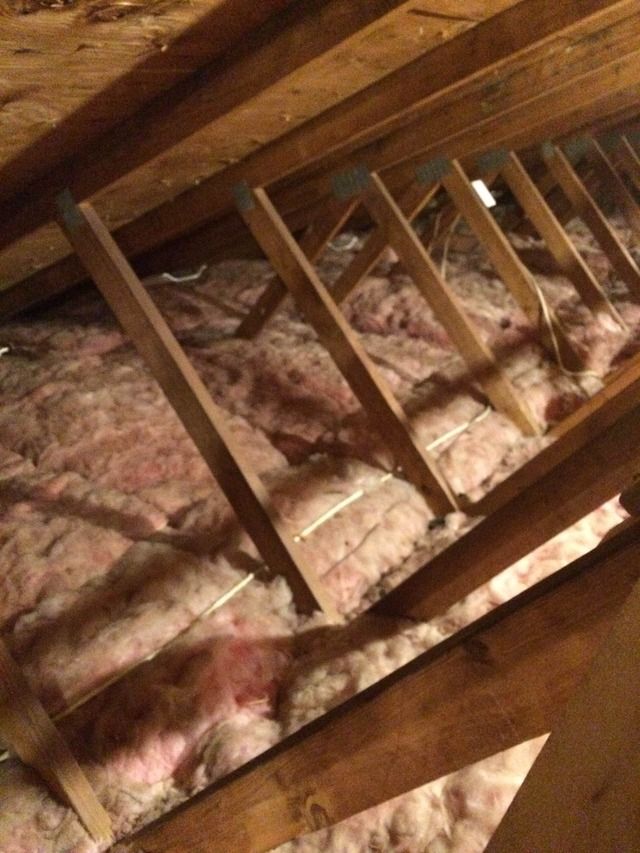
Now here is where I'm a little confused. Some of the trusses have an additional web closer to the heel. Some don't. I can't figure out the rhyme or reason.

Here the air gaps and lack of insulation, is over the front porch. All of the trusses spanning the porch have the extra web.
IMG_0121_zpso2zfsvix.jpg


Here you're looking at the back bedroom area where there is a hallway and plenty of wall. No extra webbing.
IMG_0120_zpsx6v4njwo.jpg


And here, over the back of the kitchen/living room area (the trusses involved with my project), some trusses have the extra web, and others right next to them don't.
IMG_0119_zpsd33a7yyu.jpg


This is the beam that runs lengthwise through the basement. The wall in question is 4' to the LEFT of said beam in the picture.
IMG_0175_zpszvlcmbjo.jpg


And here is what is under the wall in the basement. You can reference the air return from upstairs tying into the ductwork beneath the floor. No point load, no blocking, no lollipop columns or anything. The basement was semi-finished after the house was built, so the walls downstairs have no load. they don't even touch the floor joists as mentioned in the pic.
IMG_0178_zpstqahg6vh.jpg
 

jimgood

Well-known member
Joined
Aug 4, 2014
Messages
2,394
Location
Marshall, VA
We did this in my house. Our trusses run north/south and look just like yours. The north and south walls are about 26' apart. Our kitchen was partially enclosed with a wall about 10' from the north wall separating it from the living room. We removed it so there is nothing under those trusses anymore. So our living room and dining room (formerly the kitchen) is roughly 26' x 18'.

Edit: And the change was approved by an engineer.

Edit 2: To the point of this whole thing, that change was over 10 years ago and no ceiling sag.
 
Last edited:

ishiboo

Well-known member
Joined
Oct 27, 2010
Messages
9,481
Location
Oshkosh, WI
If the beam is 4' away from the wall, the wall was not put there to be load bearing. There's also no header over the door. The beam is there to carry the floor loads only.

That does not mean there isn't the possibility for SOME sag.
 

scull20

New member
Joined
Feb 8, 2016
Messages
4
Based on the photos it appears to be a non-load bearing wall.

This should still be confirmed by an engineer who visits the site to verify.
 

ssdave

Banned
Joined
Apr 11, 2015
Messages
2,913
Location
Eastern Oregon
There should be no excessive sag, as the trusses should have been designed for the span. However, that needs to be verified by a competent person, preferably an engineer. You run into surprises all the time in residential construction, where things were not done the conventional way.

I wouldn't go in and start putting in beams or other homemade modifications to the trusses until you have competent advice about what is needed, and whether it is needed. Adding support to the trusses could affect their action and actually CAUSE problems, not solve potential ones.
 

theoldwizard1

Well-known member
Joined
Feb 22, 2011
Messages
43,095
Location
SE MI
It does not look like the wall is load bearing, but get your professional to confirm.

Bill

CONCUR !

If that wall was carrying any load, the joists in the basement would show significant signs of deflection (sag) because it is so far from the main load carry beam.
 
OP
D

Danman2k06

Member
Joined
Dec 9, 2015
Messages
12
Location
Frederick, Maryland
Wow, sounds like there is hope yet! Thanks everyone. Tomorrow I have off so the wife and I will be visiting the county permitting office to get that ball rolling. Rest assured everyone- no questionable wood will be moved unless I've got someone's name on a paper with a stamp, saying he's responsible for the advice we take. Frederick County is known for being one of the strictest around as far as permitting/inspections/doing things to code. I'd rather be able to sleep at night than save a few hundred bucks off the overall project cost.

That said, I do like knowing what I'm about to get myself into. Helps plan out savings, further decisions, etc. I'll report back as things move along.
 

bczygan

Well-known member
Joined
Nov 4, 2009
Messages
22,002
Location
DETROIT! Arsenal of Scrappers
To be frank, if it was mine, I would be very confident, and wouldn't get an engineer involved unless required.

In fact, I wouldn't even get the city involved, but that's because I would know it's OK.

Bill
 
To avoid these ads, REGISTER NOW!

Fishplate

Well-known member
Joined
Aug 19, 2013
Messages
868
Location
Athens, Georgia
To be frank, if it was mine, I would be very confident, and wouldn't get an engineer involved unless required.

In fact, I wouldn't even get the city involved, but that's because I would know it's OK.

Until something happens, and your insurance company gets involved. Then you find out how inexpensive that little stamp can be...
 

CNGsaves

Well-known member
Joined
Sep 26, 2012
Messages
13,233
Location
KS and OK
Welcome OP and hope you don't have any problems with your planned changes.

Update GJ Profile with Location which will give you best chance at advice that matches your local situation.
 

James-W

Well-known member
Joined
Feb 3, 2013
Messages
12,432
Location
Southeastern Wisconsin
Until something happens, and your insurance company gets involved. Then you find out how inexpensive that little stamp can be...
I agree, it is always best to err on the side of caution. Get the proper approval and then you have no issues if something unforeseen happens. Don't get the proper approval and then something unforeseen happens, you may be up the creek without a paddle. Why put yourself in that situation in the first place? Remember, an ounce of prevention is worth a pound of cure.
 
OP
D

Danman2k06

Member
Joined
Dec 9, 2015
Messages
12
Location
Frederick, Maryland
Ishiboo, I also noticed the lack of headers. You can see in the doorway between the kitchen/living area, and also above the closet opening. I might chalk up the doorway to a mistake (if the wall was structural) as it is only 30". But the closet opening as well? That's about a 5' gap. Would definitely need a proper header.
 

ishiboo

Well-known member
Joined
Oct 27, 2010
Messages
9,481
Location
Oshkosh, WI
Until something happens, and your insurance company gets involved. Then you find out how inexpensive that little stamp can be...

Common thing that comes out on Internet forums all the time - if a professional didn't do the work, or if it was done wrong, or if you were an idiot and completely fucked it up... your insurance company won't cover you. Hear it with electrical all the time - if you don't have it inspected, do it to code, etc. and your house burns down you're **** out of luck.

Yet the same people know if someone gets drunk, flips their car and hits 4 other cars damaging all of them... despite them being dumb, it's covered.

Same with DIY stuff. Just because you DIY'd it, even if what you did was dumb... it's covered if it's a covered thing. Now, that's not necessarily the same protection you would get if someone else did it (plus it'd be on their insurance).

Those trusses are not going to fail because that wall is removed, no matter what. Worst thing that could happen would be a slight bit of easily correctable sag.
 

ishiboo

Well-known member
Joined
Oct 27, 2010
Messages
9,481
Location
Oshkosh, WI
Ishiboo, I also noticed the lack of headers. You can see in the doorway between the kitchen/living area, and also above the closet opening. I might chalk up the doorway to a mistake (if the wall was structural) as it is only 30". But the closet opening as well? That's about a 5' gap. Would definitely need a proper header.

Yeah. I'm not sure that section of wall is even original to the house.
 

James-W

Well-known member
Joined
Feb 3, 2013
Messages
12,432
Location
Southeastern Wisconsin
Common thing that comes out on Internet forums all the time - if a professional didn't do the work, or if it was done wrong, or if you were an idiot and completely fucked it up... your insurance company won't cover you. Hear it with electrical all the time - if you don't have it inspected, do it to code, etc. and your house burns down you're **** out of luck.

Yet the same people know if someone gets drunk, flips their car and hits 4 other cars damaging all of them... despite them being dumb, it's covered.

Same with DIY stuff. Just because you DIY'd it, even if what you did was dumb... it's covered if it's a covered thing. Now, that's not necessarily the same protection you would get if someone else did it (plus it'd be on their insurance).

Those trusses are not going to fail because that wall is removed, no matter what. Worst thing that could happen would be a slight bit of easily correctable sag.
When I built my garage and went to get it insured, the insurance company wanted to know where the trusses came from as well as who inspected the concrete, the building, and the electrical. They actually contacted the truss company and the city inspector to make sure everything was done to code. If the insurance companies do not care about these things, then why did they contact the truss company and the city inspector?

I don’t know whether an insurance company would pay a claim for a roof collapse caused by the home owner making structural changes to the truss system, but why take the chance? Even if they do pay the claim it may take a lot longer than normal and you may have a fight on your hands to get the money. Is it really worth it? In this case, the roof may be perfectly fine and there may never be a problem. But would it really hurt to get the advice of an engineer?

I guess my main question is, why are you so against having a structural engineer take a look at the situation and giving advice? Obviously they don’t work for free, but then, how many people DO work for free? It amazes me how many people feel they can do what they want, when they want, be it right or wrong, and if something does go wrong, they expect the insurance company to "pay up" for their "screw up".

I am sorry, I usually agree with you on most things. But this time I think you are wrong.
 
Last edited:
OP
D

Danman2k06

Member
Joined
Dec 9, 2015
Messages
12
Location
Frederick, Maryland
Found out some things of interest tonight. My house was built by high-schoolers. By that I mean an educational building trades program. They must have done a half decent job, because everyone comments on how well everything was done. Anyways, I got to this after I remembered our home inspector mentioning the names of two people and "inspected by vo-tech" written under them on our electrical panel. Just FYI it does have an official county sticker too. So I did some googling. Low and behold the trades program , called "CTC", is still around, and they are actually building a new house a few miles from ours. The trades center is just down the road. I'm going to pay them a visit tomorrow and see if I can muster up some drawings or the names of the company that provided the trusses. I would love to know why they are not all the same.
 

KenC

Well-known member
Joined
Dec 20, 2009
Messages
2,577
I would love to know why they are not all the same.

I can't tell where the trusses are located in relation to the front porch overhang. But, I'll bet the different ones are located over the porch and they were engineered to cantilever with no outer support. Common design with that covered porch.
 

racer-john

Well-known member
Joined
Apr 1, 2008
Messages
1,461
Location
Newmarket, ON Canada
The OP mentioned some of the trusses were sitting on the top plate of that wall and some weren't. Either weak trusses or(?); the wall is holding up something. When the wall is removed definitely a beam will have to be installed holding up all the trusses.
Wait for your engineer to give his opinion, see if it matches mine.
 

AMCguy

Well-known member
Joined
Dec 23, 2009
Messages
2,022
Location
Sunshine Coast, BC Canada
Nobody has mentioned this yet so I will.

The trusses you have referenced and the actual ones you show in your pictures are a common Fink type. They are engineered to be supported at the ends. If the truss needed support at any point other than the ends, it would have either a vertical or diagonal web member contacting the bottom chord directly over that point.
 

DC_Gearhead

Well-known member
Joined
Dec 20, 2015
Messages
139
Location
Washington DC
Common thing that comes out on Internet forums all the time - if a professional didn't do the work, or if it was done wrong, or if you were an idiot and completely fucked it up... your insurance company won't cover you. Hear it with electrical all the time - if you don't have it inspected, do it to code, etc. and your house burns down you're **** out of luck.


Yet the same people know if someone gets drunk, flips their car and hits 4 other cars damaging all of them... despite them being dumb, it's covered.


Same with DIY stuff. Just because you DIY'd it, even if what you did was dumb... it's covered if it's a covered thing. Now, that's not necessarily the same protection you would get if someone else did it (plus it'd be on their insurance).


Those trusses are not going to fail because that wall is removed, no matter what. Worst thing that could happen would be a slight bit of easily correctable sag.


What he said^^^
 
OP
D

Danman2k06

Member
Joined
Dec 9, 2015
Messages
12
Location
Frederick, Maryland
Ok guys I went up in the attic tonight and pulled back a ton of insulation, looking for any more clues. A few things I observed:

-The garage does not have any "additional webs", with a clear span of 24'.

- Every truss is toe nailed on both sides of the bottom chord to the top plate. No gap between the top plate and bottom chord.

-There was once a wall also separating the dining room and kitchen. I could see where a top plate was cut and removed, and nailers installed for sheetrock. This wall was parallel to the trusses.

-The mysterious "additional webs" disappear on both the east and west sides of the truss, as soon as the trusses reach the hallway.

-Although I mentioned the top plate was contacting the studs below the ceiling (the gaps), when I stepped on the top plate in the attic it felt solid as a rock, all along it's length.

The metal I-beam in the basement is not lined up with a single point load above it. I'ts runs it's length somewhere close to the middle of the hallway.

Here are some additional pictures I took while I was up there.

Here is the garage (it's Garage Journal, after all :lol:). Don't mind the cracks perpendicular to the trusses. My father in law missed a step and fell very hard while in the attic. Leg punched through the drywall, and cracked a lot of the joints. He's fine.
IMG_0187_zps60c17kum.jpg


This is above the garage. Note the lack of webs closer towards the heel.
IMG_0188_zpsjvk8smxh.jpg

IMG_0189_zpso14ae5ej.jpg


Here are two pictures of the webs that I spliced together. You can clearly see where the trusses have webs all along the length of the porch on the left. The red dot on the left indicated where those webs disappear at the hallway.

On the right side, some trusses have webs, some don't, and just like the other side as soon as the trusses reach the hall, they disappear to the end of the house.
IMG_0202_zpslgsm4m2f.jpg


And here is a picture looking towards the garage. The wall I wish to remove is not directly under any webs, though it is close (about 9" away).
IMG_0200_zps5uqimbip.jpg


I checked for stamps on the trusses to try and track down a MFG, but no such luck. Only the lumber code (TP NO.1 KD19)

At this point I'm 99% convinced that there is nothing structural about the wall in question. The only thing holding me back, is I have yet to receive a confident answer from anyone who has looked at it. This tell me I have a very funky situation, or I need to bring around some more intellectual friends lol. We are still in search of said knowledgable person that can see it in person rather than over the net- as much as I appreciate all of your input!
 
Last edited:

FordTruckWench

Well-known member
Joined
Jan 8, 2015
Messages
539
Location
California
On the right side, some trusses have webs, some don't, and just like the other side as soon as the trusses reach the hall, they disappear to the end of the house.

Does the presence/absence of that extra piece synchronize with any window or door openings in the back wall of the house?
 

CNGsaves

Well-known member
Joined
Sep 26, 2012
Messages
13,233
Location
KS and OK
^ ^ ^ This is what I was thinking. Those trusses that are "under-built" might be on purpose since there were support walls underneath.
 

wssix99

Well-known member
Joined
Mar 2, 2011
Messages
5,156
Location
Chicago, IL
Nobody has mentioned this yet so I will.

The trusses you have referenced and the actual ones you show in your pictures are a common Fink type. They are engineered to be supported at the ends. If the truss needed support at any point other than the ends, it would have either a vertical or diagonal web member contacting the bottom chord directly over that point.

A+++


If it indeed is non-load bearing, should I be worried about ceiling sag once it's gone? I know the roof might not collapse, but I can only help but think that after 30 years of being in the same place, the trusses will sag a tiny bit if it is removed.

That bottom chord of the truss is in tension, so if the truss is not defective or coming apart it should pull that bottom chord tight and straight like a bow string:

pr_04b.gif


It should only sag if your ceiling is exceeding the weight the truss was designed for.
 
OP
D

Danman2k06

Member
Joined
Dec 9, 2015
Messages
12
Location
Frederick, Maryland
So I checked into the trusses being over a window/door. They are, and also are not. Over the back sliding door, there are 3 trusses. 2 of which are missing webs, one of which is not. The other truss missing the web is just randomly located somewhere in the middle of the kitchen, surrounded by about 5 trusses on each side that did indeed have the web. Still stumped.

On the upside, I talked with a structural engineer on JustAnswer. I showed him all the pictures from here, and a few more, and he said that he is 100% sure that the trusses were designed to load the exterior wall only, and that nothing will happen from removing the wall. He suggested that the truss bottom chords would have been nailed to the top plates during installation, essentially keeping the chord from being pulled tight. Well, once the truss is put under any load, the chord will pull tight like you guys mentioned. This popped the nails going through the top plate out of their respected studs. The "right" way to do it would have been to install "slider plates" that allow for a slight amount of truss uplift from loads and seasonal temperature and moisture changes.

That satisfies half of my closure. As soon as I know a little more about these mystery webs, she's coming down.
 

wssix99

Well-known member
Joined
Mar 2, 2011
Messages
5,156
Location
Chicago, IL
As soon as I know a little more about these mystery webs, she's coming down.

Just the ones where you have the porch?

All of the trusses spanning the porch have the extra web.

I would expect that those extra webs come down on to your exterior wall and that the far end of the truss rests on a light beam circling your porch? Right?

If so, those extra webs just transfer more of your load to your (stronger) exterior (load bearing) walls, instead of that outer beam over your porch. (If that beam was made to be as strong as your exterior wall, it would be HUGE.)
 
To avoid these ads, REGISTER NOW!
Top Bottom