To avoid these ads, REGISTER NOW!

Kellogg Compair 335TV Issues

Resnatron

Member
Joined
Mar 2, 2016
Messages
6
Hi guys,

Brand new guy here but I think this board is pretty cool. To be honest, I found it looking for answers to my compressor issues and signed up to see if anybody could help.

I bought a used Kellogg Compair 335TV about 4 years ago and absolutely love it! It works (or worked) like a charm and never failed until recently. One day I was using it and it just stopped cold. The motor just buzzed but did not turn and blew the circuit breaker. I checked a few things like shorts and grounding and everything seemed fine. Long story short, I wound up buying a new replacement Baldor motor that matched the one on there and everything worked fine, for about 6 months.

Now, the compressor runs fine until the pressure builds up to about 80~90 lbs and then starts to "bog down". By that I mean it starts to shake and then run slower and slower and eventually stop the motor. Well, I guess it would stop the motor but I have never let it get that far, I throw the circuit breaker when it starts to labor. I don't think it is the motor because before I shut it down I can hear the belt slipping, which means to me the motor is pulling fine, the compressor is stopping it. I don't hear any knocking from the compressor and the oil level is fine. The compressor gets hot on top, but it always did.

I am pretty handy around machines. I use a MIG welder practically all day along with many other power tools, but compressors I know nothing about. Any help would be greatly appreciated. Thanks!
 
To avoid these ads, REGISTER NOW!

redmondjp

Well-known member
Joined
Nov 25, 2014
Messages
2,318
Location
Redmond, WA
Welcome! Do you have access to a clamp-on AC ammeter? That will be very helpful in determining what the exact load on the motor is (at various pressures).

From your description, it sounds like there may be some mechanical issue with the compressor pump that is causing the motor to be overloaded. This may be what caused the original motor to fail as well.

Have you tried removing the belt and turning over the pump by hand? Have you verified that the input air filters on the pump are not plugged? Just touching on all of the bases here.
 
OP
R

Resnatron

Member
Joined
Mar 2, 2016
Messages
6
Thanks for the reply! I have checked the air filter input and it is not clogged. I did turn the compressor over by hand when I replaced the motor and it seemed to turn over freely, or you know, as freely as it should I guess. I don't currently have access to an AC clamp-on ammeter.
 

matt_i

Well-known member
Joined
Mar 14, 2008
Messages
10,725
Location
SE Michigan
More specs needed, what hp motor, what rpm motor, what are the sheave sizes for motor and pump. Its possible that someone earlier replaced a 4 pole (1750rpm nominal) with a 2 pole (3450 nominal) and didn't take into account the torque loss.

That said, it does seem like you have a heat-related problem with the compressor, something is going into a bind as it warms up.
 
OP
R

Resnatron

Member
Joined
Mar 2, 2016
Messages
6
Well, it is a 5 HP, 1725 RPM Baldor motor. Model L1430T, Frame 184T. If that helps. As far as sheaves, well, I wouldn't know a sheave if it bit me. But, yes, I believe it is probably a heat related issue, just don't have any idea what.
 
To avoid these ads, REGISTER NOW!

happymachinist

Well-known member
Joined
Jul 2, 2015
Messages
118
Location
Central NE
I would look into the head of your compressor. I'm guessing your compressor is a two stage with a low and high pressure cylinder. My best guess without seeing it first hand would be the check valve of the high pressure cylinder isn't holding, thus your low pressure cylinder is doing all the work.

The low pressure cylinder (bigger) compresses the air to 90ish psi then kicks it over to the high pressure cylinder (smaller) to compress the air further~150-175 psi or whatever you cutoff is set to.

The low pressure usually is good to 90ish psi with would explain why the motor starts to labor at about that tank pressure...tough to say without seeing it in person

Sent from my XT1254 using Tapatalk
 
Last edited:

redmondjp

Well-known member
Joined
Nov 25, 2014
Messages
2,318
Location
Redmond, WA
Good things to check from happymachinist above - I think the interstage pressure is a bit lower than 90, however - the 2-stage compressors I have worked on have a pressure relief valve set around 75psi between the stages. If the high-stage valves are leaking back, then that relief valve should be blowing open - that is something to check. A pressure gauge can also be installed between stages to monitor what is going on.
 
Last edited:
OP
R

Resnatron

Member
Joined
Mar 2, 2016
Messages
6
Hey, thanks for the tip. I'll check that out as soon as I can.

As for the sheaves, it has a double pulley on it.
 

happymachinist

Well-known member
Joined
Jul 2, 2015
Messages
118
Location
Central NE
Good things to check from happymachinist above - I think the interstage pressure is a bit lower than 90, however - the 2-stage compressors I have worked on have a pressure relief valve set around 75psi between the stages. If the high-stage valves are leaking back, then that relief valve should be blowing open - that is something to check. A pressure valve can also be installed between stages to monitor what is going on.


Yeah, I couldn't remember exactly what pressure mine was. 75 makes more sense since his Kellogg starts laboring at 90.

I had a similar problem with my big Chinese made compressor. One day it just ran and ran and took forever to build pressure.

Turned out I lost the valve between the low and high pressure cylinders leaving the low pressure cylinder basically flapping in the wind. Nothing like pumping up a 120 gallon tank with a single cylinder with a 1.75" bore.

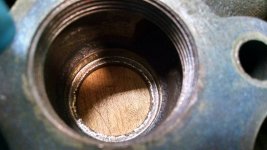
uploadfromtaptalk1457074481865.jpg

uploadfromtaptalk1457074562249.jpg

uploadfromtaptalk1457074626569.jpg


The valve failed pretty catastrophically, and being a no name compressor sourcing parts was a no go so I had to make my own. I also had to take about .050" off the surface where the valve seals.

Hopefully yours isn't this bad, it may just be carbon build up.
 

Attachments

  • uploadfromtaptalk1457074668038.jpg
    uploadfromtaptalk1457074668038.jpg
    89.7 KB · Views: 19
Last edited:
OP
R

Resnatron

Member
Joined
Mar 2, 2016
Messages
6
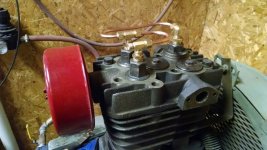
Ok, here is where I am on this issue. I took all four "caps" off of the head and looked at the valves. They all seem to be in good shape so I replaced the O-rings on the caps and put them back on the head. There is a tube running from one of the low pressure valves (big piston) down to the conical "nose" on the front of the pump. There is another tube that runs from the "nose" back up to one of the high-pressure valves (small piston) in the head. I took both of these off and made sure there were no obstructions in them and reassembled.

I then applied power to the pump and watched what it did. It pumped for awhile to about 60 lbs then seemed to start to labor. I touched all four of the valve/head "caps" and only one was warm/hot. It was the low pressure one that was NOT connected via tube to the "nose". The one with the tube was cool as well as the two high-pressure caps. I know all this technical jargon I am using is impressive, but like I said I know little about pumps.

I looked at an exploded view of the pump online and it seems that all that is inside the "nose" of the pump is an unloader. Could that be the problem or am I missing something completely?

Oh yeah, I checked the direction of rotation and it seems to be spinning in the correct direction (counter-clockwise looking at the flywheel). Just trying to think of everything.

Thanks!
 
Last edited:
OP
R

Resnatron

Member
Joined
Mar 2, 2016
Messages
6
One other thing. When the motor starts it sounds like the belts slip for just a second. Don't know if this matters but thought I should mention it.
 
To avoid these ads, REGISTER NOW!
Top Bottom