To avoid these ads, REGISTER NOW!

knife sharpening

pudgybear

Well-known member
Joined
Aug 22, 2012
Messages
228
Location
Brooklyn Michigan
I know this is stupid to some but is there a sure easy way to tell how sharp a knife really is? I have a LANSKY sharpening kit but just short of using it how can i tell if it is sharp enough, I use black spray paint to cover the blade then i can easily see if the edge is getting sharpened,,, is there a better kit?
 
To avoid these ads, REGISTER NOW!

Airframer

Well-known member
Joined
Feb 10, 2013
Messages
200
Lick your thumbnail and gently run the knife over it. If it feels slippery, it ain't sharp enough. If it bites and is smooth, it is sharp enough.
 

Airframer

Well-known member
Joined
Feb 10, 2013
Messages
200
To clarify, this is a quick test for a utility knife, not a straight razor. That level of sharp-osity should not be tested in this manner.
 

Kingcreek

Well-known member
Joined
Nov 18, 2013
Messages
143
Location
Illinois
Lansky is fine. I use a spiderco sharpmaker.
No need to use spray paint. If you want to see where you are removing metal from the bevel just use a sharpie black marker.
I just feel the edge gently across the edge with my fingertips and will be a little grabby if sharp. I like my knives super sharp and spend some time getting them that way.
 

MoonRise

Well-known member
Joined
Nov 5, 2010
Messages
4,031
Location
NJ
As said, skip the spray paint.

If you want some sort of visual on the edge and if you have the 'correct' sharpening angle, the Sharpie smear on the edge is quick and easy and works fine. Cheaper and easier than spray paint too.

The level of 'sharpness' to get or go for depends mostly on the sharpening angle. A lower angle is 'sharper' (but more delicate), while a steeper angle is not as 'sharp' (but generally more durable). example: straight razor (very low sharpening angle) versus an axe (steeper angle).

The 'correct' angle to use depends on the use of the tool (razor versus axe, for instance) and also on the specific steel alloy and its heat treatment ('better' steel can often be sharpened to a shallower angle and thus be 'sharper' while still keeping an acceptable level of durability.

As to testing the 'sharpness', there are multiple ways to do so. With the edge marked with the Sharpie, look at the edge and see if all the ink was been sharpened away and the edge angle on both sides of the blade meet at a single line. Bright even light and a magnifier can help there. Also see if there is a folded-over burr from one side of the blade flopped over to the other side. A burr can be wicked sharp, but once it breaks or folds flat or back over, the 'sharpness' can be gone.

Then you can carefully see if the edge 'glides' or cuts/sticks when attempting a very-very-very gentle "push cut" against a thumbnail (or a small wooden/plastic dowel or similar) at a 'reasonable' cutting angle (do NOT do a "draw cut" against body parts, you can get cut!)

Once you start to get a 'feel' for sharp knives and are careful, you can sort of do the gentle almost-a-push-cut (barely push against the edge) against a finger tip/pad and see if the knive edge is 'grabby' or 'sticky' against the skin (if so, it is getting or is pretty sharp and is trying to cut into the skin) or if the edge more like 'slips' or slides against the skin.

NOTE: Be careful!!!! If you are a bit ham-handed or don't have experience with SHARP edges, don't test an against against body parts. A -sharp- edge (or a sharp burr) can cut with with very little force, especially if you do a "draw cut".

Or you can do the above mentioned cut through a piece of paper. Hold the paper in the air and using the edge of the knife, slice through the paper and feel how the edge does. Did it smoothly and evenly slide/glide through the paper as it made the cut or were there spots or sections of the blade where the cut felt different or didn't cut smoothly (or at all).

Shaving the hair off your arms can work too, but after a while you then don't have any hair left on your arms. :D Also see above about draw-cuts against body parts.
 

Kracin

Well-known member
Joined
Mar 25, 2013
Messages
1,666
Location
Omaha, NE
after sharpening a galley full of knives on a ship in the navy, i can attest to having no arm hair left.....
 
To avoid these ads, REGISTER NOW!

bad_idea

Well-known member
Joined
Jun 11, 2011
Messages
4,335
Location
Pasquotank, NC
I have a warthog knife sharpener on my night stand. It makes quick work of touching up the blade on my pocket knife in the morning before work. Couple swipes, then see if it catches on my thumb nail. Run the knife along the thumb nail at approx a 30 degree angle, if it catches it is sharp enough.
 

Allgonquin

Well-known member
Joined
May 5, 2012
Messages
59
Location
MD
What Iggi said. I've had a Wicked Edge setup for more than a year now and it is the shizznit for precision sharpening with minimal material removal. With a bit of practice, if you just follow the progression of stones and strops you are guaranteed a great edge. You can put an excellent edge with a bit blunter angle for longevity on kitchen knives very quickly and you can go much further and wind up with an extremely sharp mirror edge on a favorite pocket knife or hunting knife.

And by the way I use the "Sharpie technique" all the time as well if I am trying to match a factory or existing edge angle. It's the poor-man's bluing dye, so to speak.
 
Last edited:

machine_punk

Well-known member
Joined
May 14, 2011
Messages
2,540
Location
Napa Valley, California
I'm usually sharpening my cooking knives...so I just grab a tomato and make a slice...if you can cut through the skin of a tomato, without crushing it, your knife is sharp.

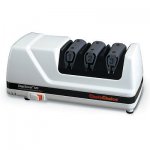
I use the Chef's Choice 3-stage sharpener. There is a STEEP learning curve, but once you get it, it makes it easy to quickly put a sharp edge on your knives.

Kev
 

Attachments

  • Chef's Choice Knife Sharpener.JPG
    Chef's Choice Knife Sharpener.JPG
    16.8 KB · Views: 10

hallboyone

Well-known member
Joined
Feb 26, 2013
Messages
129
Location
North Carolina
don't know what set you have but my first experience sharpening knifes was with a lansky. Now I free hand it with a fine Arkansas oil stone if they aren't't to dull and turn to the lansky if they are really bad. Then I use a little four inch ceramic hone to get it hair popping sharp. I've tried to lap but it never seemed to help anything.
 

ravenccorax

Active member
Joined
Nov 16, 2011
Messages
28
Location
morton wa
ive done arkansas stones,diamond stones, triple stone sets in the kitchen, steels, diamond steels, japanese water stones, carbide shavers, buffing compound on cardboard, bottom of ceramic cups/bowls, ceramic steels, files, sandpaper, even tried a lansky. read everything i could watched all the youtube videos etc etc etc. im a cook by trade so sharp knives are my tools. never once have i needed a shaving sharp edge they dull to fast for me.

the thinner the edge the sharper the less angle the sharper perceived edge. a straight edge is razor thin but anything thicker then hair will dent or roll the edge. whereas a leather man might have a 45* single edge blade thats stout and can cut inch thick rope without breaking a sweat.

every knife has a proper use. your not going to be shaving with your pocket knife and not gonna be using your filet knife to hack apart a hog. figure out what your use is and then worry about how sharp it needs to be. cutting paper is fine feathering paper is better. cutting a tomato is fine cutting a cucumber or bell pepper is my personal test.

repitition and repeatibility is the key. thats why the lansky/wickededge systems work. they take the skill out of repeating the same angle every time. how sharp your knife needs to be is your personal call. if you feel the need to be able to shave with it then thats how sharp it needs to be. if you can make paper cry and run home to mommy so be it. sometimes ill stop at the medium grit stone the micro serations work better on tomatoes. figure out your intended use for the blade and make it sharp enough that cutting is a pleasure and not a chore
 

AussieDan

Well-known member
Joined
Sep 18, 2008
Messages
298
Location
Syracuse, NY
I've been using a Lansky, it looks like the wicked edge works roughly the same way but will give you a much more accurate bevel. There is a fair bit of slop in the Lansky, though it does do a decent job. Looks like I might know what to ask for my birthday next year...
 

383

Well-known member
Joined
Aug 14, 2011
Messages
1,230
Location
Harrisonburg, VA
To see what the edge looks like, I use a pair of binoculars. In good light, hold the edge up to the eye piece and look through it backwards. It magnifies like a microscope, and you can easily see what needs to be done to the edge.
 

thadru2001

Well-known member
Joined
Oct 22, 2008
Messages
70
Another vote for WickedEdge. Keep a log of each knife you sharpen then when you need to touch one up you'll have the settings written down. Makes cleaning the edge up on a knife super fast.
 
To avoid these ads, REGISTER NOW!
Top Bottom