To avoid these ads, REGISTER NOW!

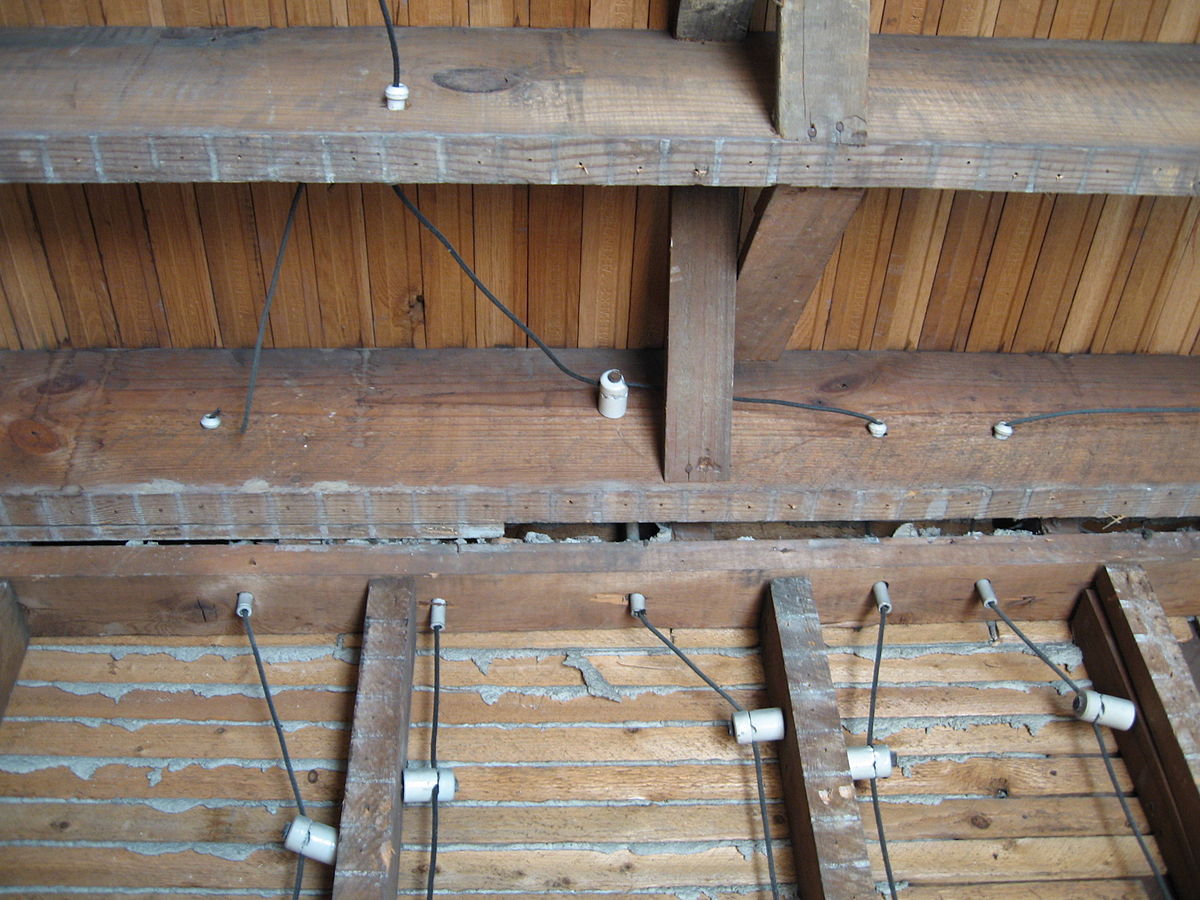
knob & tube wiring

southpier

Well-known member
Joined
Jun 28, 2009
Messages
552
i understand it has been obsolete for 60 years, but i want to learn more including distribution from the main knife switch & cartridge fused main panel.

anyone able to give me a direction to research would be appreciated. my searches all end up at pinterest & steampunk home decor!

thanks
 
To avoid these ads, REGISTER NOW!

Buckaroo5

Well-known member
Joined
Oct 18, 2012
Messages
820
Location
Central Ohio
I had it in a home that was built in 1927 - bought it in 1987 sold it in 1999. I ran new wiring to the bathroom, kitchen and garage. Was considering having the rest of the house rewired and had an electrician come to inspect it and give me a quote. He said that it was safe as is and the real danger was if somebody had scabbed into the system and did not make a secure connection resulting in risk of fire. I sold it and I'm sure the buyers (who still own it) replaced it all. The interior walls were plaster on lathe and the exterior walls were plaster on brick so it no doubt was a lot of work. The insulation on the wires was a fibrous type of material that would slough off if you bent it too much while hooking up new fixtures. The porcelain light fixtures in the basement hung by wires and looked kind of scary - I replaced all those. Really loved that house.
 
Last edited:

MShaw

Well-known member
Joined
Mar 2, 2015
Messages
1,013
Location
York, Pa.
The funny thing is that this system is actually safer than modern cables. As the two conductors are widely spaced vermin cannot chew thru the insulation and cause a short / fire.
 
OP
S

southpier

Well-known member
Joined
Jun 28, 2009
Messages
552
i also remember arsenic was put into the cloth covering/ insulation to discourage same. we were always advised to wash our hands real good after ripping this stuff out.
 
OP
S

southpier

Well-known member
Joined
Jun 28, 2009
Messages
552
not being one who generally double-posts, one of the responses in the vintage tools category suggested i put this here. to wit:

i understand it has been obsolete for 60 years, but i want to learn more including distribution from the main knife switch & cartridge fused main panel.

anyone able to give me a direction to research would be appreciated. my searches all end up at pinterest & steampunk home decor!

thanks
 

nadogail

Well-known member
Joined
Jan 23, 2009
Messages
31,935
Location
Coronado, CA
IMHO; Knob and Tube, when installed correctly, was a safe way to wire a building. I remember knobs being sold at our local dime store.

I have talked with old timers who would wire a house with one roll of wire and a bucket of knobs. You might find some good info at an antique book store,
 

Bert_

Well-known member
Joined
Dec 24, 2016
Messages
9,716
Location
NW Iowa
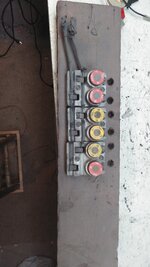
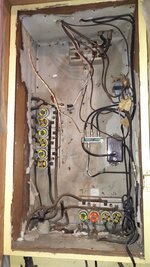
Here a couple good examples of original service equipment. The bigger one is a lot of circuits for a house at the time.

The small one on a board was just nailed to the basement ceiling, I think this was much more common.
 

Attachments

  • KIMG0516.JPG
    KIMG0516.JPG
    508 KB · Views: 159
  • KIMG2089.JPG
    KIMG2089.JPG
    458.1 KB · Views: 162
OP
S

southpier

Well-known member
Joined
Jun 28, 2009
Messages
552
. . . . some good info at an antique book store,
the internet archive has some Audels electrical bulletins but i lost patience weeding through . . . . well, suffice to say it was a rabbit warren!


rmanrman

Well-known member
Joined
Nov 2, 2012
Messages
383
Here a couple good examples of original service equipment. The bigger one is a lot of circuits for a house at the time.

The small one on a board was just nailed to the basement ceiling, I think this was much more common.
The real danger in the K&T wireing was not the actual wire but the Fuse panel where a 15 amp fuse could be replaced with a 20 or 30 amp fuse as the loads started to add up. Or totally dangerous was the penny in the fuse socket when there were no replacement on hand
Also no ground conductor because there were only 2 prong receptacles.
 

S-K Tool Fanatic!

Well-known member
Joined
Nov 28, 2022
Messages
776
Location
NE Ohio
Here a couple good examples of original service equipment. The bigger one is a lot of circuits for a house at the time.

The small one on a board was just nailed to the basement ceiling, I think this was much more common.
I have a small mountain of those style fuses, because they are always free at yard sales, and can somehow never leave them behind. Heck I think I have a few boxes still with the price tags on them.
-Tommy
 

Bert_

Well-known member
Joined
Dec 24, 2016
Messages
9,716
Location
NW Iowa
This one is pretty butchered but the cool thing is if you look at the upper corner you can see the cartridge fuse holder telling that this was a 60A service. Most all houses were getting 30A service at that time
 

Attachments

  • KIMG0441.JPG
    KIMG0441.JPG
    475.6 KB · Views: 160

Provincial

Well-known member
Joined
Sep 21, 2011
Messages
6,865
Location
Near Salem, OR
They may still sell adapters to put in the old panels. These adapters will only accept a fuse of one amp rating, so you can't put a larger fuse on the circuit. I used these in an old house my wife inherited about fifteen years ago. We had the fuse panel upgraded to breakers because the house was a rental. That is the same reason I installed the adapters.
 
OP
S

southpier

Well-known member
Joined
Jun 28, 2009
Messages
552
i read somewhere (old house journal forum?) a piece of 1/2" copper tubing with flattened ends could substitute for a main cartridge fuse !!!
 

Bert_

Well-known member
Joined
Dec 24, 2016
Messages
9,716
Location
NW Iowa
i read somewhere (old house journal forum?) a piece of 1/2" copper tubing with flattened ends could substitute for a main cartridge fuse !!!
Seen it done more than once. Found a couple renewable fuses with copper wire instead of fuse links
 

Zeke

Well-known member
Joined
Aug 13, 2009
Messages
17,176
Location
Long Beach CA, the sewer by the sea.
K&T is an open cloth/rubber insulated wire run separately and generally with no ground. One of the nuances is that neutrals are often combined as a matter of convenience (drill less holes) and can look like a tree branch with little relation to the various circuits. I'm not saying that you will have half a dozen fused circuits with only one neutral returning to the box. They are more or less balanced but you can't depend on a neutral branch matching the fused circuit device by device.

Another 'feature' of K & T is that splices are in the open, twisted and taped. Not only that, later work and added branches will be the usual when inspecting a K & T system. GEC's are overlooked and won't be to code. EGC's don't exist unless another separate bare wire was run to the boxes only. All of it is subject to damage by folks crawling around and mis-stepping with a knee, etc.

I've worked on a bunch of it so if you have any particular questions I'll do my best.
 

Jeff Ivers

Well-known member
Joined
Apr 9, 2010
Messages
2,555
Location
Oklahoma
From your post, I am not sure what your application and goal are other than knowledge acquisition. In the early 1970's, my parents bought a 40' by 40' 3 story house with the idea of refurbishing it as their residence and with the idea of renting rooms to college kids. They asked me to look the house over and tell them what I thought. I discovered knob and tube wiring throughout the house (with the exception of about 20' of romex, but that is another story) protected by 2 screw-in fuses. I pointed out to them that the house needed to be completely rewired or they would be creating a fire trap. I asked them how many renters would likely bring in a microwave and dorm refrigerator and plug them into the same circuit which was designed to support a few 100 watt bulbs. I spent a summer rewiring the house for them starting from a new 200 amp circuit breaker box. In addition, the house was old enough that I discovered areas where the insulation had flaked off the wiring exposing bare copper. If you are only trying to find out how it was done so you can make a stage set look authentic, you are welcome to ignore this post. If you are seeking knowledge because you are considering an investment in a property with this wiring, be sure to consider what you will be doing on the property.
 
To avoid these ads, REGISTER NOW!

kbuhagiar

Well-known member
Joined
Dec 27, 2005
Messages
1,742
Location
Escondido, CA
not being one who generally double-posts, one of the responses in the vintage tools category suggested i put this here. to wit:

i understand it has been obsolete for 60 years, but i want to learn more including distribution from the main knife switch & cartridge fused main panel.

anyone able to give me a direction to research would be appreciated. my searches all end up at pinterest & steampunk home decor!

thanks
Not meaning to sound like Captain Obvious, but...there are plenty of resources (both written and video) on the Internet.

Google 'knob and tube wiring'.

PS I find it a fascinating subject. I remember working on my first house forty years ago, opening up a wall and discovering a three-way wire splice, twisted and taped, hanging in the breeze, with the tape almost completely unraveled. I nearly had a heart attack right there, and didn't regain my composure until I realized that this had been the standard when the house was built (1948).
 
Last edited:

rlitman

Well-known member
Joined
Oct 18, 2010
Messages
24,591
Location
Long Island
Knob and tube was designed to run in open wall cavities. And so long as you don't mess with it or upsize a fuse, it is as safe as it was on the day it was installed. Not nearly as safe as modern standards, but not all that terrible either. Of course when people start to make changes, you get into risky territory.

However, it will cost the property owner a fortune in energy over time, because you cannot insulate your walls with active K&T. It's usually cheapest to replace it entirely and properly insulate and watch your heating bills drop big time.
 

Zeke

Well-known member
Joined
Aug 13, 2009
Messages
17,176
Location
Long Beach CA, the sewer by the sea.
There is some debate on insulating but I wouldn't and don't condone it. However, it is not illegal code wise to do that here.

citation: CA Electrical code 324-4 is amended ( https://www.creia.org/assets/docs/knob_tube_locked.pdf)

The biggest problem is not seeing the wires, not heat retention as expected. Now, an overloaded circuit is an overloaded circuit with the potential of fire insulation or not. A loose neutral is always a problem regardless.

I waited on insulation until I rewired. Now I wish I had run the wires higher in the attic rather than be buried. I lost a light and can't find the j-box. I will, it will just take a bunch of time tracing and digging. I've had every fixture down and every switch out.

Funny, I believe K &T is even 'allowed' today as long as it is totally exposed.
 
Last edited:
OP
S

southpier

Well-known member
Joined
Jun 28, 2009
Messages
552
... 'feature' of K & T is that splices are in the open, twisted and taped. ....

i remember the dreaded "western union splice".

but when were twisted, soldered, & taped connections? BX cable days? i've taken apart some pretty (post WW 2) old stuff and run across that type. and Mars connectors - outlawed for 55 or so years. wires jammed into a set screw connection w/ wire nut looking cover screwed over it.
 
OP
S

southpier

Well-known member
Joined
Jun 28, 2009
Messages
552
... not sure what your application and goal are other than knowledge acquisition. ... If you are only trying to find out how it was done so you can make a stage set look authentic....

YES! you win the GJ prize for "what's my post."

i'm a model builder and for a myriad of reasons am jumping up to 1:12 scale. basically 8x the volume of a 1:24 scale model car. so a 24' x 32' cape cod house will scale down to 24" x 32".

one of the - no The - predominant reason i am going into this endeavor is the sheer amount of detail that can be incorporated.

like the guts of a fuse box and the knob & tube wiring exposed And capable of lighting a tiny led lamp at the end of its run.
 
Last edited:
OP
S

southpier

Well-known member
Joined
Jun 28, 2009
Messages
552
Not meaning to sound like Captain Obvious, but...there are plenty of resources (both written and video) on the Internet.

Google 'knob and tube wiring'.

PS I find it a fascinating subject. I remember working on my first house forty years ago, opening up a wall and discovering a three-way wire splice, twisted and taped, hanging in the breeze, with the tape almost completely unraveled. I nearly had a heart attack right there, and didn't regain my composure until I realized that this had been the standard when the house was built (1948).
it's not that there are not resources, but i'm 70 years old and, well, at some point i want to turn this machine off and build something (see above post).

your post has offered a perfect "between the studs detail" which i would not have thought about.

i trust your palpitations have sufficiently subsided and feeling in the left arm has returned to normal.
 
OP
S

southpier

Well-known member
Joined
Jun 28, 2009
Messages
552
Knob and tube was designed to run in open wall cavities. And so long as you don't mess with it or upsize a fuse, it is as safe as it was on the day it was installed. Not nearly as safe as modern standards, but not all that terrible either. Of course when people start to make changes, you get into risky territory.

However, it will cost the property owner a fortune in energy over time, because you cannot insulate your walls with active K&T. It's usually cheapest to replace it entirely and properly insulate and watch your heating bills drop big time.
my landlord consulted an energy saving company to blow in cellulose for their 1888 vintage house. first thing the company required was an affidavit from a licensed master electrician stating there was no active knob & tube wiring in the house. he didn't have to remove the porcelain or dead wires, but rather certify i was not in use.
 

kbuhagiar

Well-known member
Joined
Dec 27, 2005
Messages
1,742
Location
Escondido, CA
my landlord consulted an energy saving company to blow in cellulose for their 1888 vintage house. first thing the company required was an affidavit from a licensed master electrician stating there was no active knob & tube wiring in the house. he didn't have to remove the porcelain or dead wires, but rather certify i was not in use.
Fascinating.

We had cellulose insulation blown into our walls in that same 1948 house that I mentioned in my previous reply. No write-offs or certifications were requested or required (that I know of). This was in 1986 in California, it was offered by (PG&E), at no cost, to qualifying homeowners.
 

Zeke

Well-known member
Joined
Aug 13, 2009
Messages
17,176
Location
Long Beach CA, the sewer by the sea.
YES! you win the GJ prize for "what's my post."

i'm a model builder and for a myriad of reasons am jumping up to 1:12 scale. basically 4x the volume of a 1:24 scale model car. so a 24' x 32' cape cod house will scale down to 24" x 32".

one of the - no The - predominant reason i am going into this endeavor is the sheer amount of detail that can be incorporated.

like the guts of a fuse box and the knob & tube wiring exposed And capable of lighting a tiny led lamp at the end of its run.
To make it look authentic you should run the wires parallel on the inside of opposing joists or studs. When you come to a block or top plate that's where the tubes are used. Also tubes for parallel wires going across joists. Never on top. You won't see many tubes in the walls as everything was fed thru the top plate from the attic. You also won't see any under a house unless there is a basement.

I've never seen K & T run at an angle. Always square to the building walls. The first bay at the wall is popular. You won't see multiple runs in the same bay. Hardly ever does one wire cross another. Exceptions of course, but that's how I've encountered it in the many homes I have dealt with it.
 

bmwrd0

Well-known member
Joined
Nov 7, 2010
Messages
5,453
Location
Beaver Fever Oregon
As mentioned above, get an Audels book from the pre-war period, that and any other electical manual from that time frame will teach you about all there is. I had to pull the K&T out of my 1913 house for insurance purposes, even though it worked fine, as there was an in-wall splice in some unknown location, making me and the insurance company very nervous.
 
OP
S

southpier

Well-known member
Joined
Jun 28, 2009
Messages
552
They may still sell adapters to put in the old panels. These adapters will only accept a fuse of one amp rating, so you can't put a larger fuse on the circuit. I used these in an old house my wife inherited about fifteen years ago. We had the fuse panel upgraded to breakers because the house was a rental. That is the same reason I installed the adapters.
the second time i read this something from my hardware store clerk career (read: first job out of high school). i think screw in fuses came with different sized bases so they couldn't be swapped around.

but we're only interested in cartridge fuses for this era project.
 
OP
S

southpier

Well-known member
Joined
Jun 28, 2009
Messages
552
gj k&t.JPGgj k&t socket.JPG

this is the (now defunct) panel in a house i caretake. it was built in 1921. any ^ remains ^ of the original circuit wiring i have seen is in steel pipe or bx cable. there is only (1) - 2 fusestat (screw in) fuse holder in the box - tucked way over on the right, which may have been an add-on when it was still in use. heavy duty copper bars on a slate backer w/ frankenstein main switch. the enclosure is about 4' wide x 3' high steel.
 
Last edited:

JunkBonds

Well-known member
Joined
May 19, 2011
Messages
1,004
I own a rental built in 1905. It has the original knob and tube knife panel still in the upper bedroom ceiling. Power came in from outside to this 2 circuit panel and a knife switch activated the 2 15 amp circuits. The two circuits were fused with std round screw in fuses. Back then they only used electricity for lights.
 

Bert_

Well-known member
Joined
Dec 24, 2016
Messages
9,716
Location
NW Iowa
gj k&t.JPGgj k&t socket.JPG

this is the (now defunct) panel in a house i caretake. it was built in 1921. any ^ remains ^ of the original circuit wiring i have seen is in steel pipe or bx cable. there is only (1) - 2 fusestat (screw in) fuse holder in the box - tucked way over on the right, which may have been an add-on when it was still in use. heavy duty copper bars on a slate backer w/ frankenstein main switch. the enclosure is about 4' wide x 3' high steel.
Wow, 100A and 240v. If that's in a house it must be a mansion.

I've only seen equipment like that in commercial buildings. A school I do work in still has some remnants of the old panels and all the wiring is in black rigid conduit
 

reader2580

Well-known member
Joined
Dec 31, 2014
Messages
14,516
Location
Minneapolis, MN
This one is pretty butchered but the cool thing is if you look at the upper corner you can see the cartridge fuse holder telling that this was a 60A service. Most all houses were getting 30A service at that time
You have to love the coax in the same space as electrical.
 

Bert_

Well-known member
Joined
Dec 24, 2016
Messages
9,716
Location
NW Iowa
You have to love the coax in the same space as electrical.
When I was there a few years ago it was still live and in use. I changed a fuse but nothing else. House has been sold since then so I don't know if it's still there
 
To avoid these ads, REGISTER NOW!
Top Bottom